Transform complex support workflows
Zendesk vs Freshservice: Which Fits Your IT Team in 2026
Type "zendesk vs freshservice" into Google and you get ten near-identical feature tables that treat the two as interchangeable. They are not. Freshservice is an IT service desk built on ITIL, and Zendesk grew up running customer support. Keep one result in view as you compare them. Delivery Hero deflected 30% of its IT tickets and cut response times 80% after adding AI to the helpdesk it already ran.
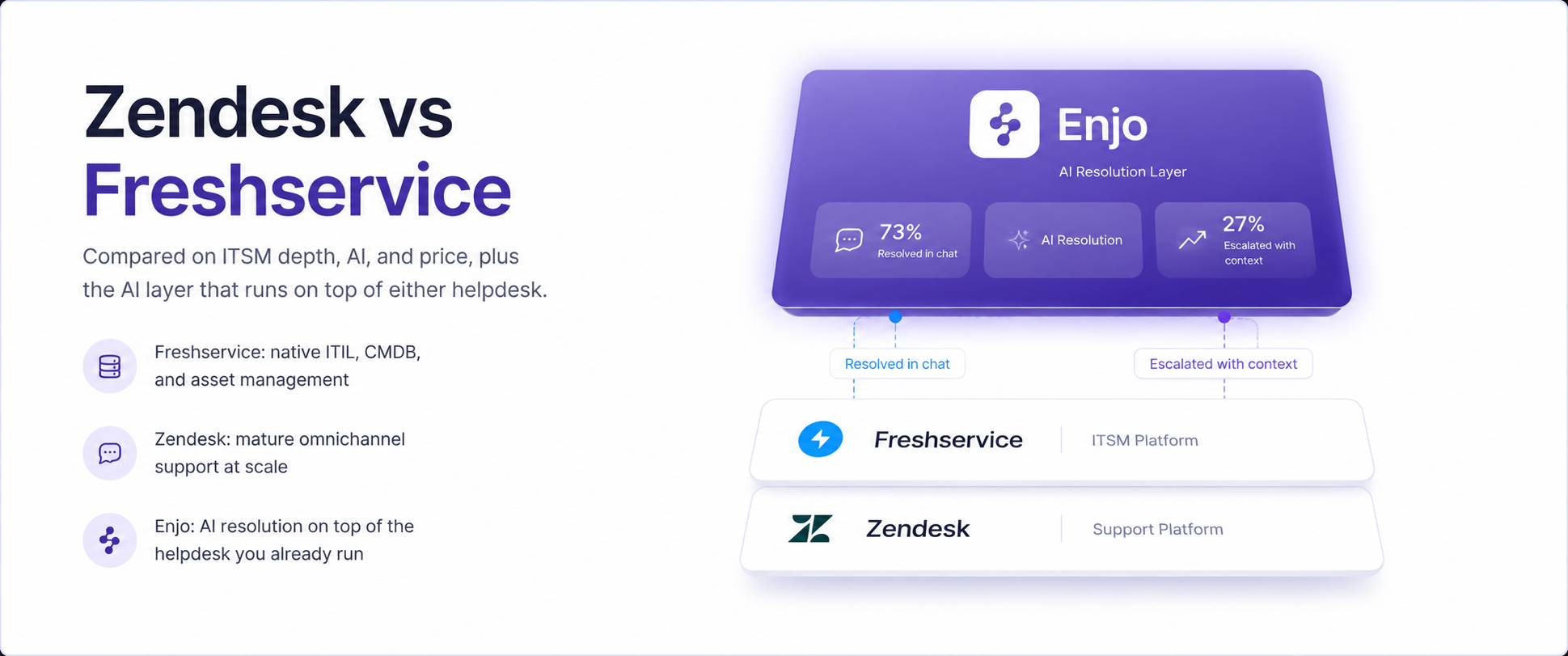
This guide keeps the two straight and skips the part where every other page pretends one is obviously better. You will leave knowing which one fits your stack, what each really costs once the AI add-ons show up, and why the tool you buy matters less than what you run on top of it. Zendesk vs Freshservice, compared on ITSM depth, AI, and price, plus the AI resolution layer that runs on top of whichever helpdesk you pick.
The Quick Verdict: Which One for Which Team
If you are setting up an internal IT or employee service desk and you want ITIL structure (incidents, problems, changes, a CMDB) working on day one, Freshservice is the more natural fit. If you are running customer-facing support at volume across chat, email, voice, and social, Zendesk offers a deeper, more mature suite. Neither platform's built-in AI resolves requests end-to-end across the rest of your stack, so if autonomous resolution is the real goal, treat that as a separate layer you add to either one.
Zendesk vs Freshservice: Feature Comparison
What Freshservice Actually Is
Freshservice is Freshworks' IT service management product. It is built around ITIL: incident management, problem management, change and release management, a service catalog, and a CMDB for tracking assets. Requesters who raise tickets are free and unlimited in number, and you pay per agent. Most mid-market IT teams choose it because structured ITSM works out of the box without a six-month configuration project, and the interface is clean enough that a new agent can be productive in a couple of days.
The AI story is where the fine print lives. Freddy AI splits into Copilot (agent assist) and an AI Agent, and on most plans, it is a paid add-on rather than something included. You can run Freshservice well without it. Just do not assume that "Freshservice has AI" means "AI is in your plan," because it is usually a separate line item at about $29 per agent per month, or it is included in the Enterprise tier.
What Zendesk Actually Is
Zendesk is a customer support platform first and foremost. Its Agent Workspace pulls email, chat, messaging, voice, and social into a single queue, and its automation engine and reporting are among the most developed in the category, which is why large support operations lean on it. Zendesk also sells a separate Employee Service track for internal IT and HR, with a service catalog, approvals, asset management, and a Workday connector, so it does show up in ITSM shortlists.
The two tracks are priced and packaged separately, and you cannot mix customer and employee support in one instance. If you need both, you are buying two. Since a May 2026 change, Zendesk includes autonomous AI agents in its plans instead of gating them behind the old add-on, though heavy AI usage still meters per resolution once you pass your allowance.
Zendesk vs Freshservice Pricing
Both are per-agent; both bill the lowest annually; and neither has a permanent free plan. There is only a 14-day trial.
Freshservice runs $19 (Starter), $49 (Growth), and $99 (Pro) per agent per month on an annual billing plan, with Enterprise custom-quoted. Asset management and the service catalog start at Growth, and full ITIL change, problem, and release management arrive at Pro. Freddy AI Copilot is a roughly $29 per agent add-on. See freshworks.com/freshservice/pricing for current details.
Zendesk's Employee Service Suite, the track that lines up with Freshservice, is $29 (Team), $59 (Growth), and $99 (Professional) per agent per month annually, with Enterprise on a quote. Copilot is a $50 per agent add-on, and Quality Assurance is $35. Zendesk's customer-service track looks cheaper on paper (Support Team at $19, email-only), but the real omnichannel Suite starts at $55. See zendesk.com/pricing for current details.
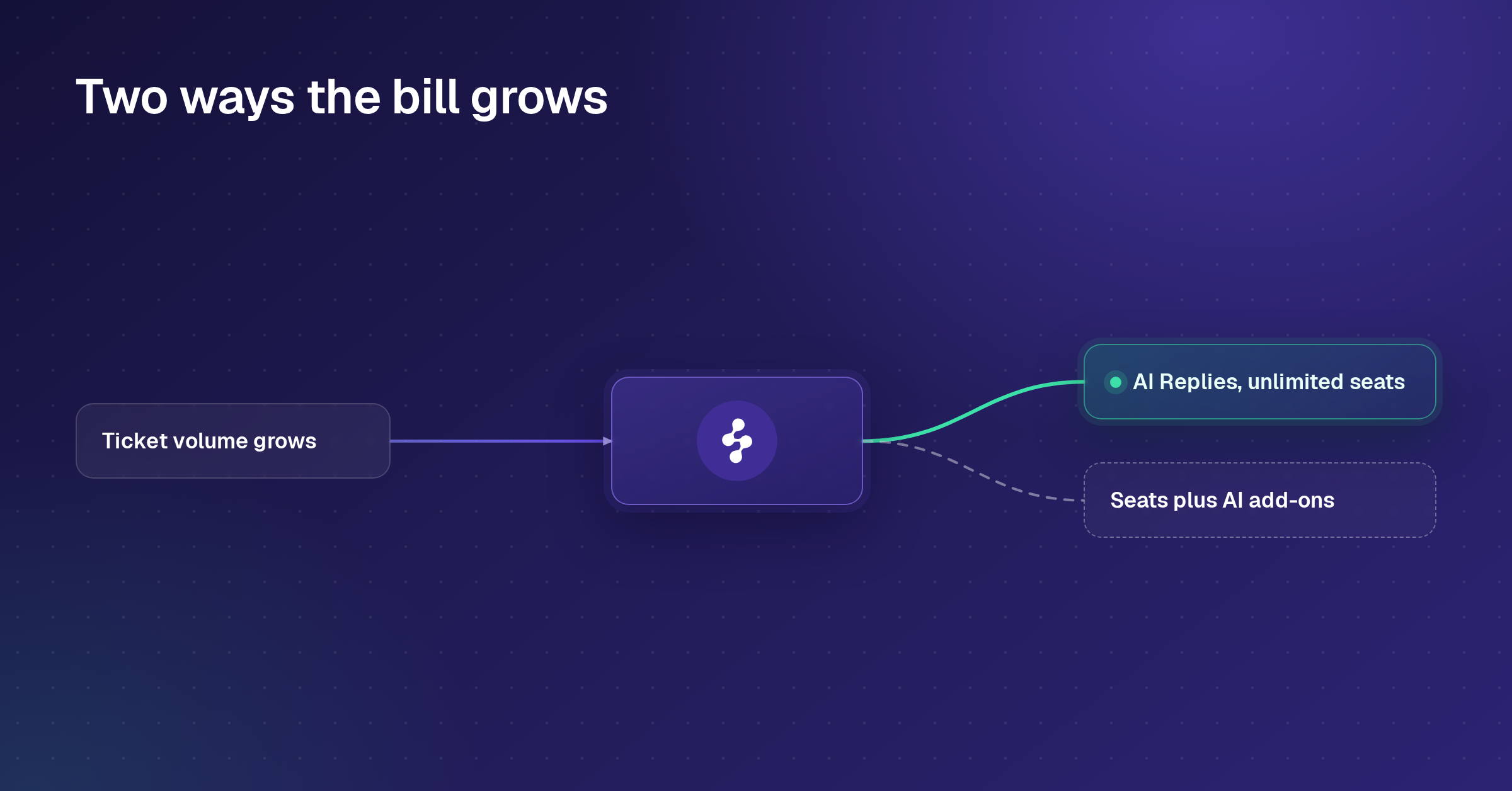
On Zendesk vs. Freshservice pricing, the sticker numbers are close at the low end, and the line that actually moves your bill is AI. Freshservice makes you add Freddy, while Zendesk includes agents but meters them and charges $50 for Copilot. For a 25-agent team that wants working AI, both land in the same ballpark once the add-ons are on, so model your real ticket volume before you sign either.
Where Freshservice Wins
Freshservice is the cleaner pick for a greenfield internal service desk. If your team needs incident, problem, and change management with a real CMDB and asset tracking, that is native here rather than bolted on. G2 reviewers (4.6 out of 5 across 1,336 reviews, 62% mid-market) keep calling out asset visibility and an easy-to-onboard UI.
It also wins on time-to-value for IT specifically. You are not translating a customer support tool into IT workflows because the ITIL scaffolding is already the design. For a few-hundred-person IT org that wants structure without a consulting engagement, it is hard to beat, and the entry price is genuinely low.
Where Zendesk Wins
Zendesk wins when support is customer-facing and high volume. The omnichannel workspace, the automation engine, and the reporting depth are more mature than Freshservice's, and the app marketplace is larger, so the odd integration you need usually already exists. G2's own head-to-head points out that Zendesk's automation engine handles more complex, multi-step tasks.
It is also the safer pick if you expect to scale across many channels and want one vendor covering chat, voice, and social. The trade-off shows up on the invoice. G2 reviewers rate Zendesk 4.3 out of 5 across more than 6,700 reviews, and the most common complaint is cost once advanced features and add-ons are factored in.
The Part Both Comparisons Leave Out: The AI Resolution Layer
Every "Freshservice vs Zendesk" page misses the same thing. Both Freddy and Zendesk AI are fine at deflecting inside their own suite, and both stop at the edge of it. They read their own knowledge base and act on their own objects. When a password reset requires Okta, or an access request requires a Jira ticket plus manager approval, native AI hands off to a human.
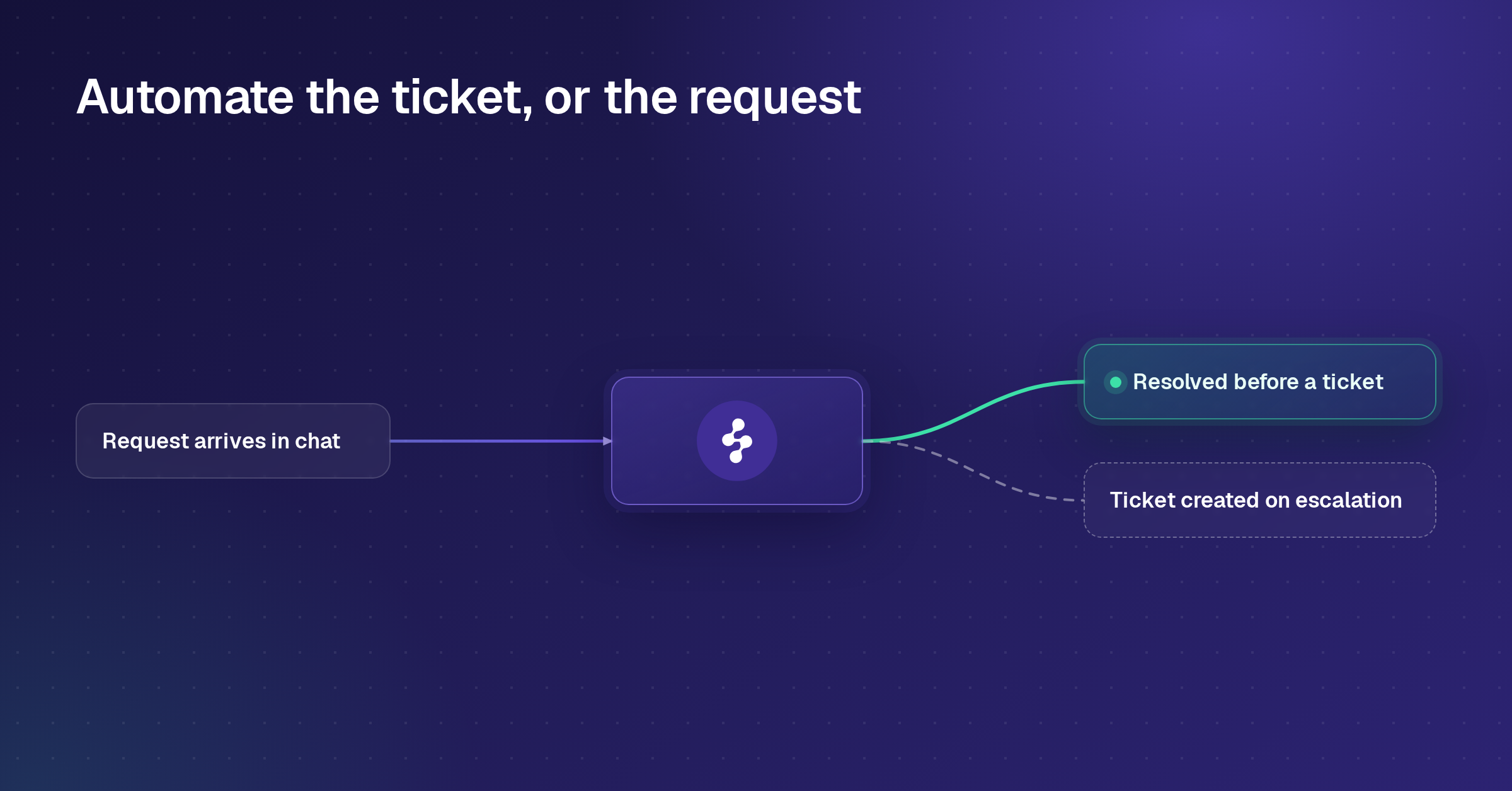
That gap is what Enjo fills, and it is why the helpdesk you pick matters less than you would think. Enjo is a helpdesk-agnostic AI resolution layer. Its AI Agents resolve common IT requests right in Slack or Teams: Studio builds the flows, AI Actions reach systems like Okta, Jira, and custom APIs, and AI Flows run multi-step logic with fallbacks when the agent is not confident. When something genuinely needs a person, Escalation opens a ticket in whatever you run, Freshservice or Zendesk, with the full conversation attached. On Zendesk, Agent Assist also embeds right in the agent view.
The numbers come from production, not a slide. Aurora resolves 63% of its IT requests autonomously. Delivery Hero deflected 30% of tickets with 80% faster responses across 70+ countries, on top of the helpdesk it already ran. BookMyShow hit 100% ticket capture through Slack. Enjo also has a permanent free tier: 200 AI replies per month, unlimited human seats, and no credit card required. It is SOC 2 Type II, ISO 27001, and GDPR compliant, with 99.9% uptime across six years, which tends to be the first thing your security team asks about. You can also check Enjo on G2.
So the "freshservice vs zendesk vs servicenow" debate is real, but it is a system-of-record decision. The resolution layer is a separate call, and honestly, the more important one for your ticket numbers. You can add AI resolution on top of Zendesk or connect it to Freshservice, and keep the service desk your team already knows.
If ServiceNow rather than Zendesk is the other name on your shortlist, our head-to-head on Freshservice against ServiceNow covers the same ground for that pairing.
How to Choose Between Zendesk and Freshservice
Match the tool to the job. Greenfield's internal IT service desk that needs ITIL and assets: Freshservice. Customer-facing support at volume across many channels: Zendesk. Already on one of them and frustrated that routine tickets still land on humans: do not switch tools, add an AI layer that resolves them and escalates the rest with context.
If you are still mapping the wider field, our rundown of the best helpdesk software shows where each of these sits relative to the rest of the market, and the IT service desk breakdown covers options for teams that live in Slack.
The Bottom Line
Buy Freshservice for a structured internal IT desk, buy Zendesk for mature customer support at scale, and remember that neither choice decides your resolution rate on its own. If getting routine tickets solved without adding headcount is the actual goal, the fastest move is to layer AI on top of the helpdesk you already run.