Transform complex support workflows
9 Best ServiceNow Alternatives 2026: Free and Open Source
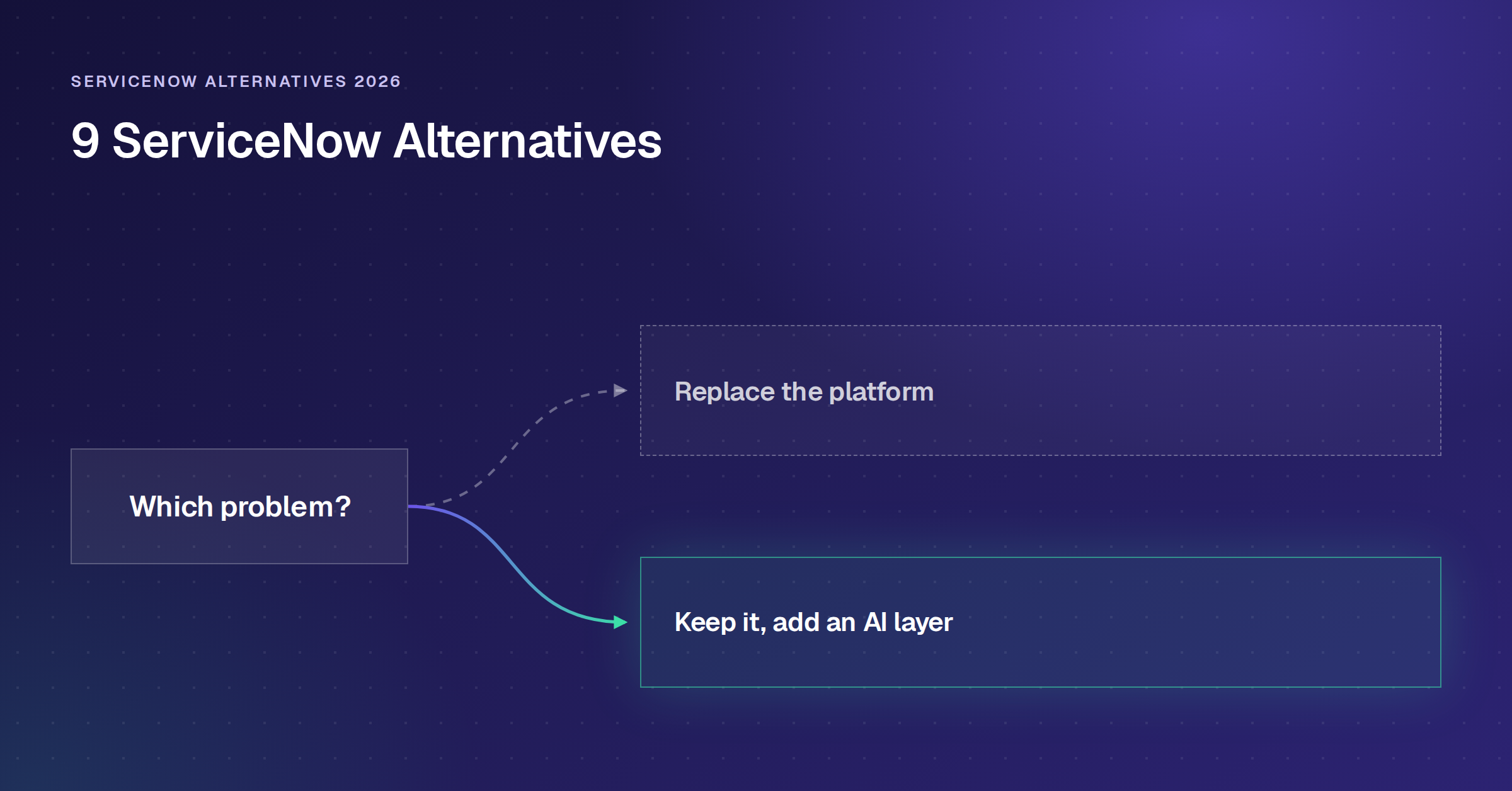
"ServiceNow alternative" searches usually mean one of two different things, and most buying guides never say which one they're answering. Some teams want to replace ServiceNow entirely: a new system of record, a new CMDB, a new home for every ticket. Others already run ServiceNow fine and just want the native AI experience on top of it to work better, without a multi-quarter Now Platform tier upgrade, a different question this guide doesn't try to answer. Compare 9 ServiceNow alternatives for 2026, plus cheaper open-source options, with deployment times, starting prices and where each one fits.
Why Teams Look for a ServiceNow Alternative?
Teams leave ServiceNow over cost, complexity and deployment time, not over missing features. Three specific versions of that come up again and again:
- Pricing opacity. ServiceNow does not publish pricing on its own site. Every deal goes through a custom quote, so you don't know the actual number until you're deep into a sales cycle.
- Slow time to value. Platform configuration, Integration Hub work for every external system, and AI Control Tower governance setup routinely push native AI rollouts past a single quarter, sometimes several.
- A rigid setup built for senior IT staff. The interface and configuration model assume a dedicated ServiceNow admin on staff. Mid-market teams without one see slower adoption and a longer path to a working service desk.
Those three reasons sit inside a wider pattern. Gartner predicts over 40% of agentic AI projects will be canceled by the end of 2027, on escalating costs, unclear business value or inadequate risk controls, and slow time to value is where most of that cost accrues.
Two Decisions to Make Before Picking a ServiceNow Alternative
Before comparing tools, separate the two questions this list answers differently for each entry:
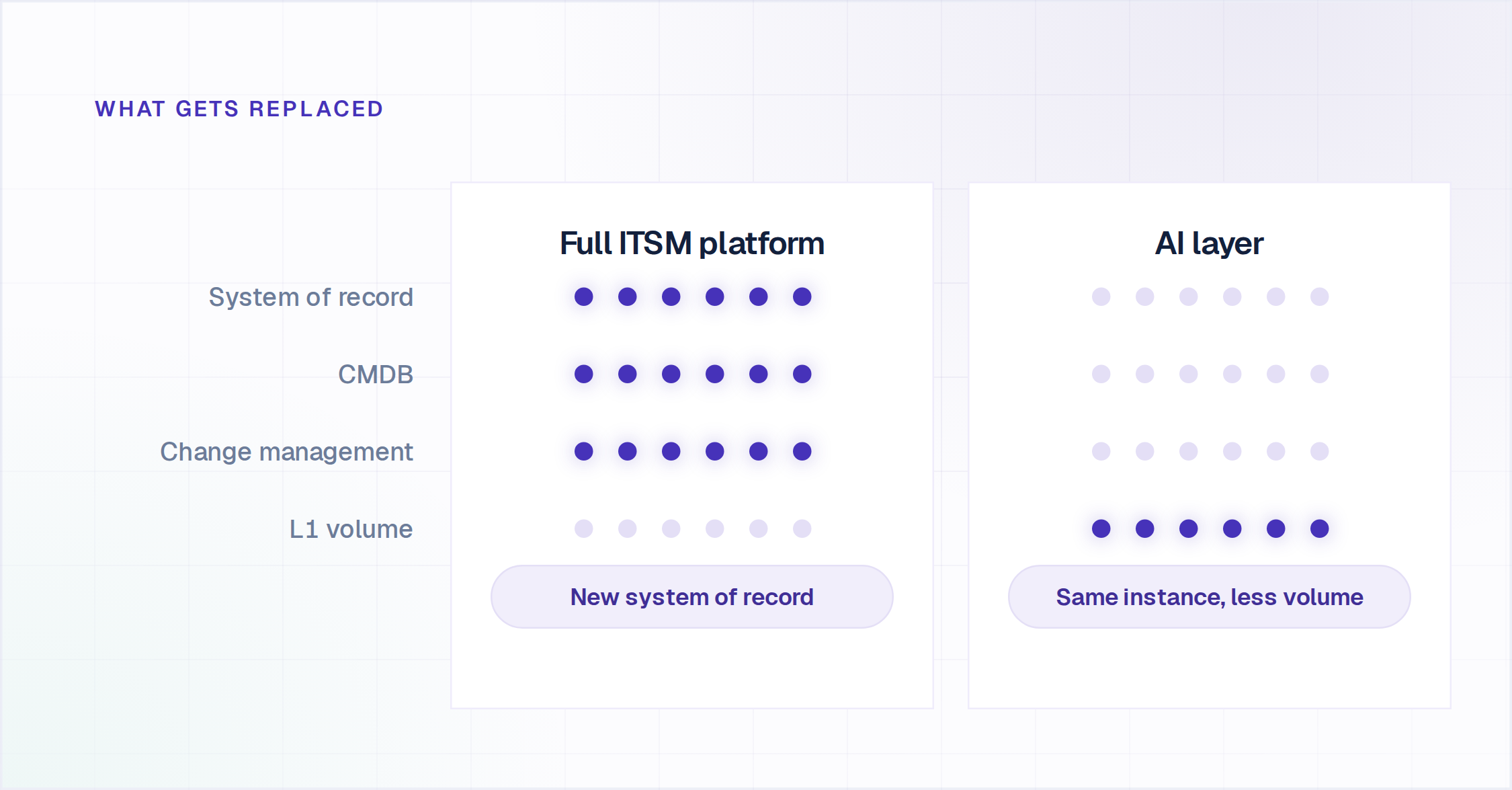
- Is your platform the problem? You need a new system of record, meaning a full CMDB and change management, because the current setup genuinely can't do the job. This guide covers that decision.
- Is the volume the problem? Your ServiceNow instance works fine, but the pain is repetitive L1 tickets and a native AI experience that's slow to deploy and hard to license. That's a different decision, covered in ServiceNow AI Agents in 2026: The Honest Buyer's Guide.
If you want the full breakdown of how these two categories get confused across the wider ITSM market, read 10 Best ITSM Tools for IT Teams in 2026. If the shortlist has narrowed to two enterprise platforms rather than a mid-market swap, the ServiceNow vs Salesforce comparison covers how each one's native AI handles IT and customer-facing work.
Cheaper and Open Source ServiceNow Alternatives
Cost is the most common reason teams start this search, and two routes cut it further than any commercial platform on the list below.
Self-hosted open source removes the licence entirely. GLPI, iTop and OTOBO are the long-running open-source ITSM options, each free to download and run on your own infrastructure. GLPI and iTop pair a service desk with asset and configuration management in the core product; OTOBO adds its CMDB through an ITSM extension. What you trade is the operator: a server, a database, upgrades, backups and someone who owns security when it breaks. For a mid-market team without a dedicated admin, that is the same resourcing problem that made ServiceNow hard, moved somewhere else.
Hosted free tiers cap volume instead of capability. Jira Service Management is free for up to 3 agents, and ManageEngine ServiceDesk Plus offers a free Standard edition for up to 5 technicians. Both give you a working service desk without a procurement cycle.
The trade is this: open source removes the licence cost and adds operating cost. A hosted free tier removes both but caps how far you can grow before paying. Neither removes the work of migrating a CMDB.
9 ServiceNow Alternatives Worth Considering in 2026
| Tool | G2 rating | Deploys in | Best for | Starting price |
|---|---|---|---|---|
| Freshservice | 4.6/5 | Days to weeks | Fast setup, mid-market | $19/agent/mo |
| Jira Service Management | 4.3/5 | 3 to 6 months outside Atlassian | Atlassian-standardized teams | Free ≤3 agents; $20/agent/mo |
| BMC Helix ITSM | 3.7/5 | Months | Large enterprise, deep ITIL | Custom quote only |
| ManageEngine ServiceDesk Plus | 4.2/5 | Days to weeks | Budget-conscious ITIL coverage | Free ≤5 techs; $13/tech/mo |
| Ivanti Neurons for ITSM | 4/5 | Months | Endpoint + ITSM combined | Custom quote only |
| SysAid | 4.5/5 | Not published | All-in-one with GenAI Copilot | Custom quote only |
| SolarWinds Service Desk | 4.3/5 | Days to weeks | Fast time-to-value, mid-market | $39/tech/mo |
| Zendesk | 4.3/5 | Not an ITSM swap | Customer-facing support, not ITSM | $19/agent/mo |
| Atomicwork | 4/5 | Not published | Replacing legacy ITSM with AI-first | Not published |
1. Freshservice
Freshservice is Freshworks' IT service management platform, built for teams that want ITIL structure without the implementation weight of ServiceNow.
How it goes to market: Sold to mid-market IT teams as part of the Freshworks suite, priced per agent per month on annual billing, with Freddy Copilot as a separate per-agent add-on on every tier below Enterprise.
- No-code workflow builder: drag-and-drop automation for ticket routing, approvals, and SLA escalation without developer involvement
- Freddy AI Agent and Copilot: conversational deflection and agent-facing reply suggestions, compared against seven other platforms in our ranking of agentic AI tools for help desk automation
- Built-in asset management: discovery and CMDB from the Growth tier up, capped at 100 assets until Pro
- ITIL processes: problem, change, and release management arrive only at the Pro tier and above
Pricing: Starter $19/agent/month, Growth $49/agent/month, Pro $99/agent/month, Enterprise custom with Freddy AI included (all annual billing; per freshworks.com/freshservice/pricing).
Where it falls short: No permanent free plan, only a 14-day trial, and Freddy Copilot is a separate add-on on every tier below Enterprise.
2. Jira Service Management
Jira Service Management is Atlassian's ITSM product, built on the same platform engineering teams already use for Jira and Confluence.
How it goes to market: Sold through Atlassian's Service Collection to teams already standardized on Jira and Confluence, priced per agent per month with a permanent free tier at 3 agents.
- Shared object model with Jira Software: major incidents link directly to the dev tickets and code changes behind them
- Rovo virtual service agent: AI-powered conversational support, available only from Premium up
- Assets (CMDB): dependency mapping and configuration tracking from Standard, with usage-based billing above the free allowance
- Free tier for 3 agents: genuinely permanent, not a trial, though it caps automation at 500 rule runs/month
Pricing: Free for up to 3 agents; Standard $20/agent/month; Premium $51.42/agent/month; Enterprise custom on annual billing (atlassian.com/collections/service/pricing).
Where it falls short: The AI virtual agent is behind Premium, and a full ITSM rollout typically takes 3 to 6 months for teams outside the Atlassian ecosystem.
3. BMC Helix ITSM
BMC Helix ITSM is an enterprise ITSM suite built on the Remedy lineage, positioned for large organizations running complex, high-volume service operations.
How it goes to market: Sold to large enterprises running complex, high-volume service operations, on custom quotes through a sales cycle, with no published list price.
- AIOps and predictive incident matching: automated correlation and root-cause surfacing across multi-cloud environments
- Deep CMDB and discovery: service modeling across AWS, Azure, and on-premises infrastructure in one view
- Low-code customization: custom fields, workflows, and business rules for regulated, audited processes
- No published pricing: every deployment runs through a custom quote and sales cycle
Pricing: Custom quote only, no permanent free tier (BMC does not publish list pricing).
Where it falls short: G2 reviewers cite implementation complexity and a dated interface compared to newer AI-native tools.
4. ManageEngine ServiceDesk Plus
ManageEngine ServiceDesk Plus, from Zoho's ManageEngine division, pairs a full ITIL service desk with built-in IT asset management at a mid-market price point.
How it goes to market: Sold to cost-sensitive IT teams, priced per technician per month on cloud or on-premises, with a free Standard edition up to 5 technicians and ITIL modules sold as annual add-ons.
- Asset management from Professional up: asset lifecycle tracking arrives with the Professional edition, and CMDB is a $1,595 per year add-on on Professional before it ships out of the box on Enterprise
- Free Standard edition: covers up to 5 technicians permanently, not a trial
- Multi-language deployment: available in 29 languages, cloud or on-premises
- AI is light: basic assist features exist, but nothing close to Freddy AI or a native virtual agent
Pricing: Free Standard edition for up to 5 technicians; Standard from $13/technician/month; Professional from $27/technician/month; Enterprise from $67/technician/month (cloud; per manageengine.com/products/service-desk/pricing.html).
Where it falls short: Problem management, change and release management, and CMDB depth beyond the basics require the higher tiers, and the interface shows its age.
5. Ivanti Neurons for ITSM
Ivanti Neurons for ITSM is part of Ivanti's broader endpoint and automation suite, aimed at mid-size to large organizations with complex IT estates.
How it goes to market: Sold into organizations already running Ivanti for endpoint and patch management, licensed per analyst plus per asset on custom quotes.
- 14 ITIL practices: incident, request, change, and problem management aligned to industry standards
- Automation bots: handle repetitive Tier-1 tasks, including password resets and status updates
- Endpoint context on every ticket: discovery links service requests directly to the device behind them
- Licensed per analyst and per asset: a two-axis pricing model that complicates budgeting for growing teams
Pricing: Custom quote only, no published list price.
Where it falls short: G2 reviewers describe an outdated interface and a steep setup curve, and licensing costs are frequently cited as high relative to alternatives.
6. SysAid
SysAid bundles help desk, IT asset management, and automation into one platform, with a GenAI Copilot layered on top.
How it goes to market: Sold to mid-sized IT teams as a single-vendor bundle of help desk, asset management and remote support, on custom quotes with no published rate card.
- SysAid Copilot: GenAI assistant for ticket summarization and suggested resolutions, included on ITSM and Enterprise plans
- Full asset management tied to tickets: hardware, software, cloud, and IoT visibility inside the same service desk
- Award-winning 24/7 support: included on every plan tier, not gated to the top
- Tailor-made pricing only: no published rate card, so every quote requires a sales conversation
Pricing: Custom quote only, no published list price.
Where it falls short: The interface feels dated next to newer AI-native tools, and Copilot's exact scope varies by plan tier in ways that aren't transparent until the sales call.
7. SolarWinds Service Desk
SolarWinds Service Desk, originally launched as Samanage before SolarWinds acquired it, is a cloud ITSM platform marketed as a faster-to-deploy alternative to heavier enterprise suites.
How it goes to market: Sold to mid-market IT teams as a faster-to-deploy alternative to heavier enterprise suites, priced per technician per month on annual billing, with rates published.
- Fast time-to-value: ITIL-aligned incident, problem, and change management deployable in days
- Built-in service catalog and self-service portal: configurable without a partner-led implementation
- Asset management and CMDB from Essentials: both included at the entry tier, with network discovery added at Advanced
- Published pricing: unlike several entries on this list, the rate card is public
Pricing: Essentials $39/technician/month, Advanced $99/technician/month, Premier $124/technician/month, all billed annually with unlimited requesters and asset pricing quoted separately (per solarwinds.com/service-desk/pricing, checked October 13, 2026).
Where it falls short: The virtual agent and AI-generated resolution summaries start at Advanced, $99 per technician, and the fuller AI set sits at Premier, $124, so the entry price covers ticketing rather than AI.
8. Zendesk
Zendesk is a customer service platform first, included here because IT teams sometimes shortlist it by mistake when the actual need is external customer support, not internal ITSM.
How it goes to market: Sold to customer-facing support organizations across a Support line and a Suite line, priced per agent per month on annual billing, with AI billed as per-agent add-ons and per automated resolution.
- Omnichannel ticketing: email, chat, voice, and social converge into one queue
- AI Agents and Copilot: Copilot is a $50 per agent per month add-on on every tier, and AI Agents bill per automated resolution once a plan's small included allowance runs out
- Marketplace of 1,800+ apps: broad third-party integration coverage
- Thin on ITIL and CMDB: no formal change management or configuration management depth
Pricing: Support Team $19/agent/month; Suite Team $55; Suite Professional $115; Enterprise custom (zendesk.com/pricing).
Where it falls short: Built for customer-facing support, not internal ITSM. If you need incident, problem, and change management with a CMDB, Zendesk is the wrong category entirely.
9. Atomicwork
Atomicwork is an AI-native platform built to replace a legacy ITSM outright, handling IT, HR, and facilities requests through chat rather than a traditional ticket queue.
How it goes to market: Sold to mid-market teams replacing a legacy ITSM outright, priced per employee per year through a sales process, with no self-serve entry point.
- Chat-first resolution: an AI agent reads requests in Slack or Teams and resolves common ones without a portal, the pattern covered in our guide to enterprise IT support
- Cross-department coverage: the same assistant handles IT access requests, HR queries, and facilities bookings
- Structured escalation: unresolved requests become tickets with context already attached
- Enterprise-only pricing: no self-serve entry point for smaller teams
Pricing: Atomicwork does not publish pricing on its own site. A Gartner Peer Insights entry reports a Professional tier at $25,000 per year for up to 250 users. That figure is buyer-reported rather than vendor-published, so confirm the current number at atomicwork.com.
Where it falls short: No permanent free tier and a small public review base, so the smallest teams can't start without a committee-level decision and a sales cycle.
AI-native platforms are the fastest-moving part of this list and the least proven at scale. Forrester's 2026 assessment found roughly three-quarters of enterprise leaders reporting agentic AI adoption while only a small minority ran it in meaningful production.
How to Run the Evaluation on Your Own Stack
Every vendor demo looks the same. These four checks run on your own systems and separate the nine platforms above quickly.
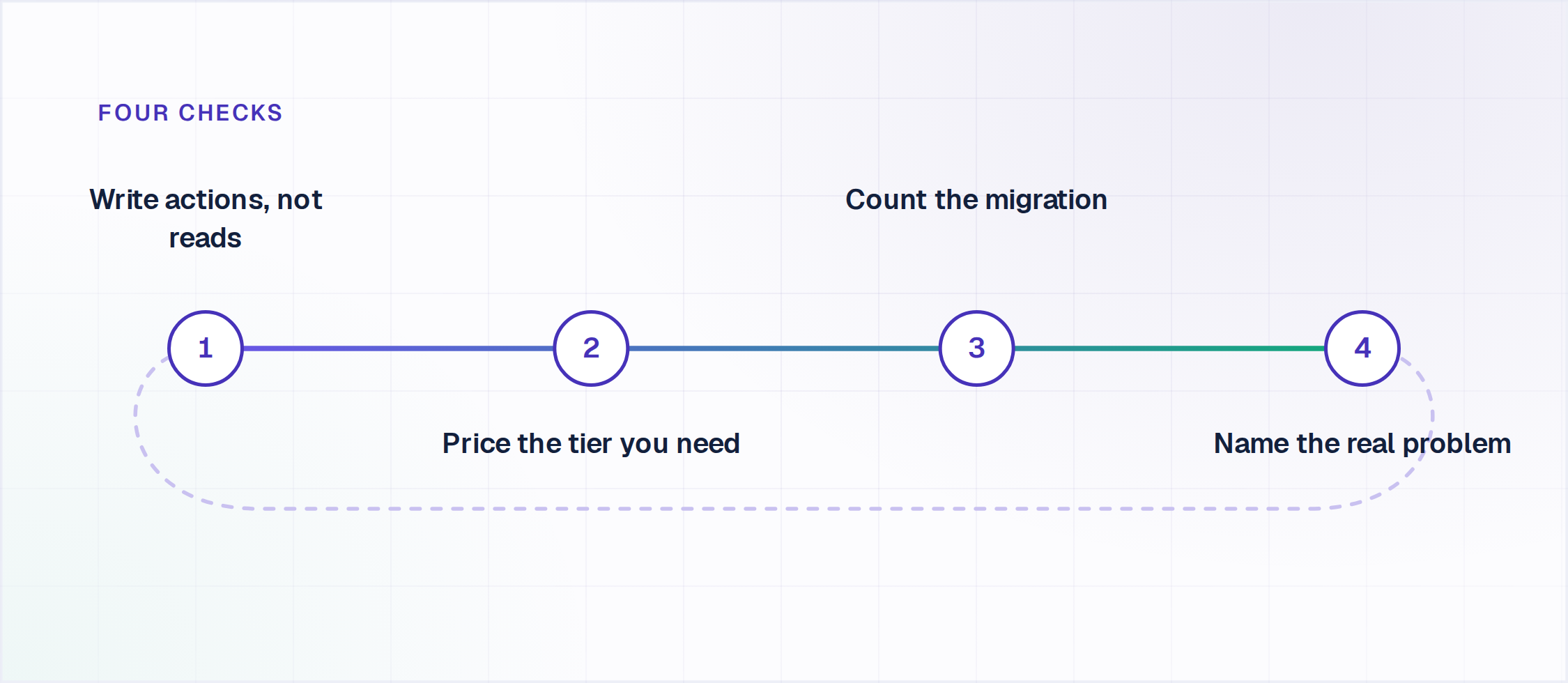
Ask for the write actions, not the read actions. Reading a ticket is not resolving a request. Get the list of operations each platform performs in Okta, Entra ID, Jira and your own APIs, and who authorizes each one.
Price the tier that actually holds your process. Change management sits at Premium on Jira Service Management at $51.42 per agent per month, and behind a $3,195 per year add-on on ManageEngine Standard and Professional. Price the tier your ITIL processes need, not the entry tier.
Count the migration, not the licence. Ask each vendor for a named reference that moved off ServiceNow at your headcount, and what the CMDB rebuild took. Freshservice, ManageEngine ServiceDesk Plus and SolarWinds Service Desk quote days to weeks. BMC Helix ITSM and Ivanti Neurons for ITSM run months.
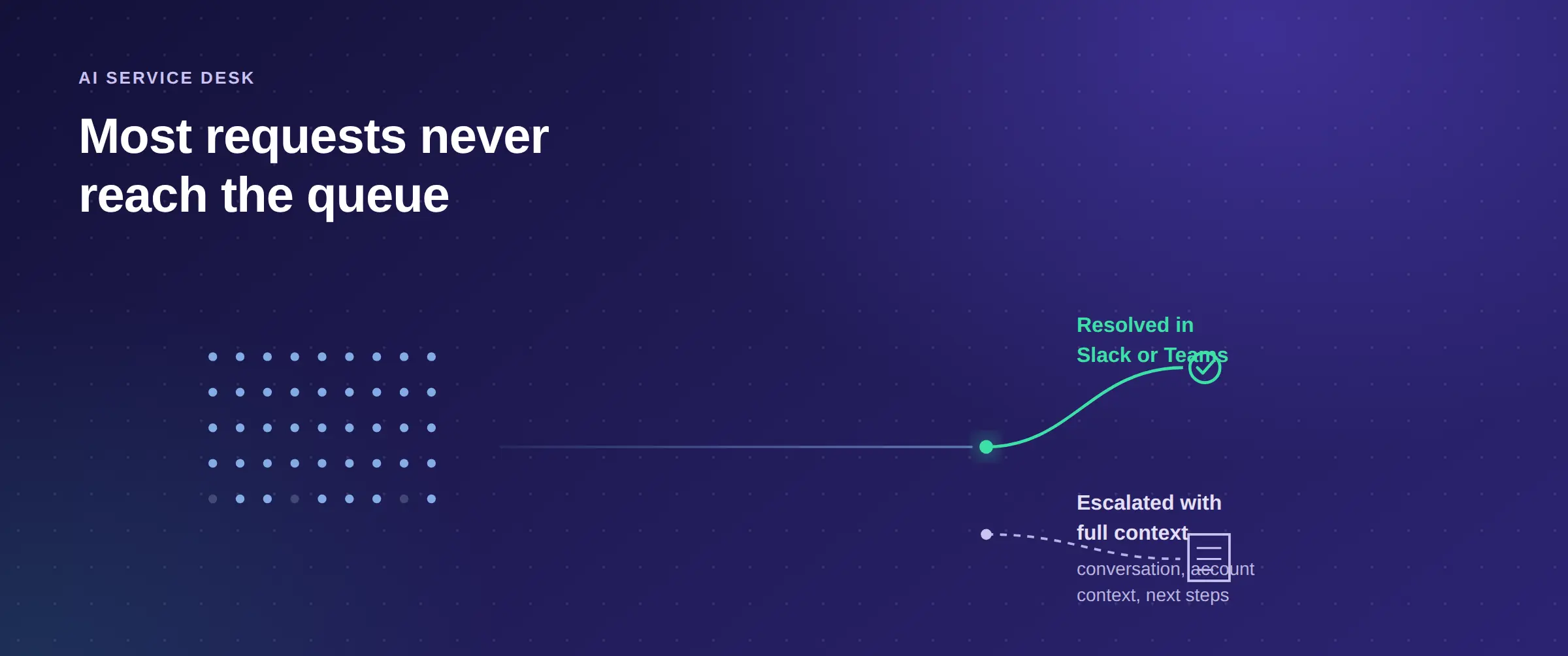
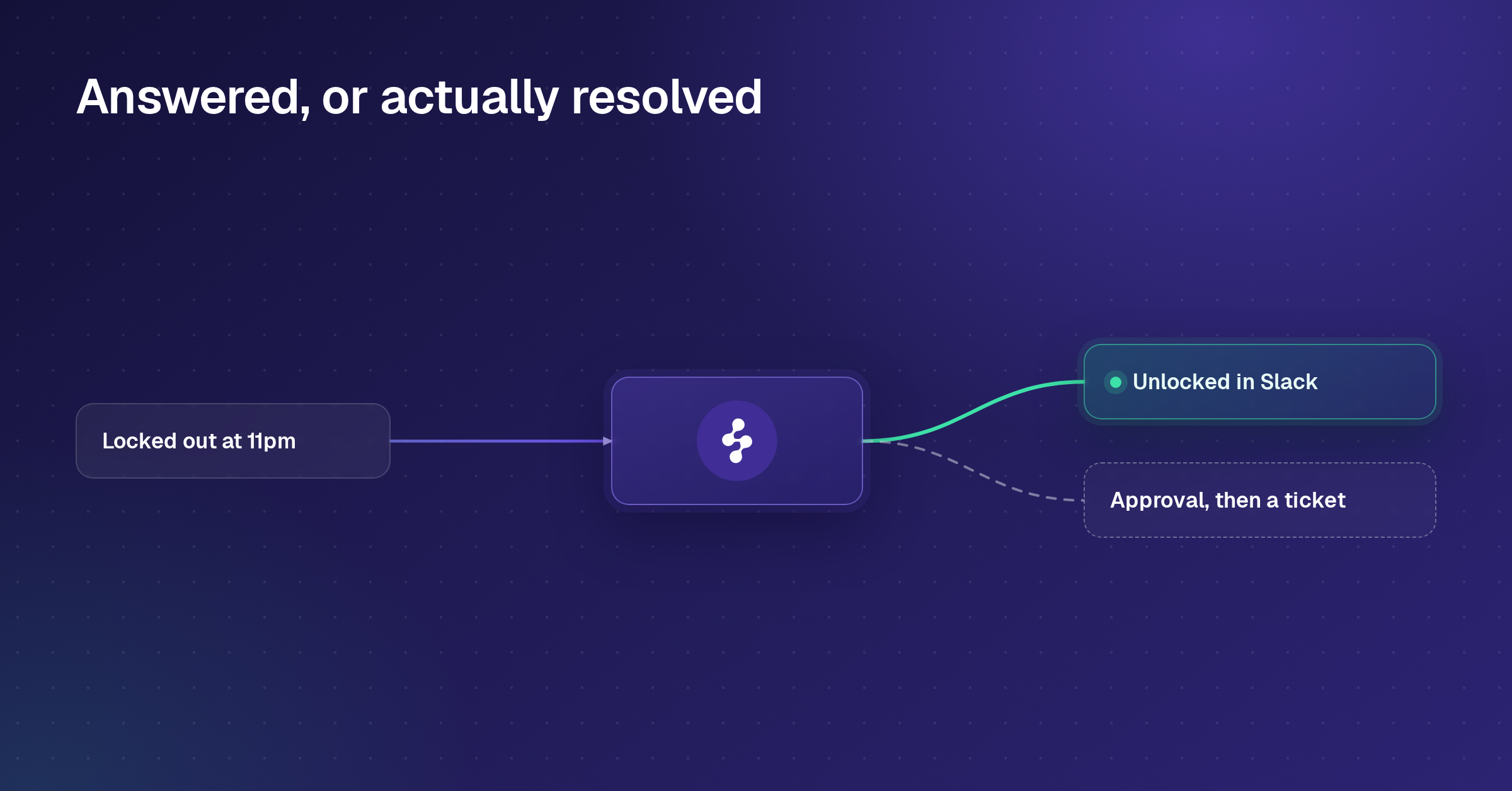
Decide whether the platform is really the problem. If your ServiceNow instance works and the pain is repetitive L1 volume plus a slow native AI rollout, none of these nine platforms addresses it. Enjo resolves requests in Slack and Microsoft Teams on the ServiceNow instance you already run, and escalates into it with the full conversation, account context and suggested next steps.
For the full field including customer-support platforms, see our ranking of the best help desk software. For small teams specifically, our comparison of helpdesk ticketing systems is the better starting point. Teams weighing Moveworks as a ServiceNow-adjacent AI layer should also read 6 Best Moveworks Alternatives, since ServiceNow's acquisition of Moveworks changes the calculus.
If ServiceNow itself is fine and the AI experience is what's broken, that's a different decision than this guide covers. Read the ServiceNow AI Agents comparison.
Frequently Asked Questions
What's the best free alternative to ServiceNow?
Jira Service Management's free tier covers up to 3 agents permanently. ManageEngine ServiceDesk Plus offers a free Standard edition for up to 5 technicians. Those are the two permanent hosted free tiers among the platforms on this list; every other entry is trial-only. If you can run it yourself, GLPI, iTop and OTOBO are free and open source, with no licence cost at all.
Do I have to replace ServiceNow entirely to fix the AI experience?
No, and that's a very different fix than anything on this list. If your ServiceNow instance works and the pain is ticket volume or a slow, expensive native AI rollout, see ServiceNow AI Agents in 2026: The Honest Buyer's Guide for the AI-layer approach, and Enjo for ServiceNow for how that layer installs on the instance you already run.
How long does switching off ServiceNow actually take?
It varies by platform. Freshservice, ManageEngine ServiceDesk Plus, and SolarWinds Service Desk can go live in days to weeks. BMC Helix ITSM and Ivanti Neurons for ITSM, with deeper ITIL and CMDB requirements, typically run for several months. The ManageEngine vs ServiceNow comparison puts those two side by side on pricing, native AI and rollout time.
Which ServiceNow alternative works natively in Slack and Microsoft Teams?
Atomicwork resolves requests directly in Slack and Teams, its primary interfaces. The other platforms on this list are ticket-portal-first, with Slack or Teams as a secondary channel at best.
Is ServiceNow actually the most expensive option on this list?
ServiceNow, along with BMC Helix ITSM, Ivanti Neurons for ITSM, and SysAid, does not publish pricing, so a direct comparison isn't possible without a sales quote. Among platforms with published pricing, SolarWinds Service Desk and Zendesk Suite Team land at the higher end for a 25-agent team; ManageEngine ServiceDesk Plus is the most affordable.
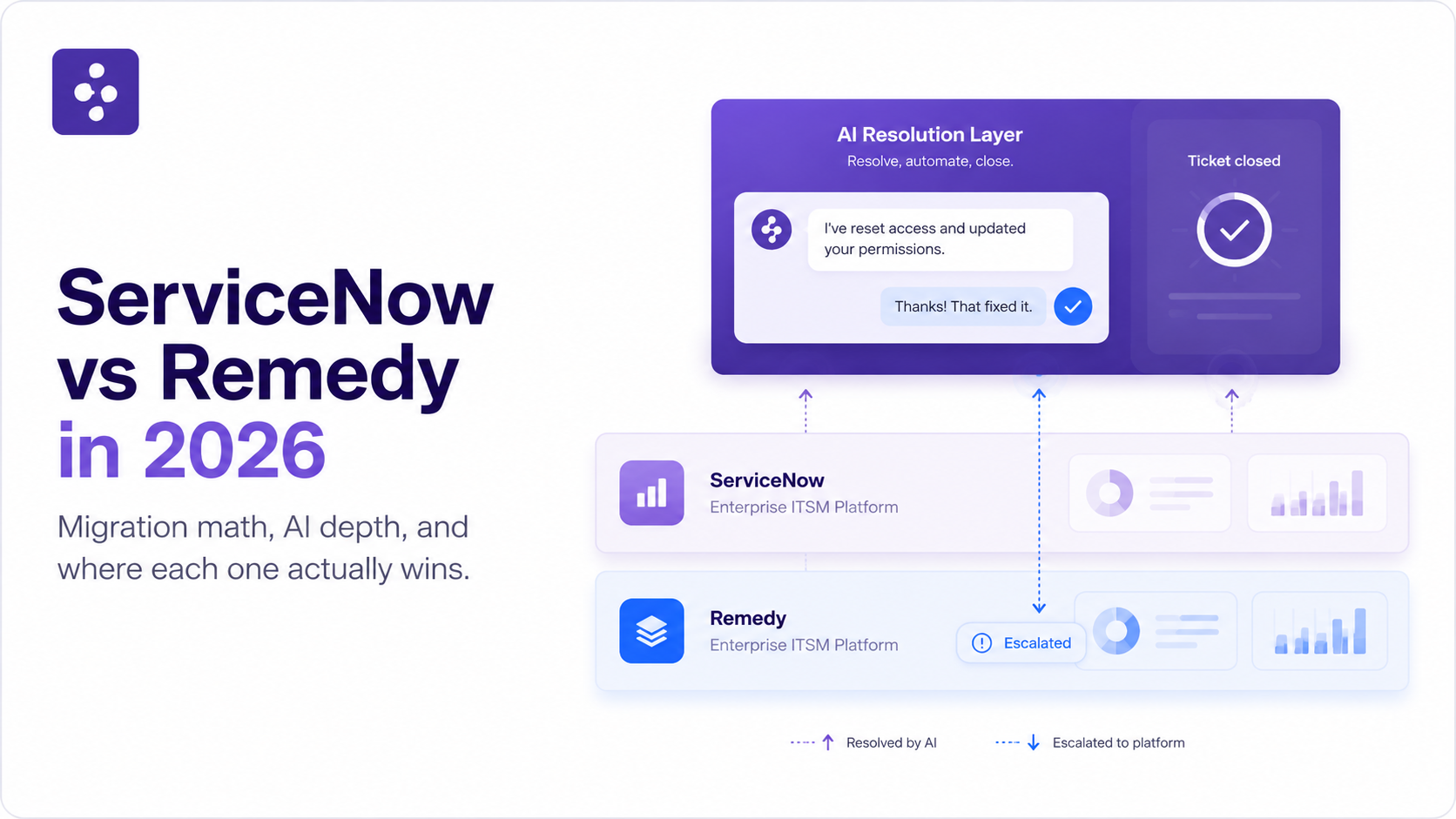
If the incumbent is Remedy rather than ServiceNow, our ServiceNow vs Remedy comparison covers the migration question directly.
Enjo publishes this guide and isn't one of the 9 alternatives above by design; it's the AI layer for teams that keep ServiceNow, not one that replaces it.