ServiceNow AI Agents in 2026: The Honest Buyer's Guide
ServiceNow's AI Agents are the most-pitched native AI in enterprise IT right now. They are also bound to the Now Platform in ways that most evaluation decks don't surface until procurement. Here's what that ceiling actually looks like, and what mid-market IT teams are doing about it.
01 / The four failure modes
What evaluation decks do not surface
ServiceNow AI Agents live on the ServiceNow AI Platform. They are coherent, well-engineered, and deeply integrated with the Now Platform. Four things tend to surface after the contract is signed.
The AI only reads ServiceNow
Confluence runbooks. SharePoint policy docs. Notion ADRs. Past Jira tickets from engineering. Indexing all of it into ServiceNow takes Integration Hub work and quarters of effort before the agent can use any of it.
Actions stay inside the platform
Out-of-the-box agents act on ServiceNow records. Unlocking Okta accounts, provisioning Google Workspace, creating Jira tickets in engineering projects, each one is an Integration Hub configuration project, not a default capability.
The tier upgrade is not optional
AI Agents, AI Agent Studio, and AI Control Tower sit on the AI Platform. Activation often requires moving up the Now Platform tier. ServiceNow does not publish pricing, so this surfaces during procurement, not evaluation.
Months before the first resolution
Platform configuration, AI Control Tower governance setup, Integration Hub work for every external system. Most native AI Agent rollouts run multiple quarters before the agent closes its first real ticket end-to-end.
None of those is a flaw in the product. They are consequences of how ServiceNow AI Agents are built: deeply native, governed inside AI Control Tower, sitting on the ServiceNow CMDB as the single system of record. The architecture is coherent. It also has a ceiling, and the ceiling is what this piece is about.
02 / When native is the right call
Where ServiceNow AI Agents fit cleanly
Three buyer shapes where the native option is the path of least resistance. If you match these, stop reading this piece and book a ServiceNow demo.
The Fortune 500 already deep on Now Platform
An IT organization that has standardized on ServiceNow for ITSM, CMDB, IT Asset Management, and HR Service Delivery, with multi-year Now Platform commitments. The native agents inherit the data model and the governance posture, which means no new vendor security review.
The regulated org where central AI governance is itself the requirement
AI Control Tower's central governance is itself a compliance requirement in some environments. Pulling AI decisions into a separate platform creates a second audit surface that some security teams will not accept.
The pure-ServiceNow team with no cross-system action requirements
If every system the AI needs to read from or act on is already inside ServiceNow, the native option is genuinely the simplest answer. No integration project, no second vendor, no separate licensing line.
For everyone else, and that is most of the mid-market IT world, there is a more practical architecture.
03 / The layered approach
AI on top of ServiceNow, not bolted inside it
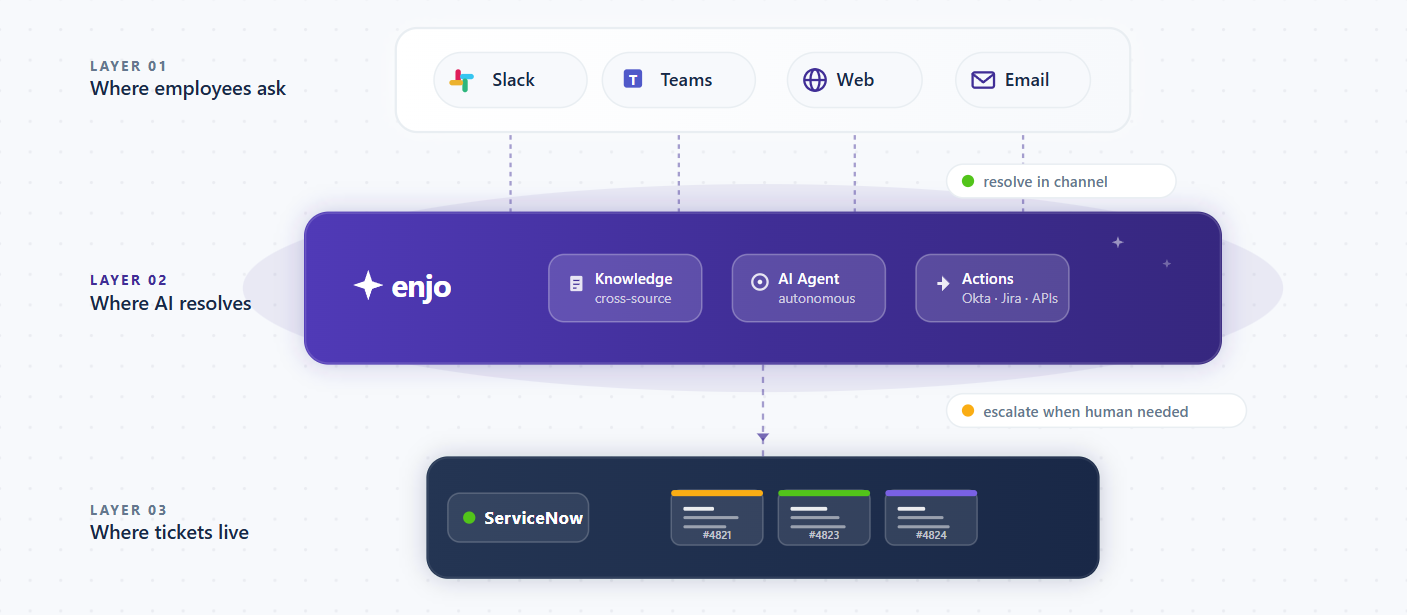
Most mid-market IT teams running ServiceNow do not need to replace it. They need AI that resolves in Slack and Teams, reads across the actual knowledge stack, takes action across systems, and creates a ServiceNow ticket with full context only when a human is needed.
Enjo on ServiceNow
Best for: Mid-market IT teams whose knowledge sprawls across Confluence, SharePoint, Google Drive, and past tickets, and who want autonomous resolution in Slack and Teams without leaving ServiceNow as the system of record.
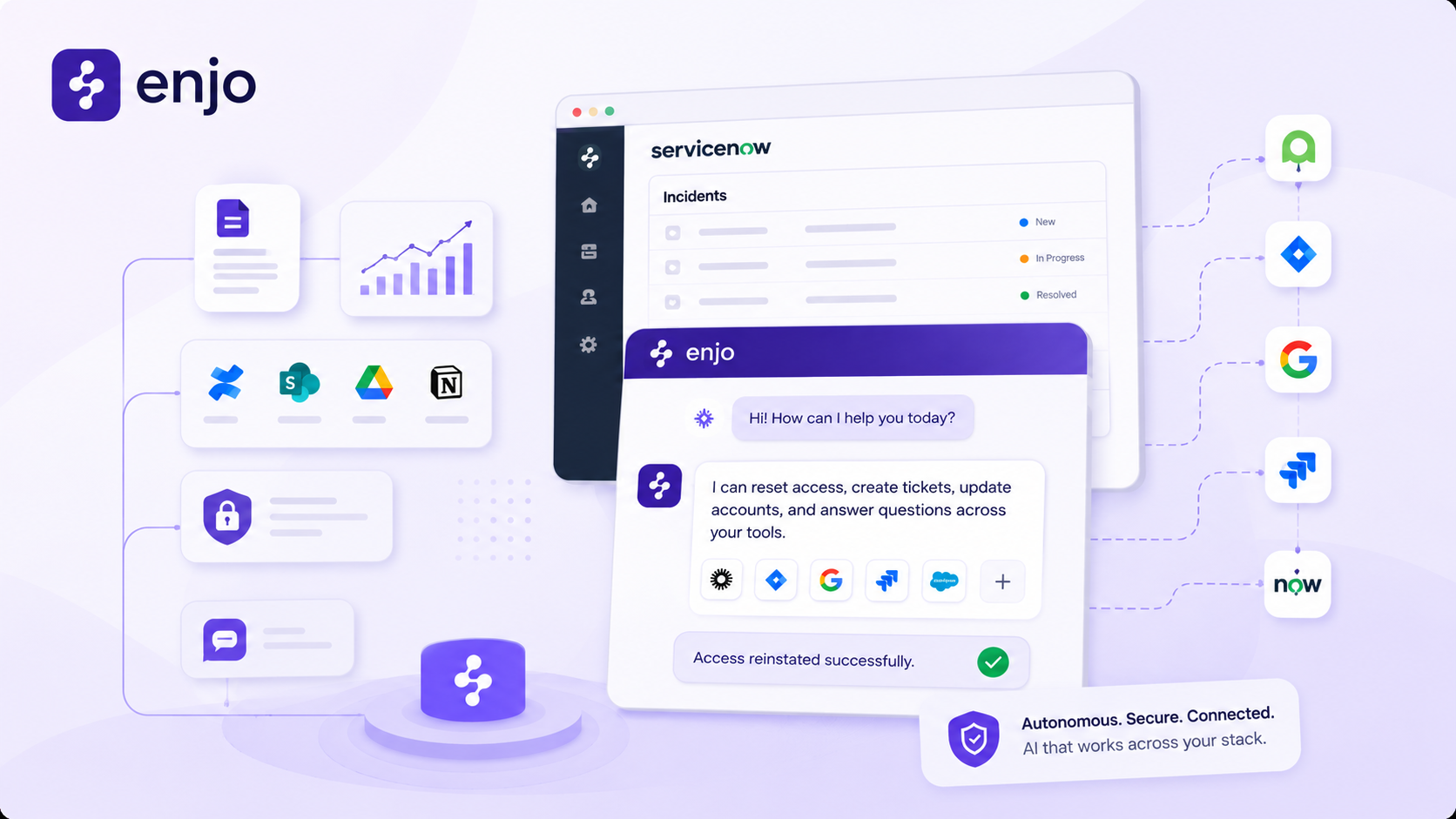
Enjo is an AI-native service automation platform that adds autonomous resolution to ServiceNow without asking you to replace it. Where the native AI Agents are bound to ServiceNow's own Knowledge Management, Enjo's Knowledge layer indexes Confluence, SharePoint, Google Drive, Notion, Guru, past tickets in Jira and ServiceNow, and internal websites into a single grounding source. The AI Agent reads from that layer, human agents see the same source of truth, and self-serve content draws from it too. No drift.
Employees interact with Enjo inside Slack, Microsoft Teams, web, and email, the channels they already work in. Behind the scenes, AI Actions reach into Okta, Azure AD, Google Workspace, Jira, Salesforce, ServiceNow, and custom APIs to actually resolve the request. When a request needs a human, Enjo creates the ticket in ServiceNow with full conversation history attached and routes to the correct queue. Agent Assist embeds inside the ServiceNow agent workspace with summaries, reply suggestions, and grounded knowledge, so the human agent picks up exactly where the AI left off.
What you get
- Knowledge that spans your actual stack: Confluence, SharePoint, Google Drive, Notion, Guru, past tickets, internal websites, not just one helpdesk's KB
- Autonomous resolution inside Slack and Teams with AI Actions across Okta, Azure AD, Jira, Salesforce, and custom APIs
- Agent Assist embedded inside the ServiceNow case view: summaries, reply drafts, grounded knowledge on every escalated ticket, installed via a standard update set
- Self-serve configuration through Studio's visual builder: your team ships changes without professional services
- Multi-step orchestration with safety nets: AI Flows handles complex workflows with explicit fallbacks when the agent is not confident
- Enterprise controls: Guardrails, audit logs, RBAC, SOC 2 Type II, ISO 27001, GDPR, 100+ languages
Pricing
Usage-based per AI Reply, not per seat. Free tier with 200 replies per month, unlimited human agent seats, no credit card. Paid plans start at $95/month for 1,000 replies. All tiers include unlimited human seats; additional replies are $0.05 each.
Add AI to your ServiceNow stack without migrating
200 AI replies per month free. Unlimited human agent seats. No credit card.
Where Enjo is not the answer. For very large ServiceNow shops fully committed to the Now Platform roadmap and AI Control Tower as the central governance surface, native AI Agents (or Moveworks, now part of ServiceNow) is the more natural fit. Enjo is the layered architecture, not a Now Platform-native build.
04 / Side by side
ServiceNow AI Agents vs Enjo on ServiceNow
Both are viable. They solve different problems. The honest read is below the table.
| What matters in production | ServiceNow AI Agents (native) | Enjo on ServiceNow |
|---|---|---|
| Knowledge sources read by the AI | ServiceNow Knowledge Management; other sources via Integration Hub | Confluence, SharePoint, Google Drive, Notion, Guru, past tickets in Jira, Zendesk, and ServiceNow, web pages, uploaded files, indexed by default |
| Cross-system actions | ServiceNow records natively; Okta, Google Workspace, Jira, Salesforce via Integration Hub configuration | Okta, Azure AD, Google Workspace, Jira, Salesforce, ServiceNow, custom APIs as default AI Actions |
| Primary employee channel | ServiceNow portal, Now Assist surfaces | Native apps in Slack and Microsoft Teams |
| Escalation behavior | Native ServiceNow workflow | Resolves in Slack and Teams; creates a ServiceNow ticket with full conversation context when human is needed |
| Governance layer | AI Control Tower, built on ServiceNow CMDB | Guardrails, audit logs, RBAC; SOC 2 Type II, ISO 27001, GDPR |
| Typical deployment time | Multi-month (platform configuration, Integration Hub work, AI Control Tower governance setup) | Days to weeks (Aptean: single day; Amber Group: 5 weeks POC to production) |
| Licensing model | Tied to Now Platform licensing tier; pricing not publicly published | Usage-based per AI Reply; 200 replies per month free with unlimited seats; $0.05 per additional reply |
| Where it lives in the org | Inside ServiceNow as a Now Platform module | Layer on top of ServiceNow; ServiceNow stays the system of record |
The honest read: a Fortune 500 already deep on ServiceNow with multi-year platform commitments gets a coherent native story. A mid-market IT team with knowledge across Confluence and Drive, action requirements in Okta and Jira, and employees living in Slack gets faster time to value from Enjo on top of ServiceNow.
05 / In production
What the layered pattern looks like at scale
Two teams running the same architectural pattern on different helpdesk substrates. AI in Slack on top, helpdesk underneath, single knowledge layer across the stack.
Delivery Hero runs IT support across 95,000+ employees in 70+ countries on a Jira-based stack with Slack as the primary channel. After deploying Enjo, the team reported 30% deflection, a 25% employee satisfaction lift, and 80% faster response times.
Aurora, an autonomous vehicle company with 2,500 employees, runs the same pattern on a different helpdesk substrate. The numbers: 63% autonomous resolution, 45% faster resolution, 60% ESAT improvement.
63%
Aurora
autonomous resolution
45%
Aurora
faster resolution
30%
Delivery Hero
deflection
80%
Delivery Hero
faster response
Neither team replaced their helpdesk to get there. Both kept their existing ticketing layer and added the AI layer on top.
06 / The honest call
Which side of the line are you on?
Native makes sense in some shapes. A layered AI makes more sense in others. Here is how the two profiles split in practice.
ServiceNow AI Agents fits if
You match most of these conditions.
- Mature Now Platform investment with deep customization
- Already on the AI Platform tier or willing to upgrade
- Knowledge mostly lives inside ServiceNow's own KB
- ServiceNow implementation partners on retainer
- Service Portal is the primary employee touchpoint
- Comfortable with a multi-month deployment cycle
A layered AI makes sense if
You match most of these conditions.
- Knowledge sprawls across Confluence, SharePoint, Drive, Notion, past tickets
- Employees ping IT in Slack or Teams before the Service Portal
- You have been quoted a tier upgrade and the math does not work
- Cross-system actions needed: Okta, Jira, custom APIs
- Production AI needed in days, not quarters
- Self-serve configuration matters more than vendor handholding
07 / Questions IT leads ask
Direct answers, no marketing detours
Do we have to leave ServiceNow to use Enjo?
No. Most Enjo IT deployments keep ServiceNow as the helpdesk of record. Enjo adds the AI resolution layer in Slack and Teams, and escalates unresolved requests into your existing ServiceNow instance with the full conversation history attached. Tickets, queues, SLAs, and reporting all stay where they are.
Is Enjo a replacement for ServiceNow's AI Agents, or does it run alongside?
It is an alternative to the AI layer, not the ticketing system. Most teams turn off the native AI Agent for IT requests, route incoming requests through Enjo in Slack and Teams, and keep ServiceNow as the system of record for escalated tickets and audit history. The native AI can remain enabled for other use cases.
How does Enjo handle escalation to ServiceNow?
When the agent cannot resolve a request, it creates a ServiceNow ticket with the full Slack or Teams conversation attached, applies the correct category and priority, and routes to the right queue. Agent Assist then surfaces summaries and reply suggestions inside the ServiceNow case view, so the human agent picks up with full context. No copy-paste, no employee restating the problem.
Does Enjo require a higher ServiceNow license tier?
No. Enjo's AI Agents, Knowledge, and AI Actions are licensed separately on Enjo's usage-based model. No Now Platform tier uplift is required. The Agent Assist plugin installs into a standard ServiceNow instance via an update set.
Is the security posture enterprise-grade?
Enjo is SOC 2 Type II compliant, ISO 27001 certified, and GDPR compliant. Audit logs, RBAC, and Guardrails are available on every plan including the free tier. Netflix, Snowflake, and Roku are among the named references on the platform.
Curious about how Enjo works on your ServiceNow stack?
30 minutes. Real knowledge sources. Real IT requests. Your sandbox. Upload your ticket history and Enjo's Desk Assessment shows you top topics, automation rates, and projected savings before you sign anything.
No credit card. Free Inbox and Help Center included. Pay only when you scale.
01 / The four failure modes
What evaluation decks do not surface
ServiceNow AI Agents live on the ServiceNow AI Platform. They are coherent, well-engineered, and deeply integrated with the Now Platform. Four things tend to surface after the contract is signed.
The AI only reads ServiceNow
Confluence runbooks. SharePoint policy docs. Notion ADRs. Past Jira tickets from engineering. Indexing all of it into ServiceNow takes Integration Hub work and quarters of effort before the agent can use any of it.
Actions stay inside the platform
Out-of-the-box agents act on ServiceNow records. Unlocking Okta accounts, provisioning Google Workspace, creating Jira tickets in engineering projects, each one is an Integration Hub configuration project, not a default capability.
The tier upgrade is not optional
AI Agents, AI Agent Studio, and AI Control Tower sit on the AI Platform. Activation often requires moving up the Now Platform tier. ServiceNow does not publish pricing, so this surfaces during procurement, not evaluation.
Months before the first resolution
Platform configuration, AI Control Tower governance setup, Integration Hub work for every external system. Most native AI Agent rollouts run multiple quarters before the agent closes its first real ticket end-to-end.
None of those is a flaw in the product. They are consequences of how ServiceNow AI Agents are built: deeply native, governed inside AI Control Tower, sitting on the ServiceNow CMDB as the single system of record. The architecture is coherent. It also has a ceiling, and the ceiling is what this piece is about.
02 / When native is the right call
Where ServiceNow AI Agents fit cleanly
Three buyer shapes where the native option is the path of least resistance. If you match these, stop reading this piece and book a ServiceNow demo.
The Fortune 500 already deep on Now Platform
An IT organization that has standardized on ServiceNow for ITSM, CMDB, IT Asset Management, and HR Service Delivery, with multi-year Now Platform commitments. The native agents inherit the data model and the governance posture, which means no new vendor security review.
The regulated org where central AI governance is itself the requirement
AI Control Tower's central governance is itself a compliance requirement in some environments. Pulling AI decisions into a separate platform creates a second audit surface that some security teams will not accept.
The pure-ServiceNow team with no cross-system action requirements
If every system the AI needs to read from or act on is already inside ServiceNow, the native option is genuinely the simplest answer. No integration project, no second vendor, no separate licensing line.
For everyone else, and that is most of the mid-market IT world, there is a more practical architecture.
03 / The layered approach
AI on top of ServiceNow, not bolted inside it
Most mid-market IT teams running ServiceNow do not need to replace it. They need AI that resolves in Slack and Teams, reads across the actual knowledge stack, takes action across systems, and creates a ServiceNow ticket with full context only when a human is needed.
Enjo on ServiceNow
Best for: Mid-market IT teams whose knowledge sprawls across Confluence, SharePoint, Google Drive, and past tickets, and who want autonomous resolution in Slack and Teams without leaving ServiceNow as the system of record.
Enjo is an AI-native service automation platform that adds autonomous resolution to ServiceNow without asking you to replace it. Where the native AI Agents are bound to ServiceNow's own Knowledge Management, Enjo's Knowledge layer indexes Confluence, SharePoint, Google Drive, Notion, Guru, past tickets in Jira and ServiceNow, and internal websites into a single grounding source. The AI Agent reads from that layer, human agents see the same source of truth, and self-serve content draws from it too. No drift.
Employees interact with Enjo inside Slack, Microsoft Teams, web, and email, the channels they already work in. Behind the scenes, AI Actions reach into Okta, Azure AD, Google Workspace, Jira, Salesforce, ServiceNow, and custom APIs to actually resolve the request. When a request needs a human, Enjo creates the ticket in ServiceNow with full conversation history attached and routes to the correct queue. Agent Assist embeds inside the ServiceNow agent workspace with summaries, reply suggestions, and grounded knowledge, so the human agent picks up exactly where the AI left off.
What you get
- Knowledge that spans your actual stack: Confluence, SharePoint, Google Drive, Notion, Guru, past tickets, internal websites, not just one helpdesk's KB
- Autonomous resolution inside Slack and Teams with AI Actions across Okta, Azure AD, Jira, Salesforce, and custom APIs
- Agent Assist embedded inside the ServiceNow case view: summaries, reply drafts, grounded knowledge on every escalated ticket, installed via a standard update set
- Self-serve configuration through Studio's visual builder: your team ships changes without professional services
- Multi-step orchestration with safety nets: AI Flows handles complex workflows with explicit fallbacks when the agent is not confident
- Enterprise controls: Guardrails, audit logs, RBAC, SOC 2 Type II, ISO 27001, GDPR, 100+ languages
Pricing
Usage-based per AI Reply, not per seat. Free tier with 200 replies per month, unlimited human agent seats, no credit card. Paid plans start at $95/month for 1,000 replies. All tiers include unlimited human seats; additional replies are $0.05 each.
Add AI to your ServiceNow stack without migrating
200 AI replies per month free. Unlimited human agent seats. No credit card.
Where Enjo is not the answer. For very large ServiceNow shops fully committed to the Now Platform roadmap and AI Control Tower as the central governance surface, native AI Agents (or Moveworks, now part of ServiceNow) is the more natural fit. Enjo is the layered architecture, not a Now Platform-native build.
04 / Side by side
ServiceNow AI Agents vs Enjo on ServiceNow
Both are viable. They solve different problems. The honest read is below the table.
| What matters in production | ServiceNow AI Agents (native) | Enjo on ServiceNow |
|---|---|---|
| Knowledge sources read by the AI | ServiceNow Knowledge Management; other sources via Integration Hub | Confluence, SharePoint, Google Drive, Notion, Guru, past tickets in Jira, Zendesk, and ServiceNow, web pages, uploaded files, indexed by default |
| Cross-system actions | ServiceNow records natively; Okta, Google Workspace, Jira, Salesforce via Integration Hub configuration | Okta, Azure AD, Google Workspace, Jira, Salesforce, ServiceNow, custom APIs as default AI Actions |
| Primary employee channel | ServiceNow portal, Now Assist surfaces | Native apps in Slack and Microsoft Teams |
| Escalation behavior | Native ServiceNow workflow | Resolves in Slack and Teams; creates a ServiceNow ticket with full conversation context when human is needed |
| Governance layer | AI Control Tower, built on ServiceNow CMDB | Guardrails, audit logs, RBAC; SOC 2 Type II, ISO 27001, GDPR |
| Typical deployment time | Multi-month (platform configuration, Integration Hub work, AI Control Tower governance setup) | Days to weeks (Aptean: single day; Amber Group: 5 weeks POC to production) |
| Licensing model | Tied to Now Platform licensing tier; pricing not publicly published | Usage-based per AI Reply; 200 replies per month free with unlimited seats; $0.05 per additional reply |
| Where it lives in the org | Inside ServiceNow as a Now Platform module | Layer on top of ServiceNow; ServiceNow stays the system of record |
The honest read: a Fortune 500 already deep on ServiceNow with multi-year platform commitments gets a coherent native story. A mid-market IT team with knowledge across Confluence and Drive, action requirements in Okta and Jira, and employees living in Slack gets faster time to value from Enjo on top of ServiceNow.
05 / In production
What the layered pattern looks like at scale
Two teams running the same architectural pattern on different helpdesk substrates. AI in Slack on top, helpdesk underneath, single knowledge layer across the stack.
Delivery Hero runs IT support across 95,000+ employees in 70+ countries on a Jira-based stack with Slack as the primary channel. After deploying Enjo, the team reported 30% deflection, a 25% employee satisfaction lift, and 80% faster response times.
Aurora, an autonomous vehicle company with 2,500 employees, runs the same pattern on a different helpdesk substrate. The numbers: 63% autonomous resolution, 45% faster resolution, 60% ESAT improvement.
63%
Aurora
autonomous resolution
45%
Aurora
faster resolution
30%
Delivery Hero
deflection
80%
Delivery Hero
faster response
Neither team replaced their helpdesk to get there. Both kept their existing ticketing layer and added the AI layer on top.
06 / The honest call
Which side of the line are you on?
Native makes sense in some shapes. A layered AI makes more sense in others. Here is how the two profiles split in practice.
ServiceNow AI Agents fits if
You match most of these conditions.
- Mature Now Platform investment with deep customization
- Already on the AI Platform tier or willing to upgrade
- Knowledge mostly lives inside ServiceNow's own KB
- ServiceNow implementation partners on retainer
- Service Portal is the primary employee touchpoint
- Comfortable with a multi-month deployment cycle
A layered AI makes sense if
You match most of these conditions.
- Knowledge sprawls across Confluence, SharePoint, Drive, Notion, past tickets
- Employees ping IT in Slack or Teams before the Service Portal
- You have been quoted a tier upgrade and the math does not work
- Cross-system actions needed: Okta, Jira, custom APIs
- Production AI needed in days, not quarters
- Self-serve configuration matters more than vendor handholding
07 / Questions IT leads ask
Direct answers, no marketing detours
Do we have to leave ServiceNow to use Enjo?
No. Most Enjo IT deployments keep ServiceNow as the helpdesk of record. Enjo adds the AI resolution layer in Slack and Teams, and escalates unresolved requests into your existing ServiceNow instance with the full conversation history attached. Tickets, queues, SLAs, and reporting all stay where they are.
Is Enjo a replacement for ServiceNow's AI Agents, or does it run alongside?
It is an alternative to the AI layer, not the ticketing system. Most teams turn off the native AI Agent for IT requests, route incoming requests through Enjo in Slack and Teams, and keep ServiceNow as the system of record for escalated tickets and audit history. The native AI can remain enabled for other use cases.
How does Enjo handle escalation to ServiceNow?
When the agent cannot resolve a request, it creates a ServiceNow ticket with the full Slack or Teams conversation attached, applies the correct category and priority, and routes to the right queue. Agent Assist then surfaces summaries and reply suggestions inside the ServiceNow case view, so the human agent picks up with full context. No copy-paste, no employee restating the problem.
Does Enjo require a higher ServiceNow license tier?
No. Enjo's AI Agents, Knowledge, and AI Actions are licensed separately on Enjo's usage-based model. No Now Platform tier uplift is required. The Agent Assist plugin installs into a standard ServiceNow instance via an update set.
Is the security posture enterprise-grade?
Enjo is SOC 2 Type II compliant, ISO 27001 certified, and GDPR compliant. Audit logs, RBAC, and Guardrails are available on every plan including the free tier. Netflix, Snowflake, and Roku are among the named references on the platform.
Curious about how Enjo works on your ServiceNow stack?
30 minutes. Real knowledge sources. Real IT requests. Your sandbox. Upload your ticket history and Enjo's Desk Assessment shows you top topics, automation rates, and projected savings before you sign anything.
No credit card. Free Inbox and Help Center included. Pay only when you scale.


Stay Informed and Inspired