10 Best ITSM Tools for IT Teams in 2026
IT leaders keep getting handed the same brief: cut the ticket backlog, do it without new headcount, and show progress by next quarter. So you open a list of the best ITSM tools, and every list looks identical, fifteen vendors, a feature grid, and a ranking that mostly reflects who published the page. None of them answer the question you actually have, which is which of these fits a team like yours.
This guide ranks the ten ITSM tools worth a mid-market IT team's time in 2026. Each tool gets live pricing, what it is good at, and a straight answer on where it falls down. One of the ten, Enjo, is built by us, so read that section with the skepticism it deserves. For the record, our IT support runs across 600+ enterprise deployments with six years of 99.9% uptime, and it goes live in weeks rather than quarters.
The best ITSM tools of 2026 fall into two camps, and picking the wrong camp means ripping out a platform you never needed to replace.
The short version: who should pick what
Start with the cases where Enjo is not the answer:
- You need a new system of record, with a full CMDB and change management: that is a platform decision, not Enjo. For a big enterprise, ServiceNow. For Atlassian shops, Jira Service Management. To replace a legacy ITSM with an AI-native platform, Atomicwork.
- You are rolling AI out across IT, HR, and customer service at enterprise scale: Aisera or Kore.ai, with the multi-month rollout and budget that implies.
- You are committed to ServiceNow: Moveworks, now native to it.
For most mid-market IT teams, though, the platform is fine, and the tickets are the problem, and that is where Enjo fits:
- Your platform works, and the real problem is L1 ticket volume: add Enjo's AI resolution layer on top, keep what you already run, and go live in weeks.
- You want requests resolved where employees already work, with AI included rather than billed as a separate add-on: Enjo resolves end-to-end in Slack and Teams, includes AI on every plan, and stays helpdesk-agnostic and independent, where Moveworks (now ServiceNow) and Aisera (now Automation Anywhere) do not.
First, the two camps (and why Enjo leads)
Here is the distinction nobody on the first page of Google makes. An ITSM platform is your system of record. It is where tickets live, where change requests get approved, where the asset database sits, the source of truth your auditors ask about. An AI resolution layer is a different animal. It sits on top and actually closes the ticket, resetting the password or provisioning the access before a human ever sees it. Most lists of the best ITSM software rank these two things side by side as if they were interchangeable. They are not, and confusing them is the most expensive mistake in this category.
Two facts from late 2025 sharpen the point. ServiceNow bought Moveworks, and Automation Anywhere bought Aisera, both within a few weeks. The two best-known independent IT-AI players got absorbed into bigger platforms almost overnight. Enjo is the resolution layer that stayed independent and helpdesk-agnostic, which matters when your stack is not, and may never be, all-ServiceNow.
We ranked the top ITSM tools on the things that decide whether a rollout survives contact with reality: how long it takes to deploy, how much admin it needs after go-live, how much it actually resolves on its own, whether it reaches across your stack or only its own data, the channels your employees already use, pricing, and security. Enjo leads the list because, for most mid-market IT teams, the platform is not the problem, the ticket volume is. If your platform is solid and the pain is volume, you want service desk automation on top, not a migration.
ITSM tools compared at a glance
The full comparison of the top ITSM tools first, so you can scan before reading the deep dives.
The 10 best ITSM tools for IT teams in 2026
1. Enjo
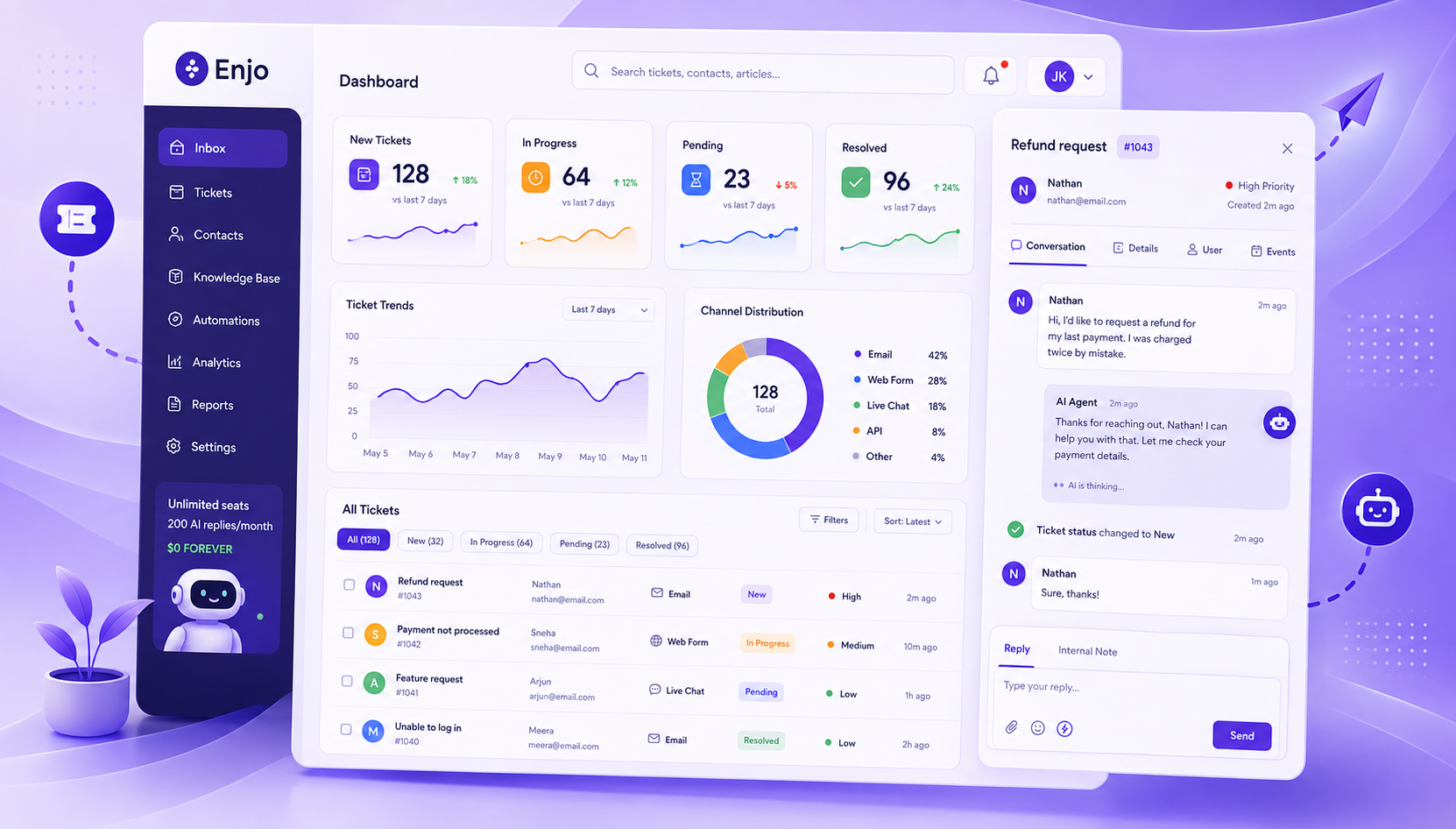
Our pick for mid-market IT, and why this list leads with a resolution layer rather than a platform (built by us, so judge it on the proof below). Enjo's AI Agents resolve common IT requests end-to-end in Slack and Teams, then escalate to your existing helpdesk or Inbox with full context when a human is needed. It is helpdesk-agnostic and, unlike Moveworks or Aisera, still independent.
Human agents get Agent Assist inside the ticket, and every action runs behind Guardrails with full audit trails.
- Best for: Mid-market IT teams that already have a working helpdesk and want to kill L1 ticket volume in weeks, without a migration.
- Proof: Aurora resolves 63% of requests autonomously and cut resolution time by 45%. Amber Group went from proof-of-concept to production in five weeks, with zero missed requests from day one.
- Pricing: Usage-based, billed per AI Reply, not per seat, and published in full at enjo.ai/pricing. There is a permanent free tier with 200 AI replies a month, unlimited human seats, and no credit card. Paid plans are $95 a month (1,000 replies) and $295 a month (3,000 replies), with extra replies at five cents each.
- Where it falls short: Enjo is not a system of record. There is no CMDB or change management in the ITIL sense. That is the point: you keep the platform you already run and add Enjo on top, rather than ripping anything out. If you need the platform itself, pair Enjo with one from the list below.
2. Motadata ServiceOps
Motadata ServiceOps is a value pick with an ITIL 4-aligned system of record. It brings incident, problem, change, and asset management together in one console, with cloud and on-premises deployment options at a lower cost than enterprise suites.
- Best for: Mid-market IT teams wanting ITIL-aligned incident, asset, and change management in one platform, on-premise or cloud, without enterprise pricing.
- Pricing: Motadata does not publish list prices, so you will request a quote from motadata.com. It is sold per technician across cloud and on-premise editions, positioned below the enterprise suites, with CMDB and asset management included rather than sold separately. No public free tier.
- Where it falls short: Like the other platforms here, ServiceOps is a system of record, not a resolution layer, and its AI is closer to assisted ticketing than autonomous L1 resolution. If the platform works and L1 volume is the pain, Enjo runs on top to resolve end-to-end in Slack and Teams.
3. ServiceNow
The platform every enterprise IT leader already knows: the full system of record, with incident, problem, change, and request management, a real CMDB, and asset management. Since the December 2025 Moveworks acquisition, its native AI lives in Now Assist and the new Foundation, Advanced, and Prime tiers.
- Best for: Large enterprises with complex, multi-department service management and the budget and headcount to run it.
- Pricing: ServiceNow keeps pricing off its public pages, so you will request a custom quote from servicenow.com. Third-party trackers put ITSM at $70 to $200+ per fulfiller per month, the AI tier adds a 50 to 60% uplift, and total cost of ownership runs three to five times the license once you add implementation. A 50-fulfiller rollout is commonly budgeted at $500K to $2M in year one, with no free trial.
- Where it falls short: It is heavy and expensive, implementations run months, and for a mid-market team it is far more platform than the problem usually requires. If you like ServiceNow but want resolution in weeks, Enjo for ServiceNow runs on top of it without the AI-tier uplift.
4. Jira Service Management
Atlassian's ITSM, built on the same platform your engineers already use for Jira, so dev and IT can share one system. It is ITIL-aligned across incident, problem, change, and request management, with deep Atlassian integration and a famously steep learning curve.
- Best for: Mid-market to enterprise teams already standardized on Atlassian, or with tight dev-and-IT workflows.
- Pricing: Atlassian publishes its tiers at atlassian.com. A free tier covers up to three agents, Standard is about $20 per agent per month, and Premium, where the AI virtual agent actually lives, is about $51 per agent per month, with Enterprise on a custom quote. The virtual agent bills per assisted conversation beyond its allowance.
- Where it falls short: The configuration curve is steep, a full ITSM rollout commonly takes three to six months, and the AI sits behind the top tier. To add resolution in Slack and Teams without waiting on that rollout, Enjo for Jira sits on top.
5. Freshservice
Freshworks' answer for mid-market IT that wants enterprise-grade ITSM without the ServiceNow weight: incident, asset, and change management, a no-code builder, and a setup faster than the enterprise suites.
- Best for: Mid-market IT teams that want a capable platform they can stand up quickly.
- Pricing: Freshworks lists four per-agent tiers at freshworks.com, roughly $19 (Starter), $49 (Growth), and $99 (Pro) on annual billing, with Enterprise custom. There is no free plan, only a 14-day trial, and change and problem management only show up at the Pro tier.
- Where it falls short: The AI you are probably shopping for, Freddy, is a paid add-on starting around $29 per agent per month, and the per-agent math climbs as the team grows. Enjo includes AI on every plan, has a permanent free tier, and bills per resolution rather than per seat.
6. SysAid
An all-in-one for mid-sized teams that would rather buy one tool than stitch together three, bundling help desk, IT asset management, and automation with a GenAI Copilot on top.
- Best for: Mid-sized IT teams that want ITSM, assets, and remote support from a single vendor.
- Pricing: SysAid does not publish prices, so you will get a quote from sysaid.com. Third-party estimates put the Help Desk edition around $79 per agent per month and the ITSM edition around $108, priced by agents, assets, and modules, with a one-time onboarding fee on top. Copilot, the GenAI piece, is an add-on.
- Where it falls short: The interface feels dated next to the newer AI-native tools, and the AI is an extra line item. For resolution that drops onto the stack you already run, with a free tier to start, Enjo is the lighter add-on.
7. Atomicwork
The newest face among the platforms, positioned hardest as the modern replacement for a legacy ITSM: a full AI-native platform across ITSM, ESM, and asset management, with agentic agents that resolve requests end-to-end in Slack and Teams. Founded in 2022, with few public G2 reviews yet, so validation leans on Gartner Peer Insights and named customers like Zuora.
- Best for: Teams ready to replace a legacy ITSM platform with an AI-native one, or to run its AI on top of ServiceNow or JSM.
- Pricing: Atomicwork does not post prices publicly, so you will request a quote from atomicwork.com. Gartner Peer Insights lists the Professional plan starting around $25,000 per year (up to 250 users), with Business and Enterprise on custom, usage-based and outcome-based terms.
- Where it falls short: It is priced for the enterprise. That $25K-a-year floor and the platform-replacement framing make it a committee-sized decision, where Enjo starts free on your real tickets without asking you to replace anything.
8. Moveworks (now part of ServiceNow)
For years the best-known AI assistant for enterprise IT and employee support, with a conversational assistant, enterprise search, and an agentic reasoning engine across Slack and Teams. As of December 2025 it is a ServiceNow company, not an independent vendor.
- Best for: Enterprises already on ServiceNow, or moving there, that want a native AI layer.
- Pricing: Custom, and now shifting toward SKUs bundled with ServiceNow modules, so you will go through servicenow.com.
- Where it falls short: The independence is gone. Analysis since the deal closed has flagged roadmap uncertainty and questions about integration depth for teams on non-ServiceNow backends like Jira Service Management or Freshservice. If you are not heading toward ServiceNow, Enjo is the independent, helpdesk-agnostic alternative, and here are the other Moveworks alternatives worth a look.
If the decision is whether to replace the platform outright, the ServiceNow alternatives guide covers nine options across full ITSM swaps and AI-layer tools.
9. Aisera
An enterprise AI platform automating service across IT, HR, and finance, running agentic and generative AI on top of systems like ServiceNow and Atlassian, with multi-agent orchestration for multi-domain rollouts. As of November 2025 it is owned by Automation Anywhere.
- Best for: Large enterprises standardizing AI service across many departments at once.
- Pricing: Custom and sales-led, with quotes through aisera.com; the public pricing page currently returns a 404. The one verifiable figure, from the Azure Marketplace, lists the AI Service Desk at $200,000 per year for up to 1,000 users.
- Where it falls short: It is built for the enterprise, with the sales cycle and price tag to match, and the recent acquisition adds roadmap questions. A mid-market team that wants to start this quarter will struggle to buy it.
10. Kore.ai
The enterprise platform for teams that want to build their own AI agents rather than buy a packaged one: the XO Platform, a Gartner-recognized conversational-AI leader with 100+ connectors and enterprise-scale deployments at the likes of Morgan Stanley and Pfizer.
- Best for: Large, often regulated enterprises with the engineering resources to design and tune agents across many use cases.
- Pricing: Kore.ai keeps enterprise pricing off its site, so quotes come through Kore.ai. A free sandbox covers 5,000 requests a month; a pay-as-you-go Standard plan starts around $100; and enterprise deals typically land near $300,000 a year, with session-based billing that can drive costs higher than expected.
- Where it falls short: It is a build-and-configure platform, not a turnkey ITSM layer. The learning curve is steep; it relies on engineering support and is overkill for a mid-market IT team. Enjo is the resolution layer that is live in weeks, not a build project.
How to actually choose
Start with one question: is your platform the problem, or is the volume the problem? For most mid-market teams it is the volume. If your ServiceNow or Jira Service Management does what you need and the pain is the flood of repetitive L1 tickets, you do not need a new system of record. You need a resolution layer on top, and Enjo can be live on your real queue in weeks. Ripping out a working platform to fix a volume problem is how six-figure projects turn into eighteen-month projects.
If the platform itself is the bottleneck, then you are shopping for the best IT service desk software, and the choice comes down to size and stack. Enterprise with budget and admins: ServiceNow. Already on Atlassian: Jira Service Management. Mid-market that wants less weight: Freshservice or SysAid. Tightest budget: ManageEngine. Betting on AI-native and ready to replace the old thing: Atomicwork.
For the AI layer itself, Enjo is the default for mid-market teams that want resolution this quarter, on the stack they already run, with a free tier to test on real tickets first. Moveworks makes sense if you are committed to ServiceNow. Aisera and Kore.ai fit large enterprises standardizing AI across many departments and willing to run the sales cycle.
Whatever you pick, weigh deployment time and ongoing admin as heavily as features. The tool that is live and resolving in three weeks beats the one with a longer feature list that your team is still configuring at the end of the quarter.
The bottom line
The ten tools here are good at different jobs, but for most mid-market IT teams the honest answer to "what are the best ITSM tools" starts in the same place: your platform is probably fine, and the tickets are the problem. That is a resolution-layer job, which is why Enjo leads this list. If the platform itself is the bottleneck, match your size and stack to ServiceNow, Jira Service Management, Freshservice, SysAid, ManageEngine, or Atomicwork for the best IT service desk software fit, and you can still run Enjo on top. If your team runs customer support rather than IT service management, the sibling comparison worth reading is our roundup of the best helpdesk software.
Frequently asked questions
What is an ITSM tool?
ITSM software manages how IT delivers and supports services: logging incidents, routing requests, and tracking changes and assets against ITIL practices. In plain terms, it replaces scattered inboxes and spreadsheets with one system of record where work gets captured, prioritized, and resolved.
Is Jira an ITSM tool?
Jira on its own is a project and issue tracker for engineering teams. Jira Service Management is Atlassian's ITSM product, built on the same platform. When someone says they run ITSM on Jira, they almost always mean JSM.
Do I need a new ITSM platform, or just AI on top of my current one?
If your platform's workflows and reporting already work and the pain is L1 ticket volume, you need a resolution layer, not a migration. If the platform itself is slow, rigid, or missing core ITIL processes, then you are shopping for a new system of record. Most teams that think they need a new platform actually need the layer, which is why Enjo leads this list.
What is the best ITSM software for a mid-market IT team?
It depends which camp you are in. For the platform, Freshservice and Jira Service Management are the usual mid-market picks. For the AI layer that resolves tickets in Slack and Teams without a migration, Enjo's AI Agents fit, and the free tier lets you test on real tickets before you commit anything.
How long does an ITSM tool take to deploy?
It splits by camp. Enterprise platforms like ServiceNow and a full Jira Service Management rollout commonly run months and often need a partner. An AI resolution layer can go live in weeks; Amber Group reached production with Enjo in five. Deployment time is the most underrated line in any ITSM decision, so weigh it as heavily as the feature list.