.fs-cmsfilter_active span { color: black; }
table of contents

Transform complex support workflows

Deploy AI inside your existing support stack and prove business impact quickly.
Request a Demo

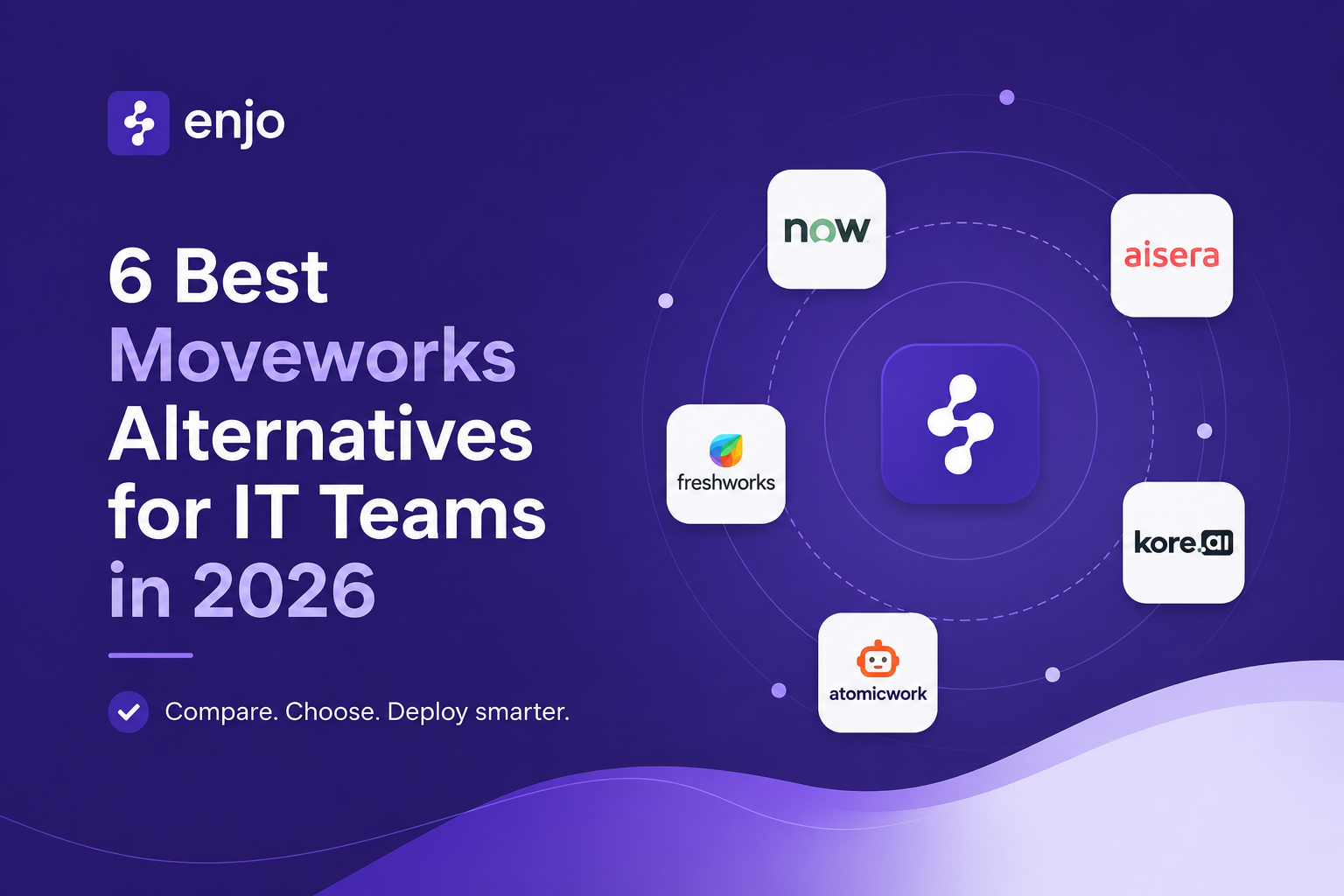
6 Best Moveworks Alternatives for IT Teams in 2026

Moveworks just became a ServiceNow product. The deal closed in December 2025, and if your stack isn't built around ServiceNow, that single fact reshuffles your shortlist. It still runs in Slack and Teams, and the integrations it came with keep working. The catch is ownership. Moveworks now follows ServiceNow's roadmap, and in February 2026 ServiceNow shipped EmployeeWorks, its own platform with the Moveworks assistant up front. Call it a preview of where the rest is heading.

If you're shopping Moveworks alternatives, you probably run mid-market IT or HR and you want the next tooling call to outlast the last one. Fair. This guide compares six options on what decides the bill and the rollout: how fast they go live, whether they handcuff your AI to one helpdesk, and what they actually cost. Each gets a straight answer on where it fits, including the cases where staying on ServiceNow is the smart move.
AI Support Agents
table of contents
Quick disclosure so you can read the rest with clear eyes: Enjo, the platform behind this guide, plays in this category, so this is a competitor talking, not a neutral analyst. We've earned the right to be in the conversation, 600+ enterprise deployments and six years of 99.9% uptime, and every tool below gets a line on who should walk away from it, Enjo included.

Quick answer: which Moveworks alternative fits you

Short on time? Here is the call, with the detail below if you want to argue with it.

  • All-in on ServiceNow: stay with ServiceNow Now Assist. The acquisition makes the integration you would buy anyway even tighter.
  • Mid-market IT or HR, juggling a few tools, living in Slack or Teams: Enjo. Weeks to live, no migration. Look at Atomicwork too if you want a full ITSM suite to replace a legacy one.
  • GenAI across IT, HR, and customer service at enterprise scale: Aisera or Kore.ai, and clear your calendar for the sales cycle.
  • Already on Freshworks: Freddy AI, as long as your requests stay inside Freshworks.
  • Want to test on your own tickets first: Enjo's free tier. No card.
Start free on EnjoPoint it at real tickets and watch what it closes. No credit card, no sales call.
Start for Free

What actually decides an IT AI rollout

The demos skip this part. Most IT teams don't lose an AI rollout because the model was dumb. They lose it because deployment quietly turned into two quarters, an integration broke at the worst time, or the AI got locked inside one ecosystem and couldn't reach the tool where the real work happens. So this guide weighs the options on four things:

  • Deployment speed. Weeks, or quarters to production.
  • Helpdesk lock-in. Does the AI work across your stack, or only inside one vendor's walls.
  • Pricing predictability. Public and usage-based, or custom and metered in ways that ambush you at renewal.
  • Cross-system action. Can it actually do something in Okta or Jira, or just talk about it.

Two more things quietly decide fit: where your knowledge lives (one tool's tidy knowledge base, or the real world of Confluence, SharePoint, and a decade of past tickets), and which channel your people actually use (Slack and Teams, or the portal they pretend doesn't exist). For the workflows behind all this, Enjo's playbook on service desk automation and its IT service overview go deeper than a list can.

Moveworks alternatives at a glance

PlatformBest forDeploy speedHelpdesk lock-inPricing transparencyFree start
Moveworks (now ServiceNow)Large enterprise IT on ServiceNowMonthsOwnershipNoneNo
★ EnjoMid-market IT & HR RecommendedWeeksNonePublicFree, no card
ServiceNow Now AssistServiceNow-standardized orgsMonthsHigh (native)LowNo
Aisera (now Auto. Anywhere)Multi-department GenAIMulti-week + servicesLowNoneNo
Freshworks FreddyTeams on FreshworksDays–weeks (if on Fresh)High (Freshworks)PartialTrial
Kore.aiEnterprise orchestrationMonths (eng-led)LowNone (404)Sandbox
AtomicworkMid-market AI-native ITSM~4 weeksSuitePartialTrial

Vendor pricing and packaging move around constantly. Confirm the current numbers on each pricing page before you take any of this to finance.

Why IT teams are looking past Moveworks in 2026

Three things are pushing people to look.

The acquisition. ServiceNow bought Moveworks in a deal that closed in December 2025 for roughly $2.85 billion, the largest acquisition in ServiceNow's history. Moveworks still sells as a standalone product and still talks to its 100-plus integrations, so nothing got switched off. But the assistant and reasoning engine are being woven into the ServiceNow platform, and the February 2026 launch of ServiceNow EmployeeWorks shows where the energy is going. If you live on ServiceNow, great, the integration gets tighter. If you don't, the fair question is whether the roadmap and non-ServiceNow integrations keep getting the same investment. Analysts have flagged the same gaps.

The whole category got swallowed in a single season. Moveworks wasn't even the only one. Automation Anywhere scooped up Aisera in November 2025, about six weeks before the ServiceNow deal closed. The two biggest independent service-desk AI vendors both disappeared into bigger platforms inside two months of each other, which is why "is this thing still independent" is now a question smart buyers ask out loud.

Moveworks was really built for one job. It does IT self-service well: a question in Slack or Teams, resolved or routed, password resets, software access, VPN. Ask it to also carry HR, finance, or customer service and you start taping the other tricks on around a one-trick tool.

Now the part most "alternatives" pages won't admit. If ServiceNow is your system of record, the acquisition is a reason to stay put. Moveworks still runs the deepest enterprise IT deployments at 10,000+ employees, with a mature employee-experience surface newer tools haven't matched. The list below is for everyone else: mid-market, not married to ServiceNow, or needing automation that reaches past IT.

The 6 best Moveworks alternatives

We've sliced this field a few other ways, the best IT support chatbots and the best enterprise AI support agents, but here's the Moveworks-specific cut.

1. EnjoRecommended
Best for mid-market IT and HR that wants production AI in weeks

Enjo bolts AI resolution onto the helpdesk you already run, or stands alone if you'd rather. Its AI Agents handle the everyday stuff in Slack and Teams (password resets, software access, VPN, "what's our PTO policy again"), and when something needs a person they hand it off with the whole conversation attached. AI Actions reach into Okta, Jira, ServiceNow, Salesforce, and custom APIs, and AI Flows run multi-step work with a fallback for when the AI isn't sure.

Strength: Helpdesk-agnostic, one knowledge layer across Confluence, SharePoint, Drive, and past tickets. Amber Group went from POC to production in five weeks, zero missed requests from day one. SOC 2 Type II, ISO 27001, GDPR.

Watch out: The customer-service vertical is younger than Enjo's IT and HR track record. An independent review notes it's built for support automation, not complex conversation orchestration.

Pricing: Free at $0 (200 AI replies/mo, unlimited seats, no card), Starter $95/mo, Standard $295/mo, $0.05/extra reply, Enterprise custom.

Skip it if: You're all-in on ServiceNow and want the single deepest native ITSM integration at 10,000+ employees. That's Moveworks' old turf, not Enjo's.

See it on your own ticketsConnect a knowledge source and watch Enjo resolve real requests in Slack or Teams. Free, no card.
Start for Free
2. ServiceNow Now Assist
Best for orgs already standardized on ServiceNow

Now Assist is ServiceNow's generative-AI layer, with Virtual Agent as the chat front end in Slack and Teams. Post-acquisition, the Moveworks reasoning engine and enterprise search are being absorbed in, so this is basically where Moveworks itself is heading.

Strength: The deepest native ITSM integration you can buy, and the path of least resistance if ServiceNow is your source of truth.

Watch out: Tied to ServiceNow's data, runtime, and licensing, with AI behind tier upgrades and a constant pull to put everything on ServiceNow.

Pricing: Fulfiller-based, with third-party estimates around $100–$200 per fulfiller/mo, plus a 25%–60% Now Assist uplift. No public list prices.

Skip it if: You're not standardizing on ServiceNow. (If you do run it but want a helpdesk-agnostic layer on top, Enjo runs inside ServiceNow without the license bump.)

3. Aisera
Best for multi-department GenAI at enterprise scale

If you want one engine covering IT, HR, and customer service, Aisera is the multi-department play: a generative-AI service platform that turns plain-language requests into executed back-office actions, not just tickets. Automation Anywhere announced its acquisition in November 2025.

Strength: Wide multi-department coverage and real action execution that goes well past opening a ticket.

Watch out: Enterprise config overhead, a learning curve reviewers raise repeatedly, and a brand-new roadmap dependency on Automation Anywhere worth getting in writing.

Pricing: No self-serve trial, no free tier, nothing published. Plan for a multi-week sales cycle and professional-services fees.

Skip it if: Your implementation bench is thin, or "live in weeks" is non-negotiable.

4. Freshworks Freddy AI
Best for teams consolidating onto Freshworks

Freddy is the native AI inside Freshdesk and Freshservice, split into Freddy Copilot (agent assist) and Freddy Agent (the autonomous bot that answers employees in Teams, Slack, email, or the portal).

Strength: Native deflection inside Freshservice and prebuilt workflows, the lowest-friction add-on if your support already lives on Freshworks.

Watch out: The AI only works inside Freshworks products and can't be pointed at another helpdesk, with limited reach into outside systems.

Pricing: A Freshservice base plan, plus Freddy Copilot at $29 per agent/mo (annual). Freddy Agent is session-based, $49 per 100 sessions, bundled only at Enterprise.

Skip it if: Your requests reach into Okta, Jira, or custom apps Freddy can't touch.

5. Kore.ai
Best for enterprise multi-agent orchestration

Kore.ai's XO Platform is an enterprise agentic-AI toolkit with a multi-agent orchestration engine, used by big regulated names like Coca-Cola, Pfizer, and Morgan Stanley.

Strength: No-code and pro-code agent building plus multi-agent orchestration across the stack, with broad channel coverage including voice.

Watch out: Built for large, complex deployments and usually needs engineering support to stand up.

Pricing: No public pricing (the pricing page literally returns a 404), custom-quoted, billed in 15-minute sessions with voice charged separately. Sandbox isn't production.

Skip it if: You're mid-market, or you need production fast on a budget you can forecast.

6. Atomicwork
Best for an AI-native ITSM/ESM suite

Atomicwork pitches itself as the modern swap for ServiceNow, an agentic service-management platform backed by Khosla Ventures and Okta Ventures. Its universal agent, Atom, works across Teams, Slack, email, and a portal, covering IT, HR, and finance.

Strength: Unified ITSM and ESM with federated knowledge from sources like SharePoint and Google Drive, and a stated goal of going live within four weeks.

Watch out: IT asset management is entry-level rather than full ITAM, and as a younger platform it has a thinner base of independent reviews.

Pricing: Per-employee, per-year, with a Professional tier aimed at 500–1,000-employee companies and entry figures reported around $90. Trial on request.

Skip it if: You need serious IT asset management.

Frequently asked questions

Did ServiceNow acquire Moveworks?Yes. The deal closed in December 2025 for about $2.85 billion, the largest acquisition in ServiceNow's history. Moveworks is still sold as a standalone product within the ServiceNow portfolio and keeps its existing integrations, but its assistant and reasoning engine are being built into the ServiceNow platform (the February 2026 EmployeeWorks launch is the clearest sign). If you're not standardizing on ServiceNow, the open question about future roadmap and pricing direction is the main reason to look around.

What's the best Moveworks alternative for mid-market IT?It depends on your stack, but for a few hundred to a few thousand employees on a mix of helpdesks who resolve requests in Slack or Teams, you want something helpdesk-agnostic that deploys in weeks. Enjo is built for that profile and starts on a free tier.

Aisera vs Moveworks: which is better?Both are helpdesk-agnostic, and both were acquired in late 2025 (Aisera by Automation Anywhere, Moveworks by ServiceNow). The real differences now are deployment effort and roadmap independence, and neither wins that cleanly anymore since both sit inside larger platforms. Run them through the four dimensions above against your own stack.

How much does Moveworks cost?Moveworks uses custom enterprise pricing and does not publish rates. Post-acquisition, expect its pricing to align with ServiceNow's packaging over time. Reply-based and free-tier models, like Enjo's, are more predictable for mid-market budgets.

Is there a free Moveworks alternative?Yes. Enjo offers a permanent free tier with 200 AI replies per month, unlimited human seats, and no credit card required. It stays live after the monthly replies are used; only the AI replies pause until the next cycle.

The short version

So where does that leave you? If you're a ServiceNow shop, the acquisition is good news, lean in. If you're not, you want a platform that runs across your stack, goes live in weeks, and bills on usage instead of headcount. That's the mid-market IT and HR profile Enjo was built for, and the good part is you don't have to take this guide's word for it.

Quick disclosure so you can read the rest with clear eyes: Enjo, the platform behind this guide, plays in this category, so this is a competitor talking, not a neutral analyst. We've earned the right to be in the conversation, 600+ enterprise deployments and six years of 99.9% uptime, and every tool below gets a line on who should walk away from it, Enjo included.

Quick answer: which Moveworks alternative fits you

Short on time? Here is the call, with the detail below if you want to argue with it.

  • All-in on ServiceNow: stay with ServiceNow Now Assist. The acquisition makes the integration you would buy anyway even tighter.
  • Mid-market IT or HR, juggling a few tools, living in Slack or Teams: Enjo. Weeks to live, no migration. Look at Atomicwork too if you want a full ITSM suite to replace a legacy one.
  • GenAI across IT, HR, and customer service at enterprise scale: Aisera or Kore.ai, and clear your calendar for the sales cycle.
  • Already on Freshworks: Freddy AI, as long as your requests stay inside Freshworks.
  • Want to test on your own tickets first: Enjo's free tier. No card.
Start free on EnjoPoint it at real tickets and watch what it closes. No credit card, no sales call.
Start for Free

What actually decides an IT AI rollout

The demos skip this part. Most IT teams don't lose an AI rollout because the model was dumb. They lose it because deployment quietly turned into two quarters, an integration broke at the worst time, or the AI got locked inside one ecosystem and couldn't reach the tool where the real work happens. So this guide weighs the options on four things:

  • Deployment speed. Weeks, or quarters to production.
  • Helpdesk lock-in. Does the AI work across your stack, or only inside one vendor's walls.
  • Pricing predictability. Public and usage-based, or custom and metered in ways that ambush you at renewal.
  • Cross-system action. Can it actually do something in Okta or Jira, or just talk about it.

Two more things quietly decide fit: where your knowledge lives (one tool's tidy knowledge base, or the real world of Confluence, SharePoint, and a decade of past tickets), and which channel your people actually use (Slack and Teams, or the portal they pretend doesn't exist). For the workflows behind all this, Enjo's playbook on service desk automation and its IT service overview go deeper than a list can.

Moveworks alternatives at a glance

PlatformBest forDeploy speedHelpdesk lock-inPricing transparencyFree start
Moveworks (now ServiceNow)Large enterprise IT on ServiceNowMonthsOwnershipNoneNo
★ EnjoMid-market IT & HR RecommendedWeeksNonePublicFree, no card
ServiceNow Now AssistServiceNow-standardized orgsMonthsHigh (native)LowNo
Aisera (now Auto. Anywhere)Multi-department GenAIMulti-week + servicesLowNoneNo
Freshworks FreddyTeams on FreshworksDays–weeks (if on Fresh)High (Freshworks)PartialTrial
Kore.aiEnterprise orchestrationMonths (eng-led)LowNone (404)Sandbox
AtomicworkMid-market AI-native ITSM~4 weeksSuitePartialTrial

Vendor pricing and packaging move around constantly. Confirm the current numbers on each pricing page before you take any of this to finance.

Why IT teams are looking past Moveworks in 2026

Three things are pushing people to look.

The acquisition. ServiceNow bought Moveworks in a deal that closed in December 2025 for roughly $2.85 billion, the largest acquisition in ServiceNow's history. Moveworks still sells as a standalone product and still talks to its 100-plus integrations, so nothing got switched off. But the assistant and reasoning engine are being woven into the ServiceNow platform, and the February 2026 launch of ServiceNow EmployeeWorks shows where the energy is going. If you live on ServiceNow, great, the integration gets tighter. If you don't, the fair question is whether the roadmap and non-ServiceNow integrations keep getting the same investment. Analysts have flagged the same gaps.

The whole category got swallowed in a single season. Moveworks wasn't even the only one. Automation Anywhere scooped up Aisera in November 2025, about six weeks before the ServiceNow deal closed. The two biggest independent service-desk AI vendors both disappeared into bigger platforms inside two months of each other, which is why "is this thing still independent" is now a question smart buyers ask out loud.

Moveworks was really built for one job. It does IT self-service well: a question in Slack or Teams, resolved or routed, password resets, software access, VPN. Ask it to also carry HR, finance, or customer service and you start taping the other tricks on around a one-trick tool.

Now the part most "alternatives" pages won't admit. If ServiceNow is your system of record, the acquisition is a reason to stay put. Moveworks still runs the deepest enterprise IT deployments at 10,000+ employees, with a mature employee-experience surface newer tools haven't matched. The list below is for everyone else: mid-market, not married to ServiceNow, or needing automation that reaches past IT.

The 6 best Moveworks alternatives

We've sliced this field a few other ways, the best IT support chatbots and the best enterprise AI support agents, but here's the Moveworks-specific cut.

1. EnjoRecommended
Best for mid-market IT and HR that wants production AI in weeks

Enjo bolts AI resolution onto the helpdesk you already run, or stands alone if you'd rather. Its AI Agents handle the everyday stuff in Slack and Teams (password resets, software access, VPN, "what's our PTO policy again"), and when something needs a person they hand it off with the whole conversation attached. AI Actions reach into Okta, Jira, ServiceNow, Salesforce, and custom APIs, and AI Flows run multi-step work with a fallback for when the AI isn't sure.

Strength: Helpdesk-agnostic, one knowledge layer across Confluence, SharePoint, Drive, and past tickets. Amber Group went from POC to production in five weeks, zero missed requests from day one. SOC 2 Type II, ISO 27001, GDPR.

Watch out: The customer-service vertical is younger than Enjo's IT and HR track record. An independent review notes it's built for support automation, not complex conversation orchestration.

Pricing: Free at $0 (200 AI replies/mo, unlimited seats, no card), Starter $95/mo, Standard $295/mo, $0.05/extra reply, Enterprise custom.

Skip it if: You're all-in on ServiceNow and want the single deepest native ITSM integration at 10,000+ employees. That's Moveworks' old turf, not Enjo's.

See it on your own ticketsConnect a knowledge source and watch Enjo resolve real requests in Slack or Teams. Free, no card.
Start for Free
2. ServiceNow Now Assist
Best for orgs already standardized on ServiceNow

Now Assist is ServiceNow's generative-AI layer, with Virtual Agent as the chat front end in Slack and Teams. Post-acquisition, the Moveworks reasoning engine and enterprise search are being absorbed in, so this is basically where Moveworks itself is heading.

Strength: The deepest native ITSM integration you can buy, and the path of least resistance if ServiceNow is your source of truth.

Watch out: Tied to ServiceNow's data, runtime, and licensing, with AI behind tier upgrades and a constant pull to put everything on ServiceNow.

Pricing: Fulfiller-based, with third-party estimates around $100–$200 per fulfiller/mo, plus a 25%–60% Now Assist uplift. No public list prices.

Skip it if: You're not standardizing on ServiceNow. (If you do run it but want a helpdesk-agnostic layer on top, Enjo runs inside ServiceNow without the license bump.)

3. Aisera
Best for multi-department GenAI at enterprise scale

If you want one engine covering IT, HR, and customer service, Aisera is the multi-department play: a generative-AI service platform that turns plain-language requests into executed back-office actions, not just tickets. Automation Anywhere announced its acquisition in November 2025.

Strength: Wide multi-department coverage and real action execution that goes well past opening a ticket.

Watch out: Enterprise config overhead, a learning curve reviewers raise repeatedly, and a brand-new roadmap dependency on Automation Anywhere worth getting in writing.

Pricing: No self-serve trial, no free tier, nothing published. Plan for a multi-week sales cycle and professional-services fees.

Skip it if: Your implementation bench is thin, or "live in weeks" is non-negotiable.

4. Freshworks Freddy AI
Best for teams consolidating onto Freshworks

Freddy is the native AI inside Freshdesk and Freshservice, split into Freddy Copilot (agent assist) and Freddy Agent (the autonomous bot that answers employees in Teams, Slack, email, or the portal).

Strength: Native deflection inside Freshservice and prebuilt workflows, the lowest-friction add-on if your support already lives on Freshworks.

Watch out: The AI only works inside Freshworks products and can't be pointed at another helpdesk, with limited reach into outside systems.

Pricing: A Freshservice base plan, plus Freddy Copilot at $29 per agent/mo (annual). Freddy Agent is session-based, $49 per 100 sessions, bundled only at Enterprise.

Skip it if: Your requests reach into Okta, Jira, or custom apps Freddy can't touch.

5. Kore.ai
Best for enterprise multi-agent orchestration

Kore.ai's XO Platform is an enterprise agentic-AI toolkit with a multi-agent orchestration engine, used by big regulated names like Coca-Cola, Pfizer, and Morgan Stanley.

Strength: No-code and pro-code agent building plus multi-agent orchestration across the stack, with broad channel coverage including voice.

Watch out: Built for large, complex deployments and usually needs engineering support to stand up.

Pricing: No public pricing (the pricing page literally returns a 404), custom-quoted, billed in 15-minute sessions with voice charged separately. Sandbox isn't production.

Skip it if: You're mid-market, or you need production fast on a budget you can forecast.

6. Atomicwork
Best for an AI-native ITSM/ESM suite

Atomicwork pitches itself as the modern swap for ServiceNow, an agentic service-management platform backed by Khosla Ventures and Okta Ventures. Its universal agent, Atom, works across Teams, Slack, email, and a portal, covering IT, HR, and finance.

Strength: Unified ITSM and ESM with federated knowledge from sources like SharePoint and Google Drive, and a stated goal of going live within four weeks.

Watch out: IT asset management is entry-level rather than full ITAM, and as a younger platform it has a thinner base of independent reviews.

Pricing: Per-employee, per-year, with a Professional tier aimed at 500–1,000-employee companies and entry figures reported around $90. Trial on request.

Skip it if: You need serious IT asset management.

Frequently asked questions

Did ServiceNow acquire Moveworks?Yes. The deal closed in December 2025 for about $2.85 billion, the largest acquisition in ServiceNow's history. Moveworks is still sold as a standalone product within the ServiceNow portfolio and keeps its existing integrations, but its assistant and reasoning engine are being built into the ServiceNow platform (the February 2026 EmployeeWorks launch is the clearest sign). If you're not standardizing on ServiceNow, the open question about future roadmap and pricing direction is the main reason to look around.

What's the best Moveworks alternative for mid-market IT?It depends on your stack, but for a few hundred to a few thousand employees on a mix of helpdesks who resolve requests in Slack or Teams, you want something helpdesk-agnostic that deploys in weeks. Enjo is built for that profile and starts on a free tier.

Aisera vs Moveworks: which is better?Both are helpdesk-agnostic, and both were acquired in late 2025 (Aisera by Automation Anywhere, Moveworks by ServiceNow). The real differences now are deployment effort and roadmap independence, and neither wins that cleanly anymore since both sit inside larger platforms. Run them through the four dimensions above against your own stack.

How much does Moveworks cost?Moveworks uses custom enterprise pricing and does not publish rates. Post-acquisition, expect its pricing to align with ServiceNow's packaging over time. Reply-based and free-tier models, like Enjo's, are more predictable for mid-market budgets.

Is there a free Moveworks alternative?Yes. Enjo offers a permanent free tier with 200 AI replies per month, unlimited human seats, and no credit card required. It stays live after the monthly replies are used; only the AI replies pause until the next cycle.

The short version

So where does that leave you? If you're a ServiceNow shop, the acquisition is good news, lean in. If you're not, you want a platform that runs across your stack, goes live in weeks, and bills on usage instead of headcount. That's the mid-market IT and HR profile Enjo was built for, and the good part is you don't have to take this guide's word for it.

Transform complex support workflows

Deploy AI inside your existing support stack and prove business impact quickly.
Request a Demo