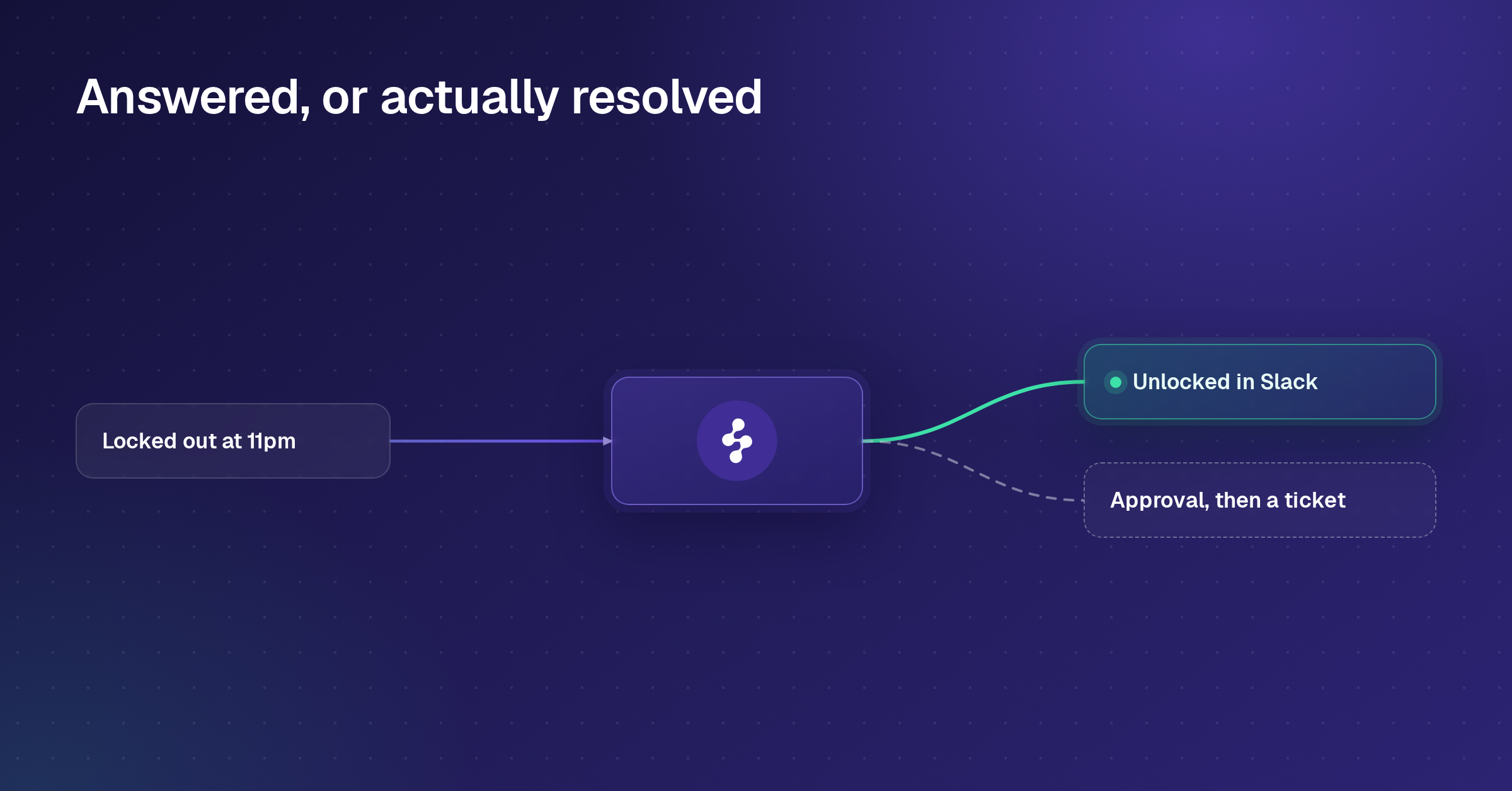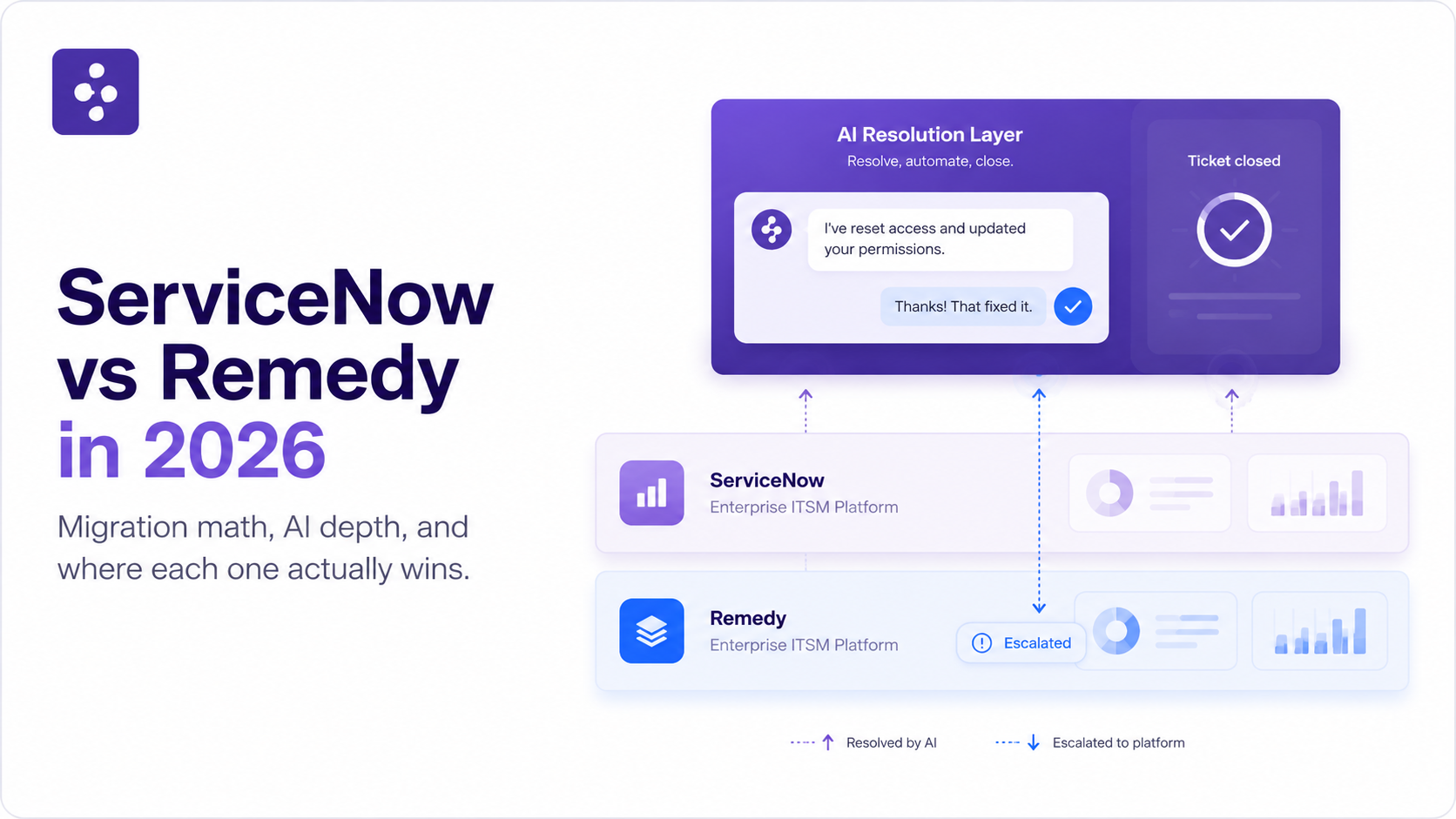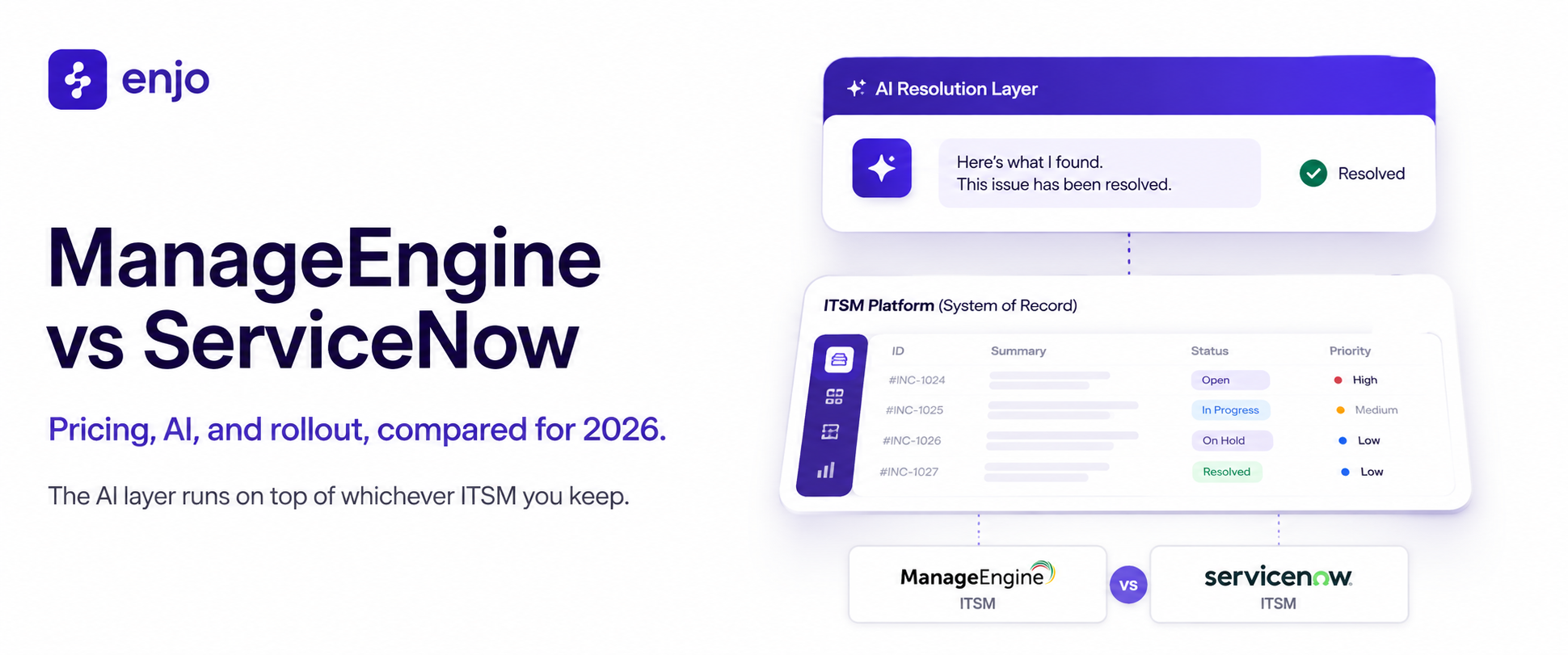
Transform complex support workflows
AI Service Desk: Features, Benefits and Real Costs (2026)
The line between an AI service desk and a chatbot is not answer quality. It is whether the system can act. A chatbot returns text. An AI service desk provisions the software, grants the access, resets the credential and updates the record, then hands a human the full conversation when it cannot finish the job. Enjo runs those as AI Actions against Okta, Entra ID, Google Workspace, Jira and ServiceNow, each one configured, authorized and written to the audit trail.
Most IT teams are past the question of whether to deploy one. Gartner expects over 40% of agentic AI projects to be canceled by the end of 2027 on escalating costs, unclear business value and inadequate risk controls, and estimates that roughly 130 of the thousands of vendors claiming agentic capability actually have it. Practitioners are sceptical for good reason, and the honest answer to "does this actually work" is a number from a real deployment rather than a vendor benchmark.
Three, from production. Aurora resolves 63% of requests autonomously at 2,500 employees. Delivery Hero runs 30% average deflection across more than 30 Jira service desks with over 95,000 people in Slack, and 80% faster response for both answering and ticket creation. Aptean resolves 300K+ cases a year with 37% handled fully by AI. Three different shapes of deployment, none of them a pilot.
Three numbers decide the purchase: what share of requests an agent resolves with no human involved, what a resolution costs, and which checks separate a real agent from a rebranded chatbot. Most explainers stop before all three.

What is an AI service desk?
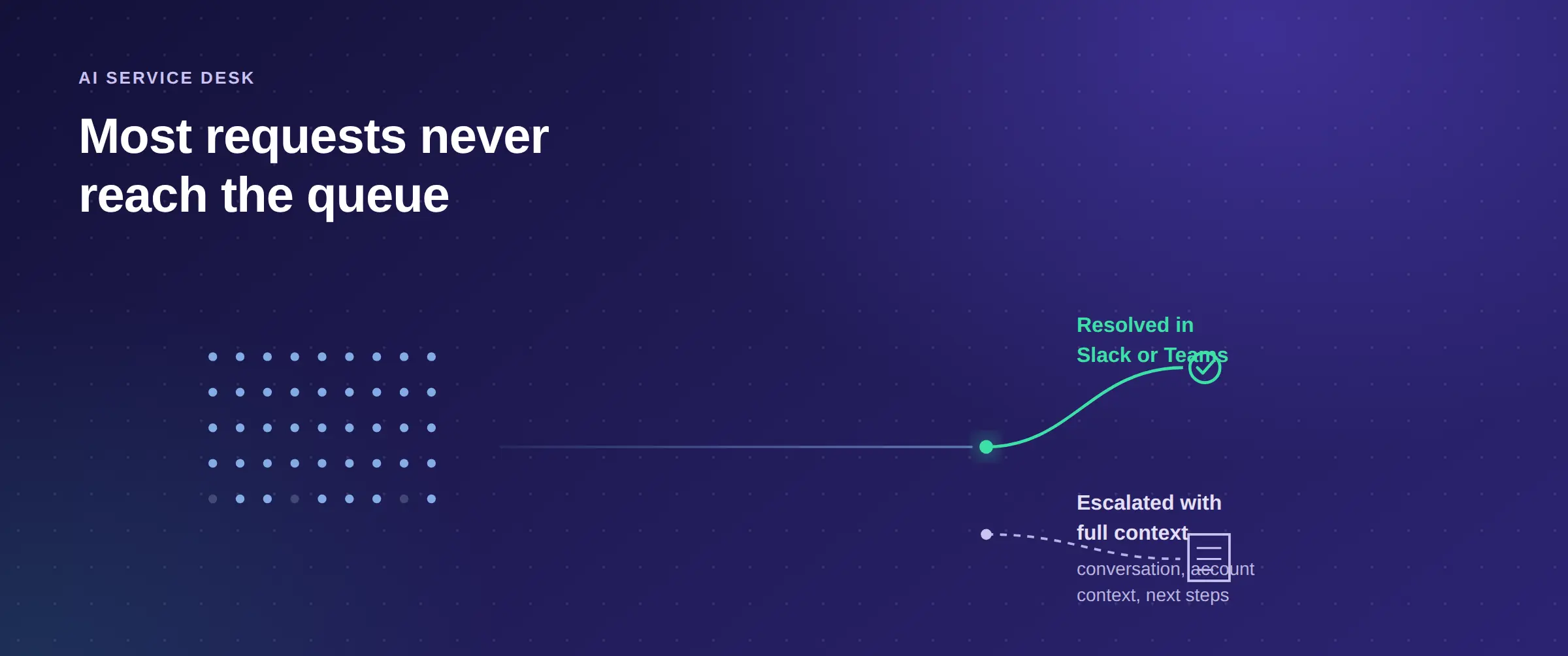
An AI service desk is a service desk where an AI agent resolves the first line of requests without a human, using your organization's own knowledge and authorized access to your systems. It differs from ticket automation in what it is allowed to finish. Ticket automation routes, tags and assigns work so a person can do it faster. An AI powered service desk completes the work itself when it can, and escalates with context when it cannot.
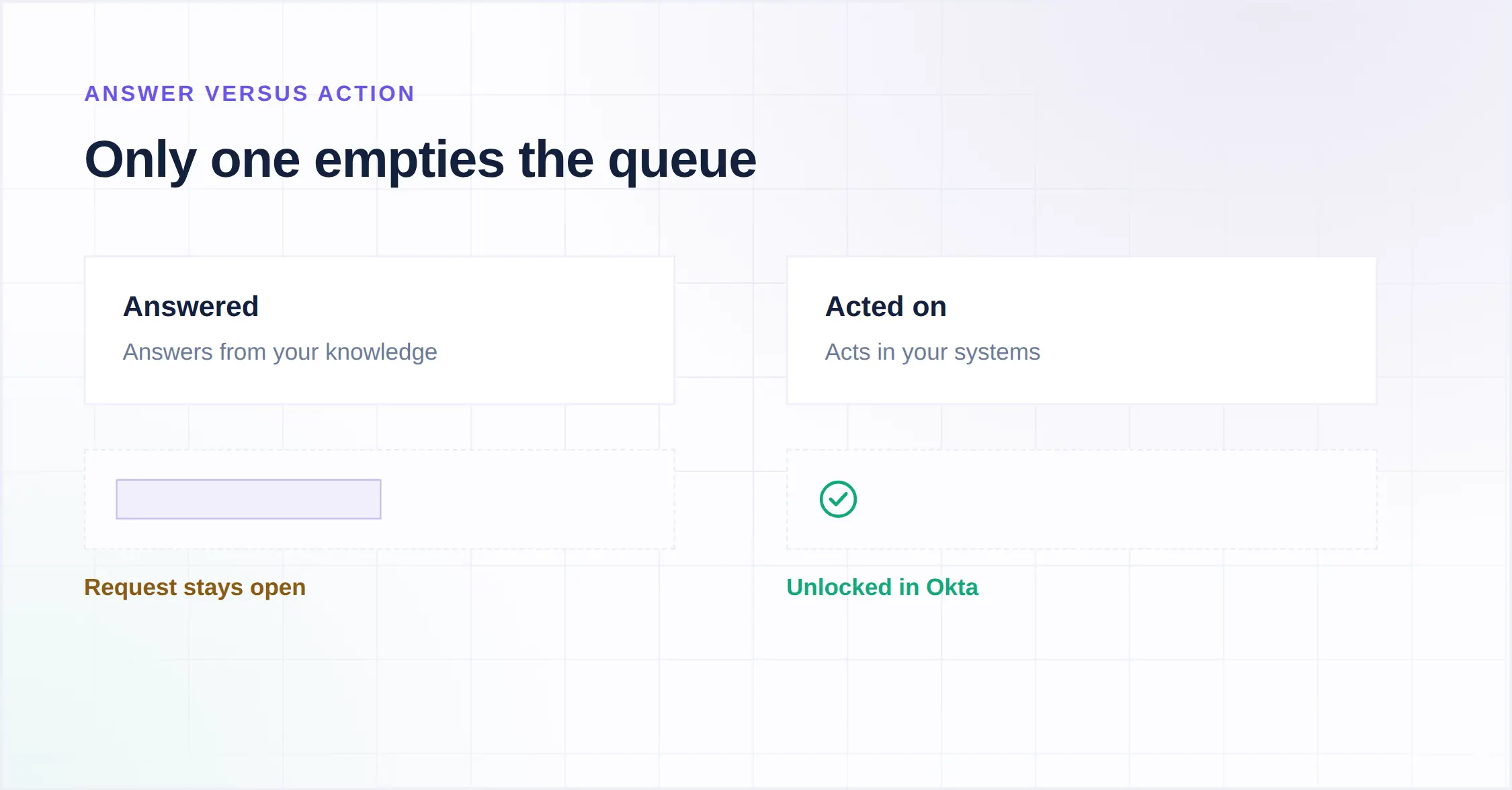
Vendors also market this as an intelligent service desk or a cognitive service desk. The mechanism is the same, and the distinction that matters operationally is between answering and acting. An agent that only answers deflects the questions your team is tired of repeating.
An agent that also acts resolves the requests that consume the most time: the access request that needs a group added in Okta, the password reset that needs an account unlocked, the approval that needs a status change in Jira. Both count as resolution. Only one of them removes the queue, which is why AI for service desk work is judged on write actions rather than answer quality.
Where service desk automation ends and an AI agent begins
Service desk automation and an AI service desk are not the same purchase, and the queries blur them constantly. Automation is rule-based: an automated service desk routes by keyword, applies SLAs, fires notifications and assigns work to the right queue. Every step is a rule somebody wrote, and it breaks when a request does not match one.
An AI agent decides. It reads the request in plain language, retrieves the answer from your knowledge, and takes the authorized action, without a rule for that specific case existing in advance. Most teams asking how to automate service desk work already have the rules layer and are hitting its ceiling: the tickets that still reach a person are the ones no rule anticipated.
The two stack rather than compete. Rules handle the deterministic paths. The agent handles everything else and escalates what it cannot finish. If you are still building out the rules layer, our guide to service desk automation covers the workflows worth automating first.
Compared with a traditional service desk
| Traditional Service Desk | With An AI Agent | |
|---|---|---|
| Intake | Portal form or email, converted to a ticket | Natural language in Slack, Microsoft Teams, website chat or the portal |
| Triage | Manual or rule-based routing | Intent recognition against the request and the requester's context |
| First response | Queue wait, then a human reads the ticket | Answer or action in the same conversation |
| Knowledge reach | Whatever the agent remembers or searches manually | One index across every connected source |
| Resolution path | Human resolves, or escalates up a tier | Agent resolves, or escalates with full context |
| After hours | Queued until the next shift | Same behavior at 03:00 as at 15:00 |
| Scaling | Add headcount as volume grows | Cost scales with resolved volume |
| Learning | Tribal, lost when people leave | Human responses feed back into the agent |
AI service desk vs AI help desk
The two terms are used interchangeably by most vendors, and the distinction is scope rather than technology. Help desk describes break-fix support, usually IT, usually reactive. Service desk is the broader ITIL-derived term covering incidents plus service requests: access, provisioning, onboarding, approvals, procurement.
An AI help desk that only answers questions covers the first. An agent that takes authorized action in connected systems covers both.
In practice, buyers searching either phrase want the same thing, which is fewer repetitive requests reaching a person. The useful question is not which label a vendor uses but which write actions it performs and who authorizes them.
How an AI service desk works
Six stages run on every request. The first four are common to any competent agent. The last two are where deployments separate.
Request intake across the channels people already use
Requests arrive where the requester already is: Slack, Microsoft Teams, website chat, or the Help Center portal. In employee support the overwhelming majority arrive through Slack and Teams, which is why a portal-only agent under-performs its demo.
Enjo runs a full feature set in Slack, including slash commands, emoji actions, approval flows and swarm rooms, and the same core resolution capabilities in Microsoft Teams. Slack Connect shared channels extend the same agent to external accounts. Channel coverage is the first thing to check against your own service desk automation plans.
Intent recognition and grounding in your knowledge
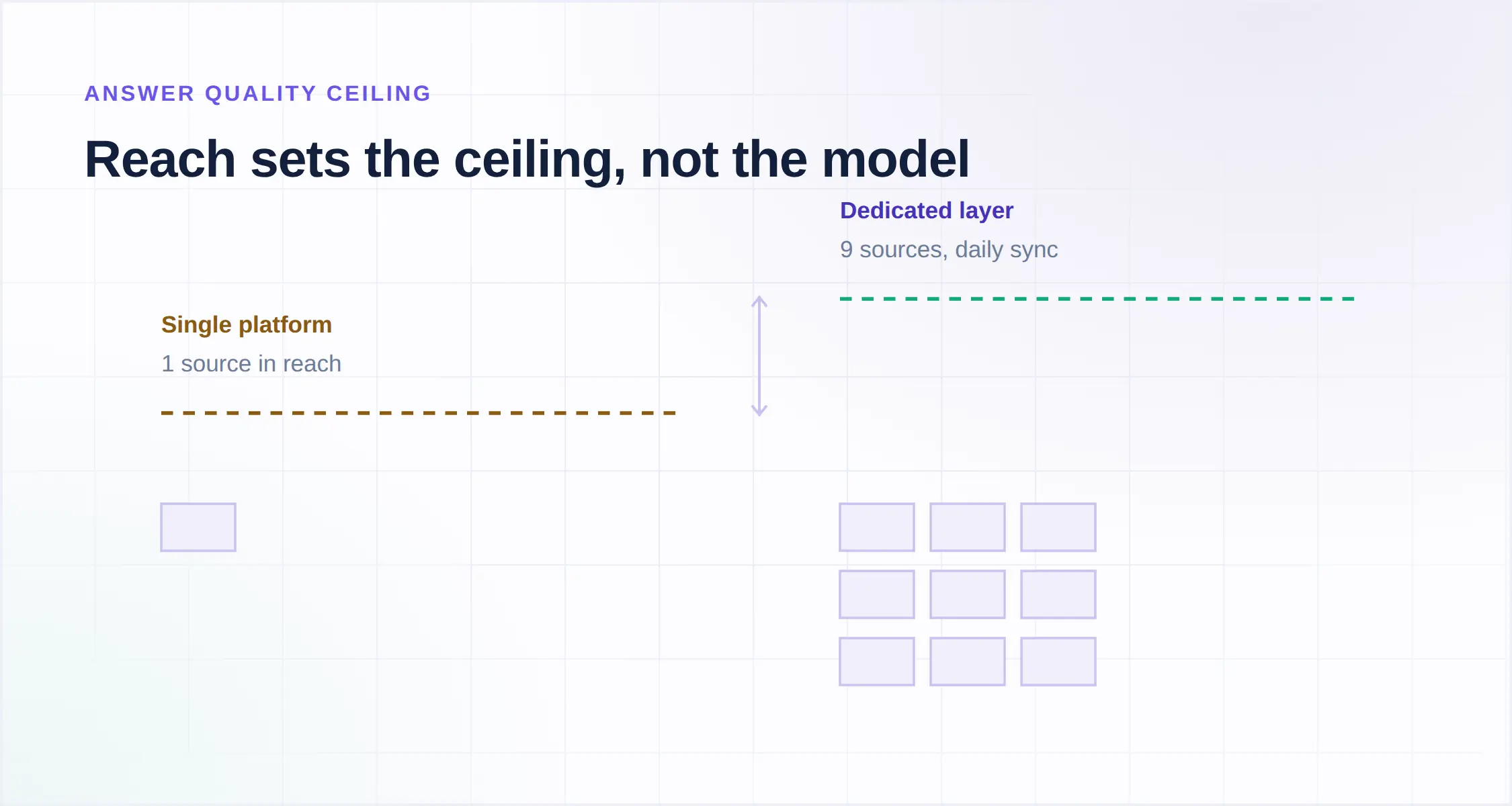
The agent classifies what the requester wants, then retrieves the answer from your content rather than from a general model. Grounding is what makes the answer usable: every response is grounded in your knowledge and carries a citation, so the requester and the reviewer can both see where it came from. Enjo indexes Confluence, Google Drive, SharePoint and OneDrive, Notion, Guru, web pages and uploaded files, plus past tickets in Jira and JSM, ServiceNow, Zendesk and Salesforce Service Cloud, on a daily sync.
The reach of that index caps answer quality. An agent can only be as good as the systems it can read, which is why the knowledge question decides more evaluations than the model question.
Autonomous resolution and action in connected systems
Informational requests end here. Transactional requests need the agent to do something in a system of record. Enjo's AI Actions perform ticket creation, lookup, updates and approvals in Jira and JSM, ticket creation, lookup and updates in ServiceNow, case and record lookup and updates in Salesforce, account unlock, access provisioning and group management in Okta, identity lookup and access provisioning in Azure AD and Entra ID, and account and group management in Google Workspace. AI Actions, sequenced by AI Flows when a request needs more than one step, also cover systems outside that list through custom API and webhook actions.
Every action is explicitly configured, authorized, bounded by guardrails and recorded in the audit trail. That combination is what makes a write action safe enough to leave unattended, and it is the part a prototype skips.
Escalation into the helpdesk your team already works in
When the agent cannot finish, the human picking it up receives the full conversation, the account context and suggested next steps, in the queue they already work. Escalation targets include Jira Service Management, ServiceNow, Zendesk, Salesforce Service Cloud and Freshservice. Agent Assist then supports that human inside the JSM, ServiceNow and Zendesk agent views and the Salesforce case view, with case summaries, reply suggestions drawn from prior resolutions, and sentiment detection.
Continuous learning from how your team responds
The agent improves through a mechanism, not a promise. When a human resolves an escalated request, that resolution becomes training signal. Resolved conversations auto-draft Help Center articles for review, unanswered portal questions escalate to the team rather than disappearing, and Training applies examples and feedback signals to the agent. Bulk Testing validates response accuracy, consistency and coverage at scale before any of it reaches production.
Guardrails, citations and the audit trail
Guardrails apply compliance controls to inputs and outputs, with a workspace baseline that per-agent rules can tighten, covering content filters and denied topics, patterns and words. The Audit Log holds a searchable activity history. RBAC sets granular roles and permissions across modules, data and actions. These three are what a CISO reviews, and they are the reason an agent gets write access at all.
Benefits of an AI service desk
Faster resolution in the channel people already use
Employees ask in Slack, Microsoft Teams or the Help Center portal and get the answer or the action in the same thread, without filing a form. Delivery Hero reports 80% faster response across more than 30 Jira service desks, and Aurora 45% faster resolution.
Support that does not stop after hours
The agent behaves the same at 03:00 as at 15:00. Requests it can finish resolve on the spot, and the rest reach the morning shift with the full conversation already attached.
Repetitive volume off the human queue
Password resets, access requests and policy questions resolve without an agent, so the team works the requests that need judgment. Aptean resolves 37% of cases fully by AI, volume equivalent to 120 agents handled by AI. When a request does need a person, it arrives with the full conversation, account context and suggested next steps.
Self-service employees actually use
Answers arrive in chat with a citation, so employees stop routing around the desk. At Kraken, 80% of employees now self-serve HR queries and 70% of the HR team's time was freed from repetitive tasks.
Higher employee satisfaction
Aurora reports a 60% ESAT improvement alongside 63% autonomous resolution, and Delivery Hero a 25% increase in employee satisfaction.
Cost that tracks volume, not seats
Enjo bills per AI reply with unlimited human agent seats. The Standard plan is $295 a month for 3,000 replies, so adding people to the queue does not change the bill.
Deflection you can measure
Agent Insights reports automation coverage, outcomes and gaps, and Executive Insights reports time saved and cost savings with the drivers behind them.
What an intelligent service desk resolves, and what it does not
The honest version of this category is that resolution rate depends on request mix more than on model quality. Requests fall into three groups.
| Request Type | Outcome |
|---|---|
| Password reset, account unlock | Resolves autonomously with an authorized action |
| Access or group membership request | Resolves with an authorized action, approval flow where policy requires |
| Software provisioning | Resolves with an authorized action |
| Policy or how-to question | Resolves autonomously from the knowledge index |
| Ticket status or case lookup | Resolves autonomously with a read action |
| Onboarding and offboarding steps | Resolves the sequence, escalates the exceptions |
| Approval routing | Resolves through in-chat approval flows |
| Hardware fault | Escalates with full context |
| Multi-system incident | Escalates with full context |
Four categories sit outside what any agent resolves on its own. Requests needing physical action, such as a replacement laptop, need a person. Requests with no policy behind them cannot be answered correctly by anything, human or agent, until the policy exists.
Judgment calls involving an exception to a rule belong with someone accountable for the exception. And a request that depends on a system the agent cannot reach will escalate every time, which is why the integration question is an accuracy question rather than a convenience one.
That last boundary moves. Custom API and webhook actions cover systems outside the named vendor list, and Troopr AI Build delivers custom integrations with a typical time to production of 2 to 6 weeks. Enjo is an AI layer, not a ticketing platform. It does not replace the helpdesk as the system of record, which is the point rather than a limit.
AI powered service desk use cases across IT, HR and support
An intelligent service desk covers several request populations with one agent, because the mechanism is identical and only the knowledge and the actions change.
IT incidents and troubleshooting. VPN failures, application errors and connectivity issues resolve from documented runbooks, with the agent escalating into JSM or ServiceNow when the symptom does not match a known pattern.
Access and permissions. Group membership, application access and account unlocks resolve through Okta, Entra ID or Google Workspace actions, with approval flows where policy requires a second pair of eyes.
Provisioning and software requests. License assignment and tool access resolve as a sequence of authorized actions rather than a ticket that waits for someone to click through three admin consoles.
Onboarding and offboarding. The agent runs the checklist, creates the accounts, files the tasks and flags the exceptions. Kraken automated its approval workflows this way and saved 450 hours a month, with response times moving from 2 to 3 days down to minutes.
HR policy and approvals. Leave balances, expense policy and benefits questions resolve from the policy library. At Kraken, 80% of employees now self-serve HR queries and 70% of the HR team's time was freed from repetitive tasks.
Security and compliance requests. Access reviews, policy attestations and evidence requests resolve against current documentation, with every interaction recorded in the audit trail.
Customer support. In website chat, the Help Center portal and Slack Connect shared channels, the same agent resolves requester questions and creates cases in the incumbent helpdesk when a human is needed.
Why most service desk AI stalls
Gartner's cancellation forecast names three causes: escalating costs, unclear business value, and inadequate risk controls. All three are architectural rather than accidental, and two of them are visible before you sign anything.
The market makes this harder. Gartner uses the term "agent washing" for the practice of rebranding assistants, robotic process automation and chatbots as agentic, and estimates that only around 130 of thousands of vendors offer genuinely agentic capability. A demo that answers questions is not evidence of an agent that resolves requests, which is the same failure pattern we cover in AI ITSM. An intelligent service desk that cannot reach your knowledge or act in your systems will stall at exactly the point the business case depended on it.
What built-in helpdesk AI is built for
Native helpdesk AI is designed to work inside one platform. ServiceNow's Now Assist operates inside ServiceNow workflows, with Otto sitting above them as the conversational front door; the knowledge, runtime and licensing are ServiceNow's. Zendesk AI reads the Zendesk knowledge base and acts on Zendesk objects, included in suite billing.
Freshworks sells Freddy AI Copilot as a per-agent add-on on top of a Freshservice subscription. Each is built as a platform extension, and that scope is the design intent rather than an oversight.
The boundary that scope creates is a knowledge boundary and an action boundary. If the answer lives in Confluence and the action happens in Okta, a single-platform agent reaches neither. That is a question about where your knowledge sits, not a question about which vendor is better, and you can answer it in an afternoon by checking your last twenty resolutions. Most evaluations of AI for service desk teams turn on that single count.
What a dedicated AI layer changes
A dedicated layer indexes across systems and acts across systems, and the knowledge, flows and training stay portable if the helpdesk vendor ever changes. The incumbent desk stays the system of record. The agent resolves in front of it and escalates into it.
| Built-In Helpdesk AI | Dedicated AI Layer | |
|---|---|---|
| Where it runs | Inside one helpdesk platform | In Slack, Teams, chat and the portal, escalating into the helpdesk |
| Knowledge reach | That platform's knowledge base | Every connected source, including past tickets across helpdesks |
| Action reach | That platform's objects | Ticketing, identity and custom systems via API and webhook |
| Pricing shape | Per agent seat, or bundled in suite billing | Per resolved volume |
| System of record | The helpdesk | The helpdesk, unchanged |
| Portability | Tied to the platform | Knowledge, flows and training travel |
How Enjo resolves requests inside your service desk
Enjo deploys into the helpdesk you already run, with vendor routes through Enjo for Salesforce, Enjo for Zendesk, Enjo for Jira and Enjo for ServiceNow. Nothing migrates.
One knowledge index across your sources
A single index grounds the agent, the human agent workflow and self-service, so what the agent says matches what your team sees and what requesters find. Aptean indexed 5M+ documents across Salesforce case feeds, knowledge bases and SharePoint, and reports 83% faster access to knowledge inside and outside Salesforce.
AI Actions in the systems where the work happens
The AI Actions catalog is the evidence for end-to-end resolution: ticket creation, lookup, updates and approvals in Jira and JSM, ticket operations in ServiceNow, case and record operations in Salesforce, account unlock and access provisioning in Okta, identity operations in Entra ID, and account and group management in Google Workspace. AI Flows orchestrates the multi-step sequences with explicit fallbacks when the agent is not confident.
Escalation your team can pick up without re-reading
The human receives the full conversation, the account context and suggested next steps, filed into JSM, ServiceNow, Zendesk, Salesforce Service Cloud or Freshservice. Agent Assist then works inside that agent view with case summaries, reply suggestions from prior resolutions, ticket autofill and one-click translation.
Guardrails, Audit Log and RBAC
Guardrails enforce accuracy and policy on inputs and outputs and are testable before rollout. The Audit Log gives investigators a searchable history. RBAC scopes who can do what across modules, data and actions. Enjo carries SOC 2 Type II, ISO 27001 and GDPR compliance, with TLS 1.2+ in transit and AES-256 at rest.
Insights that measure the deflection
Agent Insights reports automation coverage, agent involvement, outcomes and gaps. Executive Insights reports time saved and cost savings with the drivers behind them. This is the section that answers Gartner's "unclear business value" cause directly, because the number exists in the product rather than in a slide.
Deflection rates from three production deployments
Published deflection figures are usually vendor benchmarks with no company behind them. These are three named deployments with different request mixes, which is why the numbers differ.
| Deployment | Shape | Stack | Result |
|---|---|---|---|
| Aurora | Autonomous vehicle company, 2,500 employees | Not published | 63% autonomous resolution, 45% faster resolution, 60% ESAT improvement |
| Aptean | Enterprise ERP provider, 3,500+ employees, 600+ support reps | Salesforce, SharePoint, Teams | 37% of cases resolved fully by AI, 300K+ cases a year, volume equivalent to 120 agents handled by AI |
| Delivery Hero | Global delivery platform, 95,000+ in Slack, 70+ countries | Jira and JSM, Confluence, Slack | 30% average deflection, 25% increase in employee satisfaction, 80% faster response |
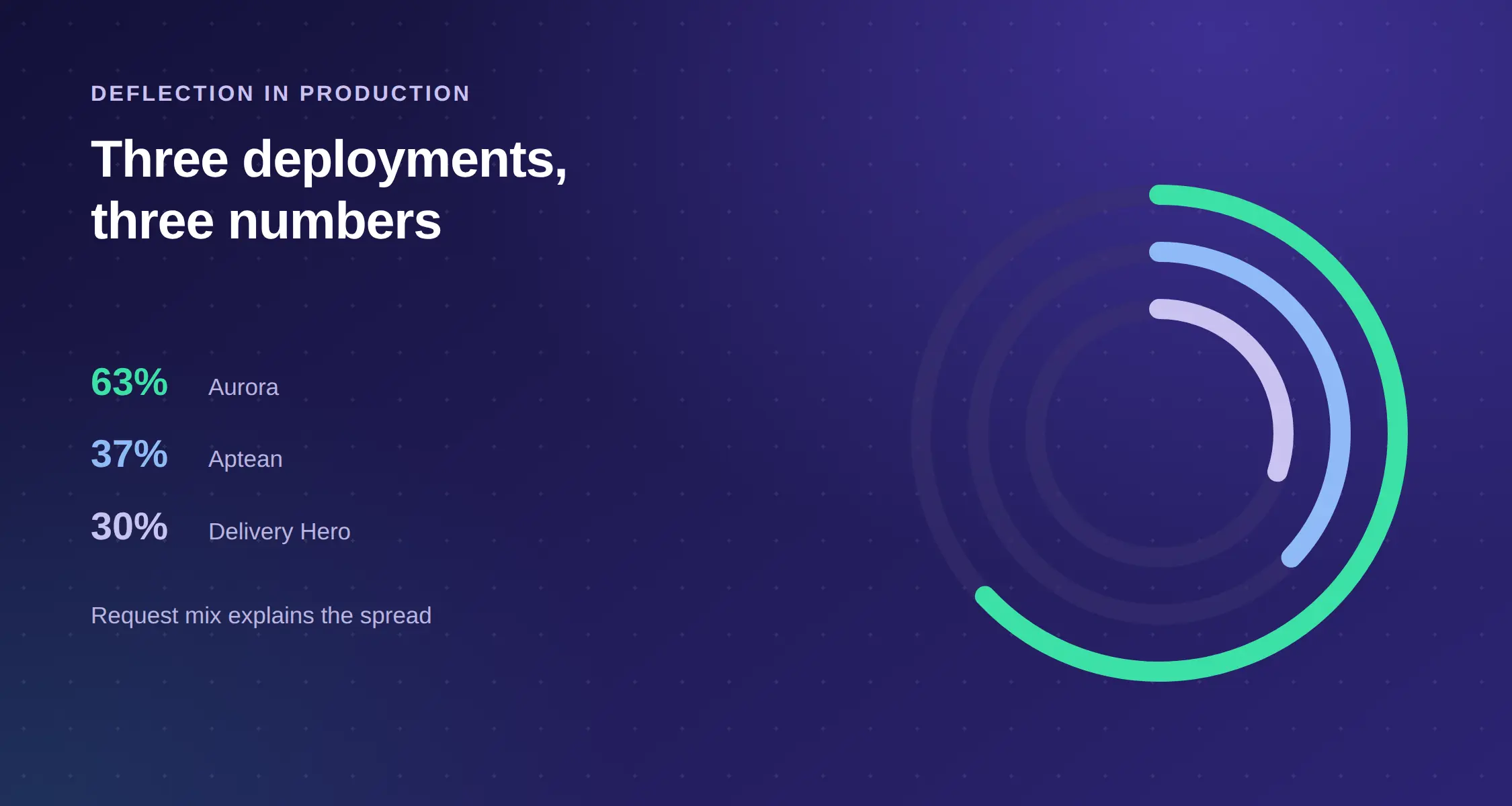
Three things explain the spread. Request mix comes first: Aurora's IT population is dense with repeatable requests, while Aptean handles technical inquiries across 80+ complex ERP products, where a larger share genuinely needs a specialist. Knowledge maturity comes second, and it is the variable you control; Aptean's figure rests on 5M+ documents unified from sources that were previously siloed. Action coverage comes third, since every request type the agent cannot act on is a request it can only answer.
Scale is not the variable. Aptean deployed its initial cohort in a single day at 3,500+ employees, Rakuten runs Enjo across 30,000+ employees, and Delivery Hero across more than 30 Jira service desks. Amber Group went from POC to full production in 5 weeks with zero missed requests from day one.
What AI service desk software costs?
Three bill shapes exist in this category, and they behave differently as automation starts working.
| Model | How It Is Charged | What Happens As Volume Grows |
|---|---|---|
| Per agent seat | A monthly fee per human agent, with AI often a separate add-on | Cost tracks headcount, and the AI add-on multiplies across every seat |
| Per resolution | A fee each time the AI resolves a request | Cost rises exactly as automation succeeds |
| Per AI reply | A fee per response the agent sends | Cost tracks resolved volume, forecastable from a reply count |
Published figures, fetched from each vendor's own pricing site in September 2026. Zendesk lists its Employee Service Suite at $29 per agent per month billed yearly for Suite Team, $59 for Suite Growth and $99 for Suite Professional, and its Customer Service Suite at $55 for Suite Team and $115 for Suite Professional, with the Copilot add-on at $50 per agent per month on Professional and above; its AI agents bill on Automated Resolutions.
Freshservice lists Starter at $19 per agent per month billed annually, Growth at $49 and Pro at $99, with Freddy AI Copilot at $29 per agent per month, and Freddy AI Agent Classic included only on Enterprise at 1,200 sessions per license per year. Fin publishes $0.99 per outcome with a 50 outcome monthly minimum, plus $29 per helpdesk seat per month when bundled with Intercom plans, and publishes an average resolution rate of 76% for Fin, with many companies reported higher.
Agentforce IT Service, Salesforce's own IT service desk, publishes per-user pricing: $75 per fulfiller per month on Enterprise Edition and $150 on Unlimited Edition, plus $15 per user per month for the AI Agents for Employees license that requesters use, with advanced AI drawing on consumption-based Flex Credits (checked on salesforce.com in October 2026). A desk with 10 fulfillers serving 500 employees on Enterprise Edition starts at $8,250 a month before credits.
Enjo prices per AI reply. The Standard plan is $295 a month for 3,000 AI replies, which is $0.098 per reply, with additional replies at $0.05. Starter is $95 a month for 1,000 replies.
The Free plan includes 200 AI replies a month with no credit card. Human agent seats are unlimited on published plans, so adding people to the team does not change the bill.
Run the math on your own volume before comparing headline prices. Our full model, with the variables that move it, is in the AI service desk ROI breakdown.
How to evaluate AI for service desk work?
Gartner's three cancellation causes map to three questions: what will this cost at the volume we expect, what number proves it worked, and what stops it doing something it should not. Most AI service desk software publishes a resolution rate; far less of it publishes a write-action catalog. Run these checks on your own systems rather than in a vendor demo, on whatever you shortlist.
| # | Check | What To Ask For |
|---|---|---|
| 1 | Knowledge reach | The list of sources it indexes, and the sync frequency for each |
| 2 | Write actions | The catalog of write actions, not read actions. Reading a ticket is not resolving a request |
| 3 | Authorization | Who approves an action, how it is bounded, and where it is recorded |
| 4 | Channel fit | Whether it runs where requests actually arrive, which for employee support is Slack and Teams |
| 5 | Identity and access | Support for your IdP, and whether it can provision access rather than only look it up |
| 6 | Model flexibility | Whether the model is fixed, and what changes if you need a different one |
| 7 | Grounding | Whether every answer carries a citation you can open |
| 8 | Guardrails and audit | Whether policy controls are testable before rollout and every action is logged |
| 9 | Escalation quality | Ask to see one escalation land in your queue, carrying the conversation, the context and next steps |
| 10 | Price behavior | What the bill looks like at 2x and 5x your current resolved volume |
Ask for the escalation demo on your own helpdesk. It is the check vendors are least prepared for, because it exposes both the integration depth and what the agent actually captures. Enjo answers all ten on the stack you already run: the source list and daily sync schedule are published, the write-action catalog is enumerated by system, actions are configured, authorized, guardrailed and logged, and escalations land in JSM, ServiceNow, Zendesk, Salesforce Service Cloud or Freshservice with the full conversation attached.
Comparing named products rather than criteria is a different job, and it is covered in our best help desk software comparison.
See what it resolves
Desk Assessment analyzes your ticket history and quantifies the automation opportunity before you commit to anything. Bring your own queue and your own request mix.
Frequently Asked Questions
How much does an AI service desk reduce ticket volume for IT teams?
Published deployments range from 30% to 63%. Delivery Hero reports 30% average deflection across more than 30 Jira service desks, Aptean resolves 37% of cases fully by AI, and Aurora reports 63% autonomous resolution. The spread is driven by request mix, knowledge maturity and how many request types the agent is authorized to act on.
How do AI service desks reduce costs?
By moving repetitive volume off the human queue so the team works the exceptions, and by changing the bill shape from per seat to per resolved volume. Enjo's Standard plan is $295 a month for 3,000 AI replies, which is $0.098 per reply, with unlimited human agent seats on published plans.
Which AI service desk platforms handle tier-1 IT support autonomously?
Look for a published write-action catalog rather than a resolution-rate claim. Tier-1 autonomy requires the agent to unlock accounts, provision access, manage groups and update tickets, not only to answer questions. Enjo performs these in Okta, Entra ID, Google Workspace, Jira and JSM, ServiceNow and Salesforce, with custom API and webhook actions for other systems.
Which AI service desk integrates with Microsoft Teams and Slack?
Enjo runs a full feature set in Slack, including slash commands, emoji actions, approval flows and swarm rooms, and the same core resolution capabilities in Microsoft Teams. Slack Connect shared channels extend the same agent to external accounts. For employee support this matters more than portal support, because nearly all requests arrive in chat.
How does an AI service desk handle multi-step employee requests?
Through orchestration with explicit fallbacks. AI Flows runs the sequence, calls each action in order, and hands off to a human at the step it cannot complete rather than failing the whole request. Kraken automated approval workflows this way and saved 450 hours a month.
How fast can an AI powered service desk go live?
Aptean had its initial cohort live in a single day, and Amber Group went from POC to full production in 5 weeks with zero missed requests from day one. Deployment time tracks how ready your knowledge sources are and how many actions you authorize at launch, not the size of the organization.
Is it safe to give an AI agent write access?
It depends on the controls, which is one of Gartner's three named causes of agentic AI project cancellation. Every Enjo action is explicitly configured, authorized, bounded by Guardrails and recorded in the Audit Log, with RBAC scoping who can do what and Guardrails testable before rollout.
Can an AI agent work without replacing our helpdesk?
Yes. Enjo deploys into an incumbent helpdesk with vendor routes for Salesforce, Zendesk, Jira and ServiceNow. The helpdesk stays the system of record, the agent resolves in front of it, and escalations file into the queues your team already works.
What does AI service desk software cost per resolution?
It depends on the bill shape. Per-resolution vendors publish a rate per outcome, per-seat vendors charge by agent with AI as an add-on, and Enjo charges per AI reply at $0.098 on the Standard plan or $0.05 for additional replies. Model each at 2x and 5x your current volume, because the three diverge sharply as automation starts working.