ServiceNow vs Remedy in 2026: The Honest Comparison
The ServiceNow vs Remedy question usually arrives one of two ways. Either someone upstairs asks why the team still runs a Remedy ticketing system older than Google, or a ServiceNow partner pitches a migration with a number that makes procurement flinch. Both moments send you looking for a straight answer.
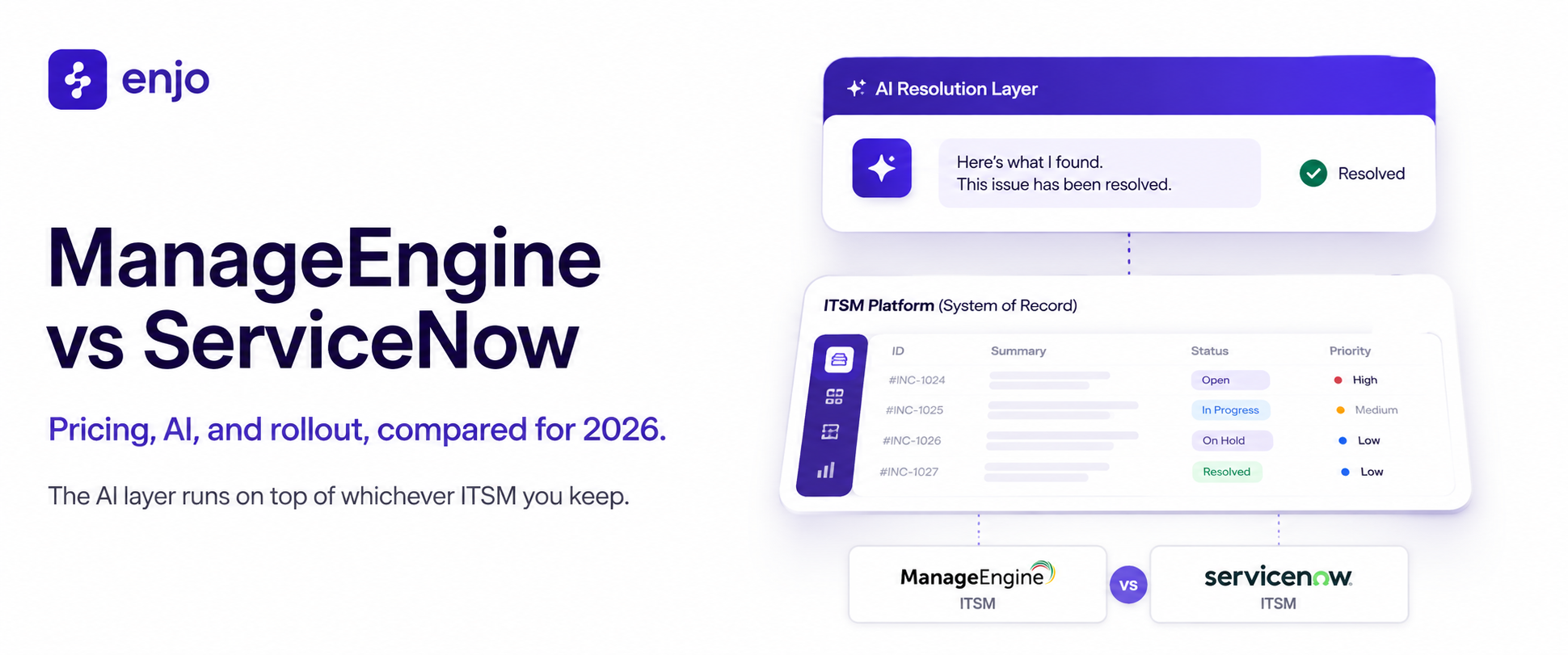
Most comparisons treat this as a fair fight between two living products, which stopped being true a while ago: BMC has spent years moving Remedy customers to BMC Helix ITSM, and the support clocks on the old versions are running out. So this guide starts from what is true in 2026, not from a recycled 2021 feature grid. ServiceNow vs Remedy, compared honestly: migration math, AI depth, where each wins, and the third decision most ITSM comparisons skip.
ServiceNow vs Remedy: The Verdict Up Front
Pick ServiceNow if you are consolidating enterprise workflows onto one platform of record and you have the budget, the admins, and a year to spend. Stick with BMC Helix ITSM if you are in a regulated or on-prem environment where deployment control beats everything else. And if the real reason this comparison landed on your desk is that leadership wants AI resolution and employees hate the portal, know that neither migration fixes that quickly: resolution is a layer decision, and it moves at a different speed. Amber Group, a $3B crypto finance firm, took Enjo from POC to production in five weeks; an ITSM replatform takes quarters.
If that third case sounds like your case, book a demo and see AI resolution running on your existing stack before the migration RFP is even scoped.
What Happened to BMC Remedy?
Remedy shipped in 1990. It predates Google, the ITIL books most teams still argue about, and a good share of the people now filing tickets in it. BMC bought it in 2002, ran it as the on-prem enterprise standard for two decades, then modernized it into BMC Helix ITSM, the cloud and container successor it sells today.
Here is the part the ranking comparisons skip. The classic on-prem Remedy platform hit its targeted end of life around April 2024, and older Remedy AR System versions already reached end of support in early 2025. Even BMC Helix ITSM OnPrem 25.3.01 has full support ending September 3, 2026, with end of support in March 2027. If you are reading this on a Remedy instance, your clock is not hypothetical; it has a date on it.
So the honest framing of BMC Remedy vs ServiceNow in 2026 is really ServiceNow vs BMC Helix ITSM, with one extra wrinkle. For a legacy Remedy shop, both answers are a migration. There is no "do nothing" door.
What Does ServiceNow Do Well, and What Does It Cost?
ServiceNow is the market's reference platform. It is cloud-native, launched in 2004, and has grown far past IT into HR, customer service, security, and finance workflows on a single data model. The CMDB is the industry standard everyone else gets compared to. The partner ecosystem and admin talent pool are enormous, which matters more than any feature the day you need to hire.
The AI story is loud and getting louder. Now Assist ships native generative AI across the platform, and ServiceNow completed its acquisition of Moveworks on December 15, 2025, folding the best-known enterprise AI assistant into its own roadmap. On G2, ServiceNow ITSM holds 4.5/5 and took the #1 spot for IT Management in G2's 2026 Best Software Awards. We wrote a full breakdown of the native option in our ServiceNow AI agents buyer's guide.
Now the bill. Implementations are partner-led projects measured in quarters, admin headcount becomes a permanent line item, and the AI features live behind Pro and Enterprise tier uplifts that reprice the whole contract. G2 reviewers reach for the words "expensive" and "complex" with striking regularity. Nobody buys ServiceNow small.
What Does ServiceNow Do Well, and What Does It Cost?
ServiceNow is the market's reference platform. It is cloud-native, launched in 2004, and has grown far past IT into HR, customer service, security, and finance workflows on a single data model. The CMDB is the industry standard everyone else gets compared to. The partner ecosystem and admin talent pool are enormous, which matters more than any feature the day you need to hire.
The AI story is loud and getting louder. Now Assist ships native generative AI across the platform, and ServiceNow completed its acquisition of Moveworks on December 15, 2025, folding the best-known enterprise AI assistant into its own roadmap. On G2, ServiceNow ITSM holds 4.5/5 and took the #1 spot for IT Management in G2's 2026 Best Software Awards. We wrote a full breakdown of the native option in our ServiceNow AI agents buyer's guide.
Now the bill. Implementations are partner-led projects measured in quarters, admin headcount becomes a permanent line item, and the AI features live behind Pro and Enterprise tier uplifts that reprice the whole contract. G2 reviewers reach for the words "expensive" and "complex" with striking regularity. Nobody buys ServiceNow small.
ServiceNow vs Remedy Comparison Table
Here is how BMC Remedy vs ServiceNow actually shakes out once you strip away the vendor decks.
Read that middle column twice. On the two rows buyers care about most, timeline and price, the platforms are identical: quarters, and call sales.
How Much Do ServiceNow and BMC Helix ITSM Cost?
Every BMC Remedy vs ServiceNow pricing thread ends the same way, with someone saying "call sales." Neither vendor publishes a price, so here is the shape of each bill instead.
ServiceNow quotes per fulfiller, meaning the agents working tickets. Third-party estimates place ITSM Pro and Enterprise between $100 and $200 per fulfiller per month; treat that range as unconfirmed and get your own number in writing at servicenow.com. Now Assist is sold as an uplift on top of those tiers, so the AI you actually came for reprices the deal.
BMC tells the same story with different vocabulary. Helix ITSM pricing runs through sales, structured around fixed, floating, and read-only license types, and both G2 and Capterra list it as contact-vendor with no entry price.
Whichever quote you chase, model the three-year total including the implementation partner, because on enterprise ITSM projects the services line often rivals the license line. Then ask each vendor what AI costs at your ticket volume. That answer moves the math more than the sticker does.
Where ServiceNow Wins Against Remedy
You are consolidating the enterprise on one platform. If the plan is IT, HR, customer service, and security operations on a single data model with one reporting layer, nothing else has ServiceNow's breadth. This is the exact play it was built for.
You need to hire and integrate at scale. The admin market, partner bench, and app marketplace around ServiceNow dwarf every competitor. Talent scarcity kills more ITSM deployments than software does.
You want the biggest AI roadmap in the category. Between Now Assist and the Moveworks acquisition, ServiceNow is spending more on ITSM AI than anyone else. If you are committed to the platform long-term, that gravity works in your favor.
Where BMC Remedy Wins Against ServiceNow
Deployment control is non-negotiable. Regulated industries, government, and data-residency-bound organizations can run Helix on-prem or hybrid. ServiceNow's answer for those environments is thinner.
Process rigor beats speed. If every change in your org passes a review board and an audit trail is a legal requirement, Helix is molded to how you already operate.
A rip-and-replace is your biggest risk. When Remedy is wired into decades of custom integrations, and the platform still works, moving to Helix inside the BMC family can carry less risk than jumping vendors entirely.
The AI Gap Both Platforms Leave Open
Be honest about why this evaluation started. It probably was not a sudden yearning for a new change-management module. Teams reopen the ITSM decision because tickets take days, employees hate the portal, and leadership saw an AI demo somewhere and asked why yours can't do that.
Both vendors answer that pain the same way: buy more platform. ServiceNow puts its real AI behind a tier uplift on an already premium contract. BMC's path runs through a Helix migration before the AI conversation even starts. Either way, the employee who just wants a password reset in Slack waits four quarters for a platform project to land.
There is a third option the comparison pages never mention, and it changes the decision math.
AI Resolution Without the Platform Migration
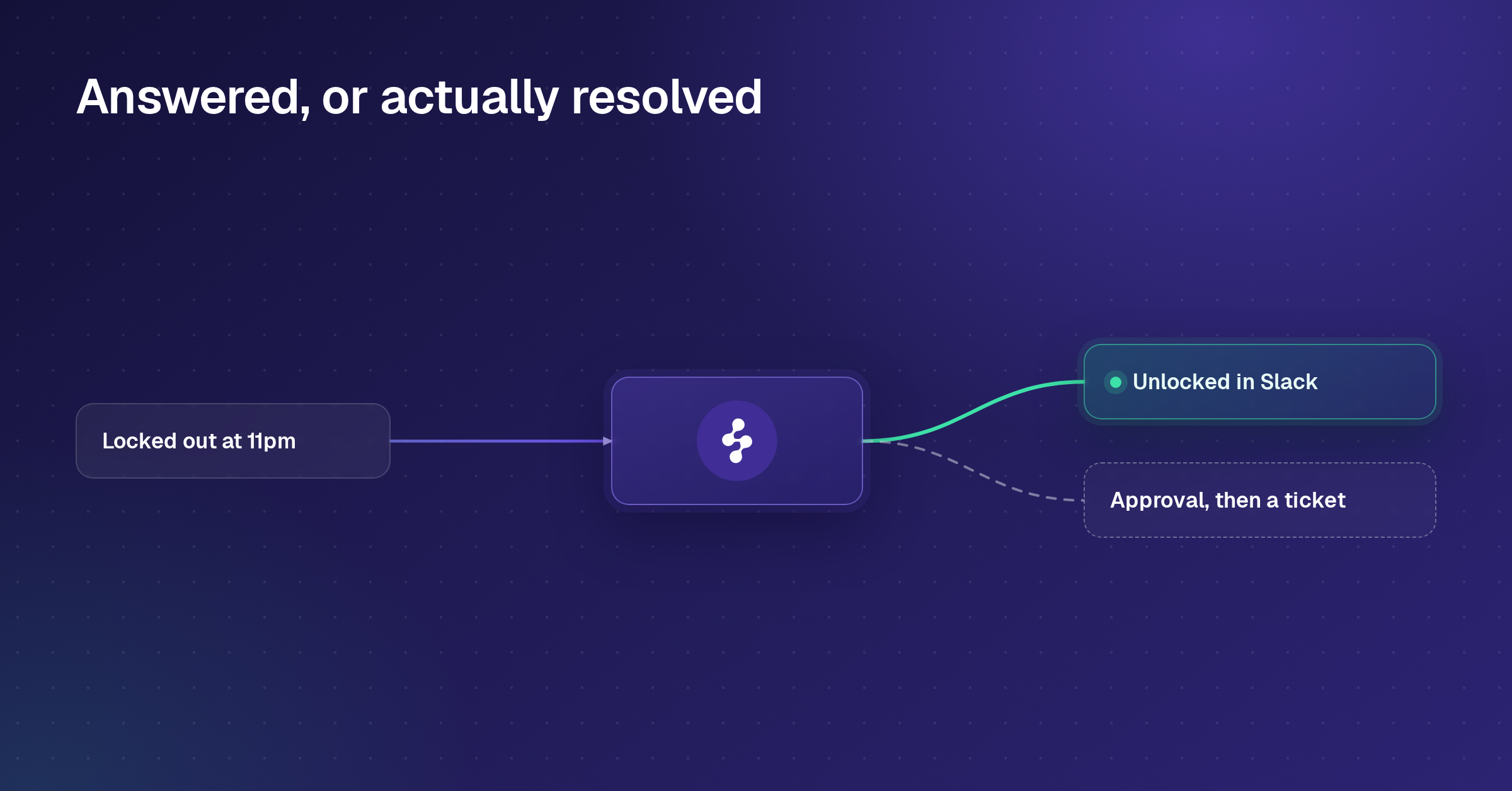
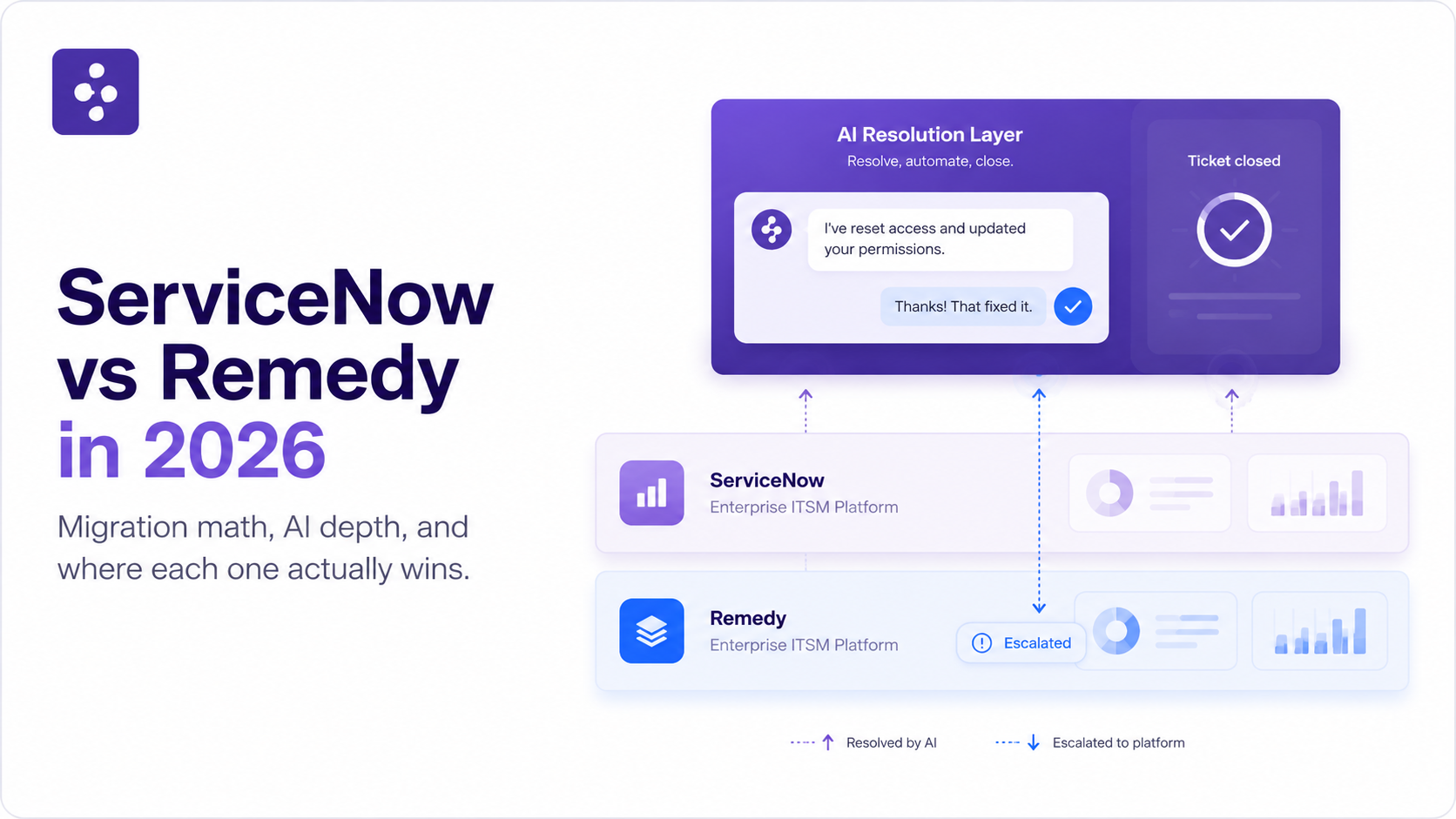
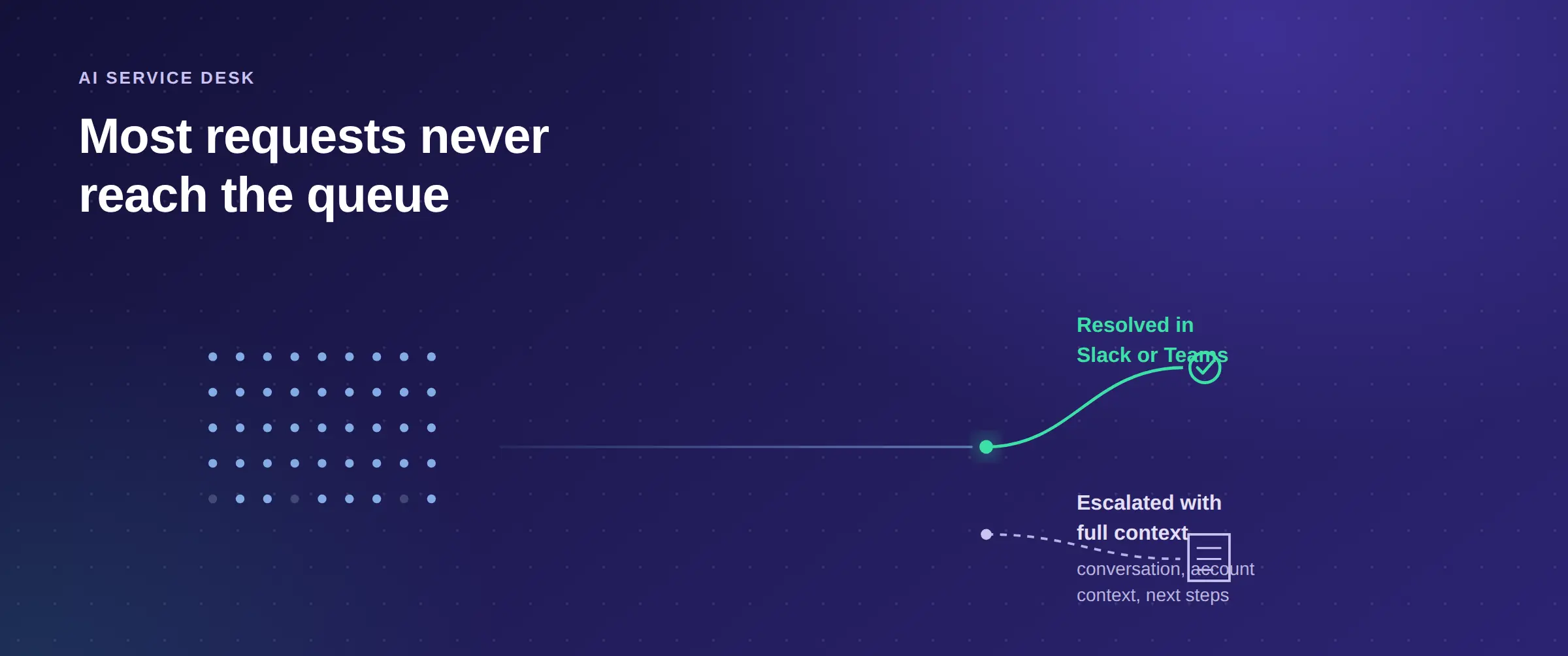
Enjo is an AI resolution layer that runs on top of your ITSM instead of replacing it. Its AI Agents resolve requests directly in Slack and Microsoft Teams: password resets, access requests, software provisioning, the whole top of the queue. The Knowledge layer grounds every answer in your Confluence, SharePoint, Google Drive, Notion, and past tickets, not just whatever made it into the ITSM knowledge base.
When a request needs a human, Escalation creates the ServiceNow or Jira ticket automatically with the full conversation attached, so agents start where the AI left off. AI Actions execute real operations, like an Okta account unlock, an Azure AD lookup, or access provisioning. Agent Assist embeds inside the ServiceNow agent view, so human agents get summaries and drafted replies in the tool they already work in. More on the approach on our ITSM solution page.
The point for a Remedy shop mid-decision: this layer survives the platform choice. Migrate to ServiceNow later and Enjo keeps running on top of it, no Now Assist uplift required. Let the migration slip a year (they slip) and your employees get AI resolution anyway, starting now.
What That Looks Like in Production
Enjo has 600+ enterprise deployments behind it, so the numbers below are patterns rather than one-offs. Aurora, a 2,500-employee autonomous vehicle company, runs 63% of IT requests to autonomous resolution and cuts resolution time by 45%. Delivery Hero deflects 30% of tickets and responds 80% faster across 70+ countries. Amber Group went from POC to production in five weeks, which is shorter than most ITSM migration discovery phases.
The compliance answer holds up in the same room where the migration gets debated: SOC 2 Type II, ISO 27001, GDPR, and six years of 99.9% uptime. Enjo rates 4.8/5 on G2, and a Netflix Senior Software Engineer specifically called out the security clearance and stable development. Your CISO will have questions; these are the answers. Book a demo and bring the hardest one.
Which Should You Choose, ServiceNow or Remedy?
Global enterprise with platform-of-record ambitions, funded for a multi-quarter program: ServiceNow. Take the implementation seriously and negotiate the AI tiers up front, not at renewal.
Regulated or on-prem, and Remedy still does its job: BMC Helix ITSM, on your timeline rather than BMC's. Close the AI gap separately instead of waiting for the platform to deliver it.
Mid-market team staring at a forced move off old Remedy: question whether you need a heavyweight at all before signing either quote. Our rundowns of Moveworks alternatives and the best IT automation software cover the lighter end of the field.
Any of the above, with employees waiting on answers today: add the resolution layer first. It is the only move on this page that pays back this quarter.
Frequently Asked Questions
The Short Version
ServiceNow vs Remedy is a real decision, and a slow one. The pain that triggered it will not wait for a replatform. Pick your system of record with the table above, then fix resolution speed this quarter: book a demo and watch Enjo close tickets on the stack you already run.
ServiceNow vs Remedy: The Verdict Up Front
Pick ServiceNow if you are consolidating enterprise workflows onto one platform of record and you have the budget, the admins, and a year to spend. Stick with BMC Helix ITSM if you are in a regulated or on-prem environment where deployment control beats everything else. And if the real reason this comparison landed on your desk is that leadership wants AI resolution and employees hate the portal, know that neither migration fixes that quickly: resolution is a layer decision, and it moves at a different speed. Amber Group, a $3B crypto finance firm, took Enjo from POC to production in five weeks; an ITSM replatform takes quarters.
If that third case sounds like your case, book a demo and see AI resolution running on your existing stack before the migration RFP is even scoped.
What Happened to BMC Remedy?
Remedy shipped in 1990. It predates Google, the ITIL books most teams still argue about, and a good share of the people now filing tickets in it. BMC bought it in 2002, ran it as the on-prem enterprise standard for two decades, then modernized it into BMC Helix ITSM, the cloud and container successor it sells today.
Here is the part the ranking comparisons skip. The classic on-prem Remedy platform hit its targeted end of life around April 2024, and older Remedy AR System versions already reached end of support in early 2025. Even BMC Helix ITSM OnPrem 25.3.01 has full support ending September 3, 2026, with end of support in March 2027. If you are reading this on a Remedy instance, your clock is not hypothetical; it has a date on it.
So the honest framing of BMC Remedy vs ServiceNow in 2026 is really ServiceNow vs BMC Helix ITSM, with one extra wrinkle. For a legacy Remedy shop, both answers are a migration. There is no "do nothing" door.
What Does ServiceNow Do Well, and What Does It Cost?
ServiceNow is the market's reference platform. It is cloud-native, launched in 2004, and has grown far past IT into HR, customer service, security, and finance workflows on a single data model. The CMDB is the industry standard everyone else gets compared to. The partner ecosystem and admin talent pool are enormous, which matters more than any feature the day you need to hire.
The AI story is loud and getting louder. Now Assist ships native generative AI across the platform, and ServiceNow completed its acquisition of Moveworks on December 15, 2025, folding the best-known enterprise AI assistant into its own roadmap. On G2, ServiceNow ITSM holds 4.5/5 and took the #1 spot for IT Management in G2's 2026 Best Software Awards. We wrote a full breakdown of the native option in our ServiceNow AI agents buyer's guide.
Now the bill. Implementations are partner-led projects measured in quarters, admin headcount becomes a permanent line item, and the AI features live behind Pro and Enterprise tier uplifts that reprice the whole contract. G2 reviewers reach for the words "expensive" and "complex" with striking regularity. Nobody buys ServiceNow small.
What Does ServiceNow Do Well, and What Does It Cost?
ServiceNow is the market's reference platform. It is cloud-native, launched in 2004, and has grown far past IT into HR, customer service, security, and finance workflows on a single data model. The CMDB is the industry standard everyone else gets compared to. The partner ecosystem and admin talent pool are enormous, which matters more than any feature the day you need to hire.
The AI story is loud and getting louder. Now Assist ships native generative AI across the platform, and ServiceNow completed its acquisition of Moveworks on December 15, 2025, folding the best-known enterprise AI assistant into its own roadmap. On G2, ServiceNow ITSM holds 4.5/5 and took the #1 spot for IT Management in G2's 2026 Best Software Awards. We wrote a full breakdown of the native option in our ServiceNow AI agents buyer's guide.
Now the bill. Implementations are partner-led projects measured in quarters, admin headcount becomes a permanent line item, and the AI features live behind Pro and Enterprise tier uplifts that reprice the whole contract. G2 reviewers reach for the words "expensive" and "complex" with striking regularity. Nobody buys ServiceNow small.
ServiceNow vs Remedy Comparison Table
Here is how BMC Remedy vs ServiceNow actually shakes out once you strip away the vendor decks.
Read that middle column twice. On the two rows buyers care about most, timeline and price, the platforms are identical: quarters, and call sales.
How Much Do ServiceNow and BMC Helix ITSM Cost?
Every BMC Remedy vs ServiceNow pricing thread ends the same way, with someone saying "call sales." Neither vendor publishes a price, so here is the shape of each bill instead.
ServiceNow quotes per fulfiller, meaning the agents working tickets. Third-party estimates place ITSM Pro and Enterprise between $100 and $200 per fulfiller per month; treat that range as unconfirmed and get your own number in writing at servicenow.com. Now Assist is sold as an uplift on top of those tiers, so the AI you actually came for reprices the deal.
BMC tells the same story with different vocabulary. Helix ITSM pricing runs through sales, structured around fixed, floating, and read-only license types, and both G2 and Capterra list it as contact-vendor with no entry price.
Whichever quote you chase, model the three-year total including the implementation partner, because on enterprise ITSM projects the services line often rivals the license line. Then ask each vendor what AI costs at your ticket volume. That answer moves the math more than the sticker does.
Where ServiceNow Wins Against Remedy
You are consolidating the enterprise on one platform. If the plan is IT, HR, customer service, and security operations on a single data model with one reporting layer, nothing else has ServiceNow's breadth. This is the exact play it was built for.
You need to hire and integrate at scale. The admin market, partner bench, and app marketplace around ServiceNow dwarf every competitor. Talent scarcity kills more ITSM deployments than software does.
You want the biggest AI roadmap in the category. Between Now Assist and the Moveworks acquisition, ServiceNow is spending more on ITSM AI than anyone else. If you are committed to the platform long-term, that gravity works in your favor.
Where BMC Remedy Wins Against ServiceNow
Deployment control is non-negotiable. Regulated industries, government, and data-residency-bound organizations can run Helix on-prem or hybrid. ServiceNow's answer for those environments is thinner.
Process rigor beats speed. If every change in your org passes a review board and an audit trail is a legal requirement, Helix is molded to how you already operate.
A rip-and-replace is your biggest risk. When Remedy is wired into decades of custom integrations, and the platform still works, moving to Helix inside the BMC family can carry less risk than jumping vendors entirely.
The AI Gap Both Platforms Leave Open
Be honest about why this evaluation started. It probably was not a sudden yearning for a new change-management module. Teams reopen the ITSM decision because tickets take days, employees hate the portal, and leadership saw an AI demo somewhere and asked why yours can't do that.
Both vendors answer that pain the same way: buy more platform. ServiceNow puts its real AI behind a tier uplift on an already premium contract. BMC's path runs through a Helix migration before the AI conversation even starts. Either way, the employee who just wants a password reset in Slack waits four quarters for a platform project to land.
There is a third option the comparison pages never mention, and it changes the decision math.
AI Resolution Without the Platform Migration
Enjo is an AI resolution layer that runs on top of your ITSM instead of replacing it. Its AI Agents resolve requests directly in Slack and Microsoft Teams: password resets, access requests, software provisioning, the whole top of the queue. The Knowledge layer grounds every answer in your Confluence, SharePoint, Google Drive, Notion, and past tickets, not just whatever made it into the ITSM knowledge base.
When a request needs a human, Escalation creates the ServiceNow or Jira ticket automatically with the full conversation attached, so agents start where the AI left off. AI Actions execute real operations, like an Okta account unlock, an Azure AD lookup, or access provisioning. Agent Assist embeds inside the ServiceNow agent view, so human agents get summaries and drafted replies in the tool they already work in. More on the approach on our ITSM solution page.
The point for a Remedy shop mid-decision: this layer survives the platform choice. Migrate to ServiceNow later and Enjo keeps running on top of it, no Now Assist uplift required. Let the migration slip a year (they slip) and your employees get AI resolution anyway, starting now.
What That Looks Like in Production
Enjo has 600+ enterprise deployments behind it, so the numbers below are patterns rather than one-offs. Aurora, a 2,500-employee autonomous vehicle company, runs 63% of IT requests to autonomous resolution and cuts resolution time by 45%. Delivery Hero deflects 30% of tickets and responds 80% faster across 70+ countries. Amber Group went from POC to production in five weeks, which is shorter than most ITSM migration discovery phases.
The compliance answer holds up in the same room where the migration gets debated: SOC 2 Type II, ISO 27001, GDPR, and six years of 99.9% uptime. Enjo rates 4.8/5 on G2, and a Netflix Senior Software Engineer specifically called out the security clearance and stable development. Your CISO will have questions; these are the answers. Book a demo and bring the hardest one.
Which Should You Choose, ServiceNow or Remedy?
Global enterprise with platform-of-record ambitions, funded for a multi-quarter program: ServiceNow. Take the implementation seriously and negotiate the AI tiers up front, not at renewal.
Regulated or on-prem, and Remedy still does its job: BMC Helix ITSM, on your timeline rather than BMC's. Close the AI gap separately instead of waiting for the platform to deliver it.
Mid-market team staring at a forced move off old Remedy: question whether you need a heavyweight at all before signing either quote. Our rundowns of Moveworks alternatives and the best IT automation software cover the lighter end of the field.
Any of the above, with employees waiting on answers today: add the resolution layer first. It is the only move on this page that pays back this quarter.
Frequently Asked Questions
The Short Version
ServiceNow vs Remedy is a real decision, and a slow one. The pain that triggered it will not wait for a replatform. Pick your system of record with the table above, then fix resolution speed this quarter: book a demo and watch Enjo close tickets on the stack you already run.