Transform complex support workflows
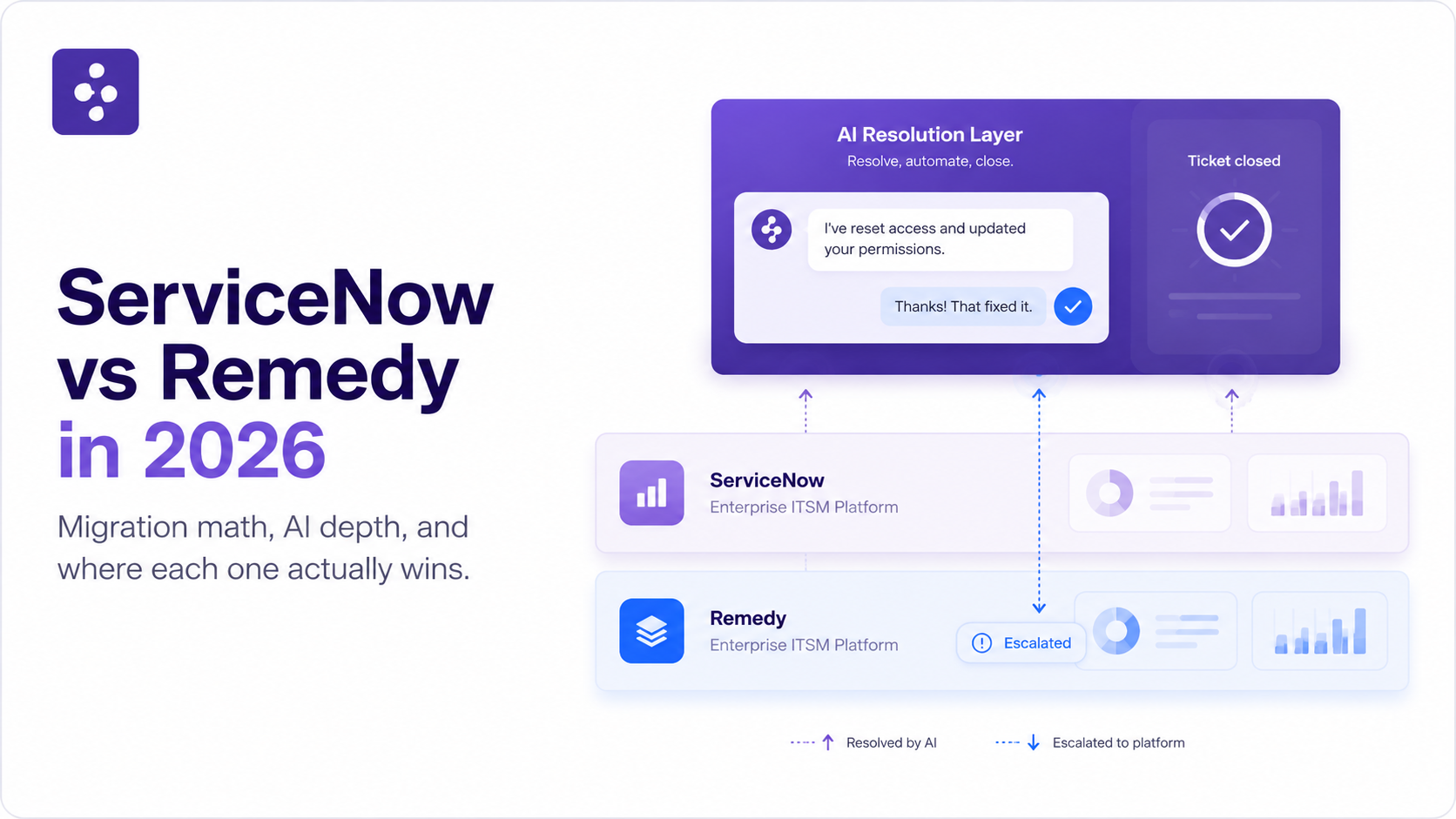
ServiceNow AI Agents in 2026: The Honest Buyer's Guide
ServiceNow's AI Agents are the most-pitched native AI in enterprise IT right now. Every evaluation deck shows the same thing: agents resolving requests inside the Service Portal, governed centrally, native to the platform you already own. What the decks do not surface is the boundary. The agents read ServiceNow's own Knowledge Management, act on ServiceNow records, and sit on a licensing tier nobody quotes you until procurement.
For a Fortune 500 already standardized on the Now Platform, none of that is a problem. For a mid-market IT team whose runbooks live in Confluence and whose employees ask in Slack, all four of those boundaries bite. Our breakdown of enterprise IT support covers what changes when AI agents take the routine load. ServiceNow AI Agents explained: where the Now Platform ceiling sits & the layered alternative for mid-market IT. Book a demo to see how it fits your stack.
What Do Evaluation Decks Fail to Surface?
ServiceNow AI Agents live on the ServiceNow AI Platform. They are coherent, well-engineered, and deeply integrated with the Now Platform. Four things tend to surface after the contract is signed.
Gartner predicts over 40% of agentic AI projects will be canceled by the end of 2027, on escalating costs, unclear business value or inadequate risk controls, and timeline is where most of that cost accumulates. None of those are flaws in the product. They are consequences of how ServiceNow AI Agents are built: deeply native, governed inside AI Control Tower, sitting on the ServiceNow CMDB as the single system of record. The architecture is coherent. It also has a ceiling, and that's what this piece is about.
Sourced from ServiceNow's own AI Agents, AI Agent Studio, and AI Control Tower product documentation on servicenow.com, reviewed August 2026. ServiceNow does not publish list pricing.
What ServiceNow AI Agents Are Built For
Three architectural conditions under which the native option carries the least integration work. Each describes what the Now Platform already covers, so the reader can check their own environment against it. If you are still choosing between the two enterprise platforms rather than evaluating AI on one, ServiceNow vs Salesforce compares them directly.
Estates standardized on the Now Platform end to end
An IT organization that has standardized on ServiceNow for ITSM, CMDB, IT Asset Management, and HR Service Delivery, with multi-year Now Platform commitments. The native agents inherit the data model and governance posture, which means there is no new vendor security review.
Environments where AI Control Tower is itself the compliance control
AI Control Tower's central governance is itself a compliance requirement in some environments. Pulling AI decisions into a separate platform creates a second audit surface that some security teams will not accept.
Deployments where every knowledge source and action target sits inside ServiceNow
If every system the AI needs to read from or act on is already inside ServiceNow, the native option is genuinely the simplest answer. No integration project, no second vendor, no separate licensing line.
For everyone else, and that is most of the mid-market IT world, there is a more practical architecture. If the platform itself is the problem rather than the AI on top of it, see our list of ServiceNow alternatives. If you are still shortlisting, our ranking of agentic AI tools for help desk automation applies the resolution test to eight platforms.
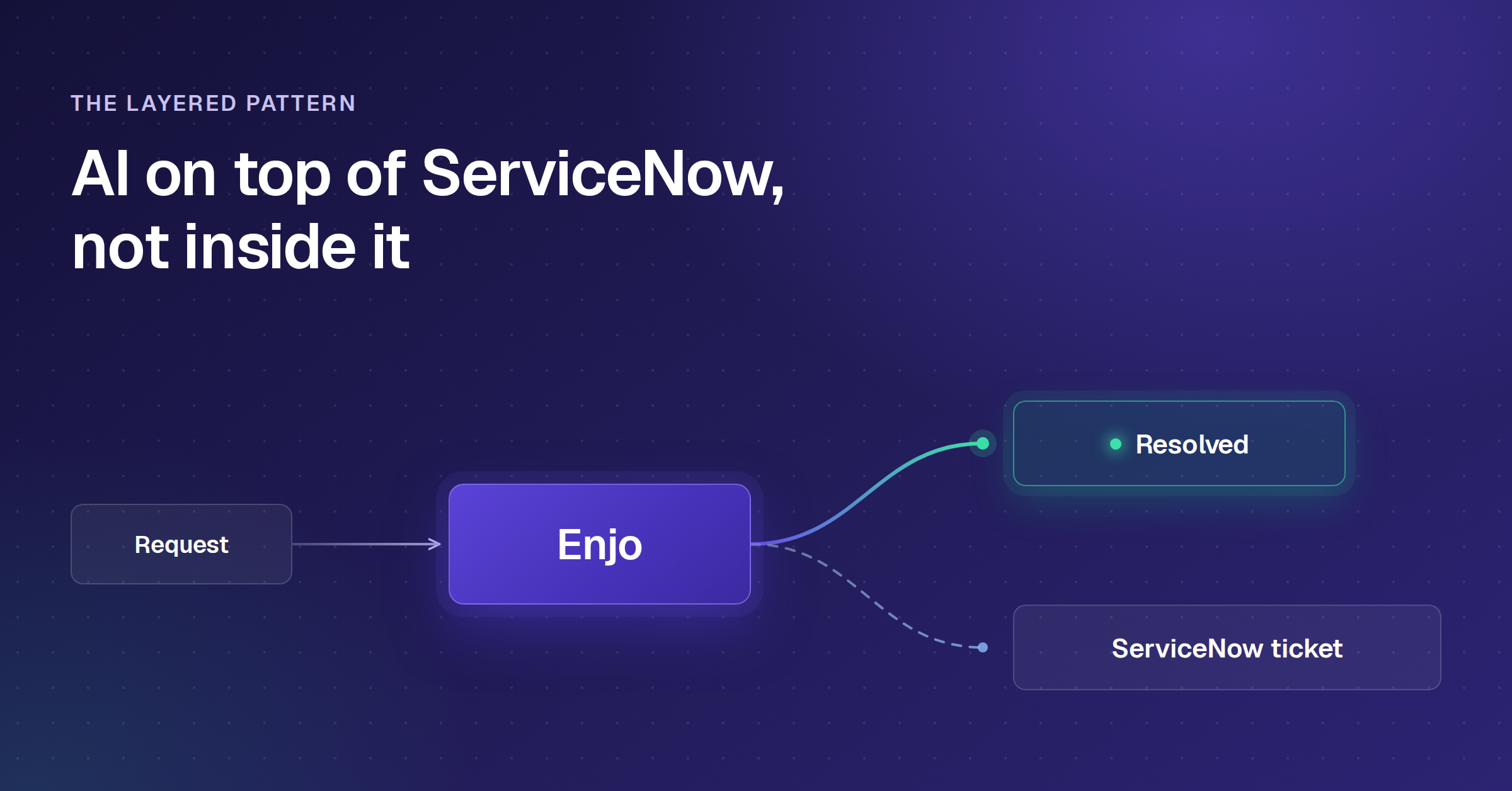
AI on Top of ServiceNow, Not Bolted Inside It
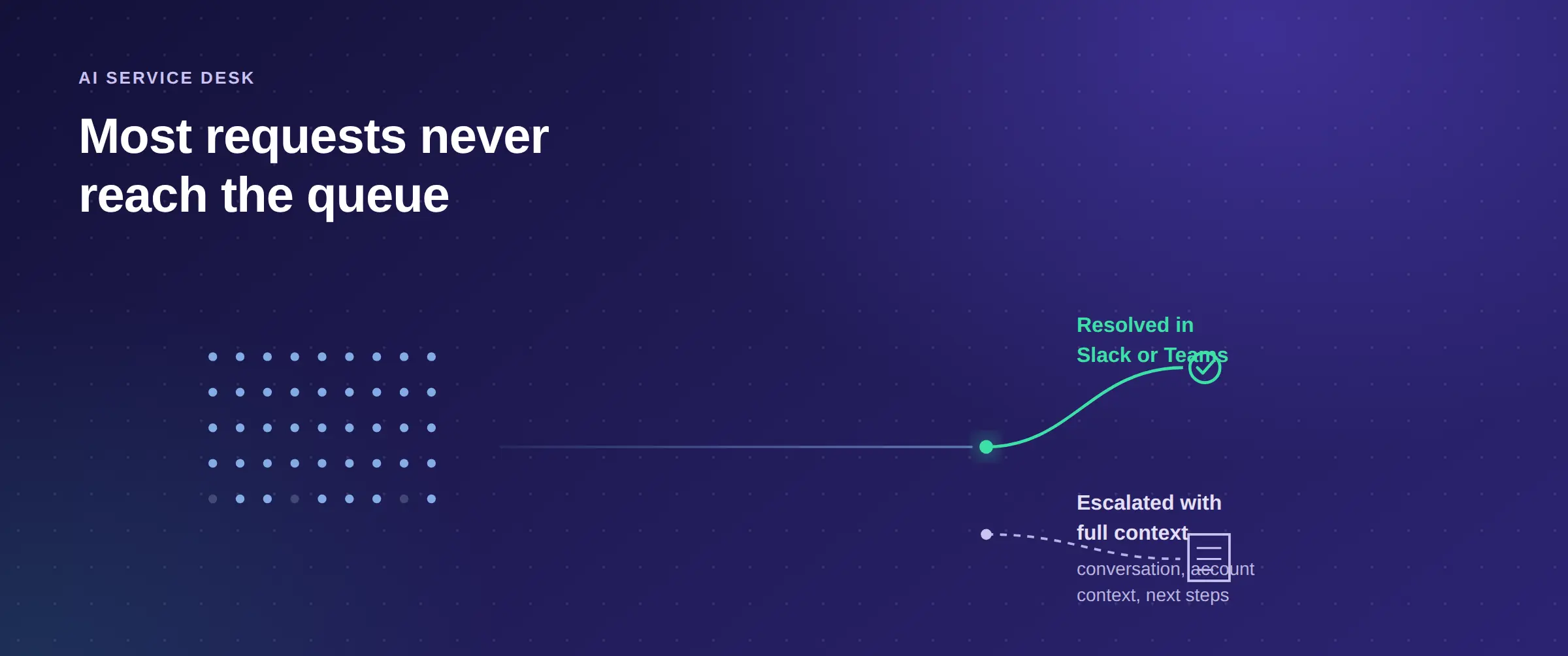
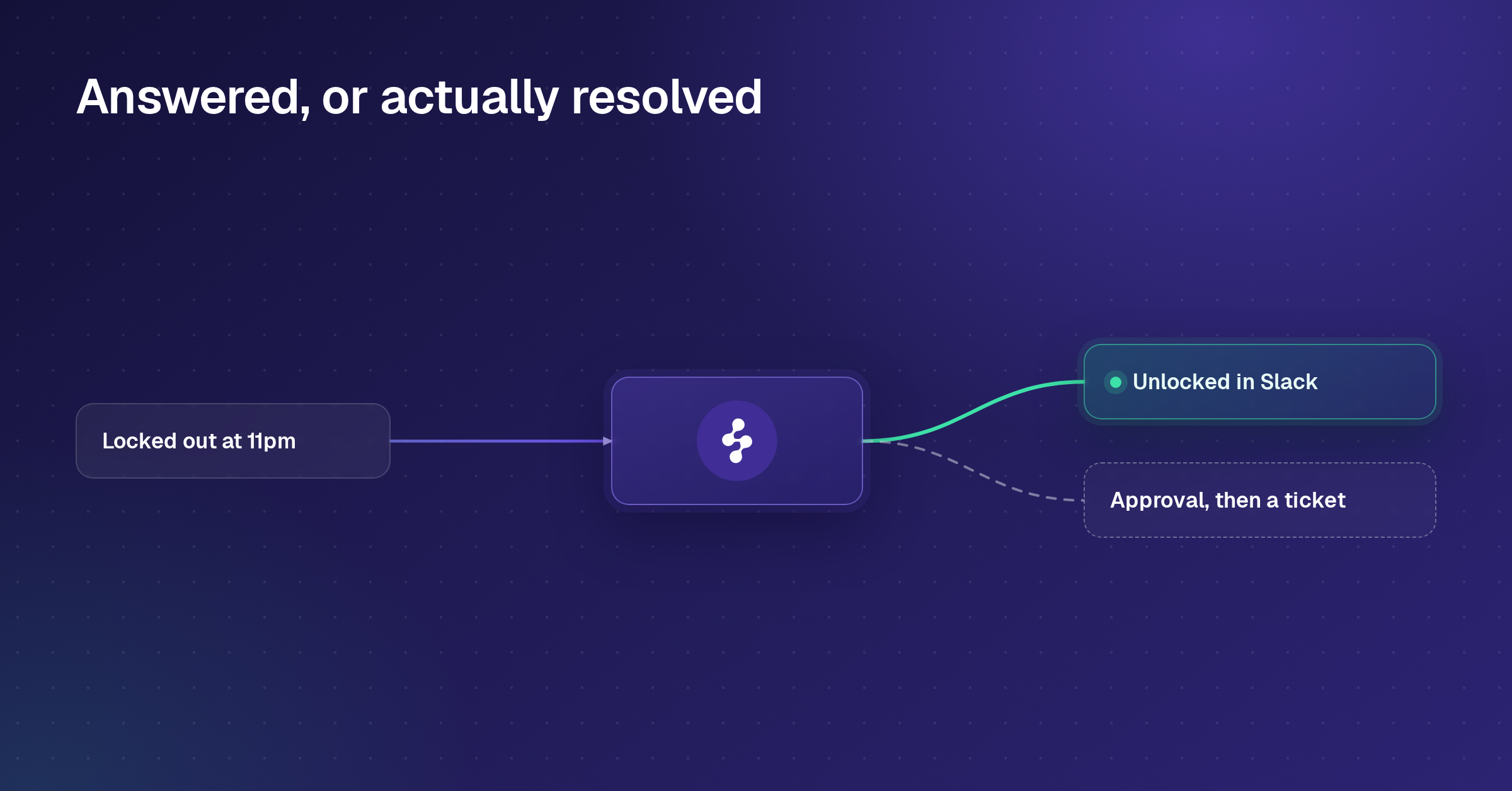
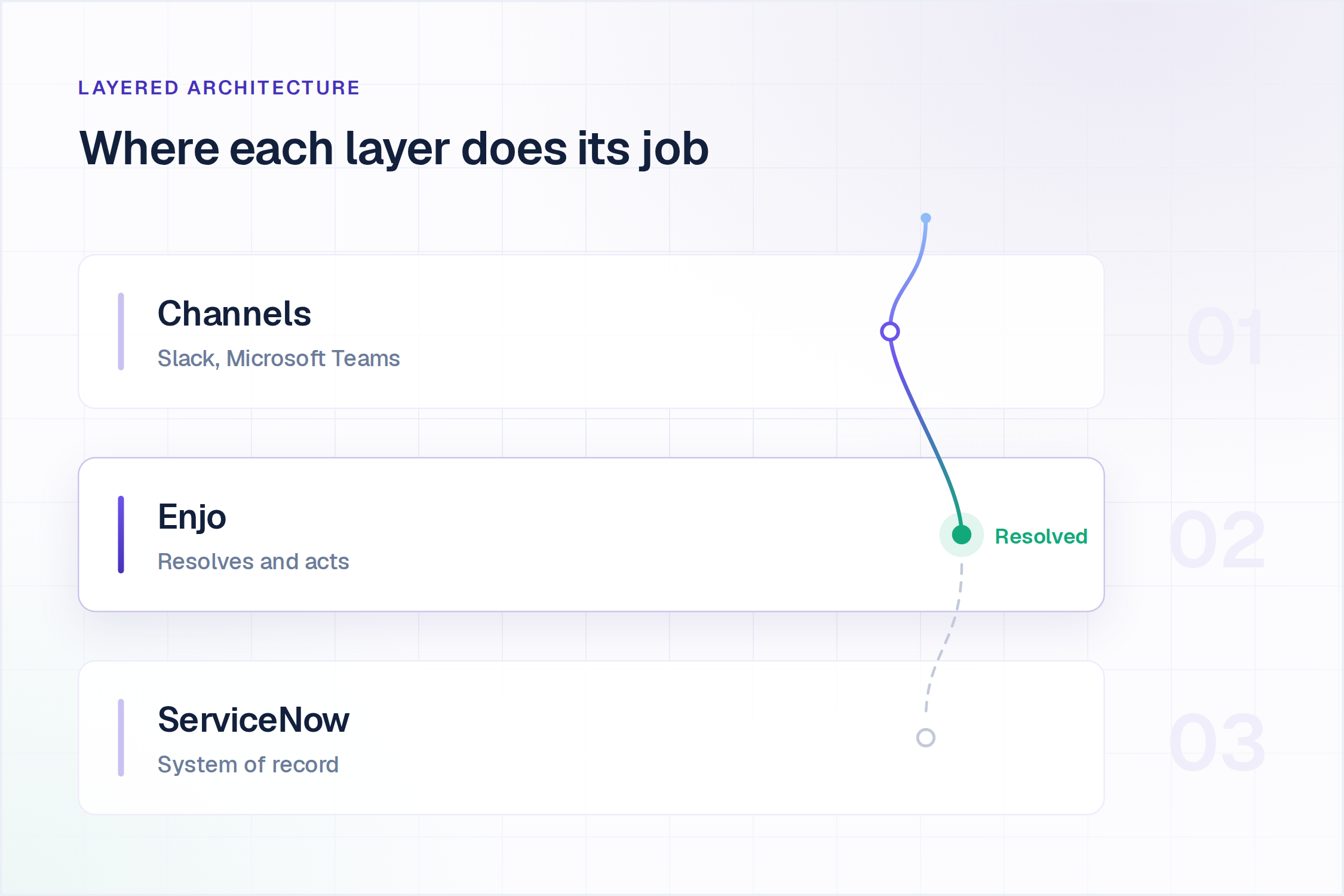
Most mid-market IT teams running ServiceNow do not need to replace it. They need AI that resolves in Slack and Teams, reads across the actual knowledge stack, takes action across systems, and creates a ServiceNow ticket with full context only when a human is needed.
Enjo on ServiceNow
How it goes to market: Sold as a dedicated AI layer that deploys onto an incumbent helpdesk, priced per AI reply with unlimited human agent seats and a permanent free tier, with no Now Platform licence uplift required.
Enjo is an AI Support Agent that resolves support requests end-to-end, including actions in your connected systems, and adds that resolution layer to ServiceNow without asking you to replace it. Employees interact with it in Slack and Microsoft Teams, and ServiceNow stays the system of record.
Key capabilities:
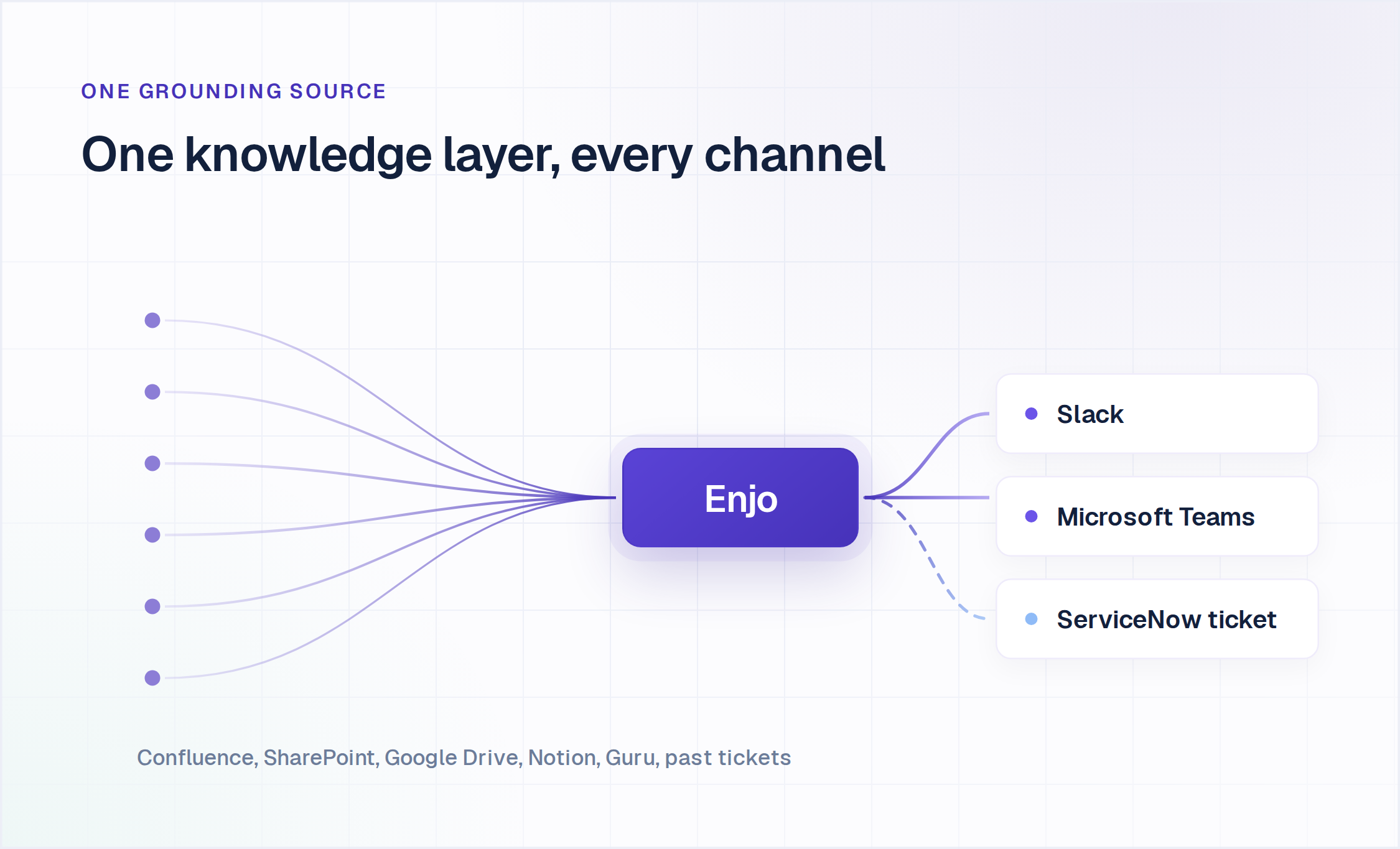
- Reads your whole stack, not one KB: Indexes Confluence, SharePoint, Google Drive, Notion, Guru, past tickets in Jira and ServiceNow, and internal sites into one grounding source. AI, human agents, and self-serve all read the same truth.
- Resolves across systems: AI Actions reach into Okta, Azure AD, Google Workspace, Jira, Salesforce, ServiceNow, and custom APIs. Agentic workflows handle multi-step sequences with explicit fallbacks when the agent is not confident.
- Escalates with full context: Enjo creates the ServiceNow ticket with the full conversation attached and routes it to the correct queue. Agent Assist surfaces summaries and reply suggestions in the case view.
- Enterprise governance, self-serve setup: Guardrails, audit logs, role-based access, SOC 2 Type II, ISO 27001, GDPR, and multilingual resolution. Your team ships changes in Studio without professional services.
Pricing: Usage-based per AI Reply, not per seat. Free plan includes 200 replies per month with no credit card required. Paid starts at $95 a month for 1,000 replies. Every published plan includes unlimited human-agent seats; additional replies cost $0.05 each on Starter and Standard. At the Free limit, requests auto-escalate to human agents and support keeps running in Inbox.
Enjo's scope: Enjo is an AI layer, not a ticketing platform. It does not replace the helpdesk as the system of record, which is the point rather than a limit. ServiceNow keeps the tickets, the queues, the SLAs and the audit history; Enjo resolves the requests that never needed to become tickets.
ServiceNow AI Agents vs Enjo on ServiceNow
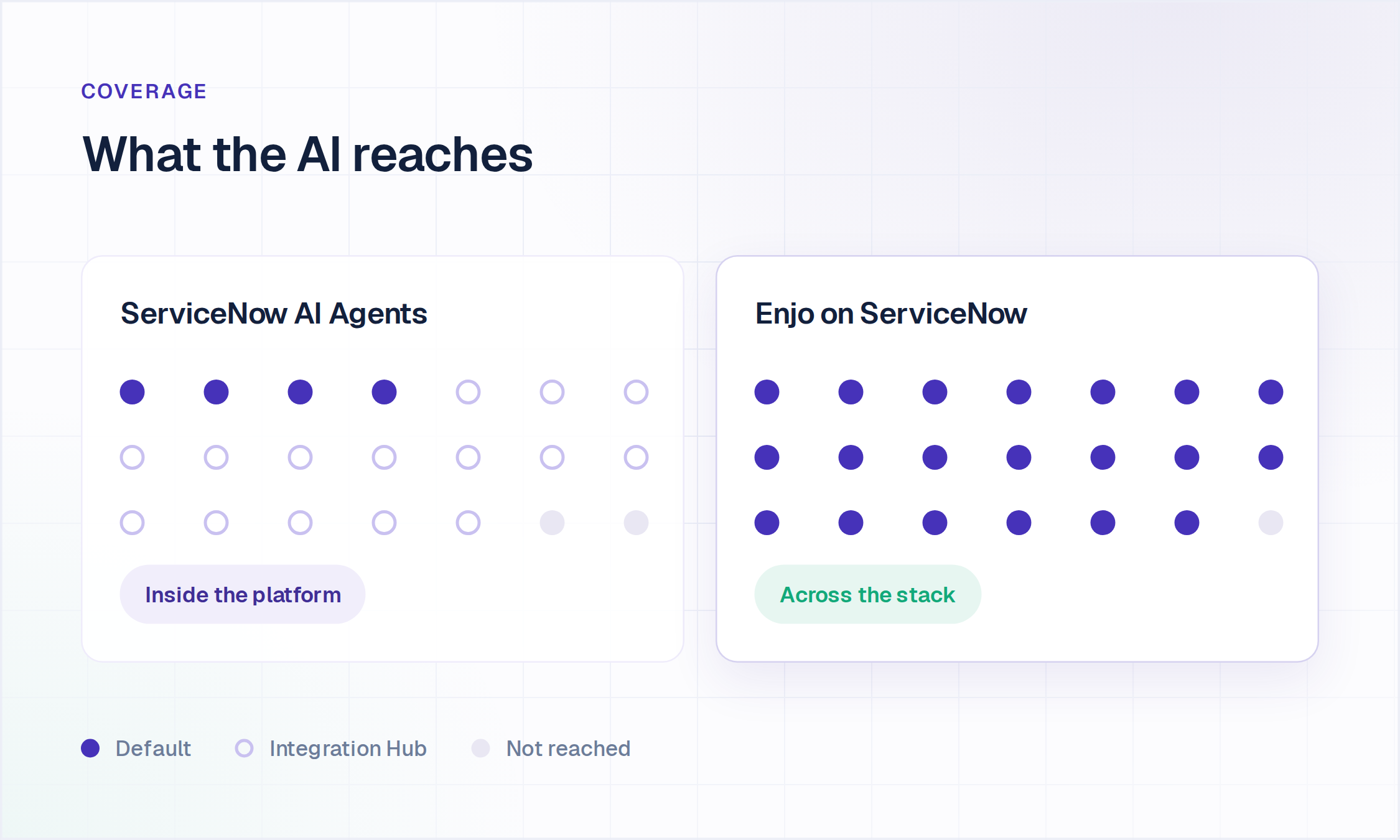
Both are viable. They solve different problems. The honest read is below the table.
The Honest Read
A Fortune 500 company already deep in ServiceNow, with multi-year platform commitments, gets a coherent native story. A mid-market IT team with knowledge across Confluence and Drive, action requirements in Okta and Jira, and employees living in Slack gets faster time to value from Enjo on top of ServiceNow.
What the Layered Pattern Looks Like at Scale
Forrester's 2026 assessment found roughly three-quarters of enterprise leaders reporting agentic AI adoption while only a small minority ran it in meaningful production. Two teams running the same architectural pattern on different helpdesk substrates. AI in Slack on top, helpdesk underneath, single knowledge layer across the stack.
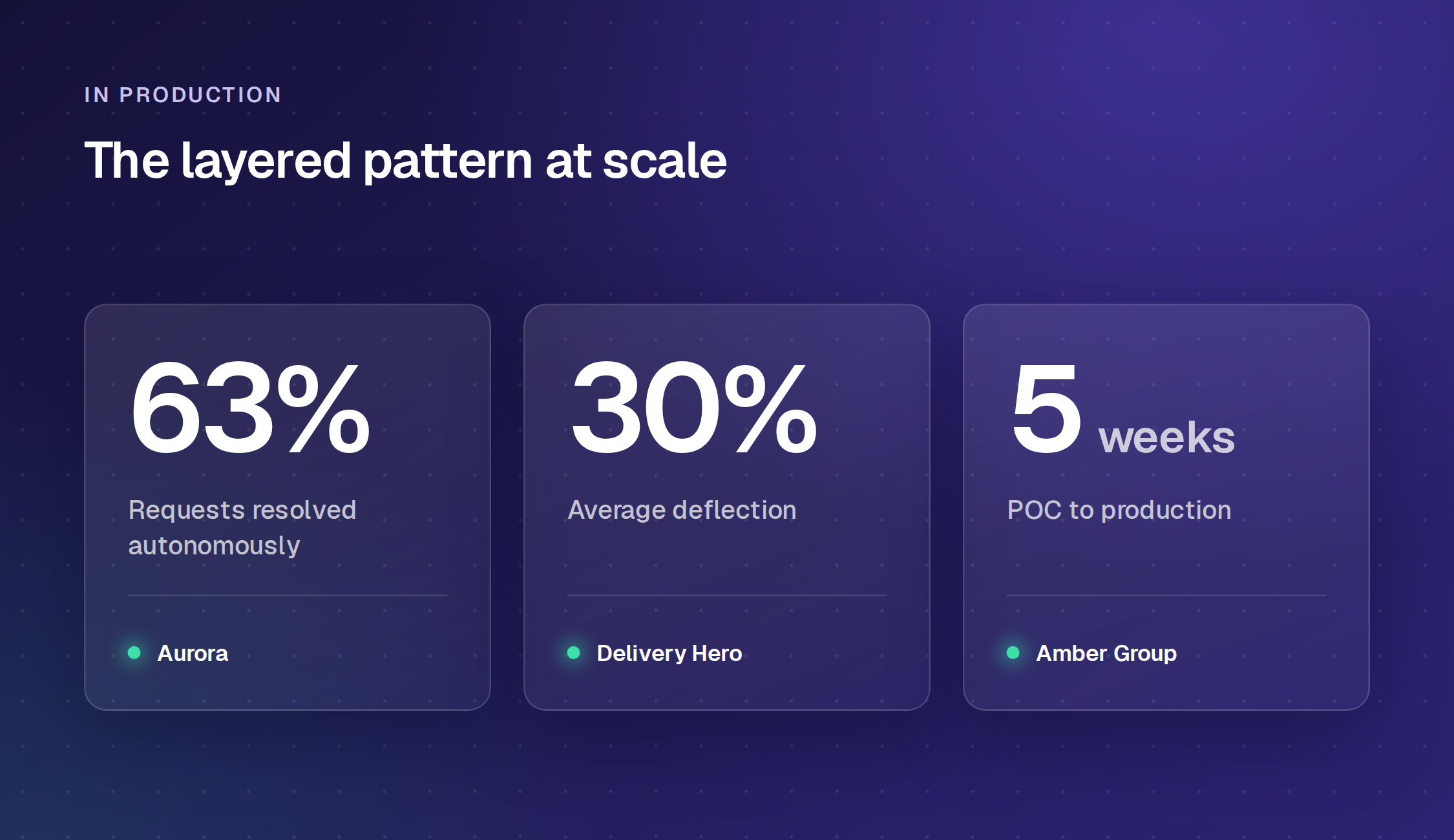
Delivery Hero provides IT support to 95,000+ Slack members across 70+ countries on a Jira and JSM stack, with Slack as the primary channel. After deploying Enjo, the team reported 30% deflection, a 25% lift in employee satisfaction, and 80% faster response times.
Aurora, an autonomous vehicle company with 2,500 employees, achieved 63% autonomous resolution, 45% faster resolution, and a 60% improvement in ESAT with the same AI-first resolution pattern.
Delivery Hero kept its existing Jira and JSM ticketing layer and added the AI layer on top.
Run These Checks on Your Own Environment
The two architectures diverge on four measurable things. Check each one against your own stack rather than against a vendor demo.

Frequently Asked Questions
Do we have to leave ServiceNow to use Enjo?
No. Most Enjo IT deployments keep ServiceNow as the helpdesk of record. Enjo for ServiceNow adds an AI resolution layer to Slack and Teams and escalates unresolved requests to your existing ServiceNow instance, with the full conversation history attached. Tickets, queues, SLAs, and reporting all stay where they are.
Is Enjo a replacement for ServiceNow's AI Agents, or does it run alongside?
It is an alternative to the AI layer, not the ticketing system. Most teams turn off the native AI Agent for IT requests, route incoming requests through Enjo in Slack and Teams, and keep ServiceNow as the system of record for escalated tickets and audit history. The native AI can remain enabled for other use cases.
How does Enjo handle escalation to ServiceNow?
When the agent cannot resolve a request, it creates a ServiceNow ticket with the full Slack or Teams conversation attached, applies the correct category and priority, and routes to the right queue. Agent Assist then surfaces summaries and reply suggestions within the ServiceNow case view, so the human agent can pick up with full context. No copy-paste, no employee restating the problem.
Does Enjo require a higher ServiceNow license tier?
No. Enjo's AI Agent, Knowledge, and AI Actions are licensed separately on Enjo's usage-based model. No Now Platform tier uplift is required. Agent Assist installs into your existing ServiceNow instance without changing the platform tier.
Is the security posture enterprise-grade?
Enjo is SOC 2 Type II compliant, ISO 27001-certified, and GDPR-compliant. Core Guardrails are included from the Starter plan. Advanced Guardrails, custom role-based access, and the audit trail with QA review flows are included from the Standard plan. Data is encrypted in transit with TLS 1.2 or higher and at rest with AES-256, with keys managed through AWS KMS.