Transform complex support workflows
Agentic Workflows: How Autonomous Support Automation Works
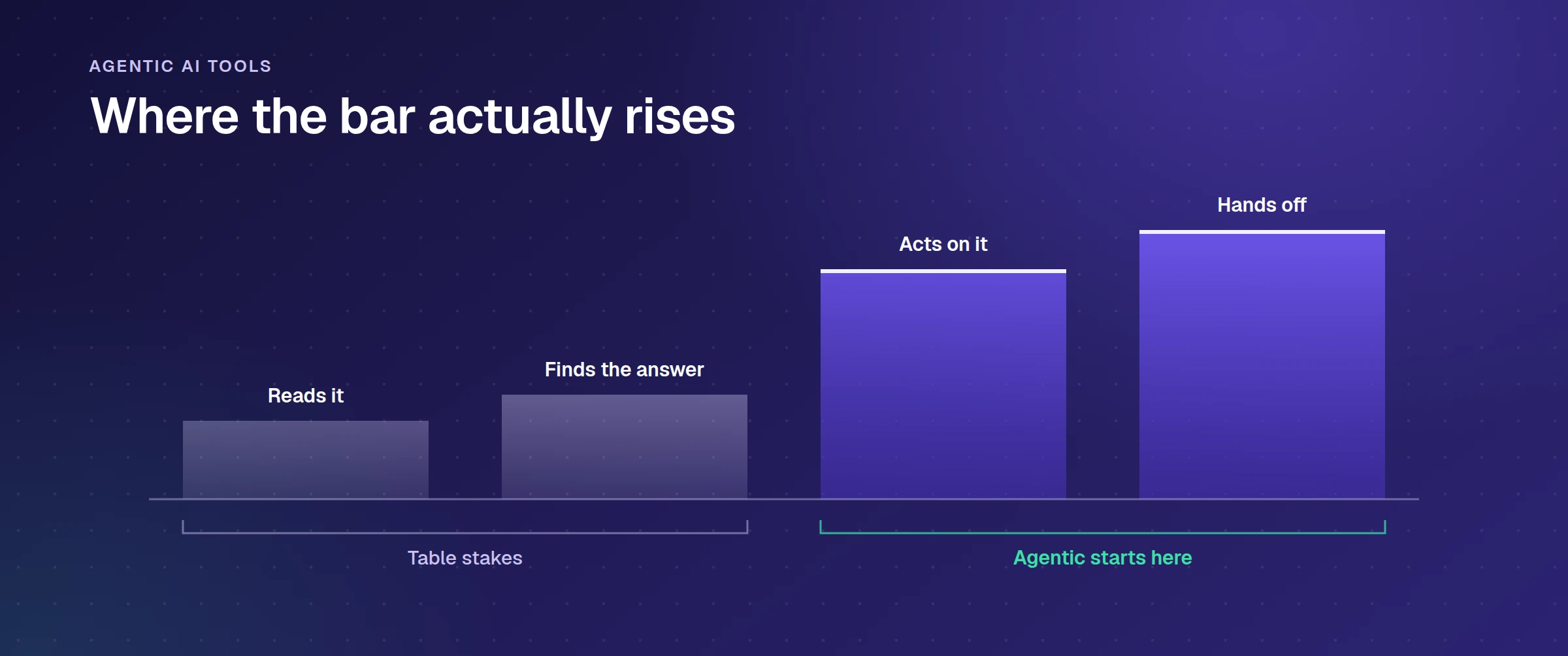
Agentic workflows are the difference between an AI that tells an employee how to request Figma access and one that checks the policy, files the Jira ticket, routes it to the manager and logs the result. The first reshapes the work. The second removes it.
Most enterprise requests are not single-step. "Reset my VPN" is four steps. "Onboard a new hire" is a dozen across HRIS, identity and IT. A language model on its own cannot run those chains safely, which is why the useful unit is not the model but the governed sequence around it.
This guide covers what agentic workflows are, the five-step loop underneath them, the architecture that makes them auditable, and four real examples across IT, HR and Finance. Agentic workflows execute multi-step IT and HR tasks end to end, with the governance to prove every step. Start free at enjo.ai to run one.
TL;DR
- Agentic workflows execute multi-step support tasks end to end, rather than only answering questions.
- They combine retrieval, reasoning and deterministic actions inside a repeatable sequence.
- They reduce manual effort across IT, HR and Finance by handling tickets, approvals and account tasks.
- They outperform LLM-only chatbots because execution is predictable and governed.
- They connect to Jira, ServiceNow, Okta, Confluence, HRIS and custom APIs.
What Are Agentic Workflows?
Agentic workflows are structured automation sequences that execute multi-step tasks with autonomy and predictable outcomes. They go beyond chatbots that only give answers. They turn a natural language request into a completed action in IT, HR, Finance or Ops.
These workflows rely on AI agents: software entities capable of retrieving context, reasoning about the request, selecting the right sequence, and executing steps across systems like Jira, Workday or ServiceNow. For the wider concept, see our explainer on agentic AI.
Agentic workflows differ from traditional workflow tools in three ways. They use language inputs as triggers. They rely on dynamic reasoning to decide what to do next. And they execute deterministic action chains that follow enterprise rules and policies.
Why Multi-Step Tasks Need Structured Workflows
Enterprise tasks are rarely single-step. Even simple requests involve branching logic. "Reset my VPN" becomes confirm identity, check device, update the credential store, notify the user. "Onboard a new hire" becomes collect details, create accounts, set permissions, trigger approvals, record completion.
Language models cannot manage those chains safely without defined workflows. Agentic workflows are the answer: repeatable, governed sequences enforced by policies, role-based access and clear step boundaries.
If you need an overview of how AI fits into support systems first, start with the AI chatbot guide.
The Retrieve, Reason, Act, Verify, Finalize Loop
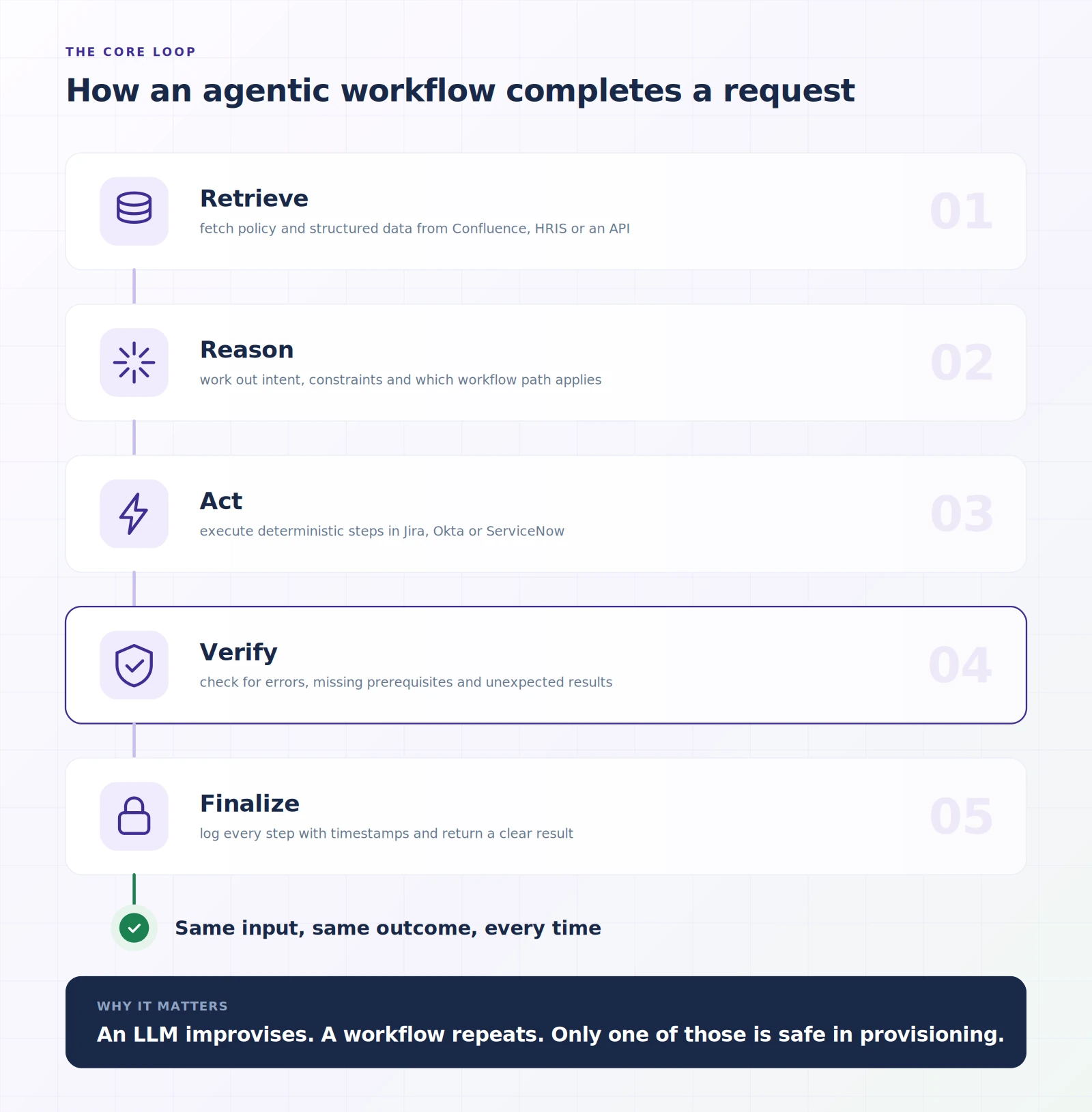
Every agentic workflow runs the same closed loop. It retrieves knowledge or structured data through RAG or an API query. It reasons about intent, constraints and the right path. It acts, executing deterministic steps, creating tickets, running approvals and updating systems. It verifies, checking for errors, unexpected results or missing prerequisites. Then it finalizes, logging every action and returning a clear result.
That loop is what makes support automation reliable. It is also how Enjo runs multi-step workflows inside Slack or Microsoft Teams, using AI Actions to orchestrate systems like Jira and ServiceNow.
Why Deterministic Behavior Matters
For enterprise teams, accuracy is not negotiable. A misrouted access request, an incorrect approval or an unlogged change creates real risk. Deterministic behavior means the same input leads to the same outcome, each step follows a documented policy, each action is logged with timestamps and metadata, and permissions align with role-based access scopes.
That is the core difference between a governed multi-step workflow and a freeform generative tool. Enjo enforces it through role-based access, Okta SSO, policy rules and audit logs.
Architecture of an Agentic Workflow
Agentic workflows follow a consistent architecture. Think of it as the blueprint that turns a natural-language request into an executable sequence.
.webp)
Real Multi-Step Automation Examples
Agentic workflows deliver value when they run end to end, not halfway. Each example below follows the same pattern: collect, validate, execute, confirm, log.
IT Access Provisioning
Access provisioning is high-volume and policy-bound. The workflow parses the request, validates identity and role through Okta, retrieves the access policy from Confluence, checks whether the user already holds the permission, creates the Jira request with metadata if not, notifies the manager in Slack or Microsoft Teams for approval, and logs the final action.
That differs from a chatbot, which shares instructions or a static link. The workflow completes the request, tracks every step and enforces the policy. For more internal-support context, see Slack and Teams AI agents.
HR Onboarding
Onboarding involves dozens of steps across HRIS, identity, facilities and IT. HR triggers it with a Slack message. The agent gathers employee details, creates accounts in HRIS and identity systems, applies role-specific permission bundles, schedules orientation, sends documentation, updates the relevant databases and triggers an audit log entry.
VPN and SSO Troubleshooting
Identity and VPN issues represent a large share of internal IT load. The workflow validates identity, gathers device data through the MDM, checks outage dashboards, runs known troubleshooting sequences, requests logs where needed, auto-creates a Jira or ServiceNow ticket with full context if unresolved, and tells the user what happens next.
For a detailed breakdown of troubleshooting flows, see the AI chatbot for customer service guide.
Finance and Compliance Routing
Finance requests combine policy checks with approval routing. An employee submits a budget request. The agent retrieves the spend policy from Confluence, calculates compliance against thresholds, routes to the proper approval chain, archives the final approval in the document store, updates internal systems with metadata and logs completion.
See how Enjo automates multi-step tasks across IT and HR in our case studies.
Why Agentic Workflows Outperform LLM-Only Chatbots
Agentic workflows succeed where LLM-only chatbots fail: repeatability, policy enforcement and safe execution.
Predictability and Repeatability
LLM responses vary with phrasing. That is acceptable for content tasks and unsafe for operations. A governed workflow gives the same request the same path, guaranteed step execution, no improvisation during critical steps and full traceability. That matters for password resets, provisioning and ticket creation.
Policy Compliance
Policies define how work should be done, and language models do not enforce them unless wrapped in strict workflows. Agentic workflows block unsafe actions through role-based access, step-level permission checks, required approvals, organisation-specific thresholds and identity verification.
Avoiding Hallucination in Execution
A language model can invent steps, instructions or systems that do not exist. That is unacceptable when executing tasks in IT or HR. Agentic workflows avoid it by relying on deterministic steps, structured inputs, validated API calls, strict schema enforcement and permission-aware context. Actions either execute or fail gracefully; they never guess.
IBM's definition of agentic workflows sets out the same requirement, and Gartner predicts over 40% of agentic AI projects will be canceled by the end of 2027, on escalating costs, unclear business value or inadequate risk controls. Governance is what separates the projects that survive.
Enterprise Guardrails
Enterprise-grade workflows respect boundaries. That means SSO identity checks, role-based scoping, approval chains, encrypted data flows, audit trails, and environment isolation or private cloud options. These guardrails ensure automation does not exceed its mandate.
How Agentic Workflows Integrate With Support Systems
Agentic workflows deliver value only when connected to the systems that hold enterprise data.
Service desks. Jira, ServiceNow, Freshservice and Zendesk. The workflow creates tickets, updates fields, attaches logs, closes resolved issues, triggers approvals and routes escalations, with no manual data entry.
Knowledge repositories. Confluence, SharePoint and Notion hold the policy, troubleshooting and procedural content. The workflow fetches the latest policy version, reads structured tables, extracts runbooks, confirms eligibility and personalizes instructions by role.
HRIS and identity providers. Identity and HR data anchor nearly every workflow, enabling automatic provisioning, eligibility checks, role bundle assignment, onboarding sequencing and offboarding. Okta ensures each action respects role-based access and SSO constraints.
Custom systems. Most enterprises have unique internal tools. Agentic workflows call REST APIs, internal microservices and proprietary endpoints, so teams automate long-tail work without custom code. Enjo exposes these through its AI Actions layer and no-code builder.
Governance, Security and Auditability
Most organisations adopt agentic workflows only when governance is clear, enforceable and auditable.
Who can trigger what. Governance begins with workflow-level access control: role-level permissions, team-based scoping, channel restrictions and identity verification through SSO. Every request maps to an authenticated identity, which removes ambiguity during high-impact operations like offboarding.
Approval rules and scoped permissions. Some workflows need human approval; others check multiple policies before executing. Strong governance covers multi-step approvals, conditional routing, scoped permissions by role bundle, and explicit constraints on when changes can happen.
Visibility into every step. Auditability is essential for compliance and internal QA. The log should record who triggered the workflow, which steps executed, inputs and outputs per step, API calls, approvals and rejections, errors and fallbacks, the final state and timestamped metadata. Enjo maintains complete audit trails across Slack, Microsoft Teams and its automation engine.
How Enjo Implements Agentic Workflows
No-code builder. IT, HR and Ops teams design multi-step workflows without writing scripts, defining triggers, conditions, branching logic, external system calls, approval chains, validations and human-in-the-loop steps. That removes the engineering bottleneck and lets departments update workflows as policies change.
One engine across channels. Enjo runs on a unified engine across Slack, Microsoft Teams, website chat and APIs, so responses, action execution and compliance stay consistent wherever the request originates. For the web-facing view, see website chatbot use cases.
Enterprise controls. Okta SSO, granular role-based access, permission-aware retrieval, environment isolation, end-to-end encryption, complete audit trails and optional private cloud deployment. Enjo runs on SOC 2 Type II, ISO 27001 and GDPR compliance.
Deterministic action chains. Workflows follow defined steps, outcomes stay consistent, results are verifiable, errors are predictable, fallbacks are safe and logs are complete. That reliability is what separates a governed workflow from a freeform tool that improvises.
How to Start With Agentic Workflows
Teams succeed when they start small, enforce governance, and build toward multi-step, high-value processes.
- Identify repetitive processes with clear rules: access requests, onboarding, troubleshooting.
- Connect knowledge sources such as Confluence, SharePoint and Notion, and validate data freshness.
- Map triggers, approvals and required guardrails against your IT and security policies.
- Pilot three to five deterministic workflows inside Slack or Microsoft Teams using a no-code builder. The channel side of this is covered in AI agents for Slack and Teams.
- Measure resolution rate, deflection and time saved, then expand to HR and Finance.
Enjo has a permanent free tier with 200 AI Replies a month and unlimited seats, which is enough to test one workflow end to end before any procurement conversation.
Frequently Asked Questions
What is an agentic workflow?
An agentic workflow is a structured automation sequence in which an AI agent retrieves context, reasons about a request, and executes deterministic steps across connected systems until the task is complete. It returns a finished task rather than a text response.
What is the difference between an agentic workflow and a chatbot?
A chatbot returns an answer. An agentic workflow completes the work: it validates identity, checks policy, calls the API, updates the record and logs the result. The dividing line is whether the request leaves the queue.
How can AI be used for workflow automation?
AI can automate IT provisioning, onboarding, ticket triage, access approvals and troubleshooting. It retrieves the policy, understands intent, and executes the sequence through APIs using deterministic action chains rather than freeform responses.
How do AI agents avoid hallucinations in workflows?
Through deterministic steps, schema validation, permission-aware retrieval and strict action frameworks. The agent executes predefined steps rather than generating them, so an action either runs or fails gracefully.
How do organisations secure automated workflows?
With SSO, role-based access, encrypted data flows, environment isolation, approval chains and complete audit logs. Every action maps to an authenticated identity and every step is recorded.
Can agentic workflows integrate with custom internal systems?
Yes. API-based actions let agents connect to proprietary tools, internal microservices and custom logic without bespoke development for each one.