
Transform complex support workflows
Agentic AI Explained: What It Is and How It Works
Agentic AI is software that pursues a goal on its own: it decides what to do, takes the action inside your systems, and finishes the job without waiting for the next prompt. That is the difference from every wave of AI before it. Traditional automation follows rules you wrote in advance. Generative AI produces an answer when you ask for one. Agentic AI does the work.
Gartner puts numbers on how fast that shift is arriving. It predicts at least 15% of day-to-day work decisions will be made autonomously through agentic AI by 2028, up from 0% in 2024, and that 33% of enterprise software applications will include agentic AI by 2028, up from less than 1% in 2024.
This guide covers what agentic AI is, how it differs from generative AI, the architecture underneath it, where the projects fail, and what a working deployment looks like inside Slack, Microsoft Teams and Jira.
Agentic AI decides, acts in your systems, and resolves the request without a prompt. Start free at enjo.ai to see one run on your own requests.
What Agentic AI Is
An agentic AI system is given an objective rather than an instruction. It breaks the objective into steps, chooses the tools and data each step needs, executes them in order, checks the result, and adjusts when something does not work.
Three properties separate it from what came before:
- It acts without a prompt. The system initiates work based on an event, a schedule, or an incoming request, not a human typing a question.
- It adapts while running. When a step fails or returns something unexpected, it revises the plan rather than stopping.
- It completes multi-step work. A request that touches four systems is one job, not four handoffs.
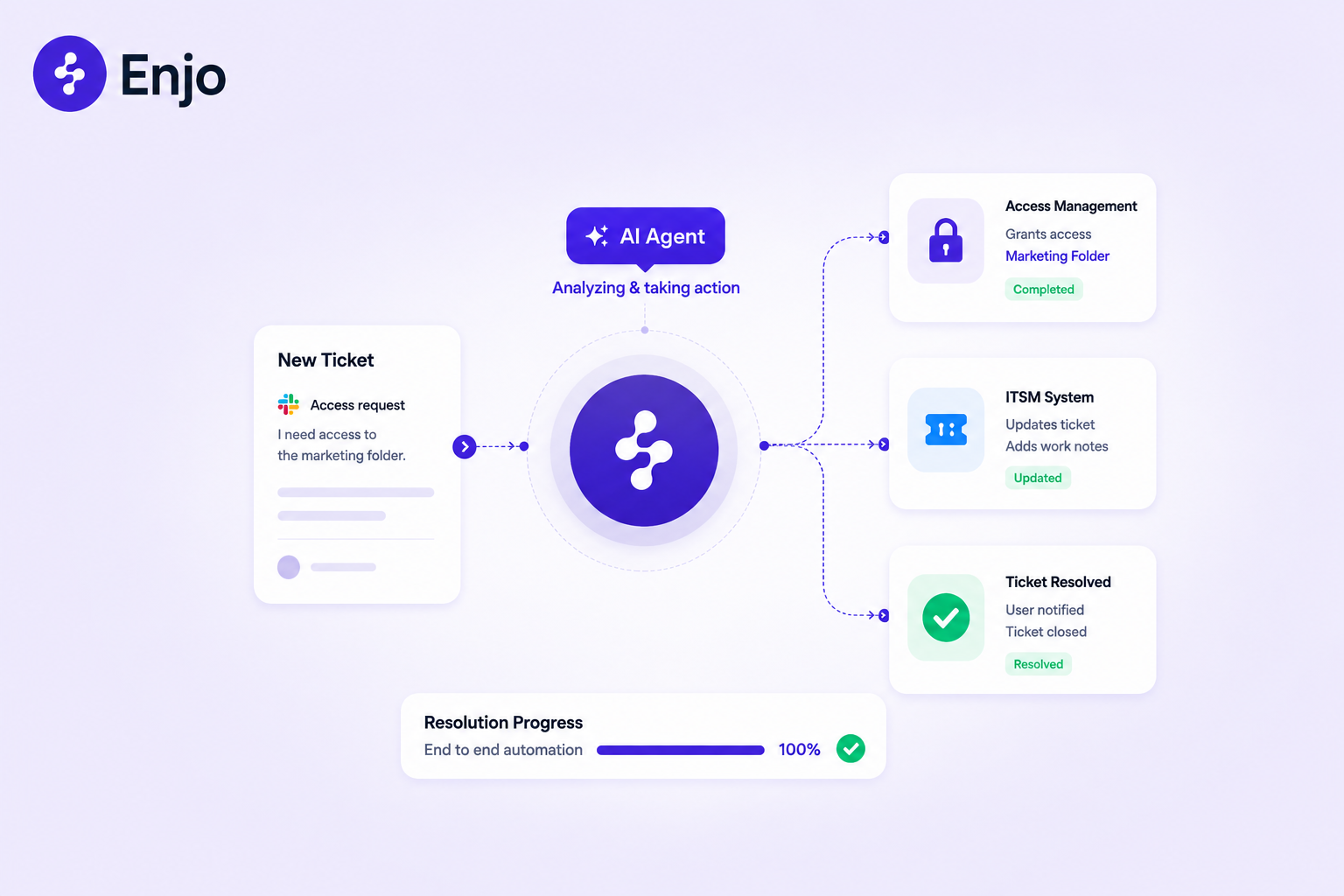
The practical test is whether work leaves the queue. A system that drafts a reply for a person to send has not removed the work, it has reshaped it. A system that verifies the requester, checks the policy, performs the change in Okta, updates the Jira ticket and tells the requester in Slack has removed it.
.webp)
Agentic AI vs Generative AI vs Traditional AI
The three are often used interchangeably, which is why buying decisions go wrong.
Traditional AI automates repetitive tasks inside rigid, rule-based frameworks. Generative AI, built on large language models, produces content in response to a prompt. Agentic AI uses the same language models for reasoning, then adds planning, tool access and the authority to act. The model is no longer the product; it is one component inside a system that decides and executes.
The Architecture of Agentic AI
Key Characteristics of Agentic AI Systems
- Autonomy. The system starts and finishes tasks without step-by-step supervision. Human review is a policy decision, not a technical requirement.
- Advanced reasoning. It weighs context and makes trade-offs, rather than matching an input to a stored response.
- Reinforcement learning. It improves by acting, observing the outcome, and adjusting. This is a mechanism, not a set-and-forget promise; the quality of what it learns depends entirely on the quality of the feedback it receives.
- Language understanding. It follows instructions written the way people actually write them, including incomplete ones.
- Workflow execution. It manages multi-step processes across systems, holding state from the first step to the last.
Agentic AI and AI Agents Are Not the Same Thing
The two terms get used interchangeably and they describe different levels.
Agentic AI is the paradigm: the design of systems that pursue goals independently.
AI agents are the components inside such a system. Each one handles a defined function. Together they deliver the outcome the framework is aiming at.
For a deeper treatment of the component layer, see our guide to AI support agents.
How Enjo Combines Agentic AI and AI Agents
Enjo is built as an agentic system that coordinates individual agents to resolve support requests end to end.
Studio is where teams configure agents for specific request types, with the scope, tone and permitted actions defined per agent.
Knowledge sources connect the agents to what your organisation actually knows. Enjo indexes the ai knowledge base, past resolved tickets, internal documents in Confluence, SharePoint and Google Drive, and connected systems of record, so answers are grounded in your material rather than the model's general training.
AI Actions and AI Flows give agents the ability to do things: reset an account in Okta, provision a licence, create or update a Jira issue, pull an order record. This is the layer that separates resolution from deflection.
Guardrails enforce what an agent may and may not do. Every action is checked against policy and logged in an audit trail that a compliance reviewer can read.
Insights surfaces which request types are being resolved, which are escalating and why, so the next agent you configure is chosen from data rather than instinct.
When an agent is not confident, it escalates to a human in your existing helpdesk or in Enjo Inbox, and the person receives the full conversation, the requester's account context, and the next steps the agent had planned.
.webp)
Different Types of Agents in an Agentic Architecture
Specialized Agents for Different Jobs
Assist agents work alongside a human rather than instead of one. They gather information from several sources and put it in front of the person handling the case. Inside a helpdesk, Enjo's Agent Assist capability does this: it surfaces the relevant knowledge and a suggested next step in the agent's existing ticket view.
Compliance-focused agents operate in regulated environments where the answer must come from an approved source. These agents are constrained to a controlled knowledge set and every action is logged, which is what makes them usable in finance, healthcare and the public sector.
Workflow agents generate and run sequences across applications. They identify which API to call, in what order, and complete the request. These are the agents that turn a five-step process into one.
Related reading: agentic workflows covers how these sequences are built and constrained.
Integrating External Agents
An agentic architecture should accept agents it did not create. That matters more than it sounds: it is the difference between adopting a new capability and replacing your platform to get it.
Enjo connects to Slack, Microsoft Teams, Jira, ServiceNow, Salesforce, Okta and more than 20 other systems, and can hand work to and receive work from agents running elsewhere in the stack. Nothing has to be migrated for a new agent to join the workflow.
Categorizing Agents in Agentic AI
Four broad categories cover most of what is deployed today:
Single-Agent Systems
A single-agent system gives one agent a set of tools and a goal. The agent plans the steps, calls the tools it needs, and assembles the result.
It works well when the problem space is narrow and the tool set is small. Its limits show up when a request needs genuinely different kinds of expertise, because one agent holding every tool and every instruction gets harder to constrain as the instruction set grows.
Multi-Agent Systems
A multi-agent system distributes the work. Each agent has its own role, permitted actions and tools, and they coordinate to complete a request.
In an IT service context this looks concrete: one agent handles account and access requests, another handles hardware provisioning, a third analyses ticket patterns to find what should be automated next. The coordination between them is where the design effort goes. Clear role boundaries and a defined handoff protocol matter more than the capability of any individual agent.
How an Agentic AI System Works, Step by Step
The Four Stages
- The request arrives. A person asks for something in natural language, in Slack, Microsoft Teams, email or website chat. The system interprets intent and asks a clarifying question if the request is ambiguous.
- The system plans and allocates. The request becomes a structured set of tasks. A coordinating layer assigns each task to the agent equipped for it, with the knowledge and tool access that task requires.
- The system refines. As work proceeds, the system checks intermediate results and requests more input when it needs it, rather than completing confidently on a wrong assumption.
- The system acts. It performs the change in the connected system, updates the record, and confirms to the requester.
Adapting in Real Time
Agentic systems adjust strategy on feedback rather than on a fixed plan. If an inventory check returns nothing available, a hardware request does not fail; it routes to procurement with the shortfall noted.
Where Machine Learning Fits
Machine learning is the component that improves the system over time. Agents analyse which resolutions held and which came back, and that signal tunes retrieval and routing. The important caveat is that this is a mechanism, not a guarantee. Systems learn from the feedback they get, which means the feedback loop has to be designed as deliberately as the agents are.
Agentic AI in Action
Here is what the difference looks like on two ordinary IT requests.
Access request in Slack. An employee asks for an admin-level password change. Enjo verifies who they are, checks their current access level against policy, and assesses whether the request is permitted. If it is, the agent performs the reset, updates the connected systems, and confirms in the same Slack thread. If it is not, the request escalates to a human with the policy conflict already identified.
Hardware request in Jira. An employee requests a laptop. The agent checks eligibility against the asset policy, checks inventory, opens the procurement workflow, generates the purchase order, assigns the task and updates the Jira ticket with status. The employee gets a real answer rather than a queue position.
Multi-Step and Follow-Up
The harder test is the follow-up. When the same employee comes back and asks to strengthen their account security, the system holds the context of the earlier reset and offers the relevant options, two-factor enrolment or updated recovery methods, without the employee re-explaining anything.
Two things make that work. Data integration through APIs gives the agent access to the record it needs to decide. Contextual understanding inside the channel keeps the conversation coherent across separate requests.
.webp)
What this looks like in production. Aurora's IT team reached 63% autonomous resolution with Enjo. Amber Group went from proof of concept to production in five weeks. Aptean, a 3,500-employee ERP company running on Salesforce, deployed in a single day and now accelerates over 200,000 customer service requests a year.
Principles Guiding Agentic AI Architecture
Modularity
Complex behaviour is split into components with defined responsibilities, so one can be replaced or upgraded without rebuilding the system. In Enjo this shows up as separable pieces: Studio for agent configuration, knowledge sources for grounding, AI Actions for execution, Guardrails for policy. Teams adopt the parts they need rather than the whole surface at once.
Scalability
The system has to absorb volume without degrading. Cloud infrastructure handles that at the compute layer, but the harder scaling problem is organisational: adding request types without adding review burden. That is why per-agent scope and permission boundaries matter as much as throughput.
Interoperability
Agents have to work across the systems already in place. An agent resolving an access request in Slack updates the corresponding Jira issue in the same operation, so nobody copies status between tools. Standard protocols and consistent data formats are what make that possible.
Reinforcement Learning
Agents improve by acting and observing outcomes. When a particular request type keeps escalating, that pattern is visible in Insights and becomes the next thing to fix, either with better knowledge or a new action. The loop only works if someone reads it.
Where Agentic AI Projects Fail
This is the part most agentic AI content leaves out, and it is the part a buyer needs.
Gartner predicts that over 40% of agentic AI projects will be canceled by the end of 2027, on escalating costs, unclear business value or inadequate risk controls. Its analysts point at the cause: most of what is running today is experiment and proof of concept, started on enthusiasm rather than a defined use case.
Forrester's 2026 assessment of the category found roughly three-quarters of enterprise leaders reporting agentic AI adoption, while only a small minority ran it in meaningful production beyond chatbot-like use. Adoption claims are running well ahead of production reality.
Three things separate the projects that survive:
- A narrow first use case. Password resets, software access and VPN issues before anything ambitious. Aurora's 63% did not start at 63%.
- A measurable definition of done. Resolution rate on a defined request type, not a general sense that AI is helping.
- Guardrails before scale, not after. Permissions, policy checks and an audit trail defined while the scope is small enough to reason about.
Against that, the upside Gartner projects is substantial: by 2029, it expects agentic AI to autonomously resolve 80% of common customer service issues without human intervention, with a 30% reduction in operational costs.
What Is Next for Agentic AI
The near-term change is in where agents run, not what they can do. Support, IT service and HR service are the first functions to see production deployment, because the requests are high-volume, well-defined and already ticketed.
- IT service. Access, provisioning and troubleshooting handled end to end, with the service desk team moving to work that needs judgement.
- Customer service. Order status, account changes and returns resolved in the channel the customer is already in, with escalation carrying full context. Our customer service automation guide covers how teams sequence this.
- HR service. Policy questions, leave requests and onboarding tasks, where the answer depends on the requester's own record.
Volume framing matters here. The point is not fewer people. The point is that repetitive load moves to agents so that people work the cases that need them.
If you are evaluating vendors, the agentic AI tools comparison applies the resolution test to eight platforms.
Start Free
Agentic AI is only worth the effort when requests actually leave the queue. Point Enjo at one request type in Slack, Microsoft Teams or website chat and see how many it resolves without a person.
Frequently Asked Questions
What is agentic AI in simple terms?
Agentic AI is software that pursues a goal on its own. It decides what steps are needed, takes the action inside your systems, and completes the request without waiting for a prompt at each stage.
How is agentic AI different from generative AI?
Generative AI produces content when you ask for it and stops there. Agentic AI uses the same language models to reason, then plans, calls tools, and performs the action. Generative AI answers, agentic AI acts.
What is the difference between agentic AI and AI agents?
Agentic AI is the overall paradigm, the design of systems that pursue goals independently. AI agents are the individual components inside such a system, each handling a defined function.
Is agentic AI safe for enterprise use?
It is when the platform enforces permissions, policy checks and an audit trail on every action. Enjo runs on SOC 2 Type II, ISO 27001 and GDPR compliance, and every action an agent takes is logged and reviewable.
Why do agentic AI projects fail?
Gartner attributes the projected cancellations to escalating costs, unclear business value and inadequate risk controls, not to model capability. Projects that succeed start with a narrow request type, define resolution in measurable terms, and set guardrails before scaling.
How do you start with agentic AI?
Pick one high-volume, well-defined request type and measure autonomous resolution on it. Enjo has a permanent free tier with 200 AI Replies a month and unlimited seats, which is enough to test a single request type end to end before any procurement conversation.