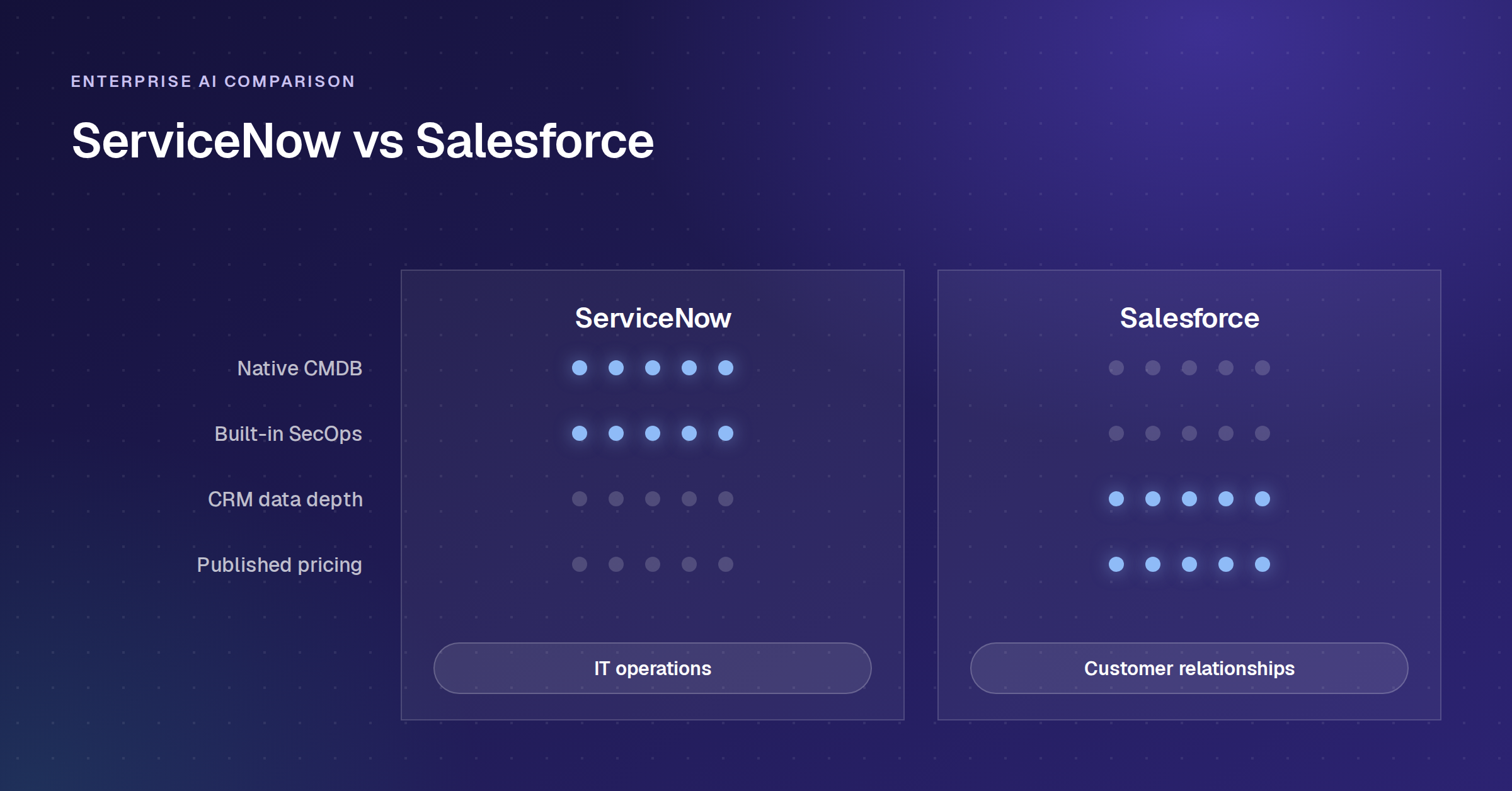
.fs-cmsfilter_active span { color: black; }
table of contents

Transform complex support workflows

Deploy AI inside your existing support stack and prove business impact quickly.
Request a Demo

ServiceNow vs Salesforce: Battle of the Enterprise Platforms

ServiceNow and Salesforce used to be easy to tell apart. ServiceNow ran IT operations. Salesforce ran customer relationships. In any serious ServiceNow vs Salesforce evaluation today, both platforms look fundamentally different..ServiceNow acquired Moveworks for $2.85 billion, launched EmployeeWorks with 100+ content integrations, and shipped an AI-powered CRM. Meanwhile, Salesforce pushed Agentforce into autonomous resolution, expanded Data Cloud with zero-copy connectors to external data, and is staking a claim in ITSM. Both now compete for the AI service automation buyer.

Native AI on both platforms has expanded well beyond their original boundaries. But enterprises often find that critical knowledge still spans more systems than a single platform can realistically unify: Confluence, SharePoint, Slack threads, Jira tickets, and Google Drive. This guide compares ServiceNow and Salesforce through the lens of what each platform's native AI can realistically resolve, where gaps remain, and when an agentic AI layer makes sense.

AI Support Agents
table of contents

The Short Answer

If your primary needs are IT operations and internal services, ServiceNow is the stronger platform. Its ITSM suite has no real competitor, and the Moveworks acquisition has made its AI stack the strongest in the market for employee-facing automation. If customer-facing service and CRM are the priority, Salesforce is the better fit. Twenty-five years of customer data depth gives its AI a structural advantage for support interactions that depend on knowing the full customer relationship.

If your stack spans both platforms, or your knowledge spans more systems than either platform can natively unify, an agentic AI layer like Enjo that sits on top of whichever platform you choose is worth evaluating. The comparison below breaks down where each platform wins, where native AI encounters gaps, and what your options are.

What is ServiceNow?

ServiceNow started in IT service management and grew into an enterprise workflow engine for internal operations. Think of it as the system that keeps the back office running: ITSM (incident, problem, change, request management, CMDB), HR Service Delivery, Customer Service Management, Field Service Management, Security Operations, and Governance/Risk/Compliance.

The platform uses a multi-instance architecture, so each customer gets a dedicated instance rather than sharing infrastructure. That matters for compliance-heavy industries where data isolation is non-negotiable.

The AI story changed dramatically in 2025 and 2026. The Moveworks acquisition brought conversational AI and enterprise search. Otto (announced in May 2026) is designed to unify these capabilities into a single interface. The Autonomous Workforce introduces AI specialists for end-to-end roles like the L1 service desk.

What is Salesforce?

Salesforce is the world's largest CRM platform, and everything about it revolves around customer data. Sales Cloud, Service Cloud, Marketing Cloud, Commerce Cloud, and Data Cloud all connect through a shared customer record. Every team sees the same customer, from the first marketing touch through the latest support ticket.

The platform runs on a multi-tenant architecture: shared infrastructure, isolated data. It scales well, but means customization works differently than on ServiceNow's dedicated-instance model.

Salesforce's AI strategy centers on Agentforce (autonomous agents that act on customer data), Data Cloud (unified data access, including external sources), and the Atlas Reasoning Engine. The company is also pushing into ITSM territory with Agentforce IT Service, a direct challenge to ServiceNow's core

ServiceNow vs Salesforce: A Detailed Comparison

Dimension ServiceNow Salesforce
G2 reviews ITSM reviews · CSM reviews Agentforce Service reviews · Platform reviews
Core identity Enterprise workflow engine for internal operations CRM platform for customer-facing operations
Architecture Multi-instanceDedicated infrastructure per customer Multi-tenantShared infrastructure, isolated data
ITSM Market leader. Full suite: incident, problem, change, CMDB, asset management New entrant via Agentforce IT Service. No native CMDB or change management
CRM New. AI-powered CRM launched 2025 Market leader. 25 years of depth
Security & compliance Built-in SecOps, GRC, vulnerability management Data encryption, MFA, GDPR/HIPAA. Relies more on third-party integrations for advanced SecOps
AI stack Now Assist + EmployeeWorks (Moveworks) + Otto + Autonomous Workforce Agentforce + Data Cloud / Data 360 + Atlas Reasoning Engine
Knowledge the AI reaches ServiceNow KB + 100+ external sources via EmployeeWorks Salesforce KB + external sources via Data Cloud connectors
Pricing model Per-user subscription + AI tier uplift. No public pricing Per-user subscription + per-conversation AI. Tiers at salesforce.com
Implementation High complexity. Certified admins, SI partner, ~5 months average per G2 High complexity. Salesforce consultants, Data Cloud + Agentforce setup

IT operations is ServiceNow's home turf, and nobody else comes close. The ITSM suite is purpose-built and tightly integrated with everything on the platform. Salesforce's entry into ITSM through Agentforce IT Service is in its early stages and lacks the operational backbone that ServiceNow has spent years refining. If IT ops is your primary need, this part of the decision makes itself.

Customer-facing service tilts toward Salesforce. The agent sees purchase history, renewal timelines, marketing engagement, and prior interactions in a single view. ServiceNow CSM handles cross-department coordination well (support + engineering + field service), but it doesn't carry the relationship context Salesforce inherits from Sales and Marketing Cloud. When teams evaluate ServiceNow vs Salesforce for customer service, it usually comes down to whether the challenge is operational coordination or customer relationship depth.

HR, field service, and sales are converging. ServiceNow has the stronger HR product (HRSD is purpose-built). Salesforce has the more mature customer-facing field service offering. For sales and order management, Salesforce's Sales Cloud with CPQ has years of depth that ServiceNow hasn't matched yet. These areas overlap more with every release cycle. Check current capabilities directly before making a call based on any single one.

Security and compliance lean on ServiceNow. Built-in SecOps, GRC, and vulnerability management provide security teams with a single platform for compliance tracking and incident response. Salesforce covers platform-level security well, but relies more on third-party tools for security operations.

Both platforms are expensive and take months to deploy. G2 reviewers for servicenow describe ServiceNow as "complex to implement," with deployments averaging roughly 5 months. G2 reviewers for Salesforce note that "licensing and add-on costs can increase quickly" and call the platform "complex, especially for new users or smaller organizations." Third-party analysis suggests that total Salesforce costs frequently exceed the list price once implementation, admin overhead, and integrations are accounted for.

Pricing: What You'll Actually Pay

Both platforms are known for total costs running well beyond the initial quote. Here's how the math works.
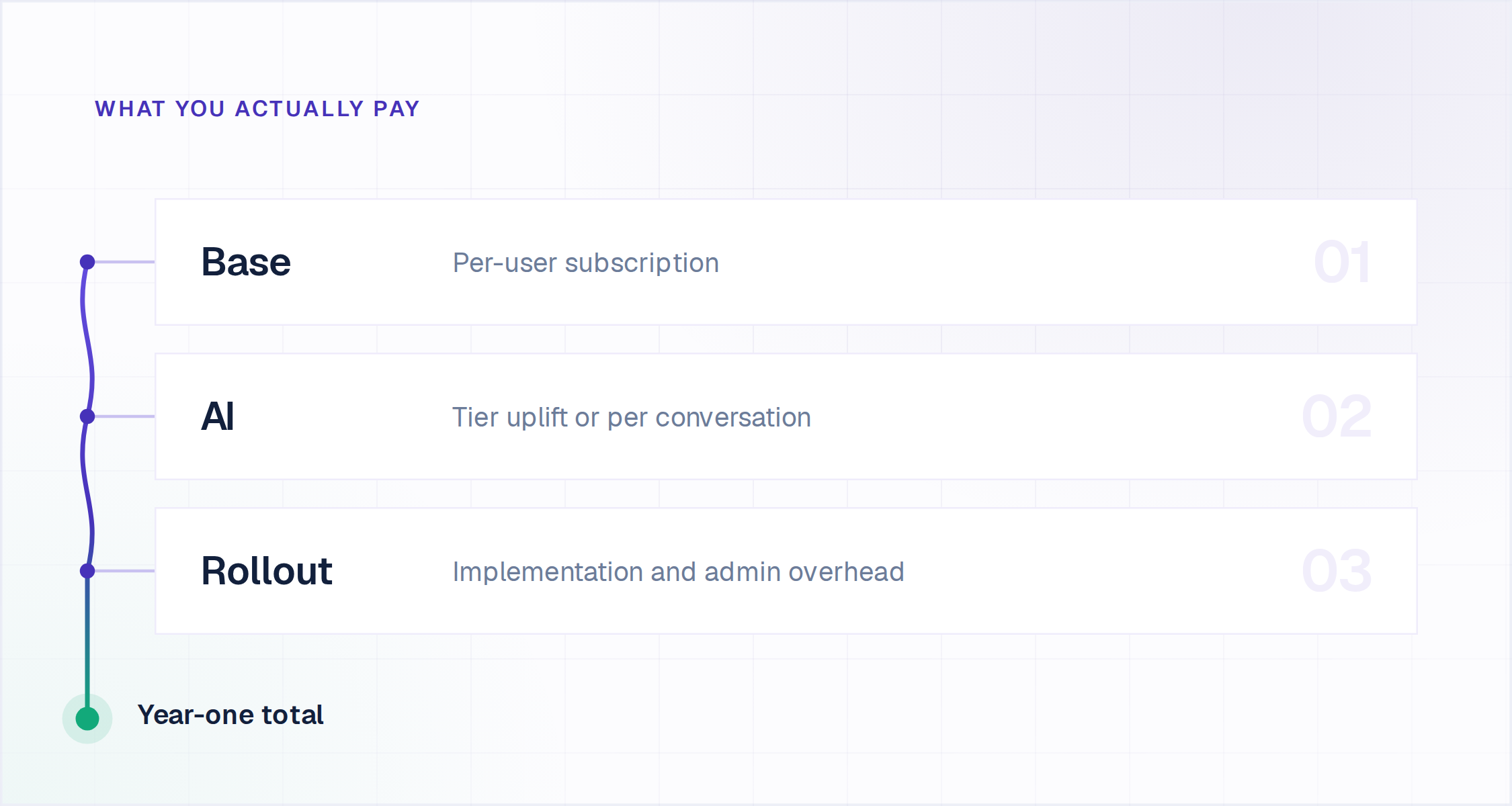
ServiceNow does not publish pricing. Every contract is custom-quoted. The base comes in Standard, Pro, and Enterprise tiers, priced per user. Now Assist requires Pro or Enterprise. Third-party estimates put the AI add-on at $25-$75/fulfiller/month. EmployeeWorks adds further unpublished licensing. On top of that, budget for SI partner fees and certified admin overhead.

Salesforce publishes base tiers (verify at salesforce.com). Enterprise starts at $165/user/month. Agentforce charges $ 2 per conversation or ~$0.10/action. Data Cloud adds variable cost. Third-party analysis notes that real costs frequently exceed the list price after implementation, with MuleSoft licensing and admin overhead factored in.

Cost Component ServiceNow Salesforce
Base Platform Custom-quoted per user $165/user/month (Enterprise)
AI Add-on Now Assist (~$25–$75 per fulfiller/month) + EmployeeWorks Agentforce ($2/conversation) + Data Cloud
25 People: Base Alone Not publicly published ~$49,500/year
25 People: Base + AI + Implementation Six figures+ (third-party estimate) Six figures+ (third-party estimate)
100 People: Base Alone Not publicly published ~$198,000/year
100 People: Base + AI + Implementation $300K–$600K+ (third-party estimate) $150K–$425K+ (third-party estimate)

Salesforce pricing is based on publicly available list pricing. ServiceNow pricing is generally custom quoted. AI and implementation estimates are indicative and may vary based on deployment scope, usage, and negotiated contracts.

ServiceNow vs Salesforce for AI Service Automation
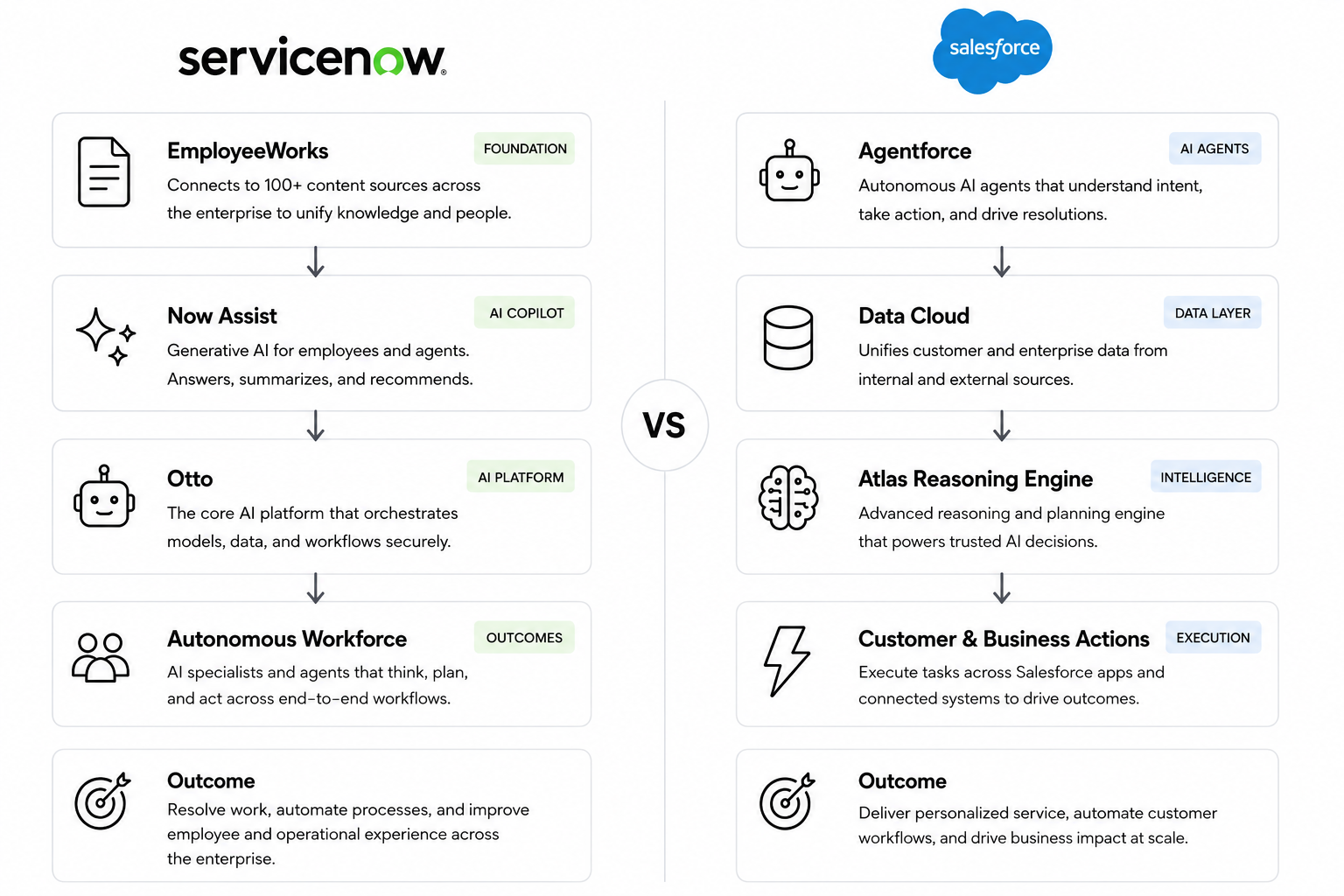
ServiceNow vs Salesforce AI comparison showing EmployeeWorks, Now Assist, Agentforce, Data Cloud, and enterprise AI service automation capabilities.

This is the Now Assist vs Agentforce comparison, and it's where the decision gets genuinely interesting.

ServiceNow's AI stack is the strongest enterprise play for internal service automation. EmployeeWorks reads from 100+ content sources, including SharePoint, Google Drive, Slack, and Outlook. Otto (announced in May 2026) aims to bring Now Assist, Moveworks, and AI Experience together into a single interface. The Autonomous Workforce assigns AI specialists to end-to-end roles, such as L1 service desk (currently in controlled availability). ServiceNow frames this as fixing "AI working in compartmentalized isolation," and the Moveworks acquisition gives the claim real substance.

Salesforce's AI stack is the strongest for customer-facing automation. Agentforce runs multi-step workflows anchored in deep customer data. Data Cloud pulls in external sources through zero-copy connectors. The Atlas Reasoning Engine handles complex decisions, and Agent Builder gives teams a low-code path to custom agents. If your AI needs to understand who the customer is across sales, marketing, and service, Agentforce starts with a structural advantage.

Where they overlap: both now read beyond their own data. Both offer autonomous agents. Both add AI cost on top of the base platform.

Where they diverge: ServiceNow's AI fits most naturally around IT workflows and the employee experience. Salesforce's AI fits most naturally around customer interactions and CRM data. When the use case drifts outside each platform's core, the fit gets less comfortable.

What can each platform's AI actually automate?

ServiceNow Now Assist + EmployeeWorks Salesforce Agentforce + Data Cloud Platform Agnostic Enjo
Resolution
IT Incident Resolution Native. Full ITSM integration with CMDB context. Limited. No native ITSM backbone. Resolves common IT requests in Slack/Teams and escalates to ServiceNow or Jira.
Customer Case Resolution Customer Service Management workflows with operations focus. Native customer support with deep CRM context. Resolves using knowledge across systems and escalates to Salesforce or Zendesk.
Knowledge & Actions
Knowledge Sources ServiceNow Knowledge Base plus 100+ external sources via EmployeeWorks. Salesforce Knowledge with external sources through Data Cloud. Confluence, SharePoint, Google Drive, Jira, Slack, ServiceNow, Salesforce and more.
Cross-System Actions ServiceNow objects through IntegrationHub. Salesforce objects through MuleSoft. Okta, Azure AD, Google Workspace, Jira, ServiceNow, Salesforce and custom APIs.
Channels & Surfaces
Employee Channels ServiceNow Portal, EmployeeWorks, Slack and Teams. Salesforce Console, Embedded Chat and Slack. Slack, Microsoft Teams, Email and Web Chat.
Agent Assist Now Assist inside ServiceNow Workspace. Einstein and Agentforce within Salesforce Console. Embeds inside both ServiceNow and Salesforce workspaces.
Self-Service Portal ServiceNow Portal with EmployeeWorks. Service Cloud Portal with Agentic Portal. AI-native Help Center with automatic article generation.
Fit & Limitations
Strongest For IT workflows, employee services and CMDB-aware automation. Customer support powered by CRM data. Cross-platform AI resolution spanning multiple enterprise systems.
Limitations Knowledge and actions outside the Now Platform. Knowledge and actions outside Salesforce. No native ITSM, CRM, CMDB or Change Management capabilities.

Feature comparison based on publicly available platform capabilities as of 2026. Actual functionality may vary based on licensed editions, integrations, and custom implementations.

Both native AI stacks require significant investment and months of setup. And while both have expanded their reach, enterprises often find that knowledge and actions still span more systems than either platform covers alone. Both platforms are also strongest at assisting human agents with summaries, suggestions, and drafts. Fully autonomous resolution, where the AI understands the request, pulls knowledge, takes action in Okta, Jira, or Azure AD, and closes the loop without a human, is where the gap widens.

Agentic AI That Works Across Your Entire Stack

Most enterprise service requests don't just need an answer. They need action: a password reset, a ticket created, access provisioned, and a workflow triggered. Agentic AI resolves these requests end-to-end by understanding the request, pulling knowledge from wherever it lives, executing actions across systems, and closing the loop without handing off to a human.

The platform you pick stays as the system of record. Agentic AI sits on top.It doesn't just surface information. It resolves requests and takes action across systems that your platform's native AI can't reach on its own.

Enjo is an agentic AI that autonomously resolves service requests by pulling knowledge and executing actions across your full stack.
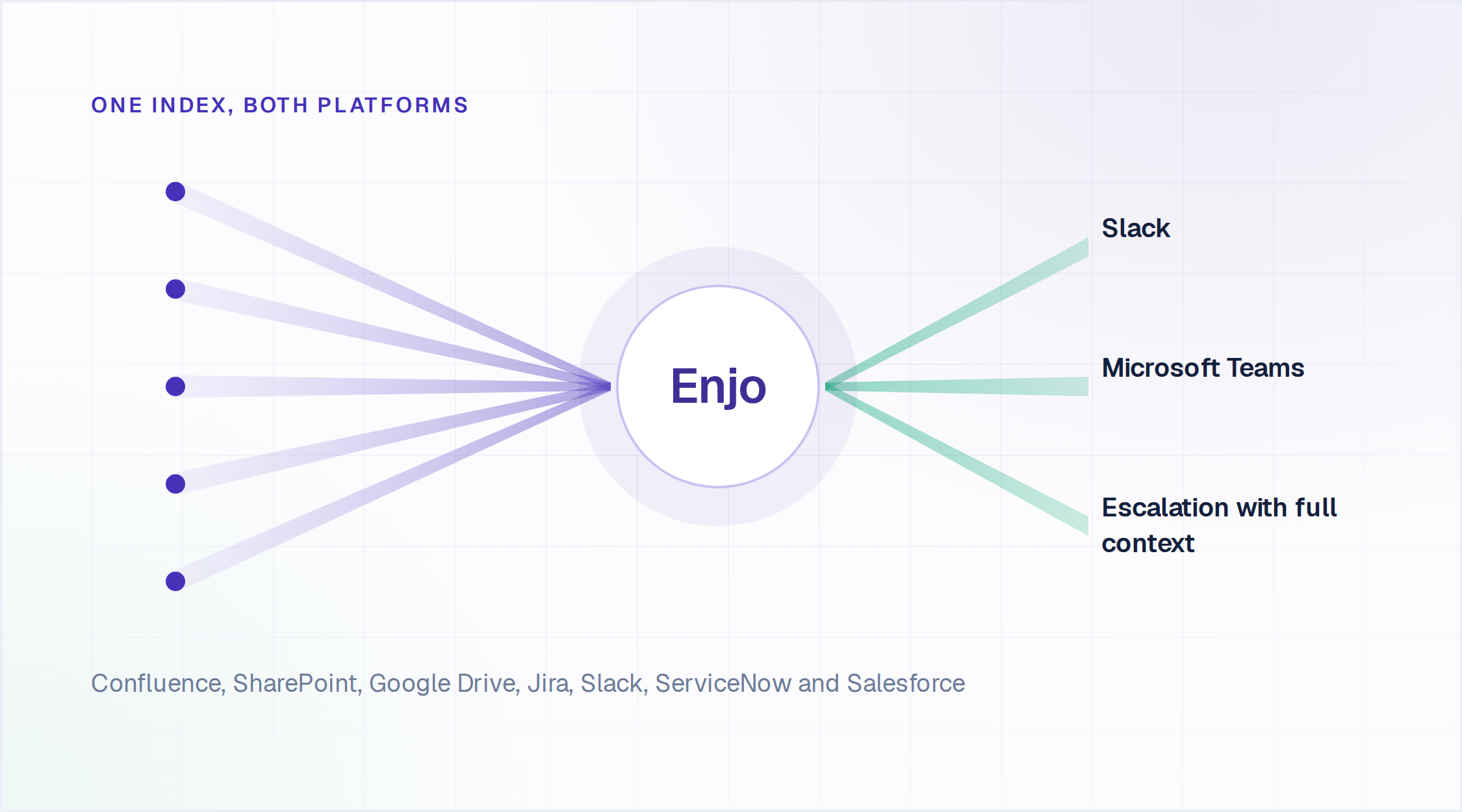
If you chose ServiceNow: Enjo's AI Agents autonomously resolve employee requests in Slack and Teams, pulling knowledge from Confluence, SharePoint, Google Drive, and your ServiceNow KB, then taking action in Okta, Jira, or Azure AD when the request requires it. Agent Assist embeds in your ServiceNow workspace for tickets that need a human touch. ServiceNow stays the system of record.

If you chose Salesforce: AI Agents resolve customer and employee requests using knowledge from Confluence, Jira, Slack, and your Salesforce KB, and take action across connected systems. Agent Assist embeds inside your Salesforce workspace. Salesforce stays in the system of record.

If you run both, AI Agents resolve across both environments. One knowledge index, Agent Assist in both workspaces, actions executed across both platforms' connected systems, escalation to whichever helpdesk owns the workflow.

Why teams add Enjo alongside native AI

ServiceNow Salesforce Enjo
Pricing Model Per-user licensing with AI add-ons. Per-user licensing with AI consumption pricing. Usage-based pricing per AI reply.
Free Tier No Limited Yes — 200 AI replies/month with unlimited seats.
Implementation Typically several months. Typically several months. Typically completed in days.
Platform Expertise Required Certified administrators or SI partners. Salesforce administrators or consultants. No specialist expertise required. Self-service onboarding.
AI Investment Portability Tied to the ServiceNow platform. Tied to the Salesforce platform. Platform-agnostic. Works across existing enterprise systems.

Comparison reflects general platform positioning and publicly available pricing models as of 2026.

DEPLOY IN DAYS, NOT QUARTERS

Curious what Enjo would resolve on your actual support queue?

Bring your ticket history. We'll map your top request types, show which knowledge sources cover them, and give you an automation estimate — no commitment, no implementation, no consultants required

Book a demo  →

Final Verdict

ServiceNow and Salesforce are both excellent platforms, and for their core use cases, the choice is clear. ServiceNow for IT operations, ITSM, and internal service orchestration. Salesforce for customer-facing service, CRM, and the full customer lifecycle. The native AI on each platform is strong and improving fast.

The nuance is in AI service automation. Both have expanded their AI's reach well beyond their original boundaries, but most enterprises still find that knowledge, workflows, and actions span more systems than any one platform can cover on its own. The question isn't whether ServiceNow or Salesforce has good AI. Both do. The question is whether that AI can reach everything it needs in your specific environment.

If your knowledge and workflows extend beyond a single platform, an agentic AI layer like Enjo can complement your choice by autonomously resolving requests across systems that native AI doesn't reach. It works alongside ServiceNow, Salesforce, or both. The platform stays. The AI resolves broader.

FAQ

Q : Can ServiceNow handle customer service, or is that only Salesforce?

A : Both can, but they approach it differently. ServiceNow CSM works best when resolution requires coordination across IT, engineering, and field service. Salesforce Service Cloud is built for interactions that depend on customer relationship context. ServiceNow also launched a CRM recently, though it's early compared to Salesforce's 25-year head start. The right choice in a ServiceNow vs Salesforce customer service evaluation depends on whether the challenge is operational coordination or relationship depth.

Q: Is a Now Assist vs Agentforce comparison the right way to evaluate?

A : Only partially. Now Assist is one piece of ServiceNow's AI alongside EmployeeWorks, Otto, and the Autonomous Workforce. Agentforce is one piece of Salesforce's alongside Data Cloud and Atlas. The full ServiceNow Salesforce comparison on AI means looking at the complete stacks, not individual products.

Q :What changed with the Moveworks acquisition?

A : A lot. ServiceNow gained conversational AI, enterprise search across 100+ external content sources, and the groundwork for Otto and the Autonomous Workforce.

Q : Can you run both platforms with unified AI?

A : Yes, and many enterprises do. IT on ServiceNow, CS on Salesforce. Each platform's native AI covers its own domain. A platform-agnostic layer like Enjo can complement both by unifying knowledge and resolution across the full environment.
The Short Answer

If your primary needs are IT operations and internal services, ServiceNow is the stronger platform. Its ITSM suite has no real competitor, and the Moveworks acquisition has made its AI stack the strongest in the market for employee-facing automation. If customer-facing service and CRM are the priority, Salesforce is the better fit. Twenty-five years of customer data depth gives its AI a structural advantage for support interactions that depend on knowing the full customer relationship.

If your stack spans both platforms, or your knowledge spans more systems than either platform can natively unify, an agentic AI layer like Enjo that sits on top of whichever platform you choose is worth evaluating. The comparison below breaks down where each platform wins, where native AI encounters gaps, and what your options are.

What is ServiceNow?

ServiceNow started in IT service management and grew into an enterprise workflow engine for internal operations. Think of it as the system that keeps the back office running: ITSM (incident, problem, change, request management, CMDB), HR Service Delivery, Customer Service Management, Field Service Management, Security Operations, and Governance/Risk/Compliance.

The platform uses a multi-instance architecture, so each customer gets a dedicated instance rather than sharing infrastructure. That matters for compliance-heavy industries where data isolation is non-negotiable.

The AI story changed dramatically in 2025 and 2026. The Moveworks acquisition brought conversational AI and enterprise search. Otto (announced in May 2026) is designed to unify these capabilities into a single interface. The Autonomous Workforce introduces AI specialists for end-to-end roles like the L1 service desk.

What is Salesforce?

Salesforce is the world's largest CRM platform, and everything about it revolves around customer data. Sales Cloud, Service Cloud, Marketing Cloud, Commerce Cloud, and Data Cloud all connect through a shared customer record. Every team sees the same customer, from the first marketing touch through the latest support ticket.

The platform runs on a multi-tenant architecture: shared infrastructure, isolated data. It scales well, but means customization works differently than on ServiceNow's dedicated-instance model.

Salesforce's AI strategy centers on Agentforce (autonomous agents that act on customer data), Data Cloud (unified data access, including external sources), and the Atlas Reasoning Engine. The company is also pushing into ITSM territory with Agentforce IT Service, a direct challenge to ServiceNow's core

ServiceNow vs Salesforce: A Detailed Comparison

Dimension ServiceNow Salesforce
G2 reviews ITSM reviews · CSM reviews Agentforce Service reviews · Platform reviews
Core identity Enterprise workflow engine for internal operations CRM platform for customer-facing operations
Architecture Multi-instanceDedicated infrastructure per customer Multi-tenantShared infrastructure, isolated data
ITSM Market leader. Full suite: incident, problem, change, CMDB, asset management New entrant via Agentforce IT Service. No native CMDB or change management
CRM New. AI-powered CRM launched 2025 Market leader. 25 years of depth
Security & compliance Built-in SecOps, GRC, vulnerability management Data encryption, MFA, GDPR/HIPAA. Relies more on third-party integrations for advanced SecOps
AI stack Now Assist + EmployeeWorks (Moveworks) + Otto + Autonomous Workforce Agentforce + Data Cloud / Data 360 + Atlas Reasoning Engine
Knowledge the AI reaches ServiceNow KB + 100+ external sources via EmployeeWorks Salesforce KB + external sources via Data Cloud connectors
Pricing model Per-user subscription + AI tier uplift. No public pricing Per-user subscription + per-conversation AI. Tiers at salesforce.com
Implementation High complexity. Certified admins, SI partner, ~5 months average per G2 High complexity. Salesforce consultants, Data Cloud + Agentforce setup

IT operations is ServiceNow's home turf, and nobody else comes close. The ITSM suite is purpose-built and tightly integrated with everything on the platform. Salesforce's entry into ITSM through Agentforce IT Service is in its early stages and lacks the operational backbone that ServiceNow has spent years refining. If IT ops is your primary need, this part of the decision makes itself.

Customer-facing service tilts toward Salesforce. The agent sees purchase history, renewal timelines, marketing engagement, and prior interactions in a single view. ServiceNow CSM handles cross-department coordination well (support + engineering + field service), but it doesn't carry the relationship context Salesforce inherits from Sales and Marketing Cloud. When teams evaluate ServiceNow vs Salesforce for customer service, it usually comes down to whether the challenge is operational coordination or customer relationship depth.

HR, field service, and sales are converging. ServiceNow has the stronger HR product (HRSD is purpose-built). Salesforce has the more mature customer-facing field service offering. For sales and order management, Salesforce's Sales Cloud with CPQ has years of depth that ServiceNow hasn't matched yet. These areas overlap more with every release cycle. Check current capabilities directly before making a call based on any single one.

Security and compliance lean on ServiceNow. Built-in SecOps, GRC, and vulnerability management provide security teams with a single platform for compliance tracking and incident response. Salesforce covers platform-level security well, but relies more on third-party tools for security operations.

Both platforms are expensive and take months to deploy. G2 reviewers for servicenow describe ServiceNow as "complex to implement," with deployments averaging roughly 5 months. G2 reviewers for Salesforce note that "licensing and add-on costs can increase quickly" and call the platform "complex, especially for new users or smaller organizations." Third-party analysis suggests that total Salesforce costs frequently exceed the list price once implementation, admin overhead, and integrations are accounted for.

Pricing: What You'll Actually Pay

Both platforms are known for total costs running well beyond the initial quote. Here's how the math works.

ServiceNow does not publish pricing. Every contract is custom-quoted. The base comes in Standard, Pro, and Enterprise tiers, priced per user. Now Assist requires Pro or Enterprise. Third-party estimates put the AI add-on at $25-$75/fulfiller/month. EmployeeWorks adds further unpublished licensing. On top of that, budget for SI partner fees and certified admin overhead.

Salesforce publishes base tiers (verify at salesforce.com). Enterprise starts at $165/user/month. Agentforce charges $ 2 per conversation or ~$0.10/action. Data Cloud adds variable cost. Third-party analysis notes that real costs frequently exceed the list price after implementation, with MuleSoft licensing and admin overhead factored in.

Cost Component ServiceNow Salesforce
Base Platform Custom-quoted per user $165/user/month (Enterprise)
AI Add-on Now Assist (~$25–$75 per fulfiller/month) + EmployeeWorks Agentforce ($2/conversation) + Data Cloud
25 People: Base Alone Not publicly published ~$49,500/year
25 People: Base + AI + Implementation Six figures+ (third-party estimate) Six figures+ (third-party estimate)
100 People: Base Alone Not publicly published ~$198,000/year
100 People: Base + AI + Implementation $300K–$600K+ (third-party estimate) $150K–$425K+ (third-party estimate)

Salesforce pricing is based on publicly available list pricing. ServiceNow pricing is generally custom quoted. AI and implementation estimates are indicative and may vary based on deployment scope, usage, and negotiated contracts.

ServiceNow vs Salesforce for AI Service Automation

ServiceNow vs Salesforce AI comparison showing EmployeeWorks, Now Assist, Agentforce, Data Cloud, and enterprise AI service automation capabilities.

This is the Now Assist vs Agentforce comparison, and it's where the decision gets genuinely interesting.

ServiceNow's AI stack is the strongest enterprise play for internal service automation. EmployeeWorks reads from 100+ content sources, including SharePoint, Google Drive, Slack, and Outlook. Otto (announced in May 2026) aims to bring Now Assist, Moveworks, and AI Experience together into a single interface. The Autonomous Workforce assigns AI specialists to end-to-end roles, such as L1 service desk (currently in controlled availability). ServiceNow frames this as fixing "AI working in compartmentalized isolation," and the Moveworks acquisition gives the claim real substance.

Salesforce's AI stack is the strongest for customer-facing automation. Agentforce runs multi-step workflows anchored in deep customer data. Data Cloud pulls in external sources through zero-copy connectors. The Atlas Reasoning Engine handles complex decisions, and Agent Builder gives teams a low-code path to custom agents. If your AI needs to understand who the customer is across sales, marketing, and service, Agentforce starts with a structural advantage.

Where they overlap: both now read beyond their own data. Both offer autonomous agents. Both add AI cost on top of the base platform.

Where they diverge: ServiceNow's AI fits most naturally around IT workflows and the employee experience. Salesforce's AI fits most naturally around customer interactions and CRM data. When the use case drifts outside each platform's core, the fit gets less comfortable.

What can each platform's AI actually automate?

ServiceNow Now Assist + EmployeeWorks Salesforce Agentforce + Data Cloud Platform Agnostic Enjo
Resolution
IT Incident Resolution Native. Full ITSM integration with CMDB context. Limited. No native ITSM backbone. Resolves common IT requests in Slack/Teams and escalates to ServiceNow or Jira.
Customer Case Resolution Customer Service Management workflows with operations focus. Native customer support with deep CRM context. Resolves using knowledge across systems and escalates to Salesforce or Zendesk.
Knowledge & Actions
Knowledge Sources ServiceNow Knowledge Base plus 100+ external sources via EmployeeWorks. Salesforce Knowledge with external sources through Data Cloud. Confluence, SharePoint, Google Drive, Jira, Slack, ServiceNow, Salesforce and more.
Cross-System Actions ServiceNow objects through IntegrationHub. Salesforce objects through MuleSoft. Okta, Azure AD, Google Workspace, Jira, ServiceNow, Salesforce and custom APIs.
Channels & Surfaces
Employee Channels ServiceNow Portal, EmployeeWorks, Slack and Teams. Salesforce Console, Embedded Chat and Slack. Slack, Microsoft Teams, Email and Web Chat.
Agent Assist Now Assist inside ServiceNow Workspace. Einstein and Agentforce within Salesforce Console. Embeds inside both ServiceNow and Salesforce workspaces.
Self-Service Portal ServiceNow Portal with EmployeeWorks. Service Cloud Portal with Agentic Portal. AI-native Help Center with automatic article generation.
Fit & Limitations
Strongest For IT workflows, employee services and CMDB-aware automation. Customer support powered by CRM data. Cross-platform AI resolution spanning multiple enterprise systems.
Limitations Knowledge and actions outside the Now Platform. Knowledge and actions outside Salesforce. No native ITSM, CRM, CMDB or Change Management capabilities.

Feature comparison based on publicly available platform capabilities as of 2026. Actual functionality may vary based on licensed editions, integrations, and custom implementations.

Both native AI stacks require significant investment and months of setup. And while both have expanded their reach, enterprises often find that knowledge and actions still span more systems than either platform covers alone. Both platforms are also strongest at assisting human agents with summaries, suggestions, and drafts. Fully autonomous resolution, where the AI understands the request, pulls knowledge, takes action in Okta, Jira, or Azure AD, and closes the loop without a human, is where the gap widens.

Agentic AI That Works Across Your Entire Stack

Most enterprise service requests don't just need an answer. They need action: a password reset, a ticket created, access provisioned, and a workflow triggered. Agentic AI resolves these requests end-to-end by understanding the request, pulling knowledge from wherever it lives, executing actions across systems, and closing the loop without handing off to a human.

The platform you pick stays as the system of record. Agentic AI sits on top.It doesn't just surface information. It resolves requests and takes action across systems that your platform's native AI can't reach on its own.

Enjo is an agentic AI that autonomously resolves service requests by pulling knowledge and executing actions across your full stack.

If you chose ServiceNow: Enjo's AI Agents autonomously resolve employee requests in Slack and Teams, pulling knowledge from Confluence, SharePoint, Google Drive, and your ServiceNow KB, then taking action in Okta, Jira, or Azure AD when the request requires it. Agent Assist embeds in your ServiceNow workspace for tickets that need a human touch. ServiceNow stays the system of record.

If you chose Salesforce: AI Agents resolve customer and employee requests using knowledge from Confluence, Jira, Slack, and your Salesforce KB, and take action across connected systems. Agent Assist embeds inside your Salesforce workspace. Salesforce stays in the system of record.

If you run both, AI Agents resolve across both environments. One knowledge index, Agent Assist in both workspaces, actions executed across both platforms' connected systems, escalation to whichever helpdesk owns the workflow.

Why teams add Enjo alongside native AI

ServiceNow Salesforce Enjo
Pricing Model Per-user licensing with AI add-ons. Per-user licensing with AI consumption pricing. Usage-based pricing per AI reply.
Free Tier No Limited Yes — 200 AI replies/month with unlimited seats.
Implementation Typically several months. Typically several months. Typically completed in days.
Platform Expertise Required Certified administrators or SI partners. Salesforce administrators or consultants. No specialist expertise required. Self-service onboarding.
AI Investment Portability Tied to the ServiceNow platform. Tied to the Salesforce platform. Platform-agnostic. Works across existing enterprise systems.

Comparison reflects general platform positioning and publicly available pricing models as of 2026.

DEPLOY IN DAYS, NOT QUARTERS

Curious what Enjo would resolve on your actual support queue?

Bring your ticket history. We'll map your top request types, show which knowledge sources cover them, and give you an automation estimate — no commitment, no implementation, no consultants required

Book a demo  →

Final Verdict

ServiceNow and Salesforce are both excellent platforms, and for their core use cases, the choice is clear. ServiceNow for IT operations, ITSM, and internal service orchestration. Salesforce for customer-facing service, CRM, and the full customer lifecycle. The native AI on each platform is strong and improving fast.

The nuance is in AI service automation. Both have expanded their AI's reach well beyond their original boundaries, but most enterprises still find that knowledge, workflows, and actions span more systems than any one platform can cover on its own. The question isn't whether ServiceNow or Salesforce has good AI. Both do. The question is whether that AI can reach everything it needs in your specific environment.

If your knowledge and workflows extend beyond a single platform, an agentic AI layer like Enjo can complement your choice by autonomously resolving requests across systems that native AI doesn't reach. It works alongside ServiceNow, Salesforce, or both. The platform stays. The AI resolves broader.

FAQ

Q : Can ServiceNow handle customer service, or is that only Salesforce?

A : Both can, but they approach it differently. ServiceNow CSM works best when resolution requires coordination across IT, engineering, and field service. Salesforce Service Cloud is built for interactions that depend on customer relationship context. ServiceNow also launched a CRM recently, though it's early compared to Salesforce's 25-year head start. The right choice in a ServiceNow vs Salesforce customer service evaluation depends on whether the challenge is operational coordination or relationship depth.

Q: Is a Now Assist vs Agentforce comparison the right way to evaluate?

A : Only partially. Now Assist is one piece of ServiceNow's AI alongside EmployeeWorks, Otto, and the Autonomous Workforce. Agentforce is one piece of Salesforce's alongside Data Cloud and Atlas. The full ServiceNow Salesforce comparison on AI means looking at the complete stacks, not individual products.

Q :What changed with the Moveworks acquisition?

A : A lot. ServiceNow gained conversational AI, enterprise search across 100+ external content sources, and the groundwork for Otto and the Autonomous Workforce.

Q : Can you run both platforms with unified AI?

A : Yes, and many enterprises do. IT on ServiceNow, CS on Salesforce. Each platform's native AI covers its own domain. A platform-agnostic layer like Enjo can complement both by unifying knowledge and resolution across the full environment.
Transform complex support workflows

Deploy AI inside your existing support stack and prove business impact quickly.
Request a Demo