Transform complex support workflows
ManageEngine vs ServiceNow (2026): Pricing, AI, Rollout
ManageEngine vs ServiceNow, compared on pricing, capabilities, and rollout speed, plus the AI layer that runs on top of whichever ITSM you keep.
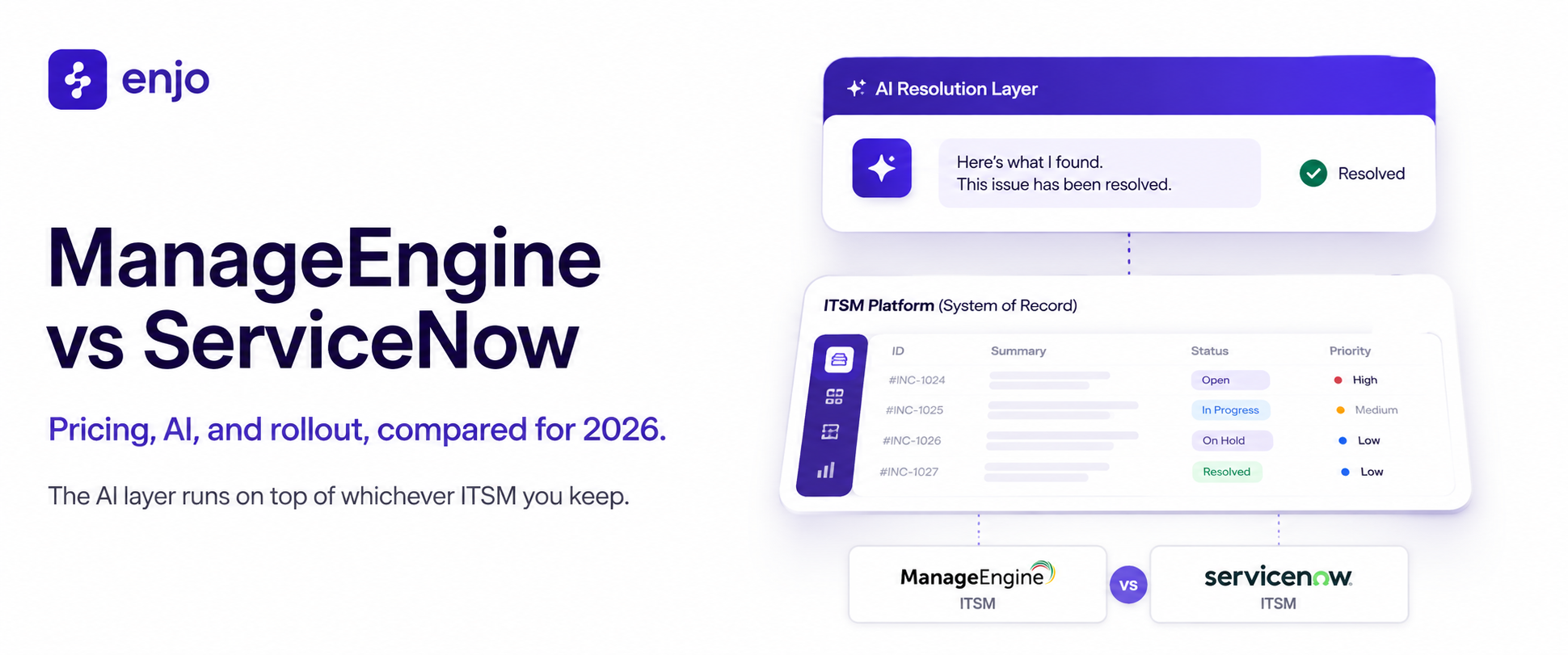
Most teams that type "manageengine vs servicenow" into a search bar are really asking two questions at once. Which platform runs our tickets, and what does the bill look like once it does? Both are fair questions with clean answers, depending on the size of your IT organization. The part that the top comparison pages tend to skip is the decision hiding inside that first one: in 2026, the software that actually resolves a ticket is a separate purchase from the platform that stores it. By the end, you will know which platform fits your team, and how to choose the AI layer independently of it. ManageEngine vs ServiceNow, compared on pricing, capabilities, and rollout speed, plus the AI layer that runs on top of whichever ITSM you keep.
The short answer
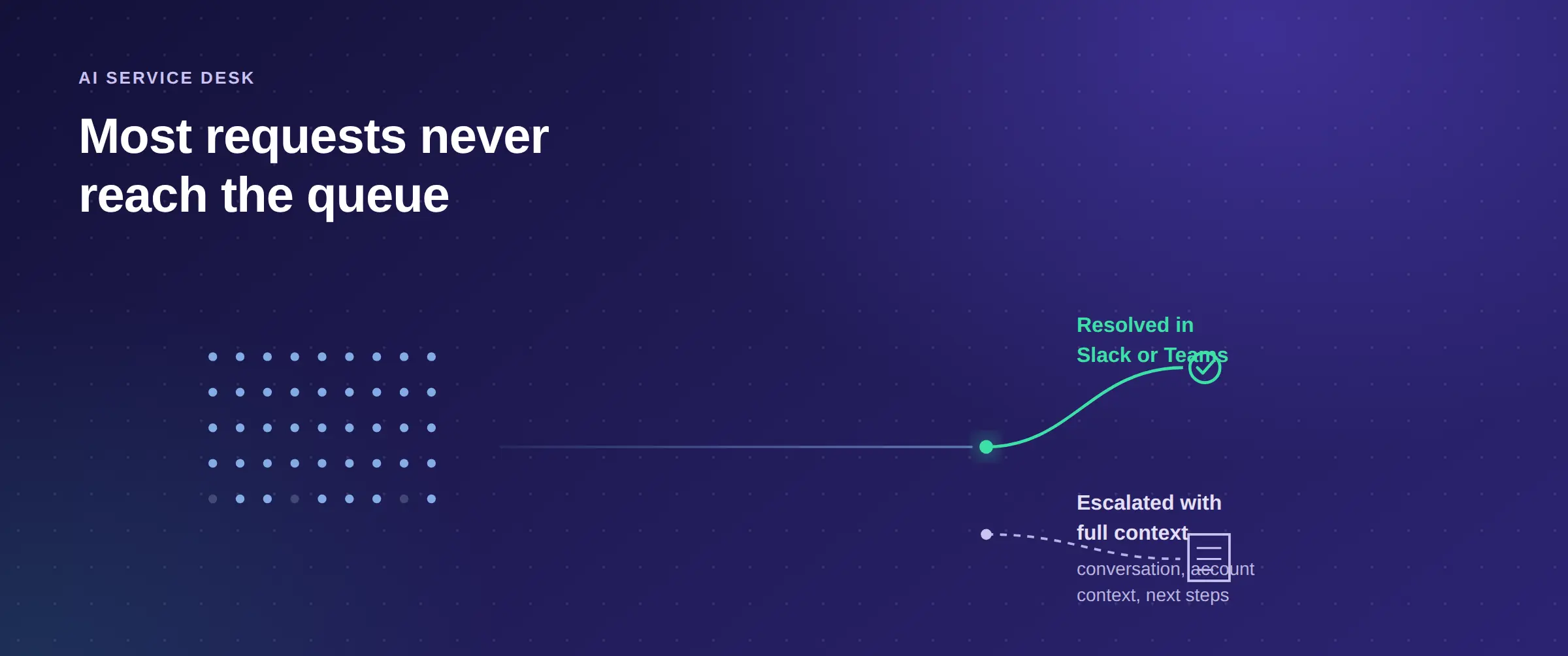
ManageEngine ServiceDesk Plus is the safer pick for mid-market IT that wants solid, ITIL-aligned ticketing and asset management live in weeks, on a price you can read straight off the page. ServiceNow is built for the enterprise, consolidating IT, HR, and security into a single governed platform, with the budget and rollout runway to match. Either way, the AI that closes your repetitive L1 queue is a separate decision, and it does not have to come from your ticketing vendor. Aurora, an autonomous vehicle company with 2,500 employees, put an AI layer in front of its IT queue and now resolves 63% of requests autonomously, with 45% faster resolution overall. Teams that treat the AI as its own call get moving fast.
ManageEngine ServiceDesk Plus at a glance
ManageEngine ServiceDesk Plus is a focused IT service desk. You license it per technician; end users are unlimited; and pricing is public: Standard starts at $13 per technician per month, Professional at $27, and Enterprise at $67, billed annually for the cloud edition (source and date in the flags below). There is a genuine free tier, the Standard edition for up to five technicians, which is more than most vendors give away. It runs on the cloud or on-premises, which still matters to regulated teams that want to hold their own data.
The catch is the add-on model. Standard is ticketing only. The moment you need real ITIL processes, the modules come as separate line items: CMDB, service catalog, problem management, and project management. Each adds around $1,195 per year, and change and release management runs about $2,395. So the sticker price and the price of a complete, ITIL-mature setup are two different numbers, and the gap widens as you turn on more processes. For a team that mostly needs clean ticketing and asset tracking without an enterprise procurement cycle, that trade is usually worth it.
ServiceNow at a glance
ServiceNow is the enterprise standard, and it behaves like one. The Now Platform is the system of record for IT, HR, security operations, and customer service under a single governance model, which is exactly why large organizations standardize on it and rarely leave. In April 2026, the company repackaged its ITSM licensing into three AI-native tiers, Foundation, Advanced, and Prime, with its Now Assist generative AI bundled into every one of them. The important detail for anyone comparing on AI: the fully autonomous ITSM agents, the ones that diagnose and close L1 tickets end-to-end, sit only in the top Prime tier. Lower tiers get summaries and suggestions, not autonomous resolution. Read the full breakdown in the ServiceNow AI Agents buyers guide.
There is also a 2026 wrinkle that reshuffles the AI conversation. ServiceNow completed its roughly $2.85 billion acquisition of Moveworks in December 2025 and now folds a Moveworks package into each ITSM tier, so its answer to "which AI closes the ticket" increasingly points back to its own platform. Pricing is where ServiceNow diverges hardest from ManageEngine. It publishes no public figures. Every deal is a custom quote shaped by module mix, fulfiller count, and support tier, and implementation typically runs three to five times the first-year license with a six to twelve-month timeline. Third-party analysts peg ITSM licensing in a wide $70 to $200-plus per fulfiller per month range, but those are estimates, not stated prices.
ManageEngine vs ServiceNow: the feature comparison
Here is how the two platforms line up on the dimensions that decide the outcome, with the AI layer broken out as its own column, because choosing AI service desk software is now a separate decision from choosing the platform of record.
ServiceNow is the opposite experience. There is no price list, so the only real number comes from a quote, and the sticker is only part of it. Independent procurement data puts the average ServiceNow contract near $130,000 a year, with implementation and professional services often adding fifty to a hundred percent on top of first-year licensing, plus annual uplift clauses that push the cost up at renewal. Now Assist AI usage is metered against consumption pools on top of that. None of this makes ServiceNow a bad platform. It makes it an enterprise platform, priced and staffed like one.
For contrast on the AI layer itself, Enjo is usage-based rather than seat-based: a free tier with 200 AI replies a month, unlimited human agent seats, and no credit card required, then $95 a month for 1,000 replies and 5 cents per reply beyond that. You can point it at real tickets before anyone signs a purchase order.
The decision underneath the decision: your AI layer
Both vendors answer the same question, "which platform runs our tickets," and both answer it well for the team they are built for. The question they quietly merge into that one is different: which software actually resolves the request so a human never has to? For most mid-market IT teams, that is the expensive, repetitive slice: password resets, software access, VPN issues, "where do I file this?" It is also the slice you can hand to AI today without ripping out the helpdesk underneath.
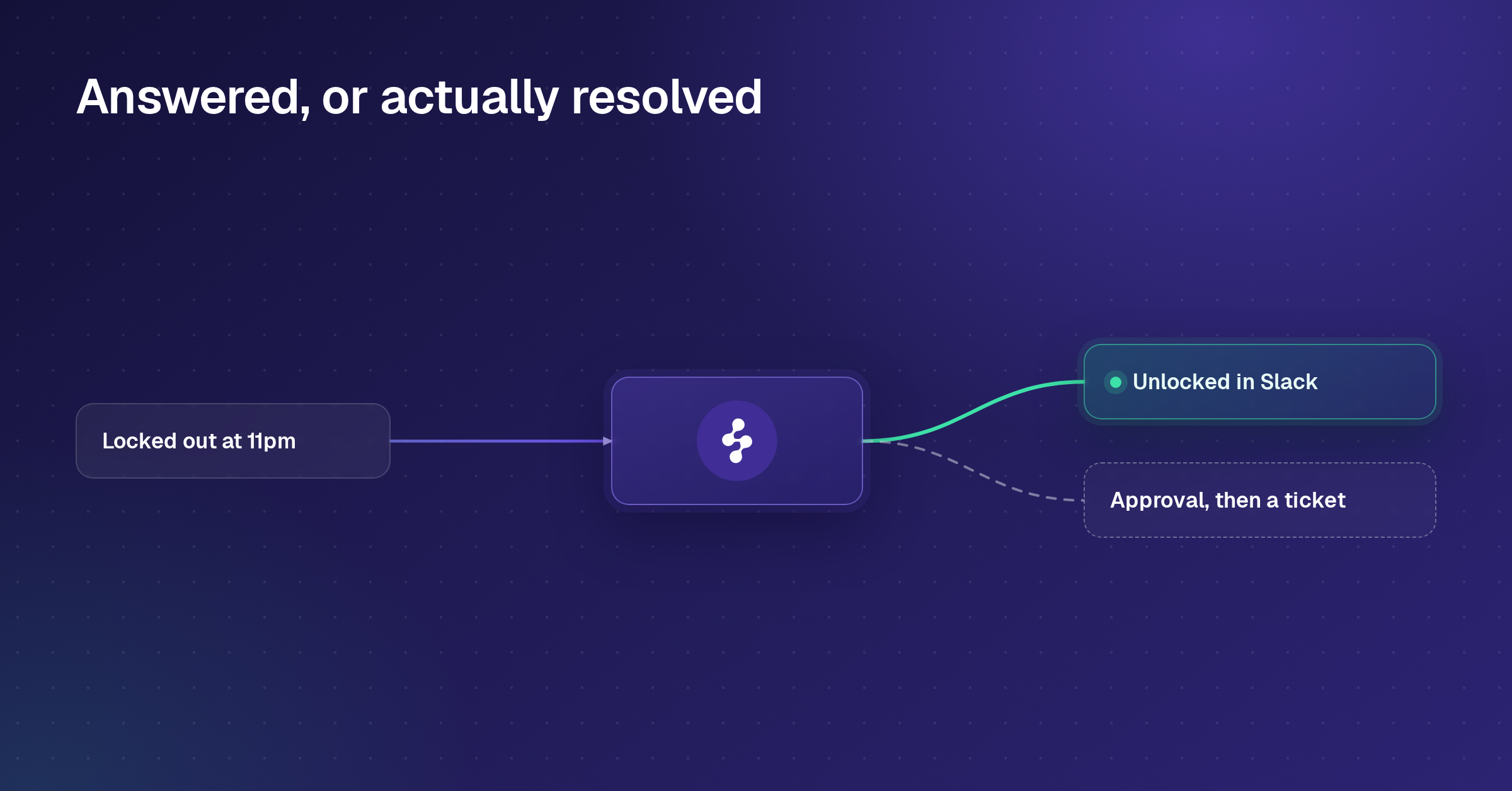
That is the gap Enjo fills, and it is why the AI layer is worth treating as its own choice. Enjo's AI Agents resolve those L1 requests end-to-end inside Slack and Teams, where employees already are. AI Actions run the real operation, clearing a locked Okta account, provisioning access, creating or updating a Jira or ServiceNow ticket, and AI Flows handle the multi-step cases with explicit fallbacks when the agent is not confident. When something genuinely needs a person, it escalates into your existing helpdesk with the full conversation attached, and Agent Assist surfaces the summary and suggested reply inside the agent's view. Guardrails, a full audit log, and RBAC keep it inside policy, which is the first thing your CISO will ask about. On that last point, Netflix's own engineering team cleared Enjo through internal security review before rolling it out.
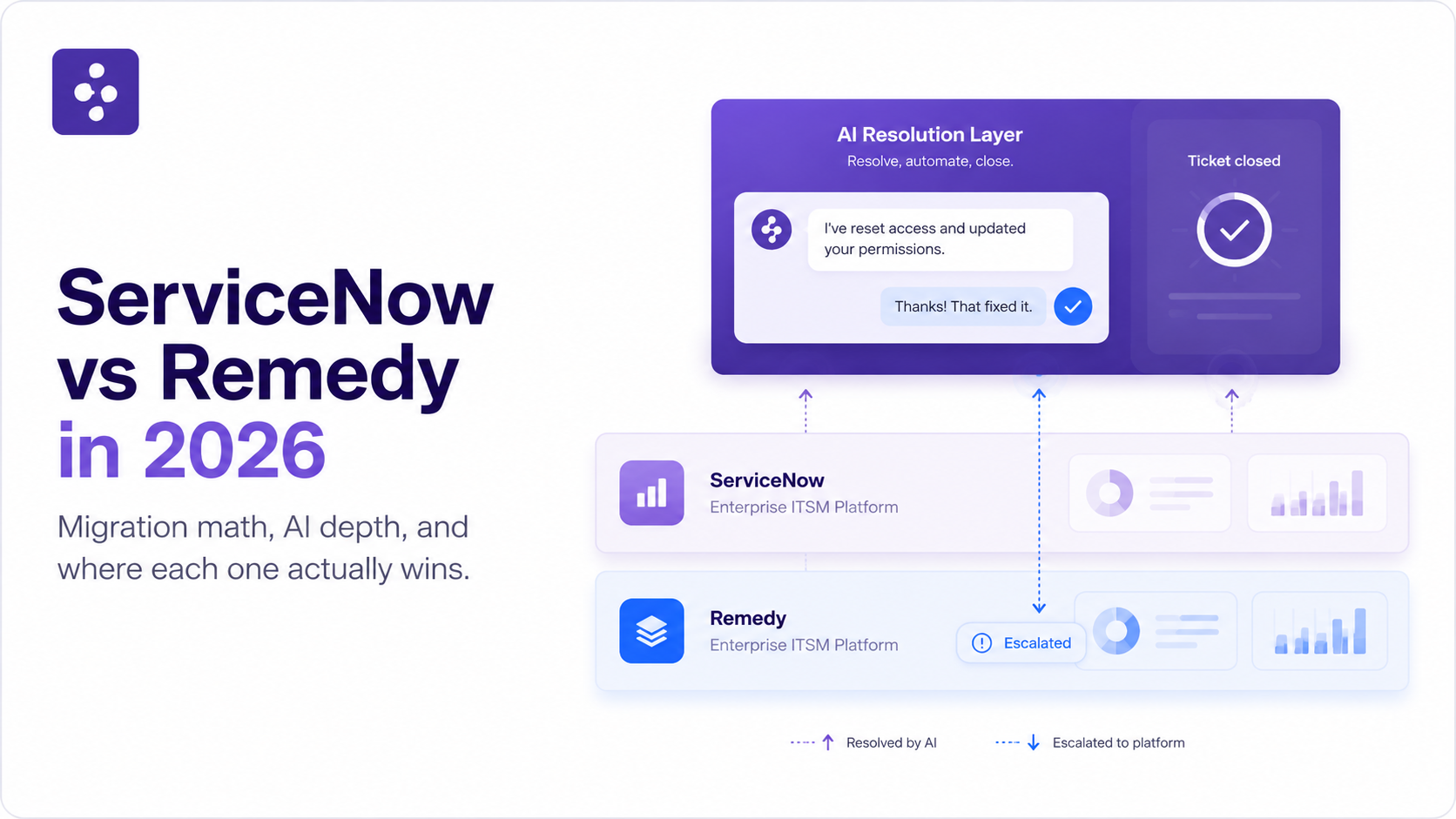
One honest note on fit. Enjo connects natively to ServiceNow, Jira, Zendesk, Freshservice, and Salesforce. For ManageEngine ServiceDesk Plus, it connects through custom API actions rather than a prebuilt connector, so confirm that path for your setup during a demo. The point holds either way: the resolution layer sits on top of the platform you already run, so you are adding AI, not migrating. This is the honest answer for anyone shopping for ManageEngine or ServiceNow alternatives, assuming the fix has to be a different ticketing platform. Often it does not. You choose your AI service desk software on its own and leave the system of record alone.
This is the same pattern behind the strongest results in the best IT automation software this year. Delivery Hero runs IT support across 95,000-plus employees in 70-plus countries on a Jira-and-Slack stack, and after adding this layer, reported 30% deflection and 80% faster response times. It works because the AI IT support sits in the channel people use and reads the knowledge that actually answers the question, wherever that knowledge lives.
Where each option wins
No platform is the right answer for everyone. Here is the honest read on when each one is the call.
The verdict
Pick ManageEngine ServiceDesk Plus if you are mid-market IT and want predictable, ITIL-aligned service management to live fast. Pick ServiceNow if you are an enterprise standardizing many functions on one platform and can resource it properly. Then treat the AI that closes your L1 queue as its own decision, because it is one, and it is the fastest lever you have on cost and response time. You can test that layer on your own tickets, on top of the helpdesk you already run, before committing to anything.