Transform complex support workflows
Internal Knowledge Base Software: 10 Tools Compared
Can one article be visible to HR and hidden from Engineering, inside the same internal knowledge base, without standing up a second site?
That question decides internal knowledge base rollouts, and it appears on almost no comparison page. Search the term and Google mostly returns general "best knowledge base software" roundups written for published help centers. We re-ran the search before publishing this and the top results were still general roundups.
The questions that actually settle an internal deployment are narrower. Does it sync with Okta or Entra ID? Do contractors burn a paid seat? And will employees really ask in Slack, rather than learning a portal they will visit twice?
Every entry carries one honest weakness, ours included, and ours is a real one. Compare 10 internal knowledge base software tools on permissions, identity sync and where employees ask, then book a demo on your own directory.
The Verdict
One question splits this list. Do you need many people co-authoring pages, or a curated library employees can query? If it is co-authoring, you want a wiki, and Confluence or Notion is the honest answer. If it is a curated library that answers questions where employees already work, Enjo is our pick. Employees ask in Slack and Teams rather than in a portal nobody visits.
What Is Internal Knowledge Base Software, and How Is It Different?
Internal buyers arrive with different questions than customer-facing ones. These four come up in nearly every evaluation.
What is internal knowledge base software?
Internal knowledge base software publishes process, policy and troubleshooting content to employees rather than customers. The content differs from a help center, and so does the architecture. Access is gated by identity, visibility is controlled per group, and the audience is a captive one that will not tolerate a bad search experience. If budget is the binding constraint, our comparison of free knowledge base software separates real free plans from trials.
What is the difference between an internal knowledge base and a company wiki?
A wiki is optimised for many people writing. An internal knowledge base is optimised for many people reading. Wikis accumulate pages of varying quality and rely on social convention to stay current. A knowledge base curates a smaller published set with named owners. Most companies need both, and most try to force one tool to be both.
Can one tool serve both employees and customers?
Some can, but treat it as a separate purchase rather than a discount. The audiences want different content, different access rules and different review cycles, and a tool that is excellent at one is rarely excellent at both. Buy for the deployment you are doing now and judge the tool on that job alone.
How do you stop an internal knowledge base from going stale?
Named owners, review dates and a loop that surfaces gaps. The failure pattern is always the same: a big migration, six enthusiastic months, then two years of decay. What prevents it is a mechanism that tells you which articles are wrong, not a reminder to check.
Is Internal Knowledge Base Software Just a Help Center with a Login?
Four things change when the reader is on your payroll. Each one quietly eliminates tools that look perfectly good on a feature list.
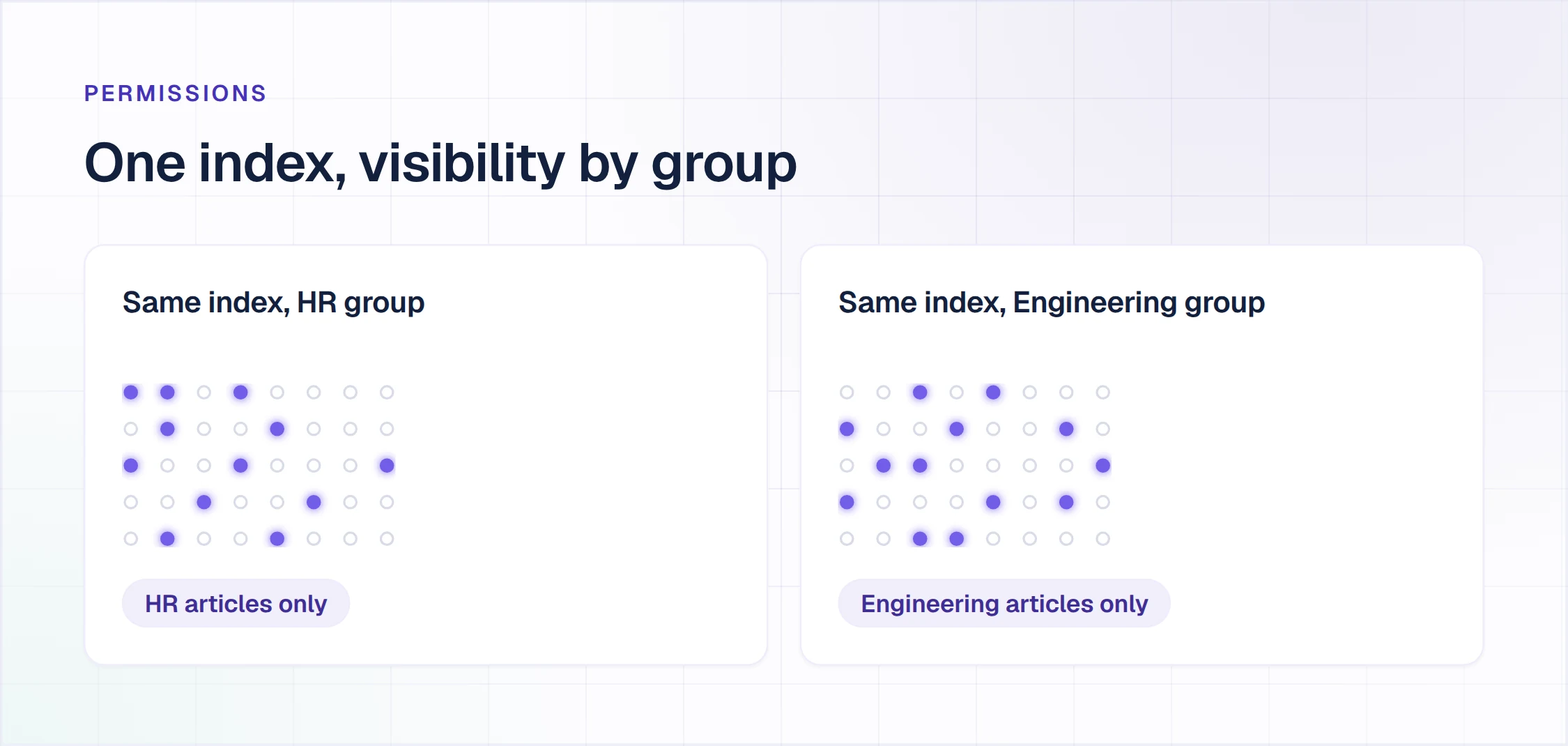
Permission granularity. A public help center has almost no access rules to enforce. An internal one needs a salary band document visible to HR and invisible to everyone else, inside the same article set, without a separate site. Tools that only do whole-site or whole-space permissions will force you into workarounds within a month.
Identity integration. Employees should not have another password. Directory sync through Okta, Entra ID, Google Workspace or SCIM is what makes onboarding and offboarding safe. Without it, your knowledge base becomes a list of ex-employees with access.
Where people ask moves. Employees do not visit portals. They ask in Slack or Teams, or they ask a colleague. An internal knowledge base that only answers inside its own web interface competes with the path of least resistance and loses.
The content is process documentation. Policy, approvals, troubleshooting runbooks, onboarding. None of it changes when the product ships; it changes when the business does, so the maintenance rhythm is different.
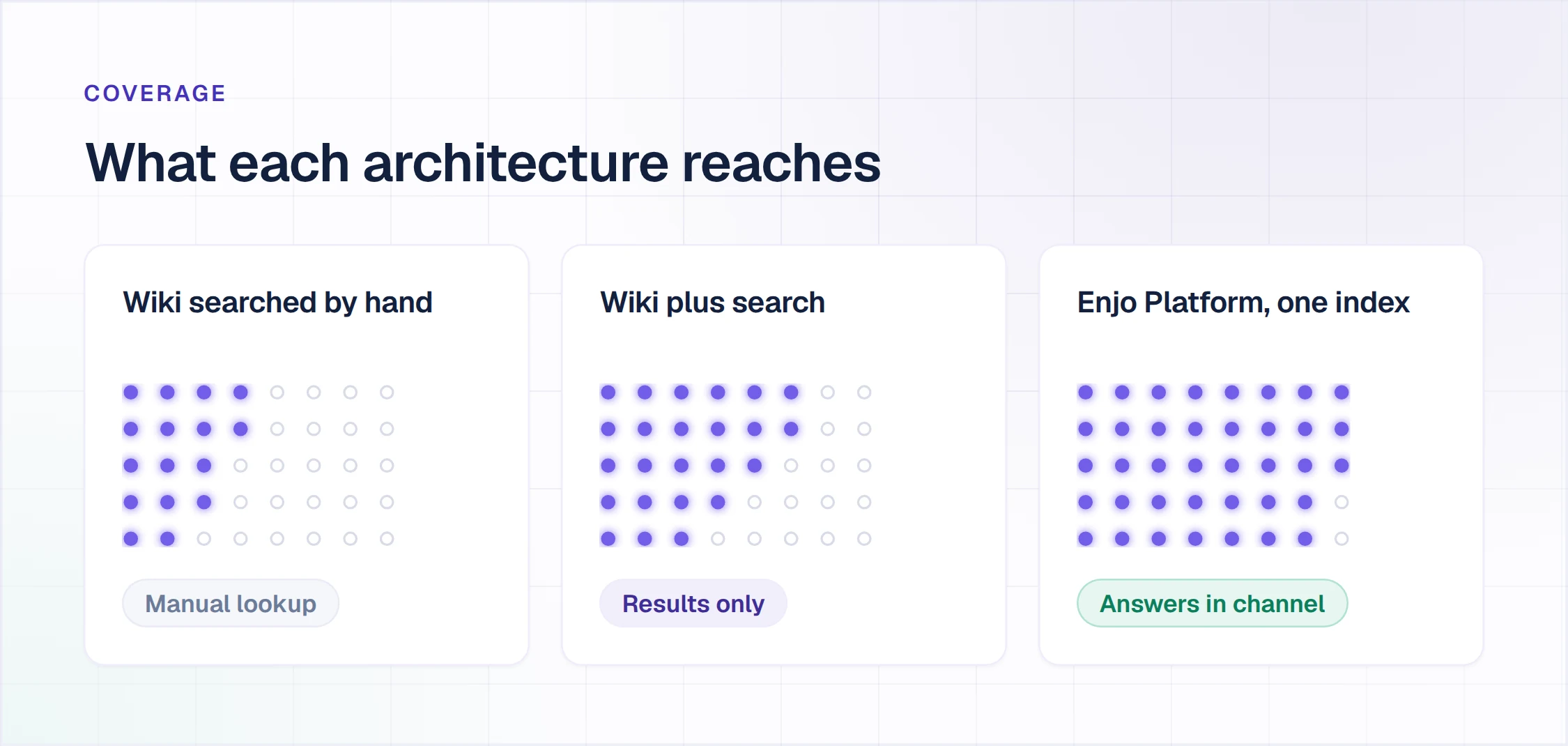
Mid-market IT teams describe the same starting position almost word for word. Knowledge is already sprawled across Confluence, Notion, Google Drive, SharePoint and past tickets, and there is usually an existing knowledge base nobody trusts. Any tool that demands you migrate all of it before it delivers anything will stall before the quarter ends.
Internal Knowledge Base Tools Compared
Permissions and where employees ask decide internal rollouts, so those are the columns rather than article templates and themes. Identity sync details sit in each entry below.
| Tool | G2 | Permission Granularity | Where Employees Ask |
|---|---|---|---|
| Enjo | 4.8 | Role, segment and login state | Slack, Teams, email, web |
| Confluence | 4.1 | Space and page | Web, Atlassian apps |
| Notion | 4.6 | Page level | Web |
| Guru | 4.7 | Card and collection | Browser extension, Slack, Teams |
| Tettra | 4.5 | Page and category | Slack, web |
| Slab | 4.6 | Post and topic | Web, Slack |
| SharePoint | 4.0 | Site, library and item | Web, Teams |
| Nuclino | 4.7 | Workspace and item | Web |
| Glean | 4.7 | Inherits each source's rules | Web, Slack, Teams |
| Simpplr | 4.7 | Site and audience targeting | Web, Teams, Slack |
Who Counts as a User, and What Does SSO Cost?
Two line items decide what an internal deployment really costs, and most comparison pages skip both. One is who counts as a billable user. The other is which plan you have to reach before your identity provider is supported at all.
An internal knowledge base is read by everyone and written by a handful, and per-seat pricing bills you for the readers. On per-seat pricing you are not buying for the 8 people who maintain articles, you are buying for the 400 who read one twice a year, plus contractors, plus the people who left last quarter and were never deprovisioned. Vendors quote the per-user rate. Multiply it by the reader count before you compare anything.
Then check what tier your identity provider lands on, because SSO and SCIM usually sit on a higher plan than the one your content needs.
| Tool | What Counts As A Billable User | SSO And SCIM Tier |
|---|---|---|
| Guru | 10-seat minimum; a read-only viewer is billed at the admin rate | Enterprise, price not published |
| Tettra | 10-user minimum, capped at 100 users | Professional tier, which itself requires 50 users |
| Slab | Free to 10 users, then per user; Enterprise carries a 100-user minimum | SAML SSO and SCIM from Business, around $12.50 per user |
| Nuclino | Free stops at 50 items, then per user | SAML SSO on Business; SCIM not documented |
| Confluence | Free to 10 users, then per user across the estate | Atlassian's identity add-on, priced separately |
| Enjo | No seat minimum, and unlimited human agent seats on every plan; the bill scales with AI replies instead, so cost tracks adoption | Okta, Entra ID, Google Workspace, SAML 2.0 and SCIM |
Two patterns are worth naming. Seat minimums make small internal pilots expensive, which is the opposite of how you want to start. And the plan that fits your content is frequently not the plan that fits your security review: a 30-person IT team piloting Tettra would have to buy 50 seats to get automated provisioning.
None of this shows up until procurement. Ask both questions in the first call.
Figures read from each vendor's published plans and provisioning documentation. Seat minimums change, so confirm yours in writing before signing.
How Did We Evaluate These Internal Knowledge Base Tools?
Six checks, every one of them specific to an internal deployment. None of them appears on our general knowledge base software comparison, because none of them decides a customer-facing purchase.
- Permission granularity. Whole site, space, or single article.
- Identity and directory sync. Which providers, and does deprovisioning actually work.
- Where employees ask. Portal only, or Slack and Teams.
- Audit and compliance posture. Who viewed and edited what, and is it exportable.
- What it does with knowledge already in other systems. Index it, or demand migration.
- Read-only and contractor seat cost. Whether people who never write still cost money.
Pricing was checked on each vendor's own pricing page in 2026. Where a vendor publishes nothing, this page says so rather than repeating a third-party estimate, because estimates consistently miss seat minimums and seat minimums are what make internal deployments expensive.
Which Internal Knowledge Base Software Is Best, and for Whom?
1. Enjo, Best When Employees Should Ask in Slack or Teams
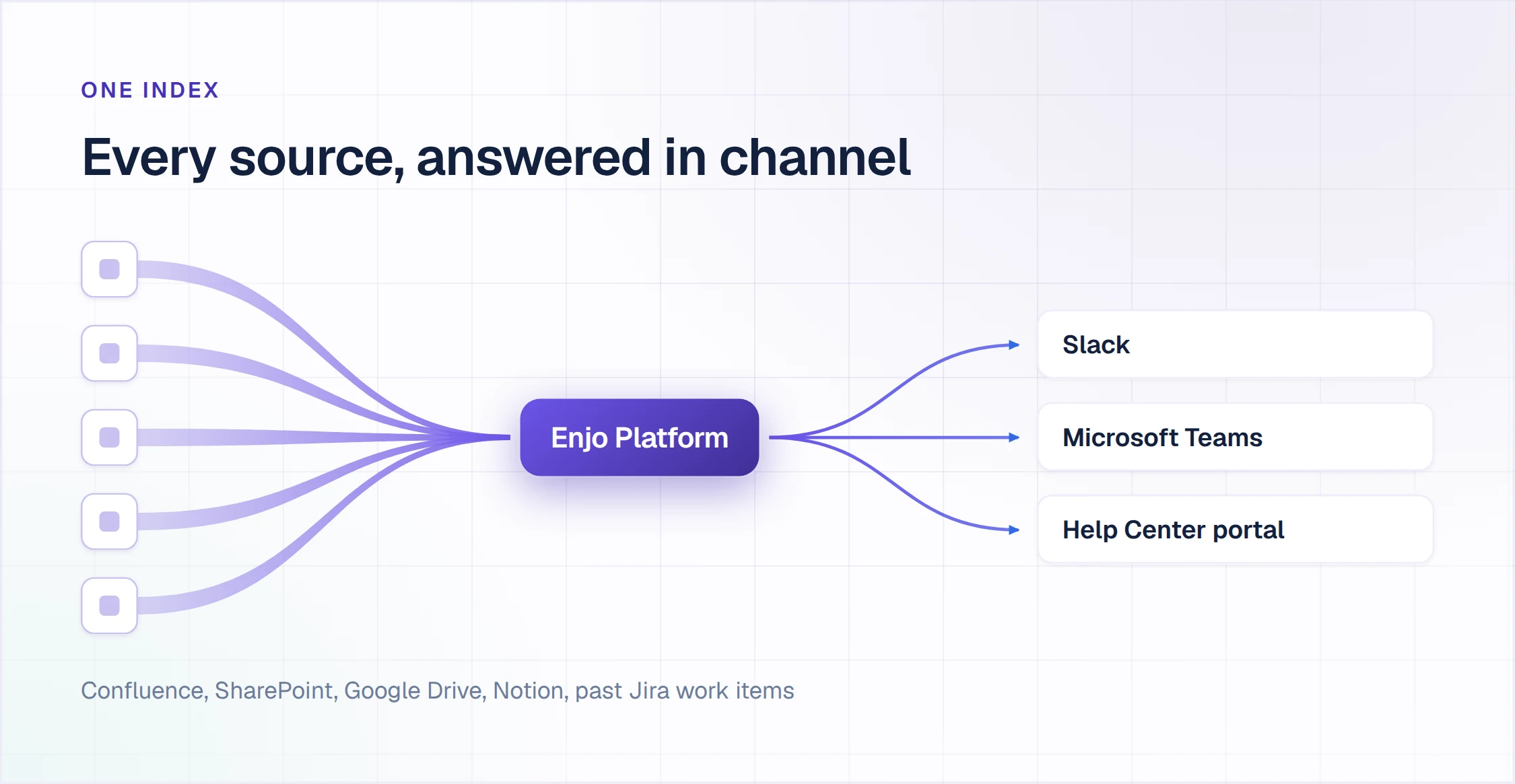
Enjo is a help center platform. Deployed internally, it is a knowledge base employees query from Slack, Microsoft Teams, email or the web rather than from a portal they have to remember, and it indexes what you already have instead of demanding a migration first.
Best for: mid-market IT and HR teams, roughly a few hundred to a few thousand employees, whose knowledge is already spread across several systems.
Key capabilities
- Indexes Confluence, SharePoint, Notion, Google Drive and past tickets rather than requiring a migration first, so value arrives before the content project finishes.
- Employees ask in Slack, Microsoft Teams, email or web, and get an answer grounded in approved internal content.
- Audience Targeting controls who sees what by role, segment, plan or login state, with single sign-on through Okta, Microsoft Entra ID, Google Workspace and generic SAML 2.0 or SCIM.
- Unlimited human agent seats on every plan including Free, so the people who staff and maintain the knowledge base are not a per-head line item.
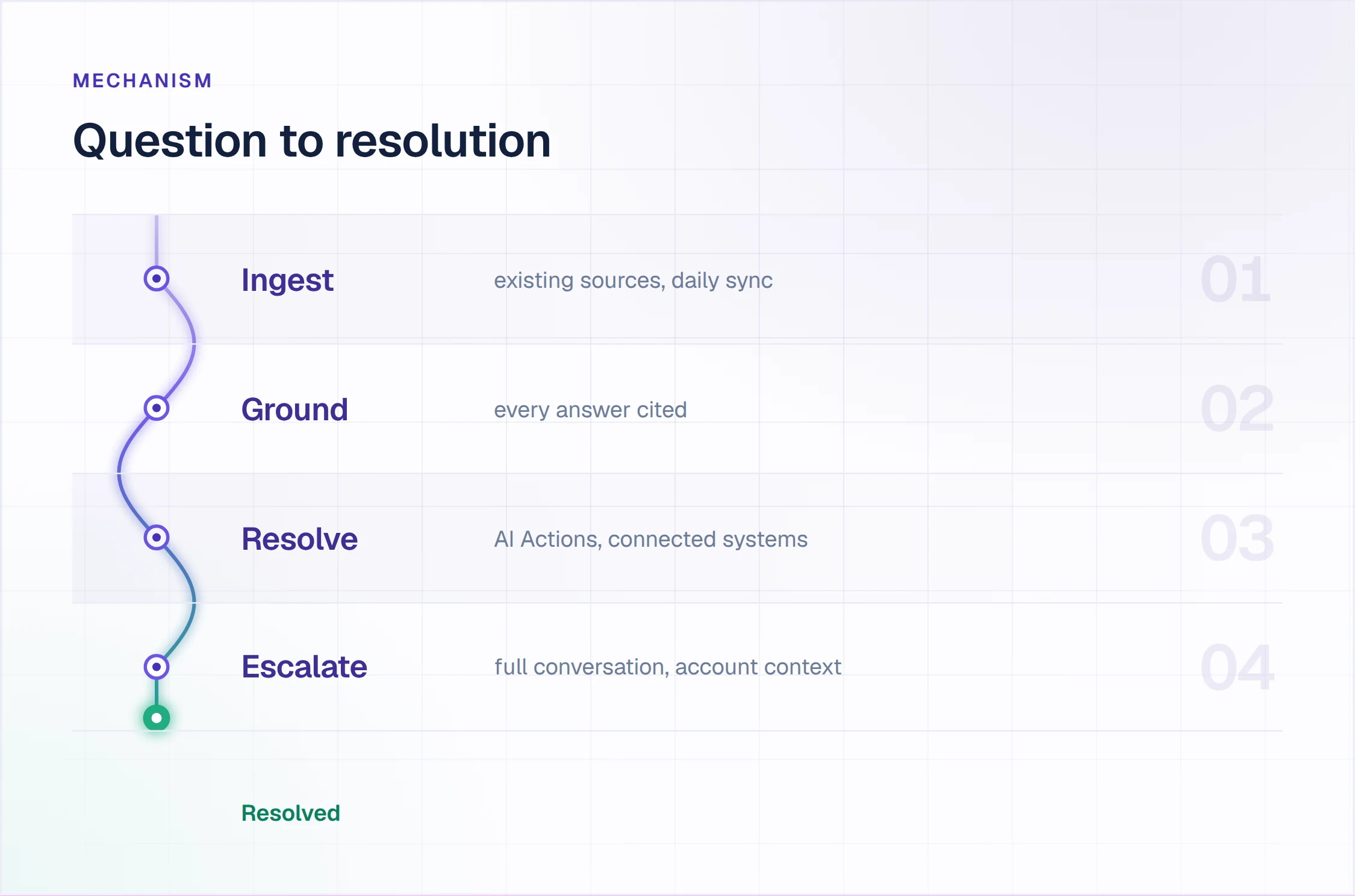
- The self-improving loop escalates unanswered questions to your team, then drafts an article from each resolved conversation for human review.
- AI Actions, from the $95 Starter plan, execute in Okta, Jira and ServiceNow, so an account unlock or an access request resolves rather than routing.
- Core Guardrails, also from Starter, plus audit trails for compliance review, backed by SOC 2 Type II, ISO 27001 and GDPR.
Pricing: the Help Center runs two tiers. Free at $0 per month with 200 AI replies, unlimited human agent seats and no credit card. Starter at $95 per month with 1,000 AI replies, adding AI Actions and Core Guardrails. Additional AI replies $0.05 each, and that meter covers every AI interaction including article generation.
What counts as one AI reply? One interaction with Enjo AI: understanding the request, responding using approved knowledge, taking actions in connected systems if needed, and escalating with full context when appropriate. A multi-turn conversation is not one reply, so model your monthly volume on interactions rather than on tickets.
Track record, stated precisely: Enjo has no named internal-knowledge-base case study yet. What exists is IT and HR employee-service track record on the same platform, which is the evidence we can stand behind. Aurora, a 2,500-employee company, reaches 63% autonomous resolution and a 60% employee satisfaction lift. Delivery Hero runs 30% deflection with 80% faster response across 95,000 employees in 70+ countries. Kraken freed 70% of HR team time and saves 450 hours a month. Treat these as platform and vertical evidence, not as internal-KB case studies.
Where it falls short: Enjo's Help Center publishes curated articles. It is not a collaborative document-editing surface, and it does not offer Confluence-style or Notion-style co-authoring. If your primary need is many people writing and editing pages together, run Confluence or Notion for authoring and put Enjo on top as the answer layer. Enjo's Help Center also launched in 2026, so it is newer than the platform's IT and HR track record.
2. Confluence, Best for Atlassian-Native Collaborative Documentation
Confluence is Atlassian's wiki, and its case rests almost entirely on already running Jira.
Best for: companies in the Atlassian estate whose teams co-author internal pages daily.
Key capabilities
- Real-time co-editing with inline comments and page approvals.
- Bidirectional links between pages and Jira issues.
- Permissions at space and page level, with anonymous access controllable per space.
- Atlassian Access adds SAML SSO and SCIM provisioning across the estate.
- Page templates covering runbooks, decision records and onboarding.
Pricing: free for up to 10 users. Paid tiers are per user; AI is confirmed on Premium.
Where it falls short: permissions stop at page level, so a single restricted paragraph inside a shared page needs a separate page instead. Search quality is the most common complaint once a space passes a few thousand pages, and finding the right document becomes the daily friction.
3. Notion, Best for Small Companies Wanting One Flexible Workspace
Notion is a flexible workspace that many companies use as their wiki by default rather than by decision.
Best for: smaller organisations willing to trade governance for keeping everything in one tool.
Key capabilities
- Freely nesting pages, so structure follows whatever the team agrees.
- Databases turn page collections into filterable views, which suits policy libraries.
- Page-level permissions, with guest access for contractors.
- SAML SSO and SCIM provisioning on Enterprise.
- Notion AI answers from workspace content on Business and above.
Pricing: $200/mo for Business with 10 members on annual billing. Guests are billed differently from members. AI requires Business or above.
Where it falls short: governance is the weak point. Nothing prevents a sensitive page being created in the wrong place with the wrong sharing, and permissions are page-based rather than article-based. Structure reliably drifts as headcount grows.
4. Guru, Best for Surfacing Verified Answers Inside Other Apps
Guru puts verified answers inside the tools employees already have open, with a verification cycle attached to every card.
Best for: teams who want knowledge to appear in the flow of work rather than in a site nobody visits.
Key capabilities
- A browser extension surfaces cards inside Salesforce, Zendesk, Gmail and similar tools.
- Every card carries a named verifier and a verification interval, making staleness visible.
- Announcements push changes to affected people and confirm they were read.
- An AI knowledge layer answers across connected sources.
- Analytics show which cards get used and which are ignored.
Pricing: quote-only, with a 10-seat minimum. Every user costs the same regardless of role, so a read-only viewer is billed like an admin.
Where it falls short: flat seat pricing punishes organisations with many occasional readers, which is exactly the shape of most internal knowledge bases. The 10-seat floor also rules out the smallest teams.
5. Tettra, Best for Small Teams Wanting Simple Verification Workflows
Tettra is a lightweight knowledge base built around Slack and a simple verification workflow.
Best for: small teams who want internal documentation with owners attached and minimal administration.
Key capabilities
- A Slack bot answers questions from the knowledge base without leaving the channel.
- Knowledge requests let anyone flag a gap, routed to a named owner.
- Page verification with an owner and an expiry, so stale pages surface.
- Categories and folders, with permissions by group.
- Integrations that pull content from Google Docs and Notion.
Pricing: Basic is $4 per user per month on annual billing, or $5 monthly, with a 10-user minimum and a 100-user cap. Scaling is $8 per user annual, $10 monthly, also with a 10-user minimum. Professional requires 50 users.
Where it falls short: the 10-user minimum means a 4-person team still pays for 10, and the 100-user cap on Basic forces a tier change as you grow. Deliberately light on structure, which becomes a constraint past a few hundred pages.
6. Slab, Best for a Clean Reading Experience Over Deep Structure
Slab is a wiki that prioritises the reading experience over administrative depth.
Best for: teams who want internal documents people will actually read end to end.
Key capabilities
- A clean reading layout that holds up for long documents.
- Unified search reaching into Slack, Google Drive, GitHub and Asana alongside Slab posts.
- Topics organise content by subject instead of a rigid folder tree.
- Post verification marks a document current, with an owner named.
- Free for up to 10 users, which is a real plan rather than a trial.
Pricing: free up to 10 users, then $125/mo. AI sits on Business at $12.50 per user.
Where it falls short: the jump from free to $125/mo at the eleventh user is abrupt for a team growing one hire at a time. Permission granularity is lighter than Confluence, so tightly restricted content is awkward.
7. SharePoint, Best for Microsoft-Committed Enterprises
SharePoint is already in the building at most Microsoft-committed organisations, which is both its strength and its problem.
Best for: enterprises standardised on Microsoft 365 where governance and retention already live in the tenant.
Key capabilities
- Permissions inherit from Entra ID, including group-based and item-level control.
- Retention, eDiscovery and DLP policies apply to knowledge content automatically.
- Deep Teams integration, so a site surfaces as a tab where people already work.
- Microsoft Search indexes SharePoint alongside Exchange and OneDrive.
- Included in most Microsoft 365 business and enterprise plans.
Pricing: typically bundled in Microsoft 365 tiers rather than bought separately. Confirm which tier your organisation holds.
Where it falls short: findability. SharePoint stores documents well and surfaces answers poorly, and building a curated employee-facing knowledge experience on top is a project with a budget, not a configuration afternoon.
8. Nuclino, Best for Lightweight Linked Internal Docs
Nuclino is a fast, lightweight wiki with the most forgiving pricing on this list.
Best for: small teams wanting quick interlinked documents without administrative overhead.
Key capabilities
- A fast editor with instant linking between documents.
- Graph and board views over the same content, alongside the standard list.
- Real-time collaborative editing.
- Search across documents and attachments.
- A free tier with no user minimum.
Pricing: free with a 50-item limit, 3 canvases and 2GB storage. Starter is $6 per user per month, Business $10, Enterprise custom. No user minimums, and up to 25% off annual billing.
Where it falls short: deliberately minimal, so permission granularity and audit depth are thin compared to Confluence or SharePoint. The 50-item free limit arrives quickly. For a regulated internal knowledge base, the governance is not there.
9. Glean, Best for Enterprise Search Across Many Systems
Glean is enterprise search rather than a knowledge base, and the distinction decides whether it fits.
Best for: larger enterprises whose problem is finding knowledge across dozens of systems, not authoring it.
Key capabilities
- Connectors index across Slack, Drive, Confluence, Jira, Salesforce and many more.
- Answers respect each source system's existing permissions.
- Personalised results ranked by team, role and recent work.
- An assistant that answers questions with citations back to source documents.
- Analytics on what employees search for and fail to find.
Pricing: not published. Glean publishes neither a per-user rate nor its seat minimum, so ask for both in the first call and get the minimum in writing.
Where it falls short: it searches content, it does not create or curate it, so a wrong document stays wrong and simply becomes easier to find. Pricing opacity and a large seat floor put it out of reach for mid-market teams.
10. Simpplr, Best for Intranet-Style Employee Communications
Simpplr is an employee intranet, so it answers a communications brief more than a knowledge one.
Best for: organisations whose need is internal communications as much as knowledge retrieval.
Key capabilities
- A personalised employee homepage targeted by department and location.
- Newsletters and campaigns with read tracking.
- Sites for teams, with content governance and expiry workflows.
- Employee recognition and survey features alongside content.
- Integrations with Microsoft 365, Google Workspace and major HR systems.
Pricing: not published. Simpplr quotes per organisation.
Where it falls short: an intranet optimises for broadcast, not for answering a specific question fast. If your problem is that employees cannot find the expenses policy, a communications platform is a heavier and less direct answer than a knowledge base.
Should You Build Internal Knowledge Base Software In-House?
Someone on the data science team will ask this, usually in the second meeting. It deserves a straight answer rather than a vendor's brush-off.
A prototype is genuinely easy now. A retrieval system over your own documents is a weekend for a competent engineer. What takes twelve months is everything after the demo. Knowledge sync across systems that change their APIs. Hallucination control, escalation logic, audit trails, RBAC and SOC 2 evidence. Ticket actions in several helpdesks, plus ongoing prompt and model maintenance as foundation models shift. None of that is hard to imagine; all of it is hard to staff, and it is what stands between a working demo and something a security team will let near production data.
Building is the right call when four things are true at once. The workflow logic is genuinely core intellectual property. You have a real in-house machine learning team. You have twelve months of runway, and no near-term compliance deadline. If any one of those is missing, buying is the better decision.
How Do You Choose Internal Knowledge Base Software?
Three questions settle this. Answer them in order, because each one narrows what the next one has to consider. If your content is developer docs rather than internal policy, the GitBook alternatives comparison is the closer fit.
Co-authoring or curated publishing? If many people write daily, you need a wiki and Confluence or Notion is the answer. If most people read and a few maintain, you need a curated library. Buying the wrong one here wastes more money than any pricing decision on this page.
What is your identity stack? Okta, Entra ID or Google Workspace determines which tools deprovision cleanly. This sounds like an IT detail and is actually a security requirement, because a knowledge base that keeps serving ex-employees is a data incident waiting to happen.
Where will employees actually ask? Be honest rather than aspirational. If your team lives in Slack or Teams, a tool that only answers in its own portal will see low adoption regardless of how good its content is. That is the single biggest predictor of whether an internal rollout succeeds.
Still choosing between categories rather than tools? Start with the wider comparison.
Read more: knowledge base software
Already running Microsoft Teams as the place employees ask? There is a setup guide for it.
Read more: how to use Microsoft Teams as a knowledge base
Frequently Asked Questions About Internal Knowledge Base Software
Can internal knowledge base software read documents already in Confluence and SharePoint?
Some can, most cannot. Tools that index existing systems let you deliver value before the content migration finishes. Tools that require migration first mean a project that has to succeed before anyone sees a benefit. Ask which one you are buying.
How do you restrict an internal article to one department?
Through group-based visibility tied to your directory. The practical test is whether one article inside a shared section can be limited to one group without creating a separate site. Many tools cannot do this, and the workaround is duplicated content that drifts apart.
Do contractors and read-only employees need paid seats?
On per-seat pricing, usually yes, and this is where internal deployments get expensive unexpectedly. Count everyone who will ever read, not everyone who will write. Enjo includes unlimited human agent seats on every plan, and prices AI usage rather than headcount, which changes the shape of that calculation.
Should the internal knowledge base be separate from the help center?
They should be separate help centers either way, because a help center serves one audience. The real question is whether the two sit on the same platform. Where the underlying answers overlap, keep both on one platform so the shared knowledge behind them is written once. Where the content genuinely differs, two products is fine. What fails is two disconnected libraries covering the same ground, because they diverge, and employees end up telling customers something the documentation contradicts.
How long does an internal knowledge base take to deploy?
Days if the tool indexes your existing systems, months if it requires migration first. For a comparable timeline, Amber Group went from proof of concept to production on Enjo in five weeks. Your timeline depends far more on content readiness than on software setup.
See It Working on Your Own Content
If your team already lives in Slack or Teams and your knowledge is spread across four systems, Enjo is the pick on this page. If the real need is many people co-authoring pages every day, buy Confluence or Notion for that and stop reading here.
Either way, the permission model is the thing a feature list cannot tell you. Bring one restricted article, one contractor account and your own directory, and half an hour will settle it.
Book a demo at enjo.ai/demo
30 minutes, your Okta or Entra ID
Test the permission model with your own directory
Bring one restricted article and one contractor account. Thirty minutes settles it.
Book a demo