Transform complex support workflows
Decagon vs Sierra in 2026: Channels, Systems, Pricing and Rollout Compared
Decagon and Sierra both sell enterprise AI agents for customer service, neither publishes a price, and neither offers a self-serve signup. They split on how the agent is built and how it is billed. Decagon has your team write agent logic as Agent Operating Procedures in natural language and code, and bills per conversation or per resolution. Sierra builds agents in Agent Studio and with Ghostwriter, its agent-building agent, alongside its own agent development team, and bills per outcome.
Every vendor fact below comes from decagon.ai and sierra.ai, checked on 2 November 2026. After the comparison come a third architecture with published plans and three checks to run on your own tickets before any contract. First, side by side: where customers reach each agent, which systems it acts in, how each one is priced and sold, and how long a rollout takes.
Decagon vs Sierra at a glance
The short answer: both are enterprise products with no published price and no self-serve signup, and both quote rollouts in weeks with the vendor's own team involved. The differences that change your contract are the billing unit (a conversation or a resolution at Decagon, an outcome at Sierra), how the agent is built and changed, and the channels each one lists. The question that settles it for your team is which of those units your own ticket history makes predictable.
| Decision Fact | Decagon | Sierra |
|---|---|---|
| Where customers reach it | Chat, voice, email, SMS, WhatsApp | Chat, voice, email, SMS, WhatsApp, ChatGPT |
| How the agent is built | AOPs in natural language, plus code | Agent Studio (no code) and Ghostwriter |
| Systems it acts in | Helpdesks, CRMs, contact centers, MCP, APIs | 40+ pre-built integrations, custom framework |
| Where escalations land | Your Zendesk, Salesforce or Intercom | Your care team, with full context |
| Billing unit | Per conversation or per resolution | Per outcome |
| Published price | None | None |
| How you start | Get a demo; no self-serve signup | Learn more page; no self-serve signup |
| Rollout | Weeks, forward-deployed team included | Weeks, with Sierra's agent development team |
| Languages | 70+ | 59 |
| Certifications listed | SOC 2 Type II, HIPAA, PCI, ISO 27001 | SOC 2, HIPAA, PCI, ISO 27001, FedRAMP High |
Scroll sideways to see both vendors.
From decagon.ai and sierra.ai (product, channel, integration, security and pricing-model pages), checked 2 November 2026. Sierra's product page says 59 languages and its trust page says 58.
What Decagon and Sierra are
Decagon
Decagon builds AI agents for customer experience under the line "the AI concierge for every customer". It was founded by Jesse Zhang (CEO) and Ashwin Sreenivas (President), lists a16z, Accel, Bain Capital Ventures, Coatue and Index Ventures among its investors, and names Avis Budget Group, Chime, Oura Health, 1-800-FLOWERS.COM and Hunter Douglas as customers. Teams build the agent with Agent Operating Procedures (AOPs), improve it with Duet, validate changes with Experiments and Testing and QA, and review every conversation with Watchtower.
Sierra
Sierra calls itself "the leading conversational AI platform for businesses". It was co-founded by Bret Taylor, previously co-CEO of Salesforce, and Clay Bavor, who previously led Google Labs, and its product page says 40% of the Fortune 50 partner with Sierra. Agents are built in Agent Studio or with Ghostwriter, studied with Explorer, Monitors and Experiments, and extended with Horizon for outcomes that take days or months. Its product page gives processing an insurance claim, returning an order and originating a mortgage as tasks an agent handles from start to finish.
Where customers reach each agent
Decagon lists voice, chat and email as its core channels, with chat running on web, mobile, SMS and WhatsApp, and says its agents work in 70+ languages. Voice connects through contact center platforms such as Amazon Connect and RingCentral, or through SIP trunking to your existing telephony.
Sierra lists inbound and outbound voice, messaging on your website, mobile app, WhatsApp, Apple Business Chat and SMS, and email. It can publish the same agent to ChatGPT as an app, and its product page says agents work in 59 languages. Voice Personas set how the voice agent sounds across 60+ locales.
Both cover the consumer channels a contact center runs. Neither vendor's channel pages name Slack, Microsoft Teams or Slack Connect shared channels as places where people reach the agent. Sierra's Ghostwriter posts its findings to your own team in Slack or Teams, which is a different job.
Which systems each agent acts in, and where escalations land
Decagon connects to helpdesks and CRMs (Salesforce, Intercom, Zendesk), knowledge sources (Confluence, Contentful, Kustomer), contact center platforms, and other systems through MCP and its APIs. Escalations go into the helpdesk you already run: chat escalations through Zendesk Sunshine and Salesforce, email through Zendesk and Intercom using tags and ticketing, and calls by transfer to a human agent. Decagon Assist then gives the person who picks it up summaries, suggested replies and in-tool actions.
Sierra lists 40+ pre-built integrations with knowledge bases, systems of record and contact centers, plus a framework for custom integrations configured in Agent Studio. Agent actions run inside each journey, from acting on the customer's behalf to routing the conversation "to your care team with full context", and Live Assist brings the agent's suggested responses and tools to care representatives. Its pages describe these systems by category, such as order management and CRM, rather than by vendor.
Neither vendor's product pages describe a helpdesk of its own for the people who take escalations. Decagon names the helpdesks it escalates into, and Sierra connects to your systems of record and contact center, so the human side of support keeps running in a tool you buy separately.
How each agent is built and changed after launch
This is where both vendors focus their own comparisons. Decagon's AOPs are written "the same way you train human agents with SOPs": natural-language procedures your CX team edits, with Git-based versioning and code for technical teams. Duet drafts AOPs from uploaded conversation transcripts and proposes improvements that a person approves.
Sierra's Agent Studio builds journeys without code: step-by-step instructions, tools, knowledge, and real-time traces of every decision. Ghostwriter builds or changes the agent from a plain-English description or from uploaded SOPs, transcripts and audio, generates simulations for each change, and shows what it built before anything goes live. Sierra's product page also describes "an expert agent development team that has supported hundreds of deployments".
Decagon's comparison page says complex Sierra logic moves to an SDK that only technical teams can change. That is Decagon's description of a competitor; Sierra's own pages present Agent Studio and Ghostwriter as where agents are built. Before signing either, ask who on your side changes a refund rule after launch, in which tool, and how the change is tested before a customer sees it.
How Decagon and Sierra are priced and sold
Neither vendor publishes a price. The pricing pages at decagon.ai and sierra.ai both return a page-not-found error, and neither site offers a self-serve signup: Decagon's call to action is "Get a demo", and Sierra's "Learn more" and "Get started" buttons both open the same Learn more page. What each one does publish is its billing model.
Decagon: per conversation or per resolution
Decagon's pricing post (Bihan Jiang, Director of Product, 10 December 2024) describes two options. Per-conversation pricing is a fixed rate for every incoming conversation, with flexible pricing at higher volumes. Per-resolution pricing is a higher fixed rate for each fully resolved conversation with no charge for escalations, and larger resolution commitments lower the rate. The post says most customers choose per conversation, and Decagon's comparison page still says so, citing predictable costs and not having to negotiate what counts as a resolution.
Sierra: per outcome
Sierra's homepage says you "only pay for the value Sierra delivers with outcome-based pricing", and its product page pairs that with a long-term partnership with its agent development team. In "Outcomemaxxing" (Elliot Greenwald, 3 June 2026), Sierra writes that outcome pricing only works where the software's work is autonomous and its result can be attributed to it, that it is "more complex than seat-based or consumption pricing", and that Sierra is "not dogmatic" and does consumption-style work where it fits. Which outcomes are billed, and at what rate, is not published.
Price figures quoted in other vendors' comparison posts come from deal reporting rather than from Decagon or Sierra, so they are left out here. What you can do before a sales call is count the two numbers each model bills on: last month's conversations, and how many of them ended without a person.
How long a Decagon or Sierra rollout takes
Both quote weeks, and both put their own people on the project. Decagon's comparison page says most enterprises go live "in weeks rather than months" and that a forward-deployed team is included with every engagement. Sierra's product page says "Deploy in weeks" and offers its expert agent development team as a long-term partner.
Neither site offers a self-serve signup or a free plan, so the clock starts once a contract is signed. Ask each vendor for the date your first real customer request would be resolved, counted from signature, and for the list of your own people the project plan needs.
A third architecture: Enjo, the AI Support Agent with published plans
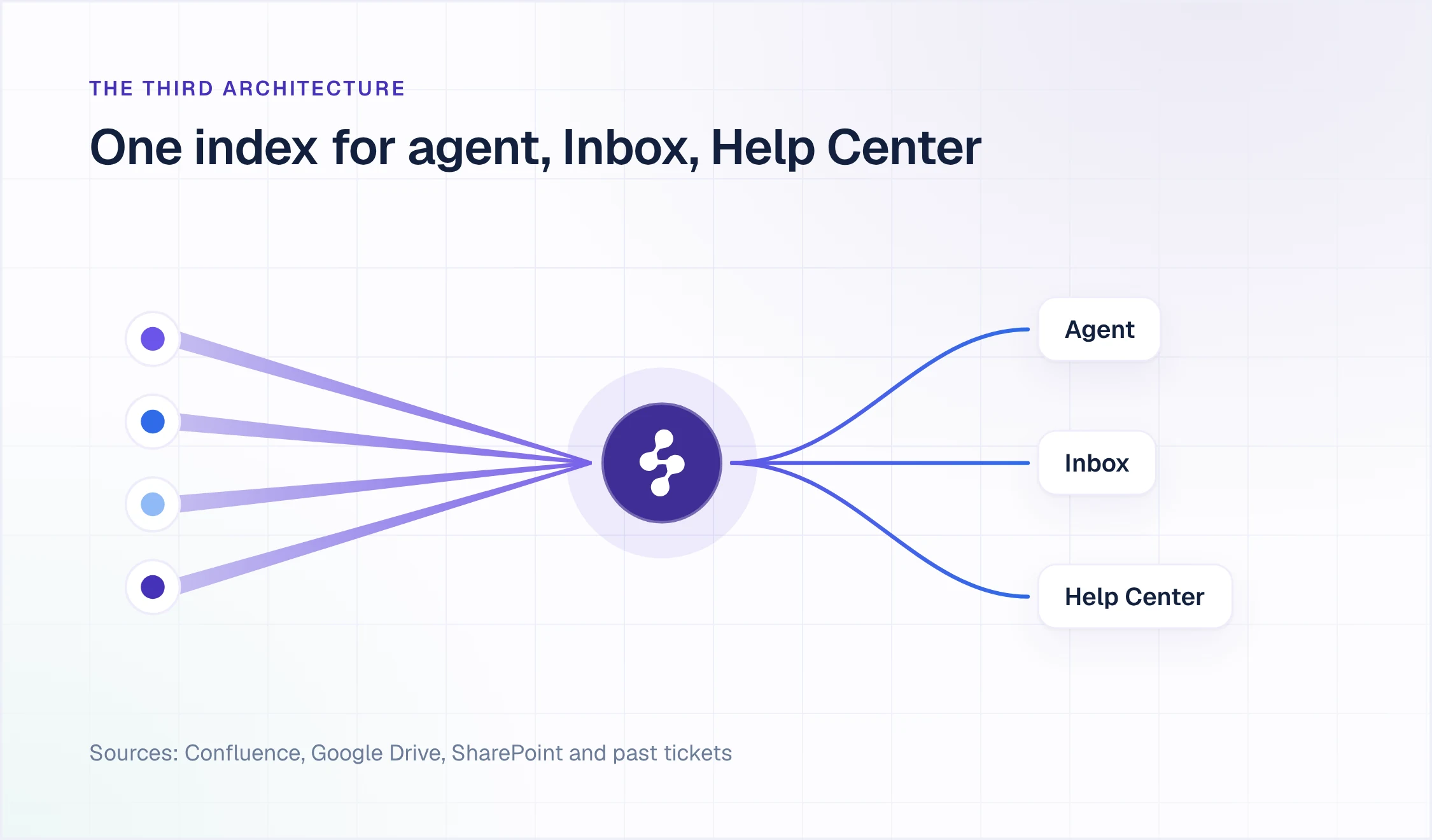
Enjo is an AI Support Agent that resolves support requests end to end, including actions in your connected systems, learns from how your team responds, and escalates with full context when it cannot resolve. It sits beside Decagon and Sierra as a third design: the agent, the helpdesk for escalations and the requester-facing help center run on one knowledge index, at prices anyone can read before a call.
- Published plans, priced per AI reply: Free at $0 with 200 AI replies a month, Starter at $95 with 1,000, and Standard at $295 with 3,000, with additional replies at $0.05 each on Starter and Standard. Every published plan includes unlimited human agent seats and unlimited AI agents, and the Free plan needs no credit card. The full table is on Enjo pricing.
- Where requesters reach it: Slack, Microsoft Teams, website chat, the Help Center portal and Slack Connect shared channels, all answered by the same agent.
- Where escalations land: in Inbox, Enjo's own helpdesk, where the person who picks up the request gets the full conversation, account context and suggested next steps. Human responses there teach the agent, with nothing extra to configure.
- Systems it acts in: AI Actions (Starter and up) query and update connected systems such as Salesforce, Okta, Microsoft Entra ID, Google Workspace and Stripe (through MCP), plus custom API and webhook actions for anything else. Every action is explicitly configured, authorized, bounded by Guardrails and recorded in the audit trail.
- What it reads: Confluence, Google Drive, SharePoint, Notion, Guru, past tickets from Zendesk and Salesforce Service Cloud, web pages and uploaded files, in one index that also powers the Help Center. Every answer is grounded in your knowledge, with citations, so what the agent says is what your team sees and what requesters find.
- How a rollout runs: sign up, connect a knowledge source or a URL, and go live on your channels. Same-day go-live is feasible: Aptean put its initial cohort live in a single day.
Resolution on Enjo includes actions in other systems. At Kraken, Enjo runs approval workflows with nudges and reminders, and those automated approvals save 450 hours a month.
Enjo is built agent-first. The AI Support Agent is configured before any queue exists, and Inbox is where escalations and human collaboration happen rather than the primary work surface. Teams that want a ticket queue first with AI attached later are describing the legacy model, which is the point rather than a limit.
You can run it on your own requests before talking to anyone: Start free at enjo.ai.
Three checks to run on your own tickets
Each check uses last month's tickets, so the answer comes from your data rather than a demo. Put the same three to Decagon and Sierra, then run them on Enjo yourself.
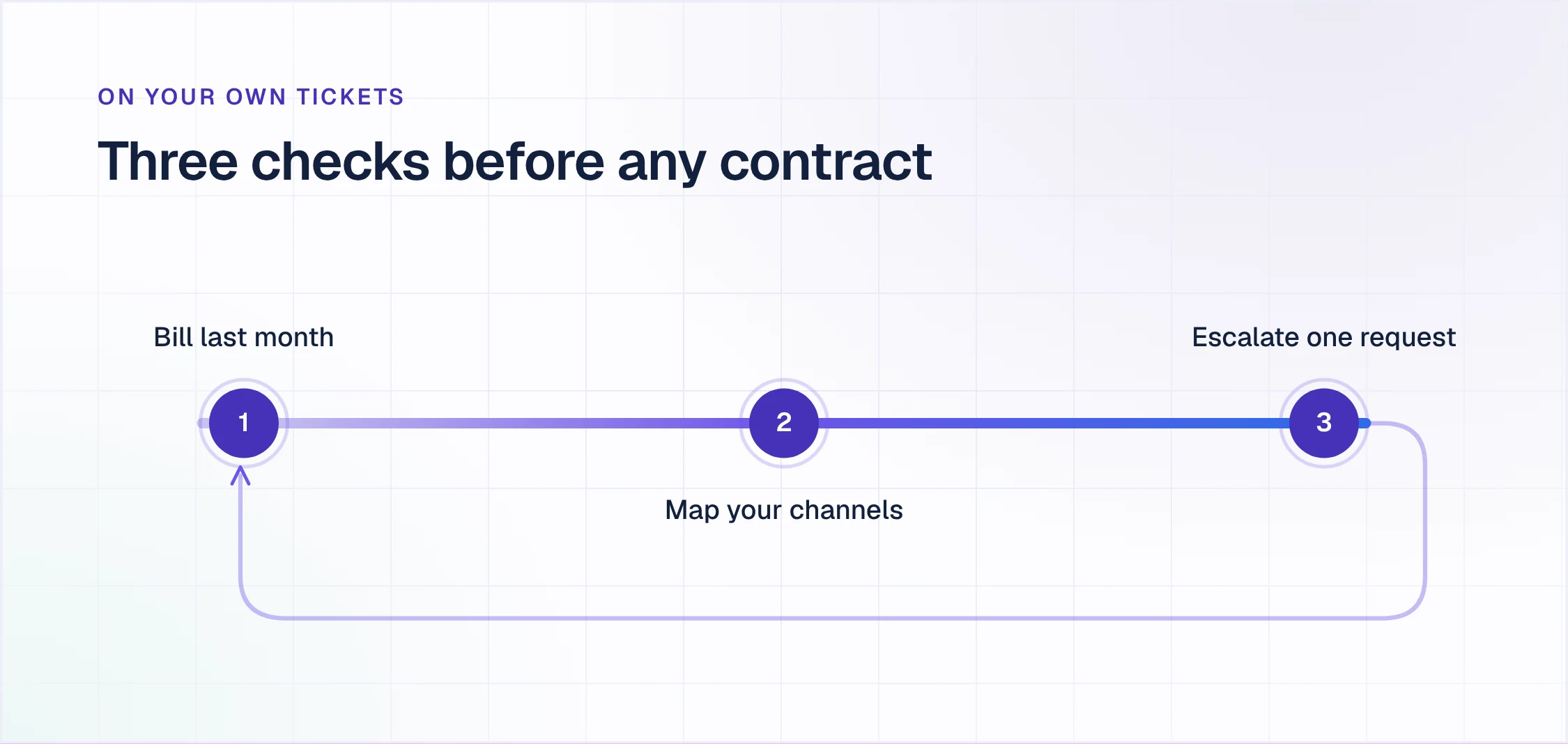
1. Bill last month in each vendor's unit
Export last month's conversations and mark the ones that ended without a person. Ask Decagon to price those counts per conversation and per resolution, and ask Sierra for its outcome definition and rate, both in writing. On Enjo the unit is the AI reply: Standard includes 3,000 replies for $295, each additional reply is $0.05, and running the Free plan's 200 replies on real requests shows how many replies a typical request takes before you pay anything.
2. Map where last month's requests arrived
Count last month's requests by channel: website chat, email, phone, WhatsApp, a help center, Slack, Microsoft Teams and shared channels. Hold that list against each vendor's channels above. Enjo answers in Slack, Microsoft Teams, website chat, the Help Center portal and Slack Connect shared channels, from the same knowledge index in each.
3. Escalate one real request and look at the person's screen
Pick a request from last month that needed a person, run it through the agent, and note three things: which tool the person works in, what arrives with the handoff, and whose seat pricing applies. On Decagon the handoff lands in your Zendesk, Salesforce or Intercom. On Sierra it reaches your care team through its integrations, with Live Assist alongside. On Enjo it lands in Inbox with the full conversation, account context and suggested next steps, and every published plan includes unlimited human agent seats.
200 AI replies a month, unlimited human agent seats, Inbox, Help Center and Insights. No credit card, no procurement.
Start free at enjo.aiFrequently asked questions about Decagon vs Sierra
What is the difference between Decagon and Sierra?
Decagon and Sierra both sell enterprise AI agents for customer service, with no published prices and no self-serve signup. Decagon builds agents from Agent Operating Procedures written in natural language and code, and bills per conversation or per resolution. Sierra builds agents in Agent Studio and with Ghostwriter, works alongside its own agent development team, and bills per outcome. Sierra also lists ChatGPT and Apple Business Chat among its channels.
Which is better, Decagon or Sierra?
Neither vendor publishes a benchmark that runs both agents on the same tickets, and each leads with its own customers' results. The comparison that holds up is on your own data: last month's volume billed in each vendor's unit, the channels your requests arrive in, and what a person receives when the agent escalates.
How much do Decagon and Sierra cost?
Neither publishes a price. Decagon describes two contract models, a fixed rate per incoming conversation or a higher fixed rate per resolved conversation, and says most customers choose per conversation. Sierra prices on outcomes. Figures in third-party posts come from deal reporting and are not confirmed by either vendor.
How long does it take to deploy Decagon or Sierra?
Both say weeks. Decagon says most enterprises go live in weeks rather than months, with a forward-deployed team included in every engagement. Sierra says it deploys in weeks, working with its agent development team.
What channels do Decagon and Sierra support?
Decagon lists voice, chat (web, mobile, SMS and WhatsApp) and email, in 70+ languages. Sierra lists voice, chat on your website and mobile app, WhatsApp, Apple Business Chat, SMS, email and ChatGPT, in 59 languages.
Who founded Decagon and Sierra?
Decagon was founded by Jesse Zhang, its CEO, and Ashwin Sreenivas, its President. Sierra was co-founded by Bret Taylor, previously co-CEO of Salesforce, and Clay Bavor, who previously led Google Labs.
Is there an alternative to Decagon and Sierra with published pricing?
Yes. Enjo publishes its plans: Free at $0 with 200 AI replies a month, Starter at $95 with 1,000 and Standard at $295 with 3,000, each with unlimited human agent seats. The Free plan needs no credit card, and once its 200 replies are used, requests escalate to your team in Inbox.