Transform complex support workflows
AI Chatbot Pricing 2026: 5 Billing Models and the Bill at 1,000 to 10,000 Conversations
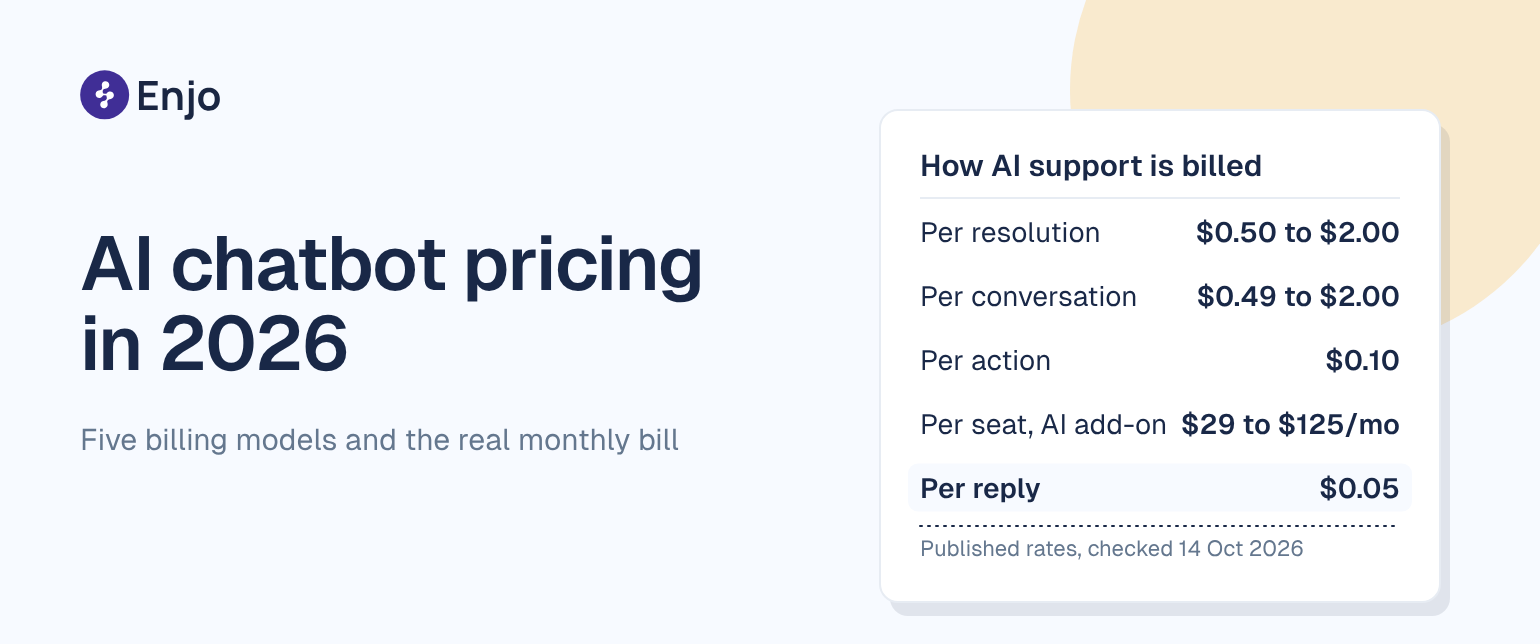
AI chatbot pricing for customer support runs on five meters in 2026: per resolution ($0.50 to $2.00 each), per conversation or session ($0.49 to $2.00), per action or credit ($0.10 an action on Agentforce), per human seat for AI add-ons ($29 to $125 a month), and per reply (Enjo, $95 a month for 1,000 AI replies, then $0.05 each). The meter decides the bill more than the sticker price does. For a 10-person support team handling 3,000 conversations a month, the same workload costs between $595 and $2,725 a month across six tools at their published rates, with the AI resolving half the conversations.
Every rate below comes from the vendor's own pricing page, checked on 14 October 2026, and covers AI agents that answer your customers or employees rather than personal assistant subscriptions. You get the five billing models with dated examples, then the full monthly bill at 1,000, 3,000 and 10,000 conversations, and the questions that turn a pricing page into a forecast.
AI chatbot pricing at a glance
Nine AI agents that answer customer service requests, what each one counts as a billable unit, and what one unit costs. Read the middle column first: it tells you which number in your own support data drives the invoice.
| Tool | Billing Unit | Published Price |
|---|---|---|
| Enjo | AI reply | $95/mo for 1,000 replies, then $0.05 each |
| Fin AI Agent | Outcome | $0.99 each, 50 a month minimum |
| Zendesk AI agents | Automated resolution | $1.50 committed, $2.00 pay as you go |
| Help Scout AI Answers | Resolution | $0.75 each |
| HubSpot Customer Agent | Resolution | $0.50 each, paid in HubSpot Credits |
| Freddy AI Agent | Session | $49 per 100 sessions |
| Agentforce | Conversation or action | $2 per conversation, or $0.10 per action |
| Tidio Lyro | Lyro conversation | $39/mo for 50, up to $700 for 1,000 |
| Chatbase | Message credit | $40 per 1,000 extra credits |
USD, from each vendor's own pricing page, checked 14 October 2026. Annual billing where the page shows it; Tidio's Lyro tiers are monthly billing. Seats and plan fees are extra wherever the vendor charges them; the full bill is further down.
The headline prices cannot be compared with each other, because the units are different. A resolution is one finished conversation. A session or conversation is every conversation the AI joins. A reply is every message the AI sends. A credit is whatever the vendor decides a step costs. The same $0.50 means a very different bill depending on which of those it buys. Below: the five billing models with live examples, then the full monthly bill, seats included, for a 10-person team at 1,000, 3,000 and 10,000 conversations.
The 5 AI chatbot pricing models, with live examples
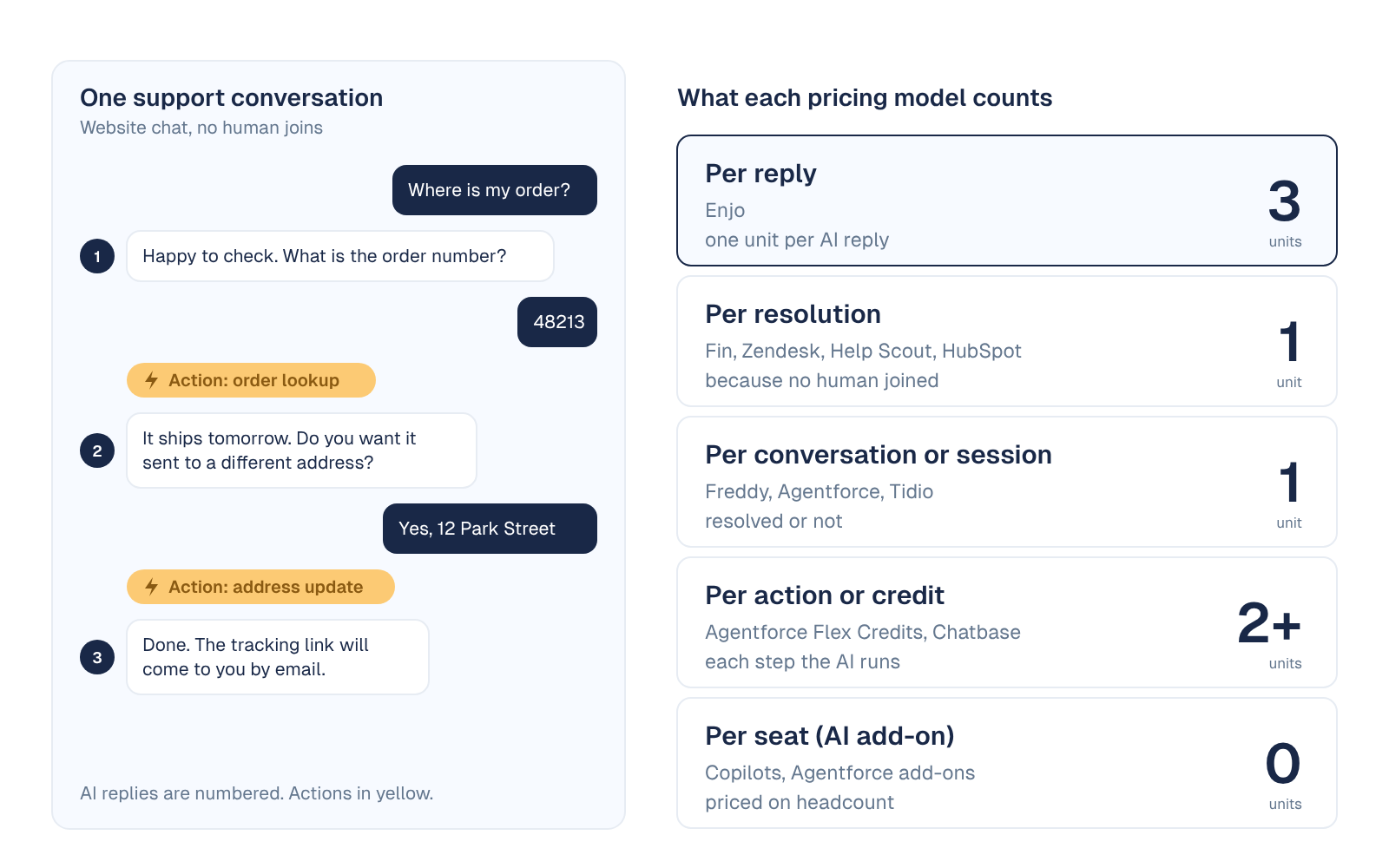
Every AI agent pricing page we checked uses one or more of five meters. Here is one ordinary support conversation and what each model counts in it. A customer asks where an order is, the AI looks it up, changes the delivery address on request, and confirms. No human joins.
1. Per resolution or outcome
You pay when the AI finishes a conversation without a human. Fin, Zendesk, Help Scout and HubSpot price their AI agents this way, and each one defines a resolution differently, which matters as much as the rate.
- Fin AI Agent: $0.99 per outcome, charged at most once per conversation, with a 50-outcome monthly minimum when Fin runs on another helpdesk. An outcome is a resolution (no further help requested after Fin's last answer) or a Procedure you configured to end in a handoff to a human, so some conversations that end with your team still bill. Conversations simply passed to your team without an outcome are not charged. On the Intercom helpdesk, seats start at $19 a month on annual billing.
- Zendesk AI agents: billed per automated resolution, which Zendesk defines as a request resolved by the AI agent without any escalation to a human agent. Plans include 5 to 10 automated resolutions per agent a month (up to 10,000 a year); beyond that, $1.50 each on a committed volume or $2.00 pay as you go.
- Help Scout AI Answers: $0.75 per resolution, once per conversation, counted only if the customer does not escalate, search the knowledge base, ask more questions or say they need more help. You can set a monthly cap; when you hit it, AI Answers switches off for the rest of the month.
- HubSpot Customer Agent: $0.50 per resolution, paid in HubSpot Credits. HubSpot counts a resolution when the conversation was not handed to a human rep for 72 hours, and Customer Agent requires a Service Hub Professional or Enterprise subscription.
The appeal is simple: no resolution, no charge. The catch is that the bill rises with the thing you are trying to improve. Double the resolution rate and the AI line doubles, with the same customers asking the same number of questions.
2. Per conversation or session
You pay for every conversation the AI joins, resolved or not.
- Freddy AI Agent (Freshdesk): $49 per 100 sessions on the Growth, Pro and Enterprise plans, after 500 free sessions that each account gets once. Freshworks defines a session as a unique interaction between an end user and the AI agent; for email, it is a 72-hour window from the customer's first email. Purchased session packs expire with your billing cycle.
- Agentforce (Salesforce): one of its consumption options is $2 per conversation, bought prepaid, as a committed baseline, or pay as you go.
- Tidio Lyro: a Lyro conversation is any customer interaction with at least one reply from the AI agent. The Lyro plan starts at $39 a month for 50 conversations on monthly billing ($32.50 a month billed annually), and Tidio's pricing calculator reaches $700 a month for 1,000; above that, Tidio quotes custom plans.
This meter does not move with your resolution rate, so it is steadier than per resolution. It moves with demand instead, which means a launch week or an outage shows up on the invoice.
3. Per action or credit
You buy a pool of credits, and each step the AI takes spends some of it.
- Agentforce Flex Credits: $500 per 100,000 credits. Each action an agent runs, such as answering a question from knowledge, looking up an order or updating a record, costs 20 credits, which is $0.10; a voice action costs 30. Salesforce's own examples run from $0.10 for a one-action question to $0.50 for a five-action appointment booking, and note that they leave out other consumption such as Data 360 credits.
- Chatbase: plans start at $40 a month with 700 message credits, and extra credits cost $40 per 1,000. Each request to the AI model costs credits depending on the model, and when an action runs, one answer can take two requests and twice the credits.
Credits are the most flexible meter and the hardest to forecast, because you only know what a request cost after you know how many steps it took.
4. Per human seat (AI add-ons)
Some AI is priced per human agent rather than per conversation, usually the assistant that drafts replies and summarizes cases for your team. It scales with headcount, so it costs the same in a quiet month as in a busy one. For a 10-person team, at list price:
- Zendesk Copilot: $50 per agent a month on annual billing, $500 for the team.
- Freddy AI Copilot: $29 per agent a month on annual billing, on Freshdesk Pro and Enterprise, $290 for the team (it can be assigned to some agents only).
- Intercom Copilot: $29 per teammate a month, $290 for the team, with 10 Copilot conversations per agent a month free. Fin's pricing page lists Copilot at $35 per user a month when Fin runs on another helpdesk.
- Agentforce add-ons for Sales, Service and Field Service: $125 per user a month, for unmetered agent use by licensed employees, $1,250 for the team.
5. Per reply
You pay for each response the AI sends. This is how Enjo bills: an AI reply is one response sent by Enjo's AI agent to a requester, and each counts as one unit of usage. Plans include a monthly number of replies (200 on Free, 1,000 on Starter at $95 a month, 3,000 on Standard at $295 a month), additional replies are $0.05 each on Starter and Standard, and published plans include unlimited human agent seats.
The meter moves with how much the AI says. It does not rise when the resolution rate improves, and it does not rise when you hire, so last month's AI message count is a working forecast for next month's bill.
What 1,000, 3,000 and 10,000 conversations a month cost
Here is the same workload priced on six tools that sell an AI agent together with the helpdesk your team answers from. The assumptions are plain so you can swap in your own:
- A 10-person support team, and every conversation answered by the AI first.
- The AI resolves 50% of conversations with no human. That is below the 70% to 75% averages HubSpot, Help Scout and Tidio publish for their own agents, which keeps the per-resolution bills on the low side.
- The AI sends 3 replies per conversation on average, resolved or not. This only changes Enjo's bill.
- Plans: Enjo Standard, Help Scout Standard, HubSpot Service Hub Professional (the first plan with Customer Agent), Freshdesk Growth, Intercom Essential with Fin, and Zendesk Suite Team, at list prices with annual billing, and without one-time fees or one-time free allowances.
| Tool and Plan, 10 Agents | 1,000/mo | 3,000/mo | 10,000/mo |
|---|---|---|---|
| Enjo Standard | $295 | $595 | $1,645 |
| Help Scout Standard + AI Answers | $625 | $1,375 | $4,000 |
| HubSpot Service Pro + Customer Agent | $1,150 | $1,650 | $3,400 |
| Freshdesk Growth + Freddy AI Agent | $680 | $1,660 | $5,090 |
| Intercom Essential + Fin | $685 | $1,675 | $5,140 |
| Zendesk Suite Team + AI agents | $1,225 | $2,725 | $7,975 |
Monthly bill in USD for conversations per month. Seats: Help Scout $25, HubSpot $90, Freshdesk $19, Intercom $19 and Zendesk $55 per agent a month. AI: Help Scout $0.75, HubSpot $0.50 and Fin $0.99 per resolution; Freddy $0.49 per session; Zendesk $1.50 per resolution after 5 included per agent. Enjo Standard: 3,000 AI replies included, then $0.05 each, seats included. HubSpot excludes its credits included with the plan and the $1,500 one-time onboarding. Rates checked 14 October 2026.
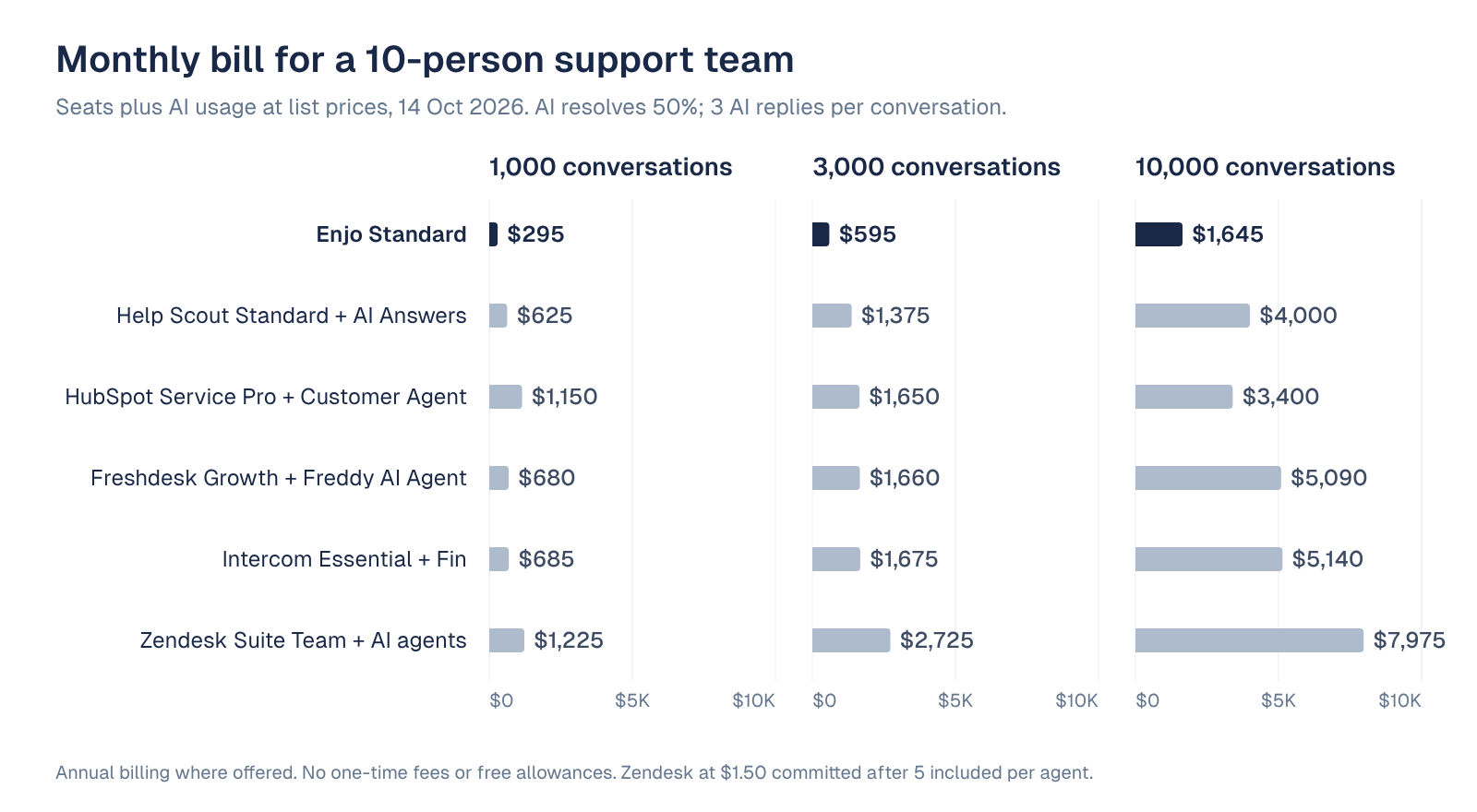
Three things stand out. At 1,000 conversations the AI line is small and seats decide the bill: HubSpot and Zendesk start highest because 10 seats cost $900 and $550 before any AI runs. By 10,000 conversations the AI line dominates every per-resolution and per-session tool: Fin's outcomes alone are $4,950 a month, Freddy's sessions $4,900 and Zendesk's resolutions $7,425. Enjo's bill grows with replies only, from $295 to $1,645, because there is no seat line to multiply.
Two checks on the Enjo row. If the AI averages 5 replies per conversation instead of 3, Enjo Standard comes to $395, $895 and $2,645 at the three volumes. That is still the lowest bill in the table at all three volumes. And Starter charges the same $0.05 per extra reply, so if Starter's features cover your team, every Enjo figure above is $100 lower.
Agentforce, Tidio and Chatbase are left out of the table because their pricing pages do not price a helpdesk for a 10-person team alongside the AI, so a like-for-like total cannot be built from published rates. On AI usage alone at 3,000 conversations, Agentforce costs $6,000 at $2 per conversation, or $900 in Flex Credits if each conversation takes three $0.10 actions; Tidio's Lyro calculator stops at 1,000 conversations ($700 a month on monthly billing) and quotes custom plans above that.
Why per-resolution pricing rises as your AI improves
Per-resolution pricing ties the bill to success. The better the AI gets, the larger the share of conversations it bills for, even when demand is flat. At 3,000 conversations a month, moving from a 50% to a 70% resolution rate is 600 more resolutions, which adds:
- $594 a month on Fin ($0.99 each)
- $900 a month on Zendesk ($1.50 each)
- $450 a month on Help Scout ($0.75 each)
- $300 a month on HubSpot ($0.50 each)
Per-session and per-reply bills stay where they were, because they count conversations or messages rather than outcomes. High resolution rates are not hypothetical: at Aurora, the autonomous vehicle company, Enjo resolves 63% of requests autonomously (Aurora case study).

To put your own numbers on it: per-resolution pricing costs the price times your resolution rate for each conversation. Per-session pricing costs the session price. Per-reply pricing costs $0.05 times the AI replies in a conversation once the plan's included replies are used. At a 50% resolution rate and 3 replies, that is $0.15 a conversation on Enjo against $0.25 to $0.75 for the four per-resolution prices above.
How to estimate your own AI chatbot bill
A pricing page is a rate card, not a forecast. Five steps turn it into a forecast of your AI agent cost, using last month's data:
- Count conversations, not tickets. Take every conversation the AI would answer across website chat, your Help Center portal, Slack, Microsoft Teams and any other channel your team answers, including the ones your team handled.
- Measure the unit the vendor bills. For per reply, count the AI messages in a sample of 100 conversations. For per resolution, apply the vendor's own definition (Fin bills configured handoffs too; HubSpot waits 72 hours for a human). For credits, ask for the credit cost of your three most common requests.
- Price the seats separately. Seats times the plan price, plus any per-seat AI add-on for the people who will use it.
- Run it at twice the volume and a higher resolution rate. The model that looks cheapest in a pilot month is not always the one that stays cheapest when the AI gets good.
- Ask the questions the pricing page skips. What exactly counts as one unit? Is a conversation that ends with a human billable? What happens at the limit: does the AI stop, buy more, or bill overage? Are there minimums or one-time fees? Do unused units expire?
Costs the pricing page leaves out
These lines are all published, just not next to the headline rate:
- Minimums: Fin has a 50-outcome monthly minimum when it runs on another helpdesk.
- One-time fees: HubSpot requires onboarding at $1,500 for Service Hub Professional and $3,500 for Enterprise.
- Billable outcomes beyond resolutions: Fin charges $0.99 for a configured Procedure handoff and $9.99 for a lead qualification.
- Pay-as-you-go premiums: Zendesk's automated resolutions cost $2.00 without a committed volume, against $1.50 committed.
- Monthly billing: Zendesk Suite Team is $69 per agent month to month against $55 on annual billing.
- Expiry: Freshworks session packs expire with your billing cycle, and the 500 free sessions are a one-time allowance per account.
- Separate AI add-ons: Fin's Pro add-on, which includes Operator, starts at $100 a month per workspace, and the per-seat Copilots above sit on top of everything else.
What Enjo costs
Enjo is an AI Support Agent that resolves support requests end to end, including actions in your connected systems, and escalates with full context when it cannot. Pricing is usage based, per AI reply, so it scales with support volume rather than headcount. The full plan detail is on Enjo pricing:
- Free: $0 a month with 200 AI replies, unlimited agent seats and channels, a shared Inbox, Help Center and Insights. No credit card.
- Starter: $95 a month with 1,000 AI replies, adding AI Actions, core Guardrails and basic Slack and Teams Insights. Cancel anytime.
- Standard: $295 a month with 3,000 AI replies, adding natural language workflows, advanced Guardrails, AI testing and training workflows, enhanced analytics, custom role-based access and Guardrails, and an audit trail with QA review flows. Cancel anytime.
- Enterprise: custom pricing with yearly billing, for regulated organizations and strict security requirements.
Additional replies are $0.05 each on Starter and Standard. On Free, once the 200 replies are used, requests auto-escalate to human agents and support keeps running in Inbox with unlimited seats, so nothing is dropped. When Enjo hands a request to a person, it lands in Inbox with the full conversation, account context and suggested next steps, and Enjo learns from how your team responds.
Every answer is grounded in your knowledge, with citations. On Standard, the plan priced in the bill above, the agent runs under advanced Guardrails, with an audit trail and QA review flows. Enjo runs in Slack, Microsoft Teams, website chat, the Help Center portal and Slack Connect shared channels, so the same per-reply math covers customer support and IT or HR teams. Enjo is SOC 2 Type II and ISO 27001 certified and GDPR compliant, and Troopr Labs, the company behind it, has 600+ enterprise deployments and 99.9% uptime over 7 years.
Measure your own replies per conversation before you pay
The Free plan of Enjo includes 200 AI replies a month, unlimited human agent seats, Inbox, Help Center and Insights. Put it on real requests, count the replies, and you have your bill at any volume.
Start free at enjo.aiNo credit card. No procurement.
Read more
- AI chatbot for business: what it resolves and what it costs
- Best AI chatbots for customer service
- Fin alternatives
- Salesforce Service Cloud pricing
- How to control costs with AI agents
Frequently asked questions
How much does an AI chatbot cost per month?
An AI chatbot for customer support costs from $0 on a free plan to several thousand dollars a month, depending on volume and the billing model. For a 10-person team handling 3,000 conversations a month, published rates checked on 14 October 2026 put the full bill, seats included, between $595 (Enjo Standard) and $2,725 (Zendesk Suite Team with AI agents) at a 50% AI resolution rate.
What are the main AI chatbot pricing models?
There are five: per resolution or outcome (Fin, Zendesk, Help Scout, HubSpot), per conversation or session (Freddy AI Agent, Agentforce, Tidio), per action or credit (Agentforce Flex Credits, Chatbase), per human seat for AI add-ons such as Copilots, and per reply (Enjo). Many tools also charge for the helpdesk seats underneath.
What counts as a resolution in AI chatbot pricing?
It depends on the vendor. Zendesk counts a request the AI agent resolved without escalation to a human agent. Help Scout counts a conversation where the customer does not escalate, ask more or say they need more help. HubSpot counts a conversation not handed to a human rep for 72 hours. Fin bills an outcome, which includes a Procedure you configured to hand off to a human.
Is per-resolution or per-conversation pricing cheaper?
It depends on your resolution rate. Per-resolution pricing costs the price times your resolution rate for each conversation, so it rises as the AI improves, while a per-conversation price stays the same at any rate. At a 50% resolution rate, a $0.99 outcome works out to $0.495 a conversation; at 70%, it is $0.69.
Are there free AI chatbots for customer service?
Yes. Enjo's Free plan is permanent: 200 AI replies every month, unlimited human agent seats, Inbox, Help Center and Insights, with no credit card. Most other vendors offer a trial or a one-time allowance instead: a 14-day Fin trial, a 3-month Help Scout AI Answers trial, 500 included Freddy sessions, and 50 Lyro conversations once per Tidio account.
How much does it cost to build your own AI chatbot?
There is no list price: you pay for model usage plus the people who build and run the system. A production system needs more than the model: retrieval across your knowledge sources, access control, SSO, audit logs, escalation logic, guardrails against wrong answers, and permanent maintenance as models change. Our guide to the AI chatbot for business covers what that system has to do.