Transform complex support workflows
Salesforce Service Cloud Pricing 2026: New Tiers, Real Cost
Customer support teams are deploying AI faster than they ever adopted new software, and the per-seat pricing model is not keeping up. Salesforce Service Cloud is still the dominant platform for enterprise customer service, and for good reason. The CRM integration is unmatched, the workflow engine is deep, and Salesforce is pouring billions into Agentforce to make the AI case.
But here is the tension. Service Cloud pricing was built for a world where you paid per agent. Now you also pay per AI conversation, per channel, and per data platform on top of that. For growing teams, those costs compound instead of scaling.
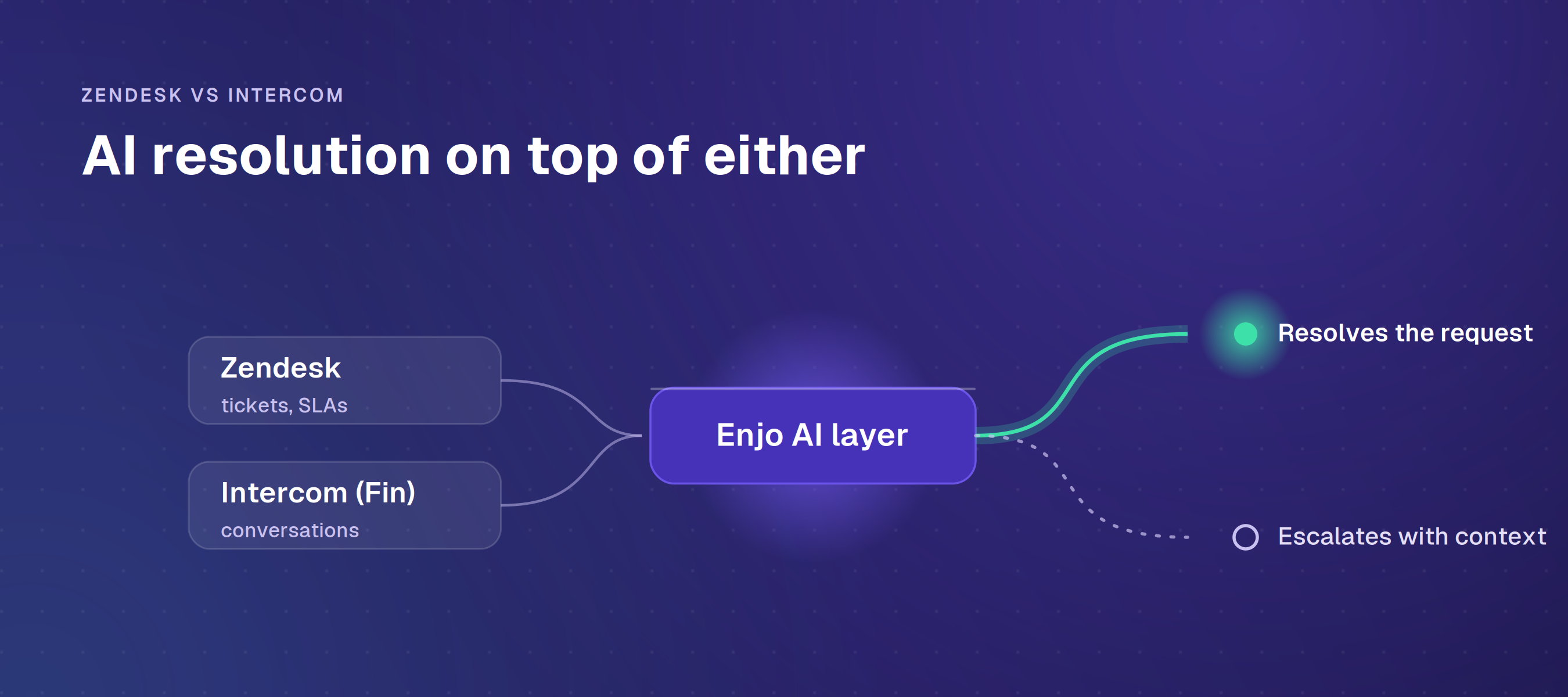
That compounding is exactly why platforms like Enjo exist: agentic AI layers that sit on top of Salesforce rather than replacing it. They decouple the AI economics from the seat economics, so you can scale resolution without scaling the bill. Salesforce Service Cloud now runs on Core, Advanced and Max. Below: what each edition costs after the September 2026 repricing, and the real bill at 5, 15 and 50 agents.
The Three Cost Layers of Salesforce Service Cloud
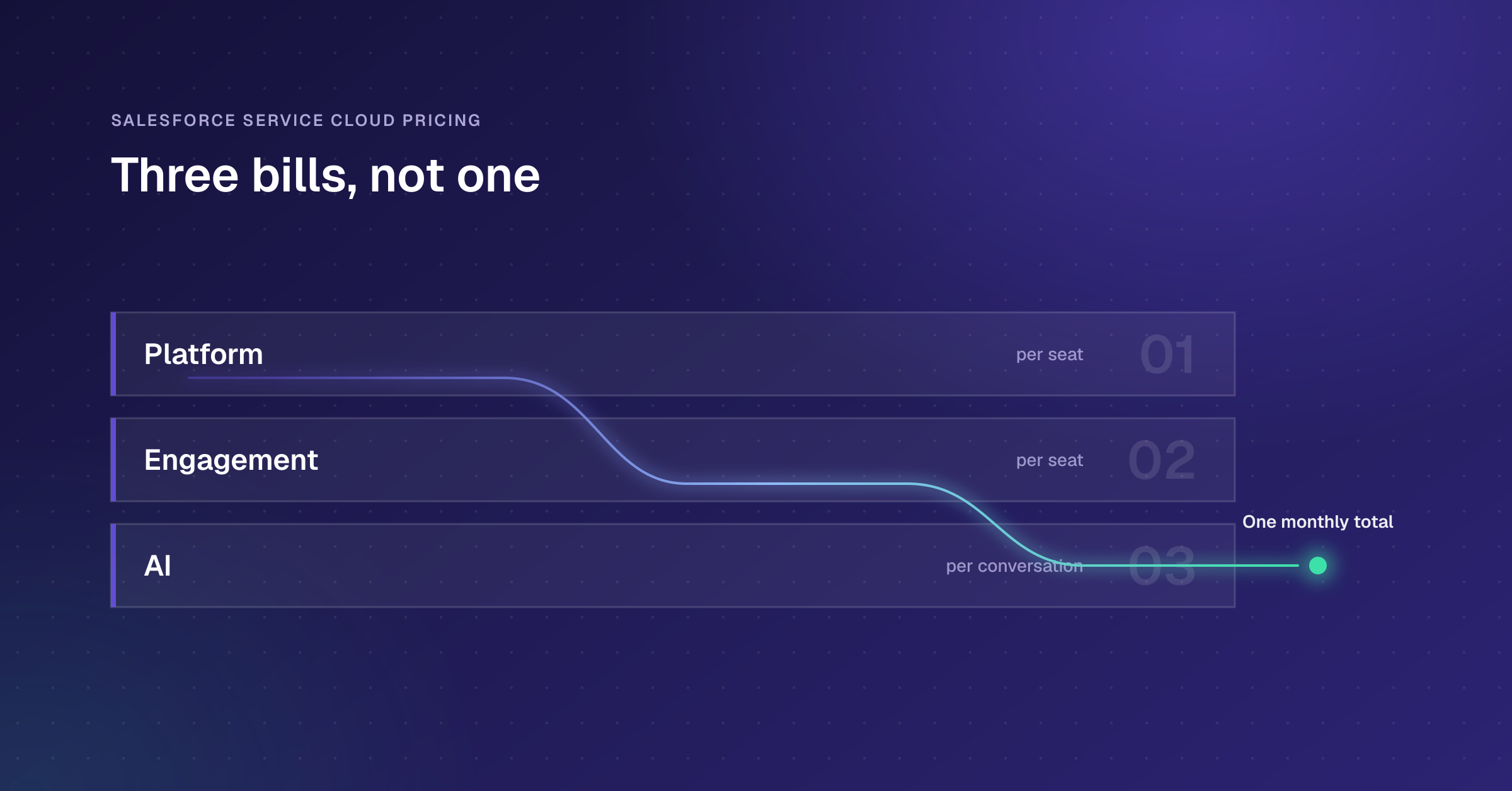
Salesforce Service Cloud pricing has three cost layers, not one. Most teams only budget for the first, and that is where the surprises start.
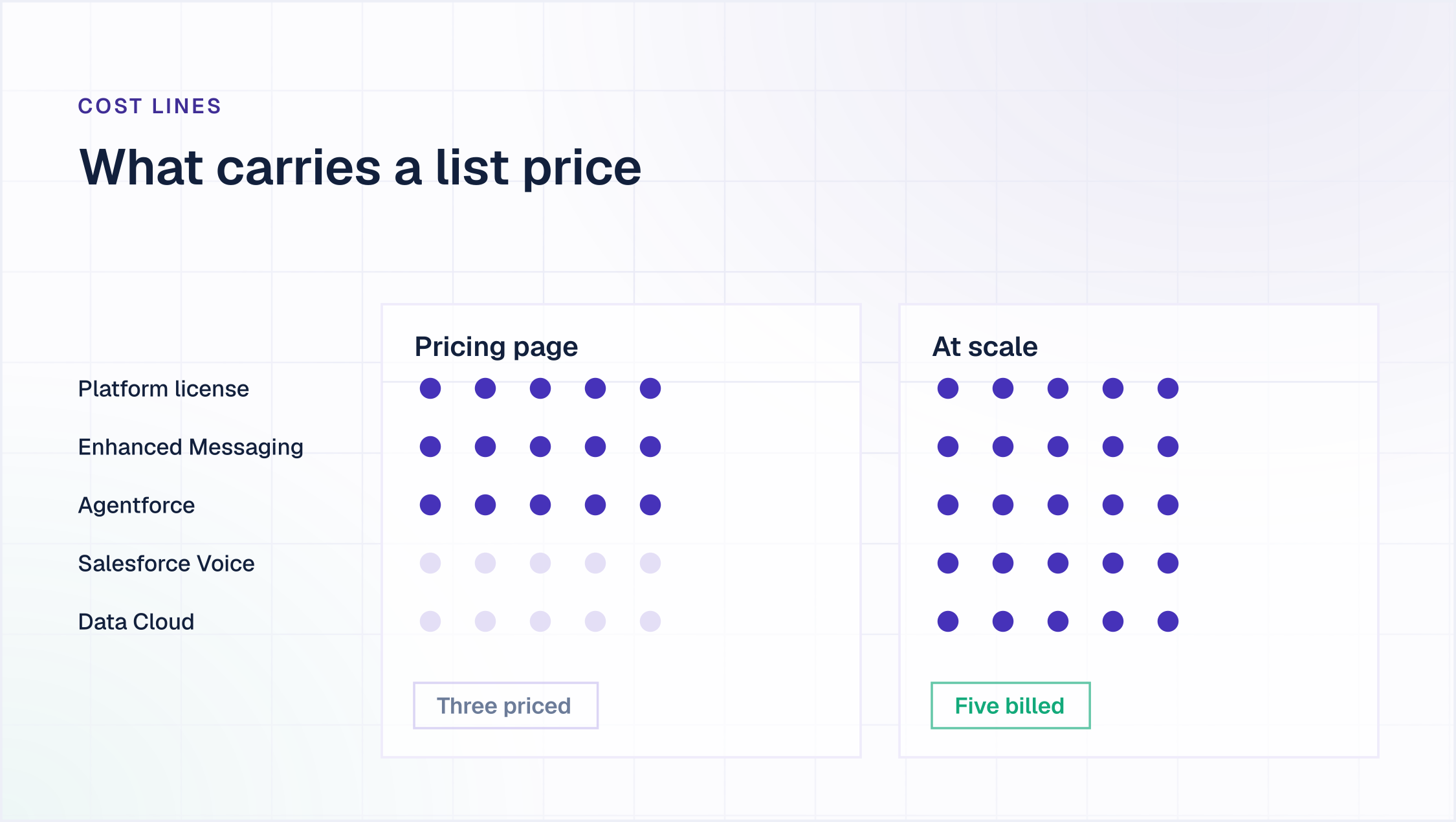
Platform Cost (per seat, billed annually): the Service Cloud license, covering case management, routing, automation and reporting. This is the number on the pricing page.
Engagement Cost (per seat, billed separately): Enhanced Messaging for chat, messaging and social. Salesforce Voice for telephony. Neither comes with the base license. If your customers reach you through anything beyond email, you are paying for this layer whether you planned for it or not.
AI Cost (per action, per conversation or per user, usage-based): Agentforce, at $0.10 per standard action through Flex Credits.
Data Cloud sits underneath it at production scale as an unpriced dependency. Unlike the first two layers, this one has no ceiling and scales with volume rather than headcount.
Platform Cost and Engagement Cost grow every time you hire an agent. AI Cost grows every time the AI runs a conversation. All three bills are independent. The listed Salesforce Service Cloud pricing reflects only Platform Cost. Teams that budget from the pricing page alone end up rebuilding that budget from scratch six months in.
Salesforce Renamed Every Edition in September 2026
If you are holding a quote or a comparison written before September 2026, the edition names on it no longer exist. On 3 September Salesforce replaced the Enterprise, Unlimited and Agentforce 1 ladder with Core, Advanced and Max, across Agentforce Sales, Agentforce Service and Agentforce Industries. Starter Suite and Pro Suite were left alone.
The mapping, and what it costs:
Salesforce frames this as more value rather than a price rise, and the bundles genuinely are wider: each tier now carries Slack, Tableau Next, the Premier Success Plan and a Flex Credit allowance that previously had to be bought separately.
Three things this changes for a buyer:
The entry point for a real service team moved from $175 to $195. If you modelled a budget on Enterprise, add 11% per seat before anything else.
Agentforce is no longer a straight add-on at every tier. On Core and Advanced, Agentforce for Service is listed as available for purchase, and Agentforce for Employees is marked Flex Credits Required. On Max it is unmetered per user. Where the AI sits in the ladder is now part of the edition decision rather than a separate line.
Comparison pages you find elsewhere are mostly stale. Most still run Enterprise at $175 and name the top tier Einstein 1 Service or Agentforce 1 Service. Every figure on this page was taken from salesforce.com/service/pricing on 22 September 2026. Existing contracts have not repriced mid-term. The change lands at renewal.
One inconsistency to carry into a quote conversation. As of 22 September 2026 Salesforce's service pricing page names the top tier Max and states 2.75M Flex Credits per org per year, while its Agentforce pricing page still calls the same $550 tier Agentforce 1 Editions and states 1M Flex Credits plus 2.5M Data 360 Credits. Two Salesforce pages, one price, different names and different credit allowances. Get the credit allowance written into the order form rather than taken from either page.
What Each Layer Costs
Platform Cost
Prices are USD per user per month, taken from salesforce.com/service/pricing on 22 September 2026. Implementation and usage costs sit on top.
If you run a mid-market customer service team, Core at $195/user/month is your realistic starting point, and every figure in this guide is priced from it. Starter Suite and Pro Suite carry transaction fees and lack the routing and automation depth a real service operation runs on. Starter Suite is also the only edition Salesforce will bill monthly. Everything from Pro Suite up requires an annual commitment.
Engagement Cost
- Enhanced Messaging (chat, messaging, social): an additional $75 USD/user/month on both Core and Advanced, included at Max, per salesforce.com/service/pricing
- Einstein Bots: an additional $75 USD/user/month on Core, included from Advanced up Knowledge, read and write: an additional $75 USD/user/month on Core; read-only is included
- Salesforce Voice (telephony): available for purchase on Core and Advanced, included at Max, with no list price published on salesforce.com/service/pricing
One thing experienced buyers learn fast: not every agent needs every channel add-on. Licensing Enhanced Messaging only to agents who actually work chat, and Voice only to agents who take calls, is the single biggest cost lever most teams overlook.
AI Cost
Salesforce sells Agentforce three ways: per action through Flex Credits, per conversation, and per user. Flex Credits and Conversations cannot run in the same org, so the first decision is which meter you are on.
- Per action (Flex Credits): Salesforce's own worked examples price a standard Agentforce action at 20 credits, or $0.10, which puts a credit at half a cent and 100,000 credits at $500. A three-action case management interaction costs $0.30. Checked at salesforce.com/agentforce/pricing, 22 September 2026.
- Per conversation: the Conversations model is still live and still sold, but Salesforce no longer displays a per-conversation rate on its pricing page. The last published figure was $2 per conversation. Treat it as unconfirmed until your Account Executive quotes it, and note that Flex Credits and Conversations cannot run in the same org.
- Per user: $5 per user per month for the Agentforce User License, which still draws down Flex Credits on top, or $125 per user per month for the Agentforce add-on, which is unmetered for employee agents. Both from salesforce.com/agentforce/pricing, 22 September 2026.
- What your edition already includes: on Core and Advanced, Agentforce for Service is listed as available for purchase and Agentforce for Employees is marked Flex Credits Required. Max includes both, unmetered per user. Checked at salesforce.com/service/pricing, 22 September 2026. Credits expire. Unused Flex Credits do not roll over into the next subscription term. There is no overage penalty; usage above your entitlement bills at your contracted rate monthly in arrears.
- Data Cloud: available for purchase on Core and Advanced, included at Max. Salesforce publishes no standalone list price, so treat it as an unpriced dependency rather than a known number.
There is no monthly ceiling on Agentforce pricing at list. A product launch, a seasonal spike, or even a viral support issue hits the AI bill directly. Before buying Agentforce as a separate add-on, check what your tier already bundles. Every active Digital Engagement licence already carries 25 bot conversations a month, per Salesforce Help, and unused conversations expire at month end rather than rolling over. Teams routinely pay for capacity they already hold.
Five Questions to Ask Before You Evaluate Pricing
The three-layer structure makes Salesforce Service Cloud pricing deeply situational. Two teams with identical headcounts can end up with wildly different bills depending on how well the platform fits their operation. These five questions are the ones that separate a strong investment from a slow-motion budget problem.
1. Will we use everything we are paying for? Core unlocks omni-channel routing, advanced automation, and API access. If your team mostly handles email with straightforward routing, much of that capability will go unused, and you will be paying for platform depth you cannot use. This is more common than anyone admits.
If ServiceNow is the other name on your shortlist, ServiceNow vs Salesforce compares them on AI reach and total cost.
2. Are we complex enough to justify Salesforce? Service Cloud was designed for organizations that run support across multiple business units, languages, geographies, and escalation paths. If you are a single team in a single region supporting a single product, the platform's sophistication works against you. The complexity is not a bug. It is the product. And if you do not need it, you are paying for it anyway.
3. Do we actually need Data Cloud and Agentforce? AI Cost is the fastest-growing line item, but it is also entirely optional. Forrester's 2026 assessment found roughly three-quarters of enterprise leaders reporting agentic AI adoption while only a small minority ran it in meaningful production, so size the commitment against what you will actually deploy. Plenty of teams run Service Cloud for case management and routing while using a separate AI agent platform for resolution. Before answering that, check what Agentforce actually includes for a Service Cloud team, because the answer decides whether the AI line item is optional.
4. Do we have the resources to manage Salesforce? This one matters more than the price tag. G2 reviewers consistently flag complexity and steep learning curve as top concerns, and having spent time in these deployments, it tracks. Without a dedicated admin, every workflow change stalls. It either becomes a consulting engagement that takes weeks or a backlog item nobody picks up. The distance between buying Salesforce and actually running it the way you need to is where most ROI projections quietly fall apart.
5. Is Salesforce the right operating model? This is the question underneath all the others. Salesforce is not something you configure and move on from. It is an operating model: ongoing admin investment, annual contracts, a specific approach to how data flows, and workflows run. When the model fits the organization, the pricing makes sense. When it does not, there is no discount large enough to close the gap.
Salesforce Has a Fit Problem, Not a Satisfaction Problem
Salesforce does not have a satisfaction problem. It has a fit problem. The capabilities that make it exceptional for large, complex enterprises become unnecessary overhead for teams that do not share the same operating model.
G2 review data clearly backs this up. The most praised features (case management, automation, CRM-native visibility, enterprise governance) are all capabilities that require real organizational complexity to exercise. The most common complaints are complexity, steep learning curve, cost unpredictability and admin dependency. Those complaints trace back to one root. The platform assumes you have dedicated admin resources, plus the multi-system, multi-team complexity that justifies the investment. Teams that have both do well. Teams that identify the mismatch after procurement spend the next few quarters trying to justify it.
This is worth being direct about. The review data do not indicate that Salesforce is too expensive or too complex. It says the platform rewards a specific operating shape. And the cost of not fitting that shape compounds.
The Real Cost at Three Team Sizes
Here is where the three cost layers stop being a framework and start being a spreadsheet.
Methodology: Service Cloud Core at $195/user/month and Enhanced Messaging at $75/user/month, both from salesforce.com/service/pricing, checked 22 September 2026. The Flex Credits line uses Salesforce's own published worked example, a three-action case management interaction at 60 credits, or $0.30, from salesforce.com/agentforce/pricing, checked 22 September 2026. The Conversations line uses $2 per conversation, the last rate Salesforce published, which its pricing page no longer displays as of the same date; treat that row as the ceiling rather than a quote.
The interaction volume of roughly 400 per agent per month is an Enjo estimate for mid-market support teams, billed as 400 conversations on the Conversations meter or 1,200 actions on Flex Credits at Salesforce's three-action example. Every monthly total, annual total and per-agent figure in this table derives from it, so treat the totals as Enjo estimates rather than quoted prices.
Salesforce Voice and Data Cloud are both required at production scale and Salesforce publishes no list price for either, so neither appears as a line item here and both sit on top of these totals. Implementation is excluded. Salesforce publishes no implementation pricing, and partner-published mid-market bands range from $25K to $200K+ depending on integration count and data quality, so treat $50K to $150K as an Enjo planning estimate rather than a quote. Enterprise discounts of 15 to 30 per cent are an Enjo estimate from negotiated deals, not a published Salesforce term.
The listed price is $195. The effective cost is $390 per agent on Flex Credits and $1,070 on Conversations, two and five and a half times the number on the pricing page respectively, and both figures sit before Salesforce Voice and Data Cloud, neither of which carries a published list price.
The gap between those two rows is the finding. Identical work, 400 interactions per agent per month, costs $120 per agent through Flex Credits and $800 through Conversations, a difference of nearly seven times on the same tickets. Salesforce will not let you run both meters in one org, so this is a single irreversible choice made at contract time, and the cheaper meter is the one its own pricing page now leads with. Anyone still budgeting from a $2 per conversation quote is pricing the expensive half of a fork Salesforce has already moved away from.
There is a specific trap here worth naming. Buying full agent seats and a large Agentforce commitment simultaneously, before you have proven what deflection rate the AI delivers, means paying twice for the same case volume. A phased approach that starts with real deflection data before sizing the conversation commitment avoids the double-pay problem.
The Architecture Decision That Defines the Investment
Gartner predicts agentic AI will autonomously resolve 80% of common customer service issues without human intervention by 2029, with a 30% reduction in operational costs. The best contact centers in 2026 already run a three-tier model: autonomous AI handles 40 to 60% of volume, AI-assisted agents take the middle tier, and humans handle the rest. That model has created a real split in how teams architect their service stack.
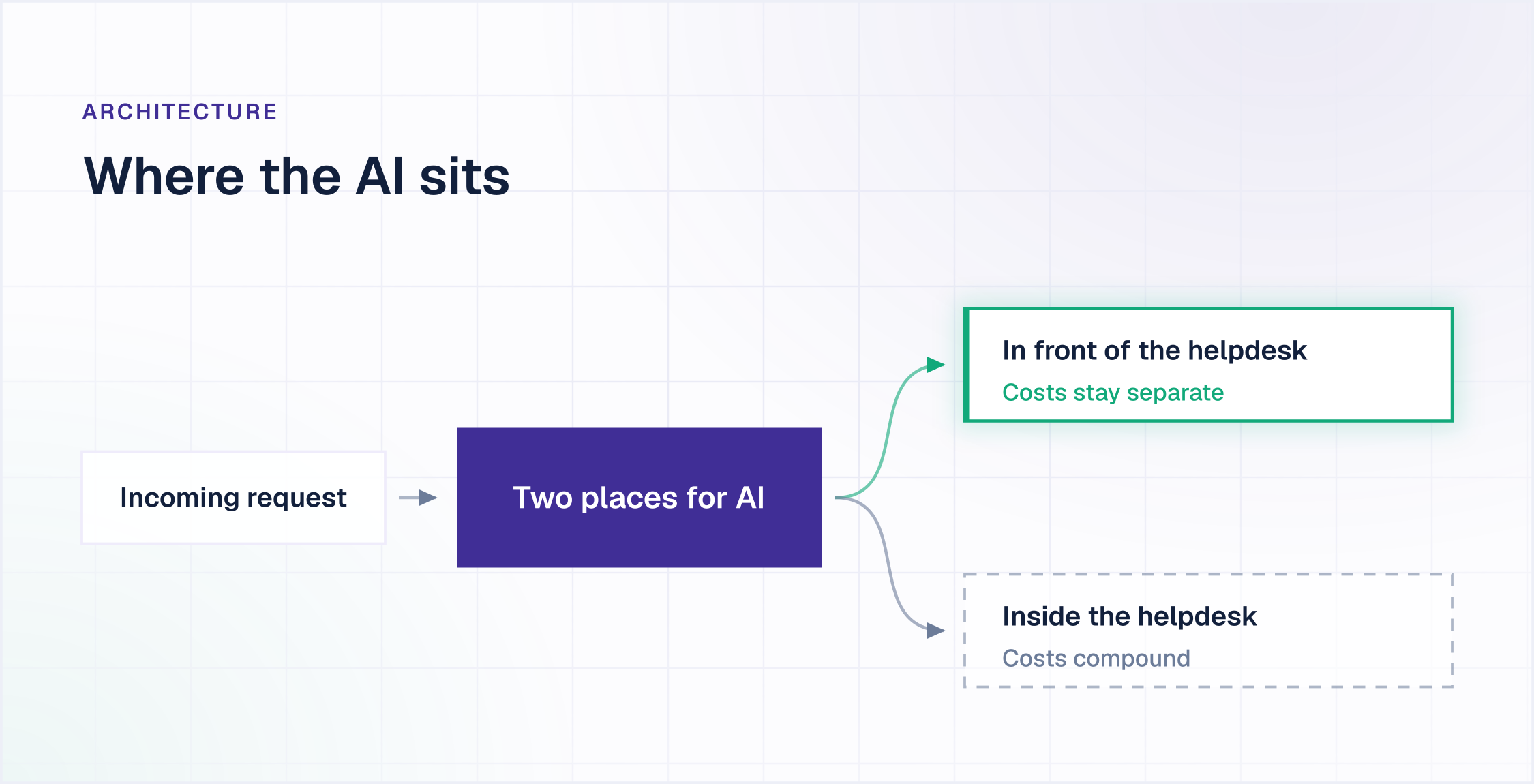
AI inside the helpdesk. Agentforce reads Service Cloud data, acts on its objects, and bills through its pricing model. A Salesforce AI agent resolves cases inside that boundary, so map what it can reach before you price it. You get native integration. You also get AI Cost compounding on top of Platform Cost and Engagement Cost, all inside the same vendor.
AI as a separate resolution layer. The AI sits in front of the helpdesk. It resolves routine requests from every connected knowledge source. Only the hard stuff reaches Salesforce and the human team, with full context already attached.
The economic logic is straightforward. Inside the helpdesk, AI cost and seat cost compound. As a separate layer, AI cost scales with resolution (which you want more of) while seat cost scales with headcount (which you want to hold). One grows. The other shrinks. They stop working against each other.
A Decision Framework
What the Price Buys at Core
- Omni-channel routing and governance depth built for support running across multiple business units, languages and compliance regimes.
- CRM-native visibility into sales history, contract status and account health inside the case record during live work.
- A configuration surface that assumes certified Salesforce administrators on staff; without them, changes route through a partner.
- Agentforce grounding and actions bound to the Salesforce platform, which reaches everything that already sits inside it and requires Data 360 for everything that does not.
- Enterprise negotiation leverage that only opens up at scale; Salesforce publishes no discount schedule, and the 15 to 30 per cent band above is an Enjo estimate from negotiated deals.
Consider a different architecture if:
- Your knowledge is scattered across Confluence, SharePoint, Google Drive, past tickets in other systems, or web content, not consolidated in Salesforce.
- You are paying per agent and per AI action or conversation at the same time; both lines grow independently, and your finance team cannot forecast a bill where the AI side has no monthly ceiling.
- You do not have Salesforce platform admins, and implementation timelines measured in months are a cost your team cannot absorb.
- You need to prove AI ROI within a quarter, not a year.
- AI resolution is a core capability for you, and it needs to run independently of any single helpdesk's data model and billing.
What an Agentic AI Layer Looks Like on Salesforce
Organizations choosing the separate resolution layer are typically looking for one thing: an AI layer that works without disrupting the Salesforce investment they have already made. Enjo, an AI layer for customer service teams, was built for exactly this.
Enjo resolves requests end-to-end, pulling knowledge from Salesforce and other connected sources, executing AI Actions in Okta, Jira, Salesforce, and custom APIs, with guardrails enforcing policy at every step. Agent Assist embeds directly within Salesforce, providing human agents with summaries, reply suggestions, and in-context knowledge. Insights show leadership where automation is working and where gaps remain.
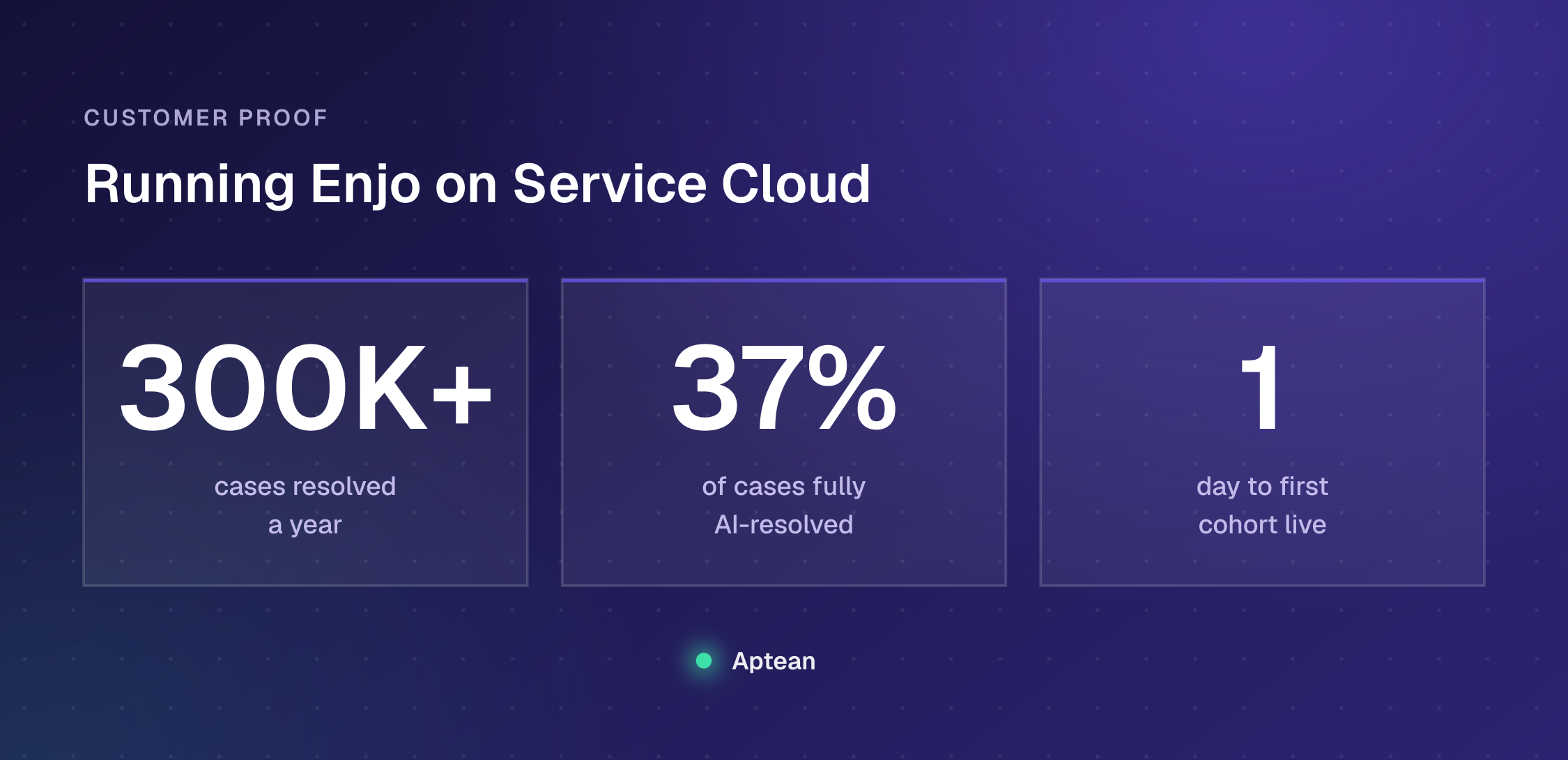
Aptean, a 3,500-employee enterprise on Salesforce, brought its initial Enjo cohort live in a single day, indexed 5M+ documents, and now resolves 300K+ cases a year with Enjo AI, 37% of them fully by AI without human involvement. They did not migrate off Salesforce. They changed the economics of running it. Enjo pricing is per AI Reply with unlimited human agent seats, starting at a free tier that requires no procurement.
For teams weighing a cheaper standalone against the platform, Freshdesk vs Salesforce Service Cloud runs the same cost model side by side, and Zendesk vs Salesforce compares the two head to head on pricing, AI add-ons and implementation cost.
Frequently Asked Questions
How much does Salesforce Service Cloud actually cost per agent?
The pricing page says $25 to $550 per user per month, depending on edition. In practice, mid-market teams on Core with Enhanced Messaging and Agentforce land around $390 per agent per month on Flex Credits, or $1,070 on the older Conversations meter, on published prices alone and before Salesforce Voice and Data Cloud.
Is Agentforce included in Service Cloud pricing?
Not on Core or Advanced, where Agentforce for Service is listed as available for purchase and employee agents draw down Flex Credits. Max, at $550/user/month, includes it unmetered per user. Consumption runs about $0.10 per standard action through Flex Credits. Verify the current rate card at salesforce.com/agentforce/pricing.
Can you run a separate AI layer on top of Salesforce?
Yes, and a growing number of teams are doing exactly that. The Enjo Salesforce integration sits on top of Service Cloud rather than replacing it. Agent Assist embeds within the Salesforce workspace, and Enjo creates Salesforce cases with full context when it escalates.
Does Salesforce Service Cloud offer a free plan?
No. Salesforce offers a time-limited free trial on each edition, not a free plan. Starter Suite at $25/user/month is the cheapest paid entry and the only edition Salesforce bills monthly. For any real CS operation, Core at $195/user/month, billed annually, is the starting point.