Transform complex support workflows
Zendesk vs Intercom: Which Fits Your Support Team in 2026
Zendesk vs Intercom usually comes down to one question: does your team think in tickets or in conversations? Zendesk built a structured service desk for high-volume, multi-channel support. Intercom built a messenger-first platform for product-led teams, and in May 2026 it renamed itself Fin around that same AI agent. That rename matters more than most comparisons let on, because Salesforce completed its roughly $3.6 billion acquisition of Fin on September 10, 2026.
Enterprise teams like Aptean, a 3,500-plus employee ERP company that deployed AI resolution in a single day, show what's possible when the AI layer isn't tied to either vendor's acquisition timeline. This piece compares Intercom vs Zendesk on pricing, AI, and fit, including what the Salesforce-Fin acquisition means for your decision.
The Short Answer
The Intercom vs Zendesk decision comes down to how your team works, not which tool has more features. Pick Intercom (Fin) if support happens inside your product, most conversations resolve in one or two messages, and you want the more turnkey AI agent today; just weigh what the completed Salesforce acquisition means for its roadmap before signing a multi-year contract. Pick Zendesk if you run high-volume, multi-channel support with formal SLAs and need the deeper ticketing and reporting stack.
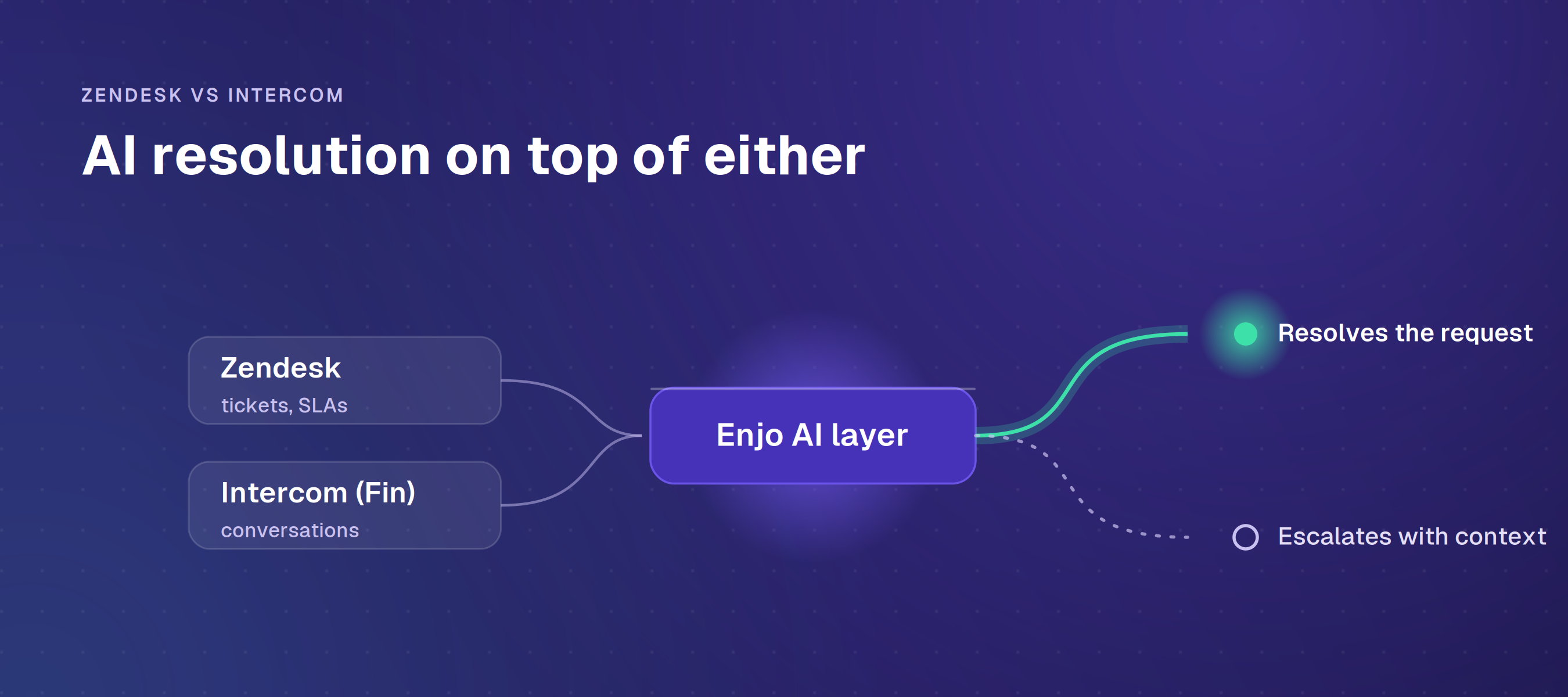
If your real problem is that neither one's AI resolves enough, or you also need to cover IT or HR requests on the same platform, an AI layer like Enjo works on top of whichever helpdesk you land on. Whichever way this Zendesk vs Intercom decision lands, that part doesn't have to wait on this one.
Book a demo →Zendesk vs Intercom: Key Differences at a Glance
| Capability | Zendesk | Intercom (Fin) |
|---|---|---|
| Core model | Structured tickets, queues, and SLAs | Conversational inbox, tickets layered on top |
| Live chat/messaging | Native, added as a channel to the ticket system | In-app Messenger is the product's origin point |
| Native AI agent | AI Agents on every Suite plan, billed per Automated Resolution; Forethought agents added via the March 2026 acquisition | Fin AI Agent, billed at $0.99 per outcome, also runs standalone on other helpdesks |
| Knowledge base | Zendesk Guide, mature multi-brand and multilingual tooling | Intercom Articles, tightly tied to the Messenger |
| Reporting/analytics | Zendesk Explore, built for CX ops, SLA, and agent performance | Centers on conversation and AI performance metrics |
| Integrations | 1,800+ apps in the Zendesk Marketplace | Smaller catalog, deep native Slack and Salesforce ties |
| Setup time | Longer, configuration-heavy rollout | Typically live in one to two weeks |
| G2 rating | 4.3/5 | 4.5/5 |
| Starting price | $19/agent/mo (Support Team, ticketing only); $55/agent/mo for Suite Team with AI and messaging | $29/seat/mo (Essential, annual) |
What Does the Salesforce-Fin Acquisition Mean for This Decision?
Intercom rebranded to Fin in May 2026, folding its corporate identity into the name of its AI agent. Weeks later, Salesforce agreed to acquire Fin for approximately $3.6 billion, and completed the deal on September 10, 2026, three months ahead of schedule. Fin now sits inside Salesforce AI Labs.
For a support leader signing a contract today, that timeline isn't a footnote. Salesforce plans to fold Fin's AI agent into Agentforce, its own AI platform, which reached $1.2 billion in ARR last quarter. What that means for Fin's standalone pricing, its "works with any helpdesk" positioning, or its roadmap hasn't been announced. A multi-year Intercom (Fin) contract signed this year is also a bet on how Salesforce repackages it.Teams weighing that risk before renewing often look at Fin alternatives directly.

Zendesk vs Intercom Pricing: Seats, Add-Ons, and the AI
Pricing is where the Intercom vs Zendesk comparison stops being about features. Zendesk charges per agent seat, with AI billed separately per resolution. Intercom (Fin) charges per seat plus $0.99 per Fin outcome, a hybrid that's typically cheaper to start but harder to predict as AI usage climbs. Neither vendor's sticker price is the number that shows up on your actual invoice.
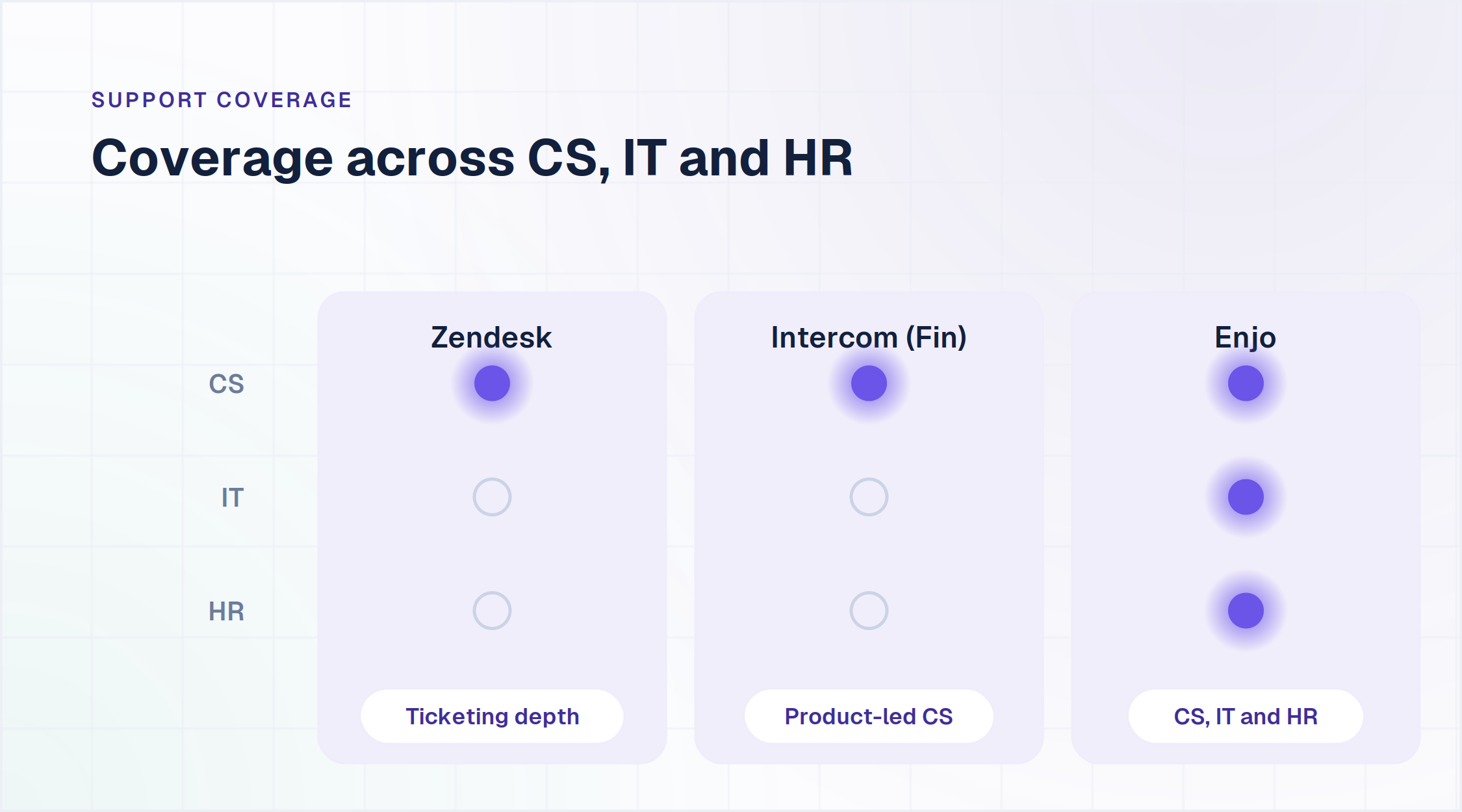
Worked example: 20 seats, 1,000 AI resolutions/month
| Item | Zendesk (Suite Professional) | Intercom (Essential) |
|---|---|---|
| Seats (20) | 20 × $115 = $2,300 | 20 × $29 = $5801 |
| Copilot add-on | 20 × $50 = $1,000 | 20 × $29 = $580 |
| AI resolutions (1,000) | ~$1,5002 | 1,000 × $0.99 = $990 |
| Rough monthly total | ~$4,800 | ~$2,150 |
Illustrative list-price math, not a quote. Zendesk AI resolutions are billed at $1.50 each on committed volume or $2.00 pay-as-you-go. Visit each vendor’s site directly to verify current pricing.
Enjo: The AI Layer That Doesn't Require Picking a Side
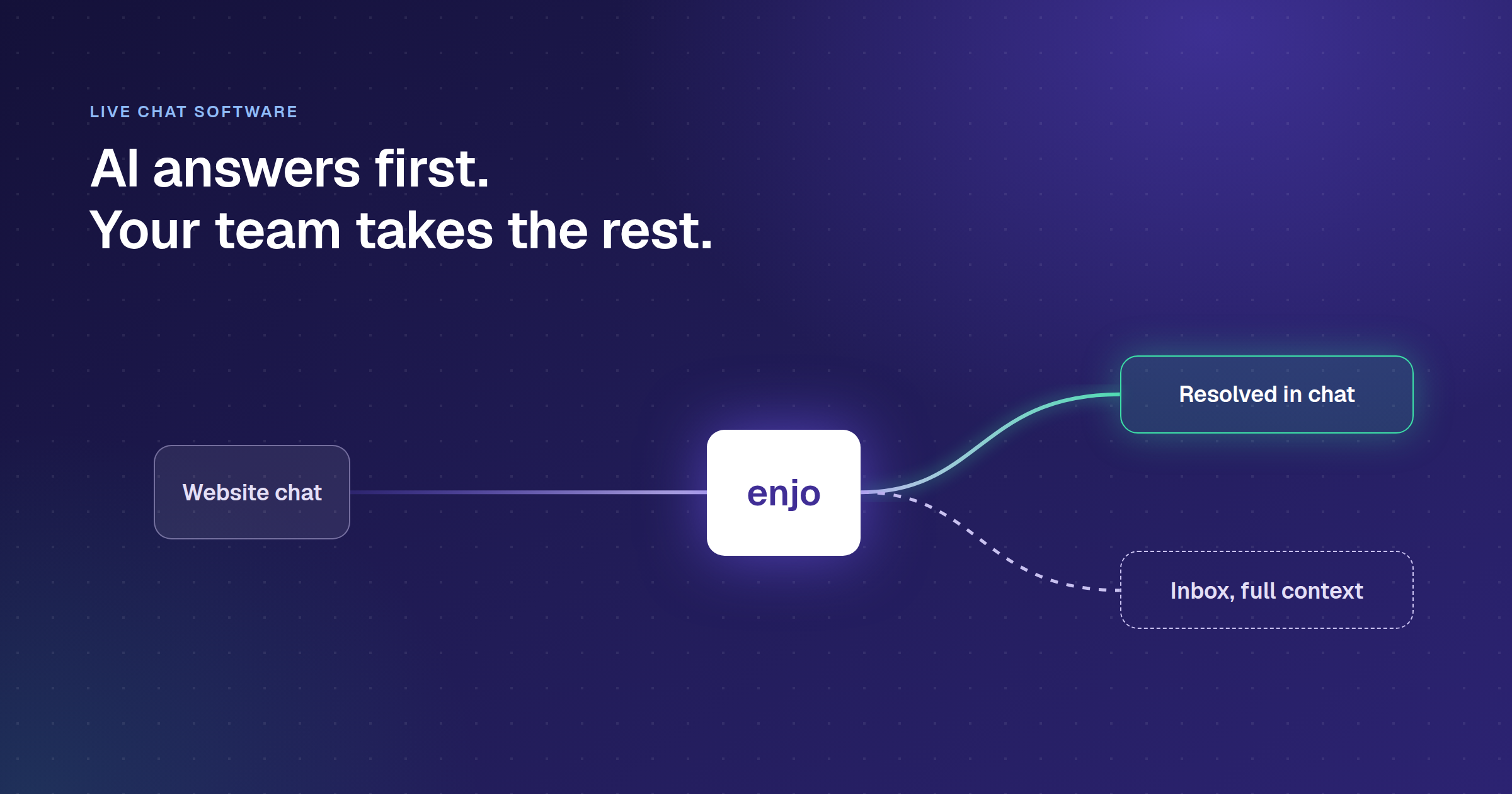
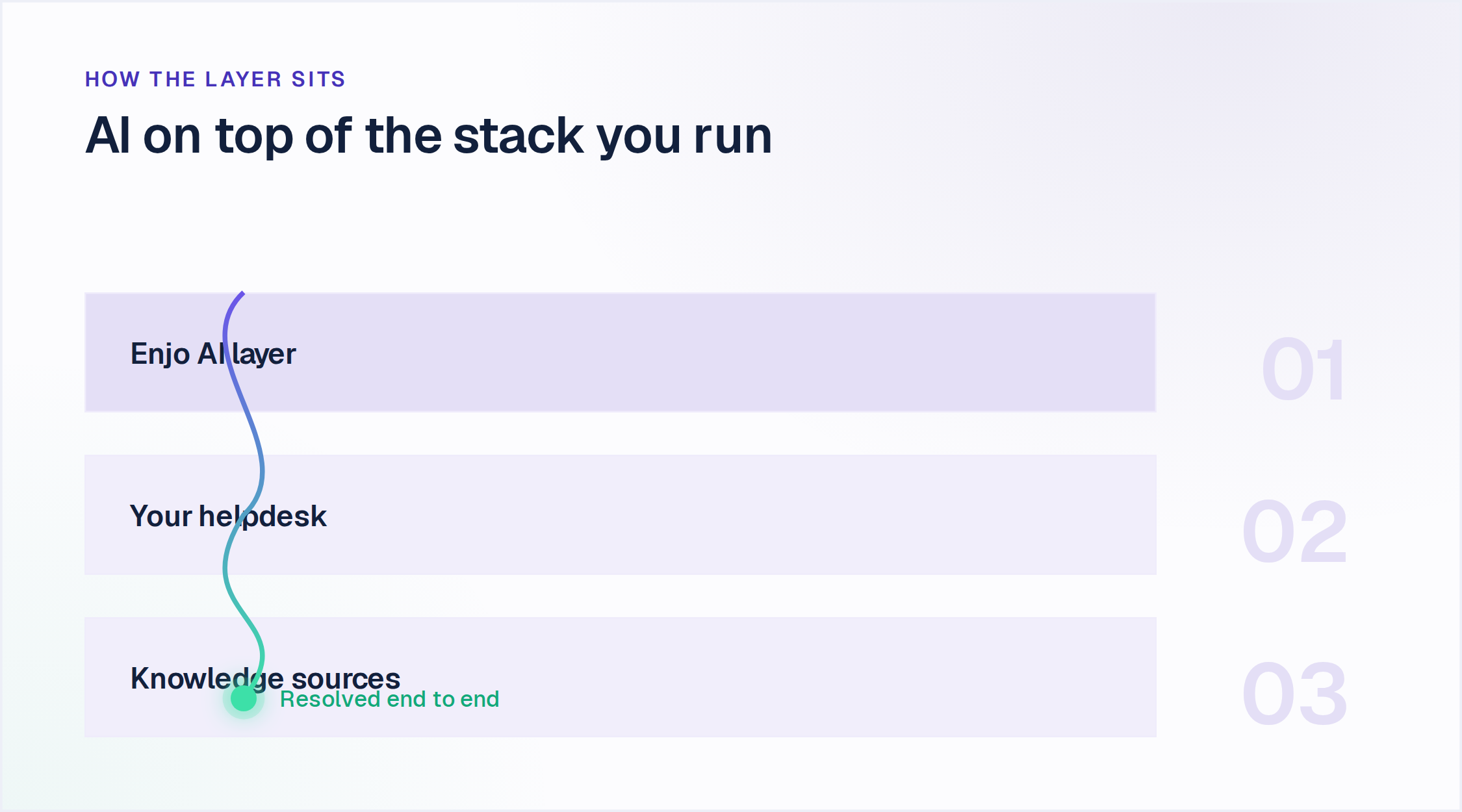
Enjo is an AI Support Agent that adds autonomous resolution to Zendesk or Intercom (Fin) without asking you to migrate: the agent is configured first and resolves the requests it can complete, and your existing helpdesk keeps the escalations.
AI Agents resolve requests end to end in Slack, Teams, email, or web, using AI Actions to take real steps in connected systems and AI Flows to orchestrate multi-step resolutions with explicit fallbacks. When AI can't resolve a request, it escalates to your existing helpdesk with full context, or to Enjo Inbox if you run standalone.
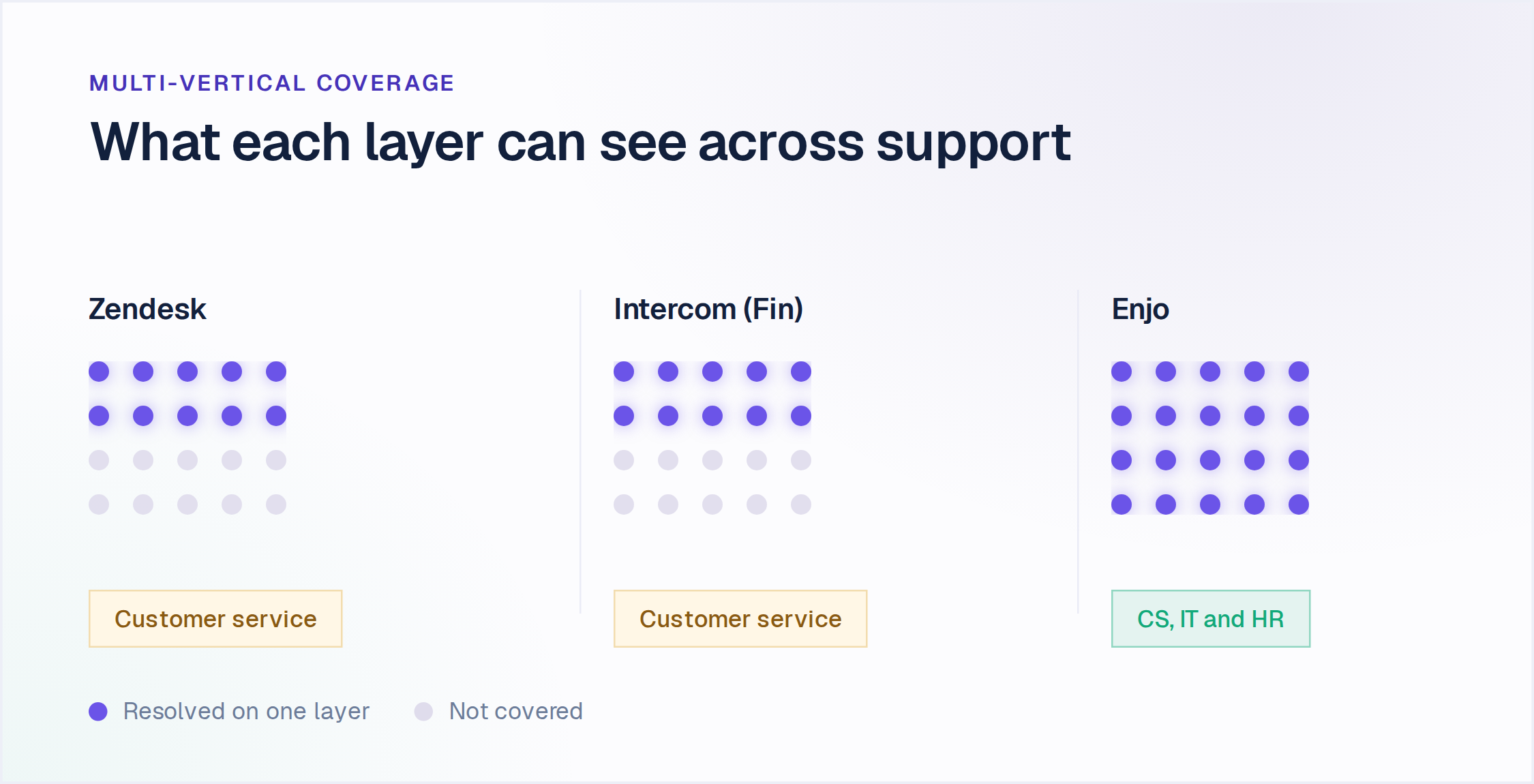
Agent Assist embeds directly in the Zendesk agent view, surfacing case summaries, reply suggestions, and relevant knowledge without a tab switch. Guardrails apply compliance controls across every AI interaction, with a full audit log. Unlike either platform in this comparison, Enjo runs the same knowledge layer across IT, HR, and customer service, one customer service software platform instead of three separate tools.
Zendesk: Built for the Ticket Queue
In the Zendesk vs Intercom decision, Zendesk is the structured customer service platform, built around tickets, queues, and SLA-driven routing. Suite plans bundle ticketing, live chat, voice, a knowledge base (Guide), and AI Agents, with pricing from $19/agent/month for ticketing-only Support Team up to $115/agent/month for Suite Professional. Zendesk lists 1,800+ apps in its Marketplace, the broadest integration surface in this comparison.
Zendesk's AI story expanded in March 2026 when it completed its acquisition of Forethought, adding self-learning AI agents that work across helpdesks, not just inside Zendesk. AI Agents are included on every Suite plan, billed per Automated Resolution, with the Copilot add-on at $50/agent/month for proactive assistance. Zendesk holds a 4.3/5 rating on G2 from 6,786 reviews, with reviewers most often citing strong reporting and integration depth, and add-on-driven cost creep as the recurring complaint.
Intercom (Fin): Built for the Conversation
Intercom, now operating under the Fin brand for its AI business, is built around the Messenger: an in-app, in-product conversational layer rather than a ticket queue. Fin AI Agent is included on every plan and also runs standalone on top of another helpdesk, including Zendesk and Salesforce, at $0.99 per resolved outcome with no seats required.
Fin holds a 4.5/5 rating on G2 from 3,815 reviews, edging out Zendesk on user sentiment, with small-business reviewers making up the majority of that base. The open question is what Salesforce ownership does to that experience. Nothing has changed in Fin's pricing as of this writing, but a buyer signing a multi-year contract today is signing with a Salesforce product, not an independent vendor.
Where Enjo Wins
- Multi-vertical resolution. Neither Zendesk nor Intercom resolves IT and HR requests on the same knowledge layer as customer service. Enjo does, which matters once support means more than the CS queue.
- No acquisition timeline to plan around. Enjo sits on top of either platform rather than betting on how Salesforce repackages Fin post-close.
- Free tier, unlimited seats. 200 AI replies a month at no cost, permanently, with unlimited human seats on every plan, instead of per-seat-plus-per-resolution stacking.
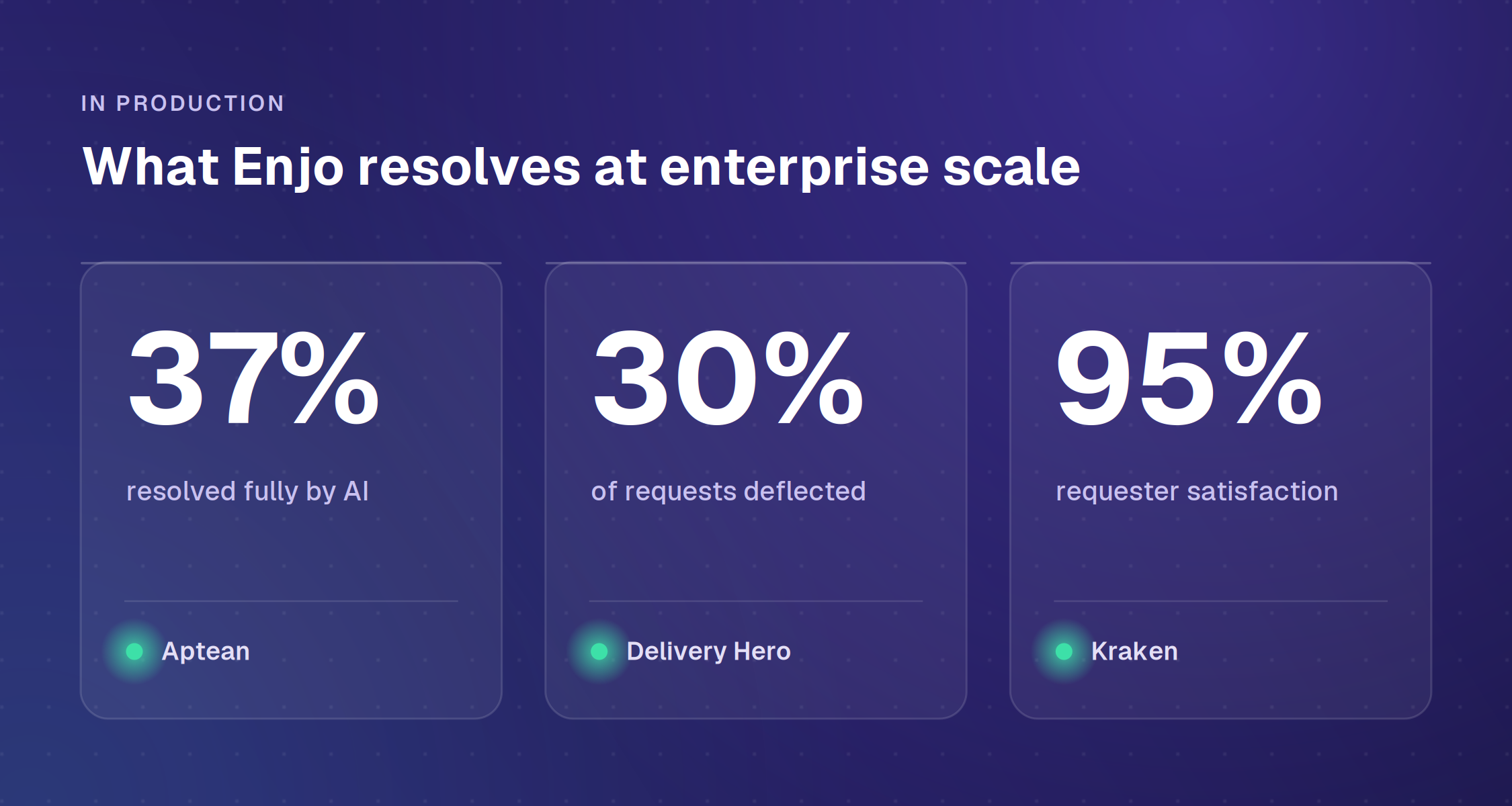
- Proof at enterprise scale. Aptean deployed Enjo in a single day on a Salesforce stack, trained the AI on 5M-plus documents, and now resolves 300K-plus cases a year with Enjo AI, 37% of them fully resolved by an AI chatbot for customer service with no human involvement.
Where Zendesk Fits
- High-volume, multi-touch ticketing with SLAs, skills-based routing, and QA at 50-plus agent scale.
- The broadest integration marketplace here, useful for teams consolidating on one vendor.
- Predictable per-seat pricing, easier to forecast than a seat-plus-usage hybrid.
- Zendesk Guide handles multi-brand and multilingual help centers, which matters once you support more than one product line.
- Explore reporting gives CX ops the SLA and agent-performance views that most conversation-first tools do not build.
Where Intercom (Fin) Fits
- In-app Messenger plus proactive tooling (tours, checklists, campaigns) built for product-led teams.
- Fastest setup of the two, typically live in one to two weeks.
- The more turnkey native AI agent today, though "today" carries real weight now that Salesforce owns it.
- Fin runs standalone on Zendesk, Salesforce, and HubSpot at $0.99 per resolution, so you can test it without leaving your helpdesk.
- Reporting centers on resolution rate and CSAT, which is the shorter path to proving AI value to a finance team.
Final Verdict
The Intercom vs Zendesk answer depends on where your conversations start. If your support happens inside your product and resolves in one or two messages, Intercom (Fin)'s strengths hold today; weigh the acquisition timeline before a multi-year commitment. If you run high-volume, multi-touch support across channels with formal SLAs, Zendesk remains the more predictable platform. Either way, resolving more with AI doesn't require picking a side between Zendesk and Intercom; an AI layer works on top of whichever one you already run.
Frequently Asked Questions
Q: What is the main difference between Intercom and Zendesk?
The Zendesk vs Intercom split is structural. Zendesk organises support around tickets, queues, and SLAs. Intercom (Fin) organises it around conversations inside your product.
Q: Is Intercom the same as Fin?
Intercom and Fin are the same company. Intercom rebranded to Fin in May 2026, centering the company name on its AI agent product.
Q: Does Salesforce's acquisition of Fin affect current Intercom customers?
Salesforce completed the acquisition on September 10, 2026. No contract changes have been announced, but the packaging and pricing risk going forward is real.
Q: Is Intercom (Fin) cheaper than Zendesk?
Intercom (Fin) is usually cheaper at low AI volume. Fin's per-outcome rate ($0.99) is lower than Zendesk's estimated rate, but both bills grow with AI usage. Run the math at your actual resolution volume before comparing. Cost is the most common Intercom vs Zendesk tiebreaker, and it flips as AI volume grows.
Q: Is Zendesk better than Intercom for enterprise support?
Zendesk is usually the stronger fit for enterprise support that needs deep SLA management, routing, and reporting at 50-plus agent scale. In a Zendesk vs Intercom decision, Zendesk skews toward mid-market and enterprise CX operations, while Intercom skews toward product-led teams.
Q: Can I add AI resolution to Zendesk or Intercom without switching platforms?
You can add AI resolution without switching platforms. An AI layer like Enjo adds autonomous resolution on top of either one, with no migration required.
Q: Which is better for a team that also runs IT or HR support, not just customer service?
Neither Zendesk nor Intercom is built for that. This is where a multi-vertical platform like Enjo is the cleaner fit.
Q: Is Zendesk Chat the same as Zopim?
Zendesk Chat and Zopim are the same product. Zopim was the live chat tool Zendesk acquired in 2014 and renamed Zendesk Chat. Today live chat and messaging are built into Zendesk's Suite plans, so comparing Zopim with Intercom now means comparing Zendesk's messaging with Intercom's Messenger, covered in the table above.
Q: Can you use Zendesk and Intercom together?
You can. Fin runs as an AI agent on top of Zendesk through Fin for platforms, so a team can keep Zendesk as its helpdesk and use Fin for automated resolution, billed at $0.99 per outcome. An AI layer like Enjo works the same way, resolving requests on top of Zendesk and escalating into it with full context.
Q: Is Intercom a replacement for Zendesk?
It can be, for teams whose support happens mostly in chat and inside their product. Teams that rely on formal ticket queues, SLAs and multi-channel routing usually keep Zendesk and add an AI layer on top instead of replacing it.