Transform complex support workflows
10 Best AI Chatbots for Customer Service in 2026
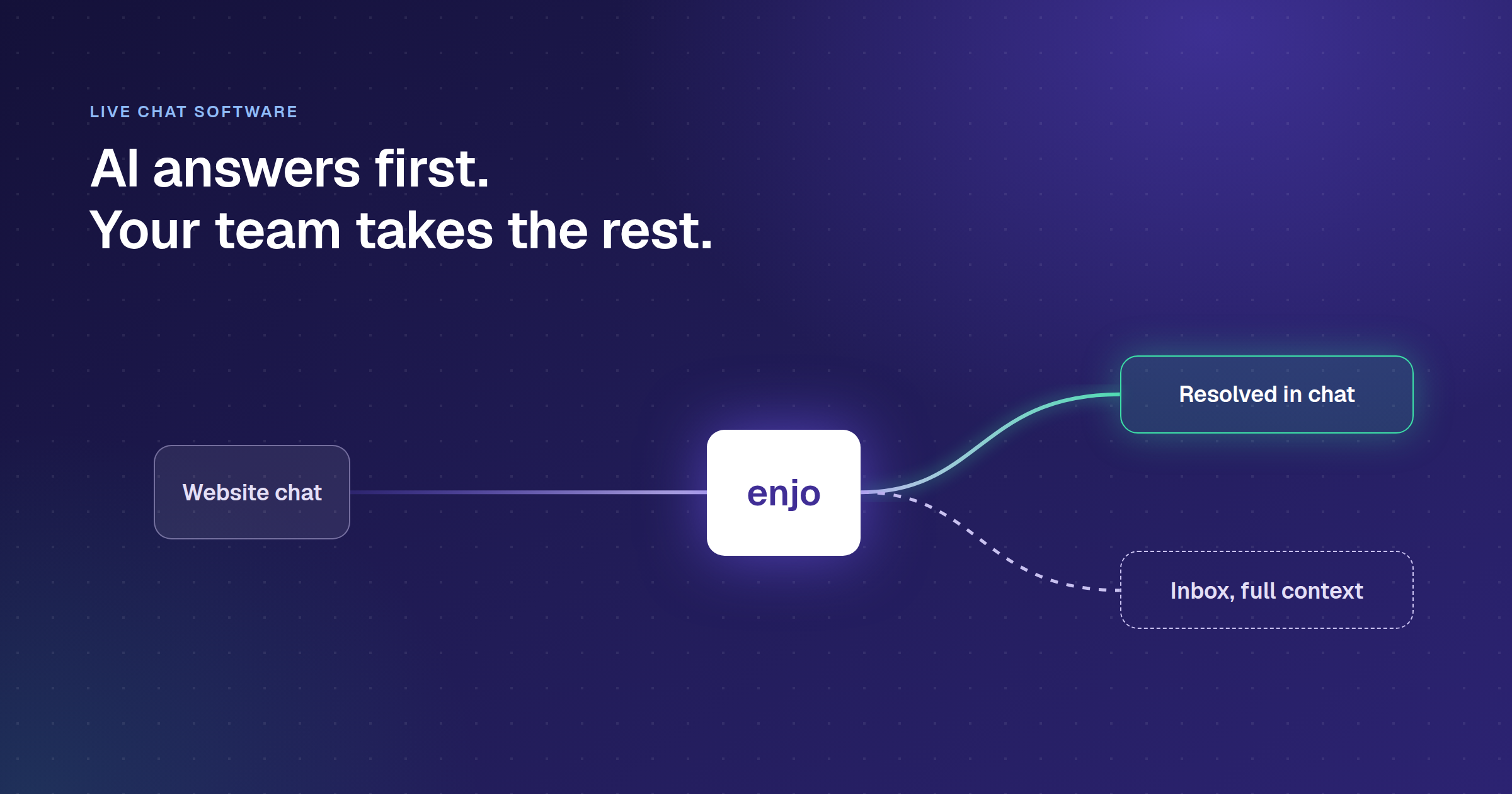
An AI chatbot for customer service is now judged on one number: how many requests it finishes without a human. Answering the question was the old bar. Resolving the request, taking the action it needs in a connected system, and handing off with context when it cannot, is the current one.
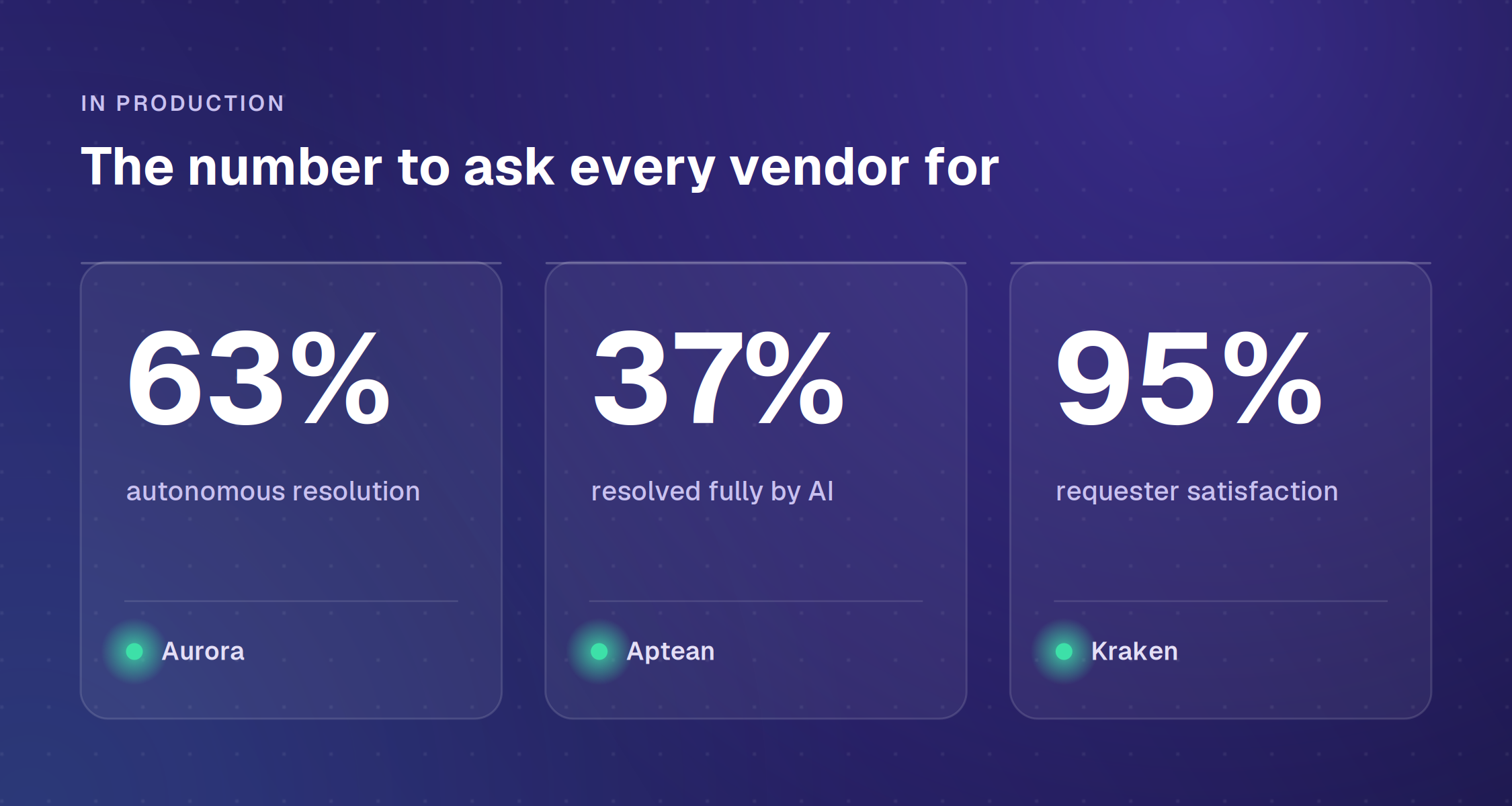
The gap between those two bars is where most of this category still sits. Enjo runs 63% autonomous resolution at Aurora, an autonomous vehicle company of 2,500 people, alongside 45% faster resolution and a 60% ESAT improvement. That is the shape of the number worth asking every vendor for, and almost none of them publish it.
Below are ten tools compared on what each one resolves, what it costs, and what an escalation actually carries into the queue your team works.
What Is an AI Chatbot for Customer Service?
An AI chatbot for customer service is software that receives a customer request in natural language, retrieves the answer from your own content, and replies without a human involved. The current generation uses large language models over your knowledge sources rather than keyword matching against a scripted decision tree, which is why it can handle a question phrased in a way nobody anticipated.
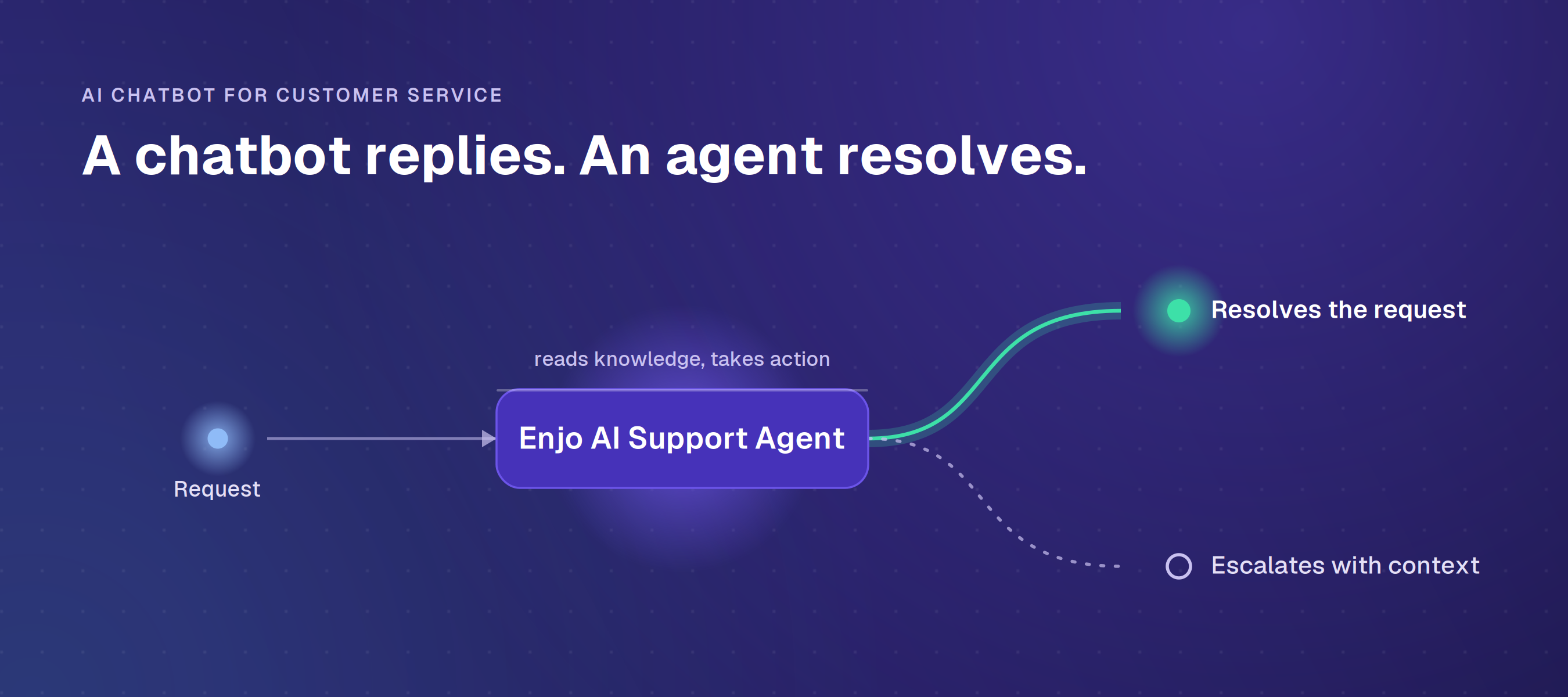
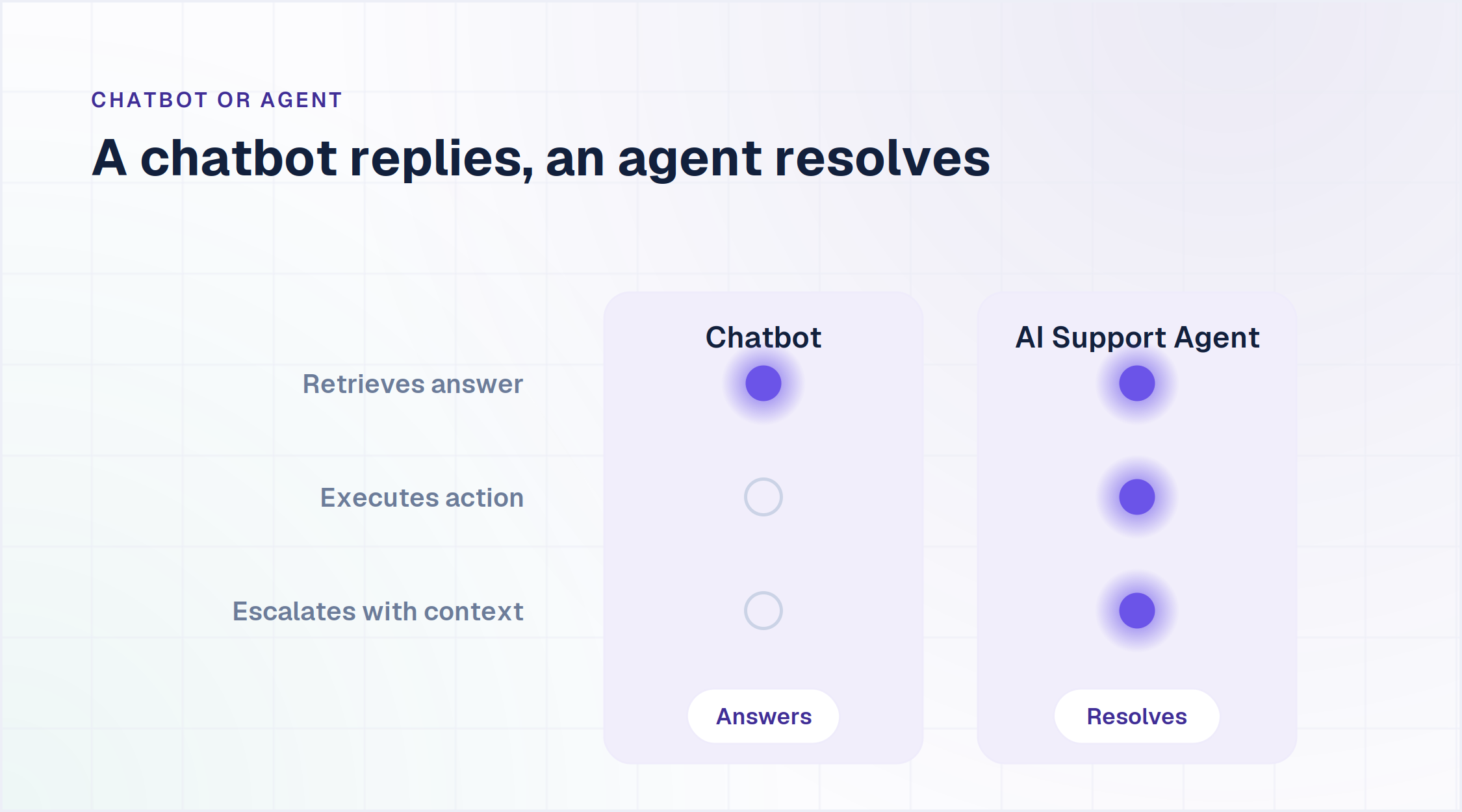
The meaningful split inside the category is action. A chatbot that only retrieves can answer "what is your return window", and stops there. An AI Support Agent that can execute an authorized action can also process the return, reset the password or provision the access, because it has a write path into the system that owns that record.
That distinction decides what share of your queue it can actually close. It is also the line between the tools on this list, and the reason two products with near identical marketing produce very different resolution rates on the same tickets. Our guides to the AI chatbot for business and to AI support agents for customer service cover the architecture underneath and what the human receives on handoff.
How We Evaluated These AI Chatbots
We started from the tools appearing on the pages currently ranking for this category, removed anything that is a flow builder rather than a reasoning agent, and scored what remained on five dimensions. Every price carries a source and a fetch date, and where a vendor does not publish a rate we say so rather than estimating. Three of the ten publish nothing at all.
Knowledge reach beyond one system. Answer quality is capped by what the tool can read. A bot confined to the help center it ships with will never resolve a request whose answer lives in Confluence, SharePoint or a three-year-old ticket in another helpdesk.
Write actions, and who authorizes them. Reading a ticket is not resolving a request. We looked for the list of actions the agent can execute, where the authorization is configured, and whether the action is recorded.
It is the same test our comparison of AI customer service software applies to ten agent platforms.
Where requesters reach it. Website chat, a Help Center portal, email, Slack, Microsoft Teams and Slack Connect shared channels are different surfaces with different engineering behind each one. We name channels rather than accepting coverage claims. Where the widget on your own site is the primary surface, our comparison of live chat software runs the same checks across ten of them.
What the escalation carries. Every tool here escalates something. The cost of that escalation depends on whether the human receives the full conversation, the account context and suggested next steps, or a bare ticket with a transcript attached, and on whether an Agent Assist layer drafts the reply for them.
How the price behaves at twice the volume. Per-resolution and per-conversation meters mean a better bot produces a bigger invoice. Per-conversation models charge for the failures too, so at a 60% resolution rate roughly 40% of that spend covers interactions that resolved nothing.
The 10 AI Chatbots for Customer Service
1. Enjo
Enjo is an AI Support Agent that resolves customer service requests end to end and escalates with full context when it cannot, running standalone or inside an existing helpdesk.
How it goes to market: Sold to customer service, IT and HR teams, priced per AI reply with unlimited human agent seats on published plans and a permanent free tier, with self-serve signup and no procurement cycle.
Key capabilities:
- Executes authorized actions mid-conversation: AI Actions creates, looks up and updates records in Jira, ServiceNow and Salesforce, unlocks accounts and provisions access in Okta, and reaches any other system through custom API and webhook actions.
- Reads knowledge outside the helpdesk: one index covers Confluence, SharePoint, Google Drive, Notion, Guru and past tickets across Zendesk, Salesforce, Jira and ServiceNow, synced daily.
- One knowledge layer, no drift: the same index grounds the agent, the human agent workspace and the requester-facing Help Center, so what the agent says is what agents see is what requesters find.
- Escalates with the work already done: the human receives the full conversation, the account context and suggested next steps, in the queue they already work.
- Multi-step workflows with defined fallbacks: AI Flows handles sequences with logic and stated behavior when the agent is not confident, built in Studio without code.
- Tested before it reaches a customer: Bulk Testing validates accuracy, consistency and coverage at scale, and Playground sandboxes prompts, tools and policies pre-production.
- Grounded answers with inspectable reasoning: every response carries a citation, with Guardrails on inputs and outputs and a searchable audit log on every AI decision.
Integrations: Salesforce, Zendesk, Jira Service Management, ServiceNow, Freshservice, Slack, Microsoft Teams, Confluence, Notion, SharePoint, Google Drive, Okta, Entra ID.
Customer proof: Aptean, an enterprise ERP provider with 3,500+ employees and 600+ support reps, brought its initial cohort live in a single day. It now resolves 300K+ cases a year with Enjo AI, 37% of them fully by AI without human involvement, across 5M+ documents indexed from Salesforce case feeds, knowledge bases and SharePoint. That is volume equivalent to 120 agents handled by AI, with 83% faster access to knowledge inside and outside Salesforce.
Pricing: Free includes 200 AI replies a month with unlimited human agent seats, unlimited AI agents, unlimited channels, Inbox, Help Center and Insights. Starter is $95 a month for 1,000 replies, Standard is $295 a month for 3,000, and additional replies are $0.05 each. Enterprise is custom on yearly billing.
Scope: Enjo is configured as the agent first, not as a chat widget with answers loaded into it. Requests it cannot resolve escalate into Inbox with the full conversation, account context and suggested next steps, which is the point rather than a limit.
Built by Troopr Labs, which has 600+ enterprise deployments and 99.9% uptime over 7 years across its products, with SOC 2 Type II, ISO 27001 and GDPR compliance.

2. Fin
Fin is an AI agent for customer service messaging, sold standalone on other helpdesks and bundled with the Intercom suite. It runs on Intercom, Salesforce, HubSpot, Freshworks, Dixa, Front, Zoho, Sprinklr and Gorgias, handling tickets, cases, emails, live chat, WhatsApp and SMS.
How it goes to market: Sold as a single-product AI agent that layers onto whichever helpdesk a team already runs, billed per outcome with no seat cost on the standalone path.
Key capabilities:
- Outcome-based billing with a defined unit: one outcome per conversation regardless of how many actions Fin takes, and no charge when a conversation simply passes to the team.
- Procedures for multi-step work: natural-language automations that can end in a configured handoff to a human or a workflow.
- Pre-launch validation: simulations, regression tests and audience testing before deployment.
- Agent-side assistance sold separately: Copilot is an inbox assistant at $35 per user per month.
Pricing: $0.99 per outcome with a 50-outcome monthly minimum on a non-Intercom helpdesk, or $0.99 per outcome plus $29 per helpdesk seat per month with Intercom. Qualification outcomes bill at $9.99 each. A 14-day free trial is available. Fetched from fin.ai on 7 September 2026.
Limitation: The bill rises as the agent improves. Every additional resolution is another $0.99, so the months where automation works best are the months the invoice is largest, and there is no free tier to test on real volume first. Salesforce completed its acquisition of Fin in September 2026, so its roadmap now sits inside Salesforce's.
3. Zendesk AI Agents
Zendesk AI Agents are the autonomous resolution layer inside the Zendesk platform, paired with Copilot for human agents and intelligent triage for routing.
How it goes to market: Sold inside Zendesk plan tiers, with AI agents included in every Suite and Support plan and billed on the outcomes they deliver.
Key capabilities:
- Automated resolution billing: the automated resolution is the billing unit, counted only when a request is resolved without escalation to a human.
- Action Builder for cross-system steps: multi-step action flows across Zendesk and third-party systems, with a prebuilt connector library and low-code tooling.
- Language breadth: support for 80+ languages.
- Marketplace depth: 1,800+ apps, partners and integrations.
Pricing: Support Team $19/agent/month, Suite Team $55/agent/month, Suite Professional $115/agent/month, Suite Enterprise + Copilot contact sales (all annual). Copilot add-on $50/agent/month. Visit zendesk.com directly to verify current pricing.
Limitation: The per-resolution rate is not on the pricing page. Zendesk publishes the seat tiers and the add-on rates, and describes automated resolution billing without stating the figure, so total cost cannot be modelled from published information alone. There is no free tier, only a 14-day trial.
4. Tidio (Lyro)
Tidio is a customer service platform whose AI agent, Lyro, answers questions from your support content and can run on another helpdesk on its own.
How it goes to market: Sold to smaller teams and ecommerce operations, billed on conversation volume rather than seats, with Lyro available as a standalone add-on to Zendesk, Salesforce or another helpdesk.
Key capabilities:
- Content ingestion without setup work: FAQ upload, FAQ scraper, website scraper and Zendesk article import on every tier.
- Billing unit that excludes bot replies: a billable conversation requires a message from a human agent, and Flows and Lyro replies do not count as agent replies.
- Actions on the ecommerce stack: native Shopify actions from the Growth tier.
- Pay-per-resolution at the top tier: Premium carries pay-per-resolution billing and a stated 50% Lyro resolution rate.
Pricing: Free at $0, Starter $24.17 a month annually for 100 billable conversations, Growth from $49.17, Plus from $300 a month plus usage, Premium quote-based. The Lyro AI Agent add-on starts at $32.50 a month for 50 Lyro conversations, with the first 50 free for the lifetime of the account. Fetched from tidio.com on 7 September 2026.
Limitation: Seats cap at 10 until the Plus plan, and SSO and compliance features sit on Premium only. The AI quota also runs separately from the human conversation quota, so two meters have to be watched at once.
5. Ada
Ada is an enterprise AI agent platform for customer service, built around its own reasoning engine and its own agent workspace, with connectors into helpdesks and contact center systems.
How it goes to market: Sold to enterprise consumer brands running high-volume service, sales-led with no published rate card, with reference concentration in retail and consumer DTC.
Key capabilities:
- Multi-model reasoning: orchestrates models from multiple providers rather than committing to one, with zero data retention agreements across them.
- Channel spread from one build: voice, chat, email, SMS and in-app from a single agent configuration.
- Behavioral control without code: managers refine agent responses by reviewing underperforming conversations and applying feedback.
- Regulated-industry posture: certifications spanning SOC 2, GDPR, HIPAA and PCI DSS.
Pricing: Not published. Ada quotes per contract.
Limitation: There is no self-serve path and no free tier, so the first look at the product comes through a sales conversation rather than your own ticket queue. Reviewers report initial setup as heavy for smaller teams.
6. Forethought AI Agents by Zendesk
Forethought is a self-improving AI agent layer that runs on an existing helpdesk. It is now sold by Zendesk as "Forethought AI agents by Zendesk", described as agents that understand requests, take action and improve outcomes over time, and positioned as working on any platform rather than Zendesk only.
How it goes to market: Sold through Zendesk on a contact-sales basis, with no migration required and a separate demo path.
Key capabilities:
- Learns from resolved tickets: each solved ticket feeds the next outcome rather than requiring a retraining cycle.
- Runs on a non-Zendesk stack: integrates with a current setup whether that is Zendesk or another service provider.
- Workflows across channels: built for work spanning all channels and environments.
- Triage alongside resolution: intent and sentiment classification feeding routing, not only answer generation.
Pricing: Not published, contact sales. Confirmed on zendesk.com on 7 September 2026.
Limitation: The independent vendor relationship is gone. Forethought's roadmap and commercial terms now sit with Zendesk, which is the specific dependency a team picking a helpdesk-agnostic layer is usually trying to avoid.
7. Freshdesk (Freddy AI)
Freddy AI is the AI layer embedded across the Freshworks suite, covering self-service deflection, agent assistance and ticket triage.
How it goes to market: Sold as a single-vendor suite consolidation, with Freddy priced as an add-on on top of the platform subscription.
Key capabilities:
- Embedded across the suite: the same AI layer spans Freshdesk, Freshchat and Freshservice.
- Self-service bot on help content: trained on published articles without separate configuration.
- Reply suggestions and conversation summaries for human agents inside the ticket.
- Predictive ticket routing based on historic patterns.
Pricing: Growth is $18 per agent per month, Pro $59 and Enterprise $95. Freddy AI Copilot is $29 per agent per month on Pro and Enterprise, and Freddy AI Agent sessions include 500 one-time sessions, then $49 per additional 100. Visit freshworks.com directly to verify current pricing.
Limitation: Freddy operates inside Freshworks. A team whose answers live in Confluence or SharePoint, or that needs a write action in Okta or Jira, is outside what the suite reaches. The free plan is a time-limited programme rather than a permanent tier.
8. Netomi
Netomi is an enterprise AI platform for customer service combining autonomous agents, human agent assistance and channel breadth across web, app, email, SMS and messaging.
How it goes to market: Sold to large enterprises in regulated and high-volume sectors, sales-led with no published rate.
Key capabilities:
- Governance ahead of the model call: topic guardrails, prompt-injection defences and duty-of-care controls run before an AI action rather than after.
- Certification breadth: SOC 2 Type II, ISO 27001, HIPAA and PCI DSS.
- Confidence scoring with fallback logic: answer confidence thresholds trigger configurable fallback workflows.
- Native helpdesk and contact center connectors across Zendesk, Salesforce, ServiceNow, Genesys and others.
Pricing: Not published. Netomi quotes per contract.
Limitation: No self-serve onboarding and no free tier, and reviewers report implementation as heavy for teams without enterprise-level support attached. Its G2 rating rests on a small review sample relative to the rest of this list.
9. Gorgias
Gorgias is an ecommerce-focused helpdesk with a conversational AI agent that handles order-related requests inside the chat thread.
How it goes to market: Sold to ecommerce brands on Shopify, BigCommerce and Magento, billed on ticket volume rather than seats, with the AI Agent metered per resolved conversation.
Key capabilities:
- Order actions in the conversation: cancels orders, applies discount codes and manages subscriptions without leaving the thread.
- Native store data: direct connections to Shopify, BigCommerce, Magento and WooCommerce for live order and customer context.
- Seats do not drive the bill: ticket-based billing rather than per-agent licensing.
- Revenue attribution reporting tying support conversations to sales.
Pricing: Starter $10 a month for 50 tickets, Basic $60, Pro $360 and Advanced $900 on monthly billing, with annual billing lower, plus $0.90 to $1.00 per AI Agent resolution. Visit gorgias.com directly to verify current pricing.
Limitation: An AI resolution also consumes a ticket from your allowance, so a fully automated conversation can bill twice. Value is also tied to store data, and the order and subscription objects the agent is built around do not exist outside an ecommerce catalogue.
10. Chatbase
Chatbase is a no-code platform for building an AI agent trained on your own documents, website and connected sources, then embedding it on a site or in Slack.
How it goes to market: Sold self-serve to small and mid-sized teams that want a support agent live in days without engineering involvement.
Key capabilities:
- Training on your own sources: documents, a website URL or a connected knowledge base, with answers restricted to that content.
- Helpdesk escalation from the Standard tier: rules hand off to a human via live chat or a helpdesk ticket, with Zendesk, Salesforce, Intercom, Freshdesk and Gorgias connectors.
- Credit-metered replies: each AI response consumes message credits, with heavier models consuming more per reply.
- Model choice in the builder: advanced OpenAI, Anthropic, Gemini, Meta and Mistral models on paid tiers.
Pricing: Free at $0 for 50 message credits a month, Hobby $40 for 700 credits, Standard $150 for 4,000, Pro $500 for 15,000, Enterprise custom. Yearly billing is 20% lower. Add-ons run $40 per 1,000 extra credits, $25 per additional agent per month, and $99 a month to remove Chatbase branding. Fetched from chatbase.co on 7 September 2026.
Limitation: On the free plan, agents are deleted after 14 days of inactivity, so it functions as a sandbox rather than a permanent tier. Credit consumption also varies by model, which makes the effective cost per reply harder to forecast than a flat per-resolution rate.
How to Run the Evaluation
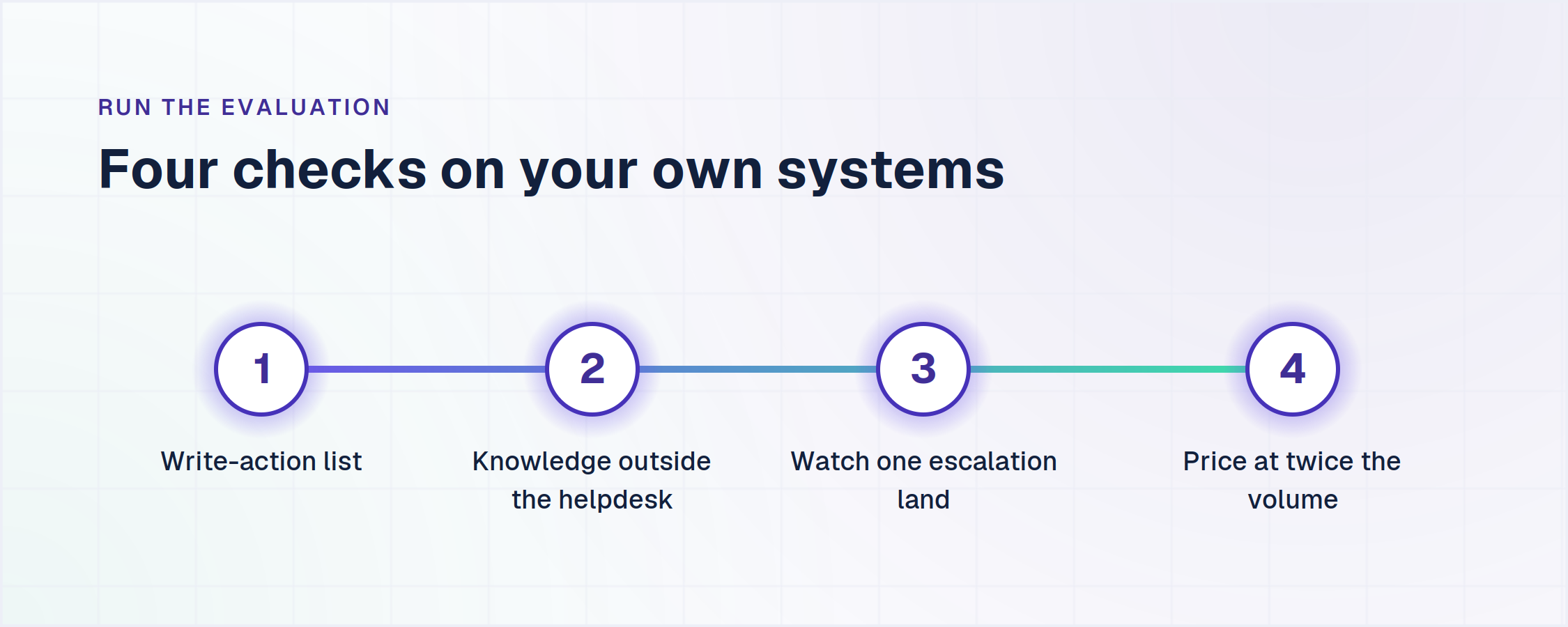
Run these four on your own systems, not in a vendor demo. The answers separate this list faster than any feature grid.
Ask for the write-action list, not the integration list. An integration that reads a ticket is not the same as one that unlocks an account or updates a case. Ask which actions the agent can execute, who authorizes each one, and where that authorization is recorded. Enjo answers this with the AI Actions catalogue plus an audit log entry on every decision.
Point it at one knowledge source that does not live in your helpdesk. Pick the Confluence space or SharePoint folder where the real answer actually sits, and see whether the agent can reach it. Enjo indexes Confluence, SharePoint, Google Drive, Notion, Guru and past tickets across four helpdesks on a daily sync.
Watch one escalation land in the queue your team works. Not a transcript in an email. The full conversation, the account context and suggested next steps, in the ticket, with the agent able to pick up where the AI stopped. This decides how much each escalation actually costs you.
Price the same volume at twice today's traffic. Per-outcome and per-resolution meters mean a better agent produces a larger bill, and three vendors here will not give you a rate before a sales call. Enjo is $295 a month for 3,000 AI replies with additional replies at $0.05, so the second line of the model is arithmetic rather than a negotiation.
The cost of getting the handoff wrong is measurable. Gartner's September 2026 survey of 3,566 customers found only 27% would try a chatbot again after a negative experience, which is why what a tool does when it cannot resolve matters as much as its resolution rate. Forrester's 2026 assessment found roughly three-quarters of enterprise leaders reporting agentic AI adoption while only a small minority ran it in meaningful production beyond chatbot-like use.
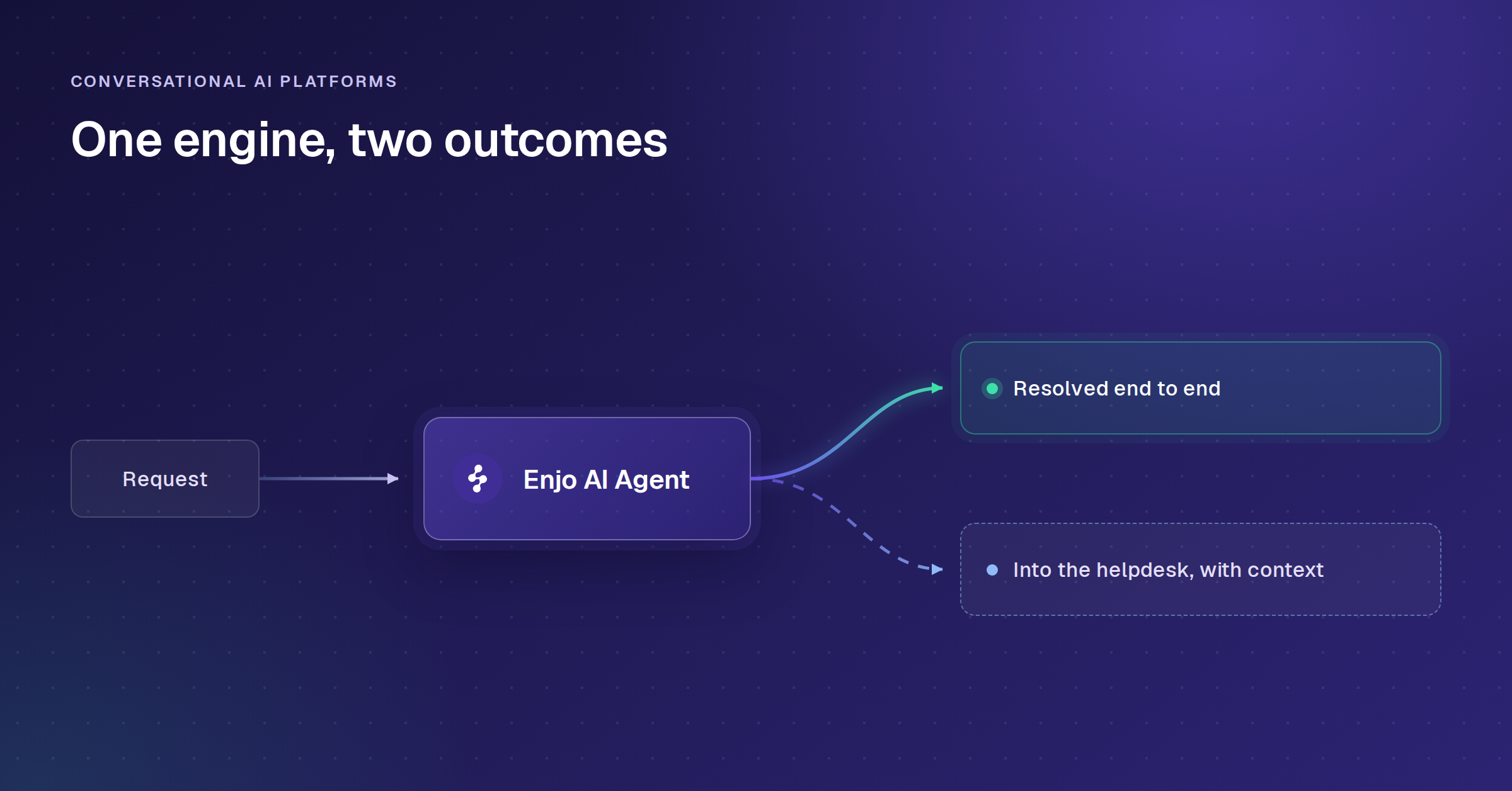
If your requests arrive in a website widget rather than a helpdesk queue, our guide to the AI chatbot for website covers the setup path. If you are evaluating infrastructure to build multiple agents on rather than a single deployed agent, see our ranking of conversational AI platforms.
The Bottom Line
The question that separates these ten is not answer quality, it is what happens after the answer. Ask each vendor for the write-action list, point it at a knowledge source outside your helpdesk, and watch one escalation land in your actual queue.
Start free at enjo.ai and put an AI Support Agent on your real requests today, with 200 AI replies a month and unlimited human agent seats.
Frequently Asked Questions
How are AI chatbots used in customer service?
They resolve the repetitive layer of the queue: order and account status, password and access requests, policy questions, returns and plan changes. The stronger implementations also execute the action the request implies, then escalate anything they cannot finish with the conversation and account context attached. AI Insights on what the agent could not answer then feeds back into the knowledge base, ranked by volume so the next automation is the one that clears the most work.
How do you create a chatbot for customer service?
Connect your knowledge sources first, then define the actions the agent may take and who authorizes them, then test before exposing it to customers. With Enjo, connecting a source and generating a self-service help center from a URL or existing docs takes minutes, Bulk Testing validates accuracy across a batch of real questions, and Guardrails set the topics and patterns the agent will not touch. Escalation rules come last, because they define what the human receives when the agent stops.
Can you use ChatGPT for customer service?
Only with your own data connected and controls around it. A general assistant has no access to your ticket history, order records or policy library, and no audit trail on what it told a customer. Teams that go this route end up building retrieval, permissions, guardrails and logging themselves, which is the work the platforms on this list already ship.
What is the difference between an AI chatbot and an AI agent?
A chatbot replies; an agent resolves. The distinction is whether the tool can execute an authorized action in a connected system, such as provisioning access in Okta or updating a case in Salesforce, rather than only retrieving and phrasing an answer. Our breakdown of chatbots vs conversational AI covers where the line sits in practice.
How much does an AI chatbot for customer service cost in 2026?
Published rates on this list run from free to $0.99 per resolved conversation, and three of the ten vendors publish no rate at all. Enjo is free for 200 AI replies a month with unlimited human agent seats, then $95 a month for 1,000 and $295 for 3,000. Per-outcome models mean the bill grows as the agent improves, so model your real volume at twice current traffic before committing.