Transform complex support workflows
12 Best Conversational AI Platforms in 2026
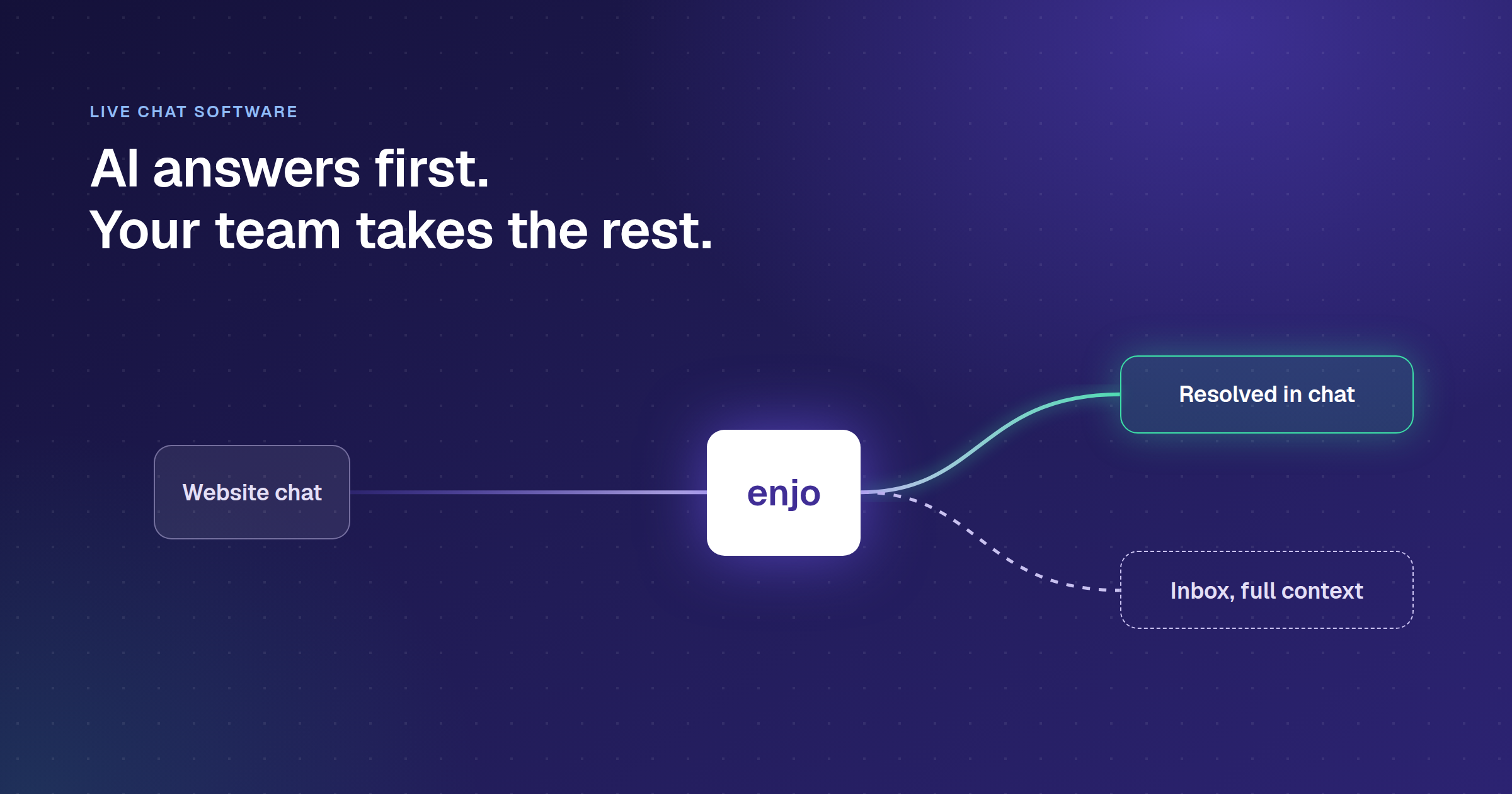
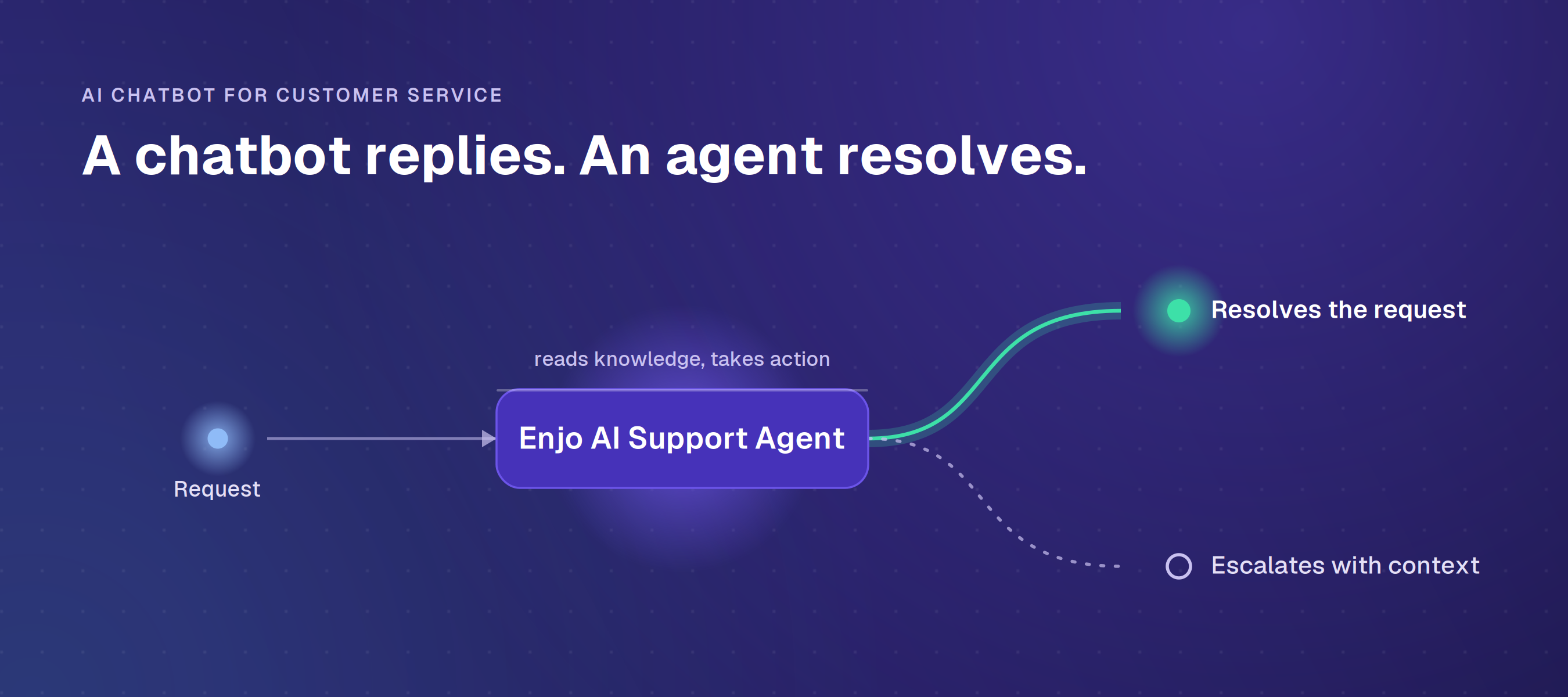
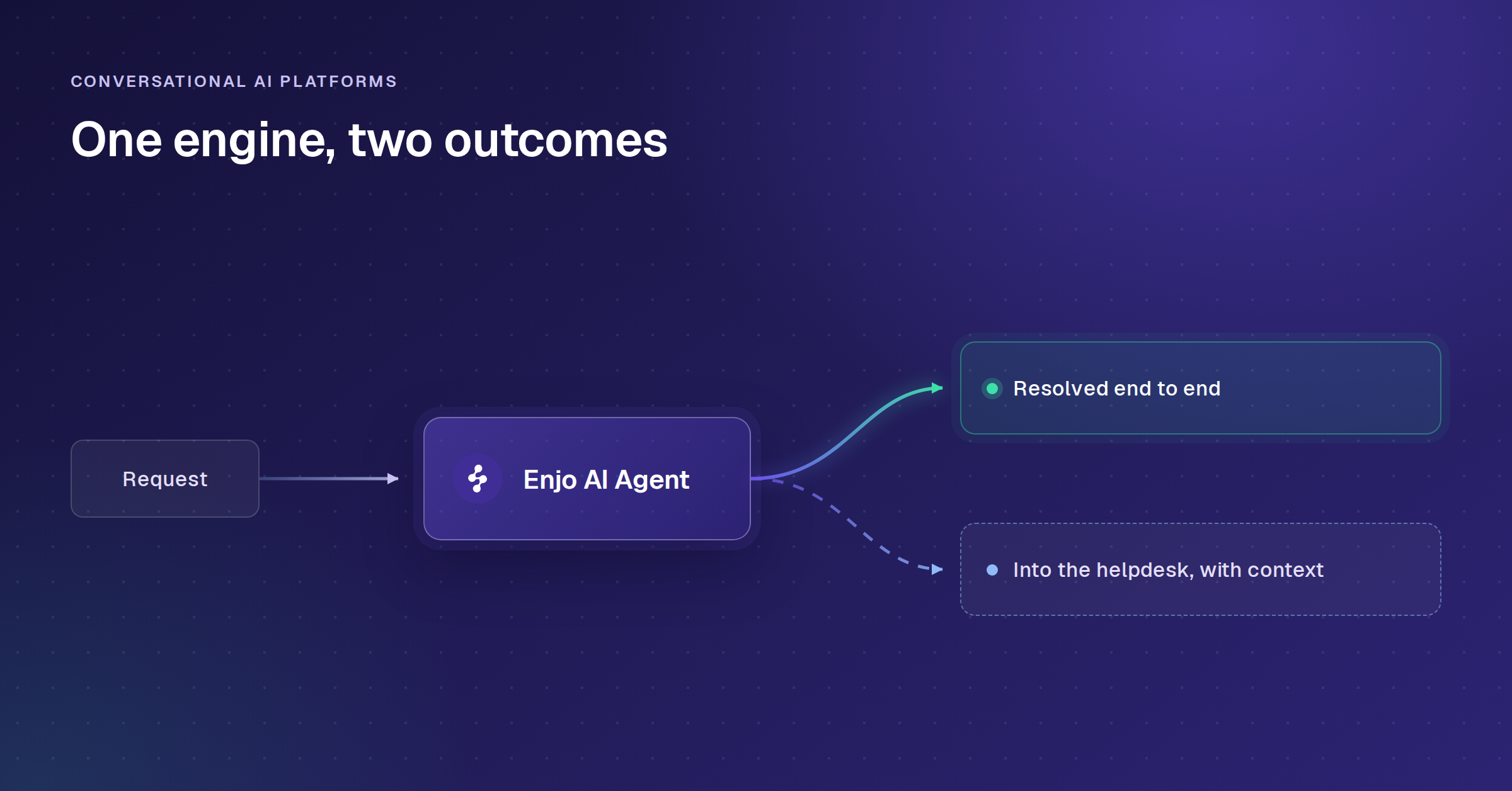
Conversational AI platforms split three ways: contact-centre and CX platforms you build agents on, voice agent runtimes for phone calls, and resolving agents deployed into the helpdesk. Enjo is the resolving agent: it resolves requests inside Salesforce, Zendesk, Jira or ServiceNow and escalates back into the same ticket with the full conversation, account context and suggested next steps.
- Enjo: resolves requests inside the helpdesk you already run and escalates with full context
- Cognigy (NiCE): low-code voice and digital agents for large contact centres, now part of NiCE CXone
- Kore.ai: no-code XO Platform for bot building and workflow automation, with a choice of model
- Boost.ai: conversational AI for banking, insurance and government, with hybrid NLU and language-model control
- Yellow.ai: 35+ channels including LINE, KakaoTalk and WeChat, grounded by agentic retrieval
- Aisera: a cognitive layer over IT, HR and service systems, now part of Automation Anywhere
- LivePerson: live agent messaging plus generative AI automation for large consumer brands
- Talkdesk: AI agents inside a full cloud contact centre, priced per user per month
- IBM Watsonx Assistant: virtual agents on IBM Cloud, with a free Lite tier
- Retell AI: voice agents for inbound and outbound calls, pay as you go from $0.07 a minute
- Synthflow: no-code voice agents that connect into Five9, Genesys Cloud, Talkdesk and other phone systems
- ElevenLabs Agents: voice and chat agents on ElevenLabs speech models, starting from a free plan
A conversational AI platform is what a support team reaches for when its current setup is no longer enough. Most teams start with a single AI chatbot for business bolted onto the website: it answers questions, deflects a few tickets, and calls it a day. The cracks show up fast. A customer calls instead of types, or a conversation moves from chat to voice, and suddenly it is a different vendor, a different setup, a different bill. Worse, when the bot escalates to a human, it does so with no context, so the agent starts from scratch anyway.
That is the ceiling a conversational AI platform is built to remove: one engine across channels, real integration with the helpdesk, and enough governance that security does not kill the deal in week one.
This guide compares twelve conversational AI platforms on helpdesk integration, governance and pricing. Only five of the twelve publish a rate at all, so the section on what you will actually pay is where most of the work went.
The Short Answer
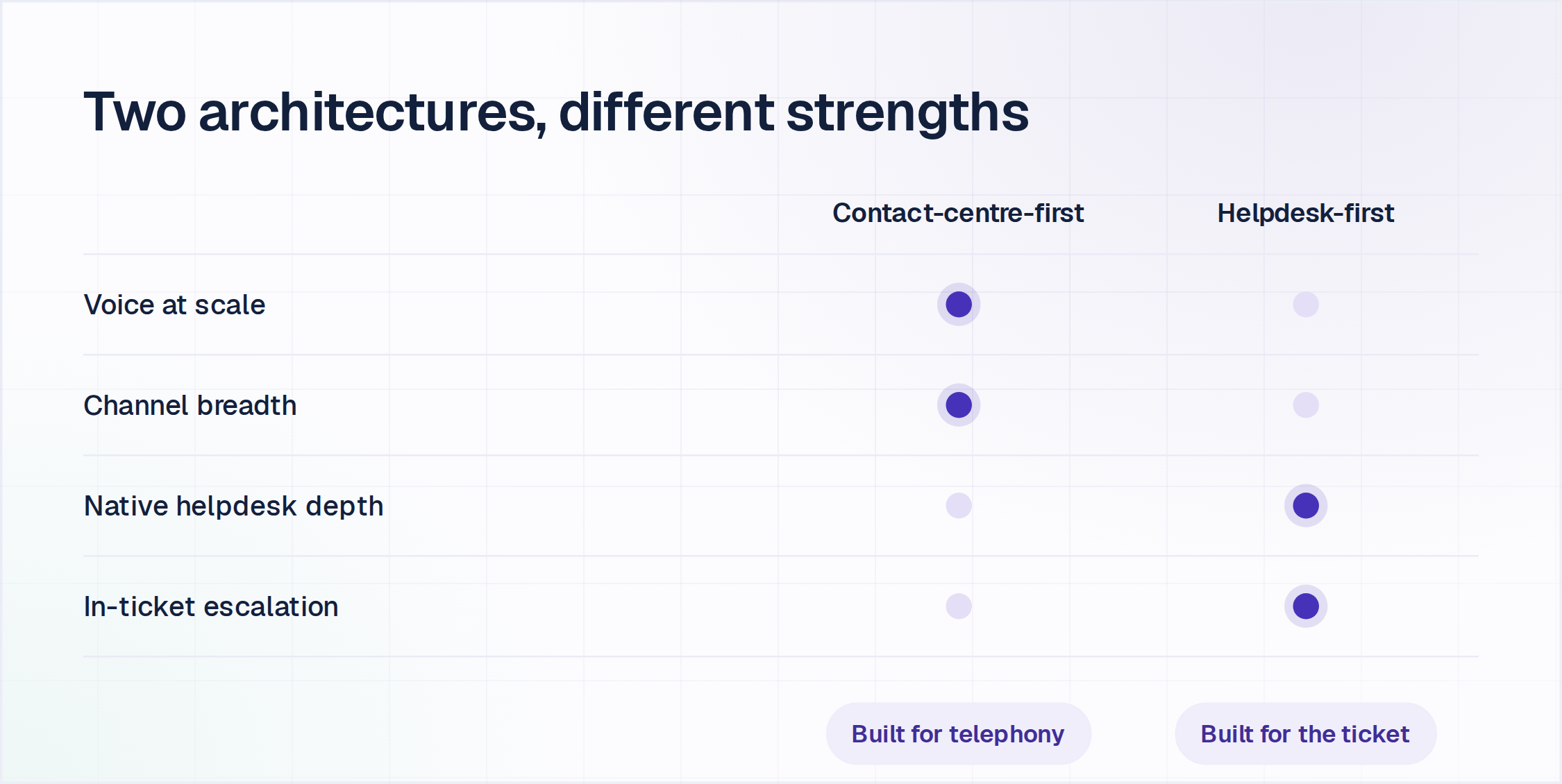
This category splits on where each vendor started. Almost every platform here was built contact-centre-first, which produces depth on voice, channel breadth and routing infrastructure. Enjo was built helpdesk-first: the AI Agent resolves requests end to end inside Salesforce, Zendesk, Jira or ServiceNow and escalates back into the same system with the full conversation, account context and suggested next steps attached. If you want a single deployed agent rather than a platform to build on, start with our AI chatbot for business guide.
What Is a Conversational AI Platform?
A conversational AI platform is the infrastructure a team builds and runs virtual agents on: natural language understanding, dialog orchestration, connectors to the channels requesters actually use, and the governance controls that decide what an agent is allowed to do.
It differs from a single AI chatbot in scope. A chatbot is one deployed agent answering a defined set of questions. A platform is the layer from which multiple agents are built, versioned and governed, across chat, voice, email and messaging. The practical test is whether you are buying one agent or the ability to run several.
The Divide That Decides Your Shortlist
Almost every platform in this category was built contact-centre-first. That produces genuine strength on voice, channel breadth and routing infrastructure, and a predictable weakness on native helpdesk depth. The gap between buying a platform and running one in production is well documented. Forrester's 2026 assessment found roughly three-quarters of enterprise leaders reporting agentic AI adoption while only a small minority ran it in meaningful production beyond chatbot-like use.
How We Evaluated These Conversational AI Platforms
Every platform below is scored against five dimensions that decide whether it survives contact with a real deployment rather than a demo.
Helpdesk and CRM integration depth. Does it read and write to Salesforce, Zendesk, Jira or ServiceNow natively, or does every action route through middleware someone has to build and maintain? Native integration is usually the difference between weeks and quarters in production. Enjo's integrations span ticketing systems, knowledge sources, channels and action targets.
Channel breadth. Count the channels where requests actually arrive, such as website chat, a Help Center portal, Slack, Microsoft Teams and Slack Connect shared channels, and check whether one runtime and one knowledge index serve all of them. A platform that splits channels across products forces a second procurement cycle and a second copy of the knowledge.
Governance posture. Audit trails, role-based access, and certifications like SOC 2 and ISO 27001 are what get a platform past a CISO on the first call rather than after the pilot. The downside of getting escalation wrong is measurable. Gartner's September 2026 survey of 3,566 customers found only 27% would try a chatbot again after a negative experience, which is why what a platform does when it cannot resolve matters as much as its resolution rate.
Deployment speed. Weeks to production versus quarters is the clearest signal of whether a platform actually ships once bought.
Pricing transparency. Published rates versus sales-led custom quotes decide whether procurement can model total cost before committing budget, or has to negotiate blind.
The 12 Best Conversational AI Platforms
G2 ratings read 30 August 2026, and for Retell AI and Synthflow on 1 October 2026. Three of twelve offer a free plan, and five publish pricing. Category direction is worth holding alongside the vendor detail: Gartner predicts agentic AI will autonomously resolve 80% of common customer service issues without human intervention by 2029, with a 30% reduction in operational costs.
1. Enjo
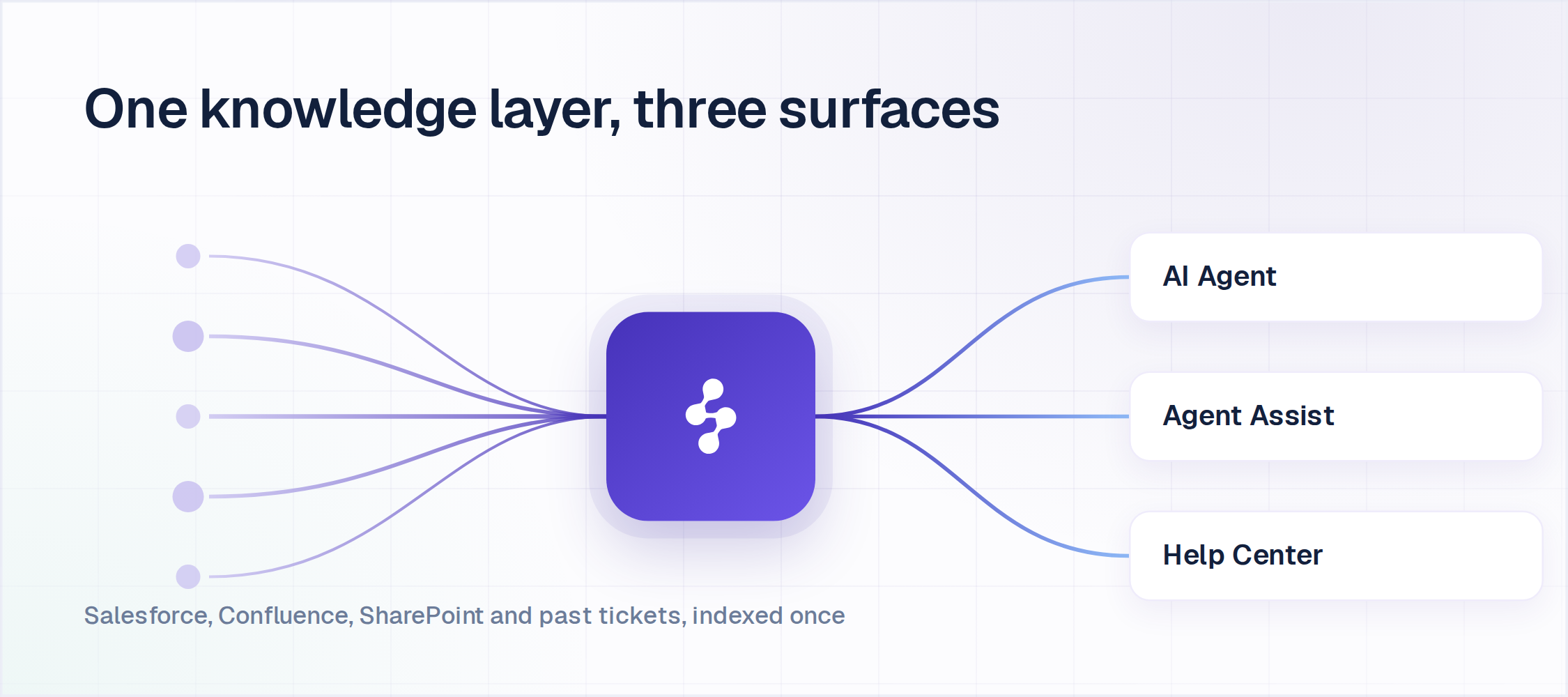
Enjo is an AI Support Agent that adds autonomous resolution to the helpdesk you already run, and can run standalone. Its AI Agent resolves requests end to end and escalates with full context when it cannot, drawing on a single knowledge layer spanning Salesforce, Confluence, SharePoint and past tickets. It is built helpdesk-first, which is what puts resolution inside Slack, Microsoft Teams, website chat and the Help Center portal, and escalation inside the ticket rather than around a telephony runtime.
How it goes to market: Sold to customer service, IT and HR teams that keep their existing helpdesk, priced per AI reply with unlimited human agent seats and a permanent free tier.
Key capabilities:
- Autonomous AI Agent with no-code agentic workflows for multi-step, cross-system execution
- One knowledge layer powers AI resolution, Agent Assist for live agents, and the customer-facing Help Center, with no duplication
- Native to Slack, Microsoft Teams, website chat and the Help Center portal, including Slack Connect shared channels
- Embeds inside Salesforce, Zendesk, Jira Service Management and ServiceNow, or runs standalone with a free Inbox
- Guardrails on AI inputs and outputs, plus full audit logs
- Multilingual resolution, with one-click AI Translation of drafts inside Agent Assist
- Continuous learning from every human reply in real time, with nothing additional to configure, plus Bulk Testing to validate accuracy and coverage before launch
- SOC 2 Type II, ISO 27001 and GDPR compliance with role-based access control and a searchable audit log on every AI decision, from Troopr Labs, which holds 600+ enterprise deployments and 99.9% uptime over 7 years
Integrations: Salesforce, Zendesk, Jira Service Management, ServiceNow, Freshservice, Slack, Microsoft Teams, Confluence, Notion, SharePoint, Google Drive and Okta.
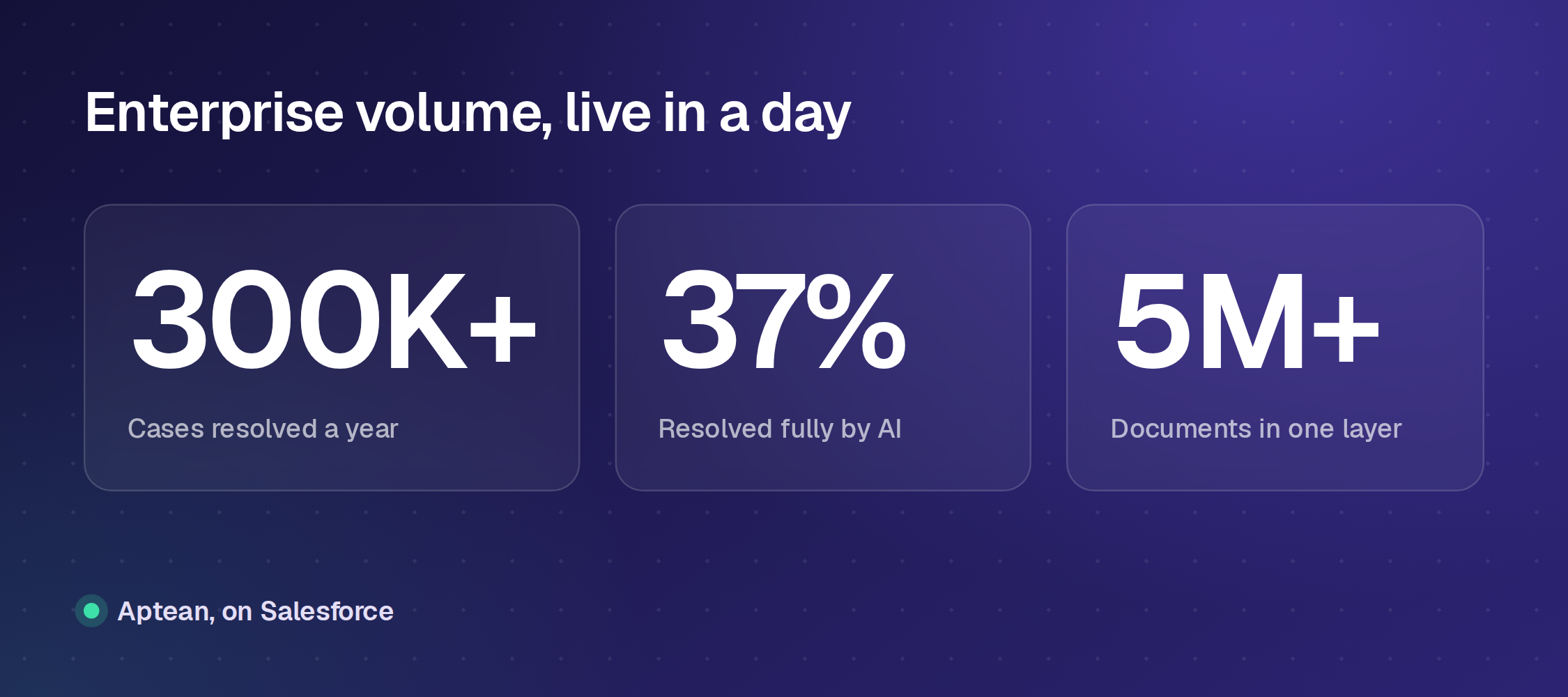
Customer proof: Aptean, a 3,500+ employee enterprise ERP company, brought its initial cohort live in a single day, indexed 5M+ documents, and now resolves 300K+ cases a year with Enjo AI, 37% of them fully by AI without human involvement.
Enjo also runs a Production Pilot: Troopr engineers build and operate the first agent on the team's real systems for 30 days at no cost. Success criteria are set at kickoff, including a committed 20% automation target, and the pilot tenant becomes the production tenant with nothing rebuilt.
Pricing: Free includes 200 AI Replies a month and unlimited human seats. Starter is $95 a month for 1,000 replies. Standard is $295 a month for 3,000. Enterprise is custom. Additional replies cost $0.05 each. Published at enjo.ai/pricing.
2. Cognigy (now NiCE Cognigy)
Cognigy is a low-code, contact-center-grade conversational AI platform for building voice and digital agents, orchestrated through its Nexus engine. It is now part of NiCE's CXone platform following a 2025 acquisition. Reviewers praise its ease of use, though it is enterprise and sales-led with no self-serve entry point.
How it goes to market: Sold into large global contact centres through NiCE, quote-based with no self-serve entry point, and positioned alongside the CXone platform.
Key capabilities:
- Multi-LLM orchestration across OpenAI, Anthropic, Google and AWS Bedrock models
- Voice Gateway for telephony-grade voice agents alongside chat
- 100+ prebuilt integrations plus an Extension Framework for custom connectors
- On-premise and air-gapped deployment for regulated industries
Integrations: Amazon Connect, Genesys Cloud CX, NiCE CXone, Avaya Experience Platform, Cisco Unified Contact Center Express, Dynamics 365, HubSpot CRM, Jira, Microsoft Teams, Microsoft Azure, Dialogflow.
Customer proof: NiCE Cognigy lists Bosch, Nestlé, DHL, Lufthansa Group, Mercedes-Benz and Toyota among its enterprise customers, without published outcome metrics for this use case.
Pricing: Custom, quote-based only, with no published rate card. Confirm current terms at cognigy.com.
3. Kore.ai
Kore.ai's XO Platform is a broad, no-code conversational AI platform for bot building, natural language understanding and workflow automation. It lets teams choose their own model rather than locking into one vendor. Reviewers consistently describe a steep learning curve, and it is not built for fast, self-serve experimentation.
How it goes to market: Sold to Fortune 2000 enterprises on custom multi-department contracts, sales-led with no published rate and no self-serve entry point.
Key capabilities:
- Model-agnostic orchestration across GPT-4, Claude and Kore's own models
- Omnichannel deployment across WhatsApp, web, IVR and SMS from one build
- Strong compliance posture, with SOC 2 and HIPAA-ready configurations
Integrations: Prebuilt actions for Salesforce, ServiceNow, Zendesk, Jira, Freshdesk, Freshservice and HubSpot, plus agent transfer into Genesys, NICE, Salesforce and ServiceNow.
Pricing: Custom and sales-led, with no public pricing and no self-serve entry point. Confirm current terms at kore.ai.
4. Boost.ai
Boost.ai is a Norwegian conversational AI platform built for regulated industries such as banking and insurance, with self-learning natural language understanding that needs less training data than most competitors to reach production accuracy. It is designed for hybrid control, letting teams move between traditional NLU and language models. Reviewers consistently flag analytics customisation as a gap.
How it goes to market: Sold into banking, insurance and government, concentrated in the Nordics, on quote-based contracts with no published pricing page.
Key capabilities:
- No-code conversation builder with self-learning intent suggestions
- Hybrid orchestration of traditional NLU and language models for auditable, hallucination-resistant responses
- Strong compliance track record in Nordic banking and insurance deployments
Integrations: Microsoft Teams, Zendesk, Salesforce, and additional contact center systems via its integration framework.
Customer proof: Boost.ai names Nordea, DNB, Sage and Trading 212 among its enterprise customers, without published outcome metrics for this use case.
Pricing: Custom and quote-based, with no public pricing page. Confirm current terms at boost.ai.
5. Yellow.ai
Yellow.ai serves 1,100+ enterprises across 35+ channels, including regional apps such as LINE, KakaoTalk and WeChat. It uses agentic retrieval to ground responses in enterprise knowledge across chat and voice. Reviewers report inconsistent context retention at scale, and pricing is not published.
How it goes to market: Sold to global consumer brands on custom contracts, positioned on regional channel breadth across 35+ messaging surfaces.
Key capabilities:
- Agentic retrieval with a claimed sub-1% hallucination rate
- 35+ channel deployment, including region-specific messaging apps
- Multi-agent orchestration for splitting complex queries across specialised agents
Integrations: Salesforce, SAP, Oracle, Zendesk, Freshdesk, Shopify, Genesys, ServiceNow, Workday.
Customer proof: Yellow.ai names Sony, Domino's, Hyundai and Randstad among its enterprise customers, without published outcome metrics for this use case.
Pricing: Custom and sales-led, with no published rate card. Third-party estimates vary too widely to cite reliably. Confirm current terms at yellow.ai.
6. Aisera
Aisera automates IT, HR and customer service requests by acting as a cognitive layer over a company's existing systems. Automation Anywhere acquired Aisera on 4 November 2025, folding it into a larger enterprise RPA stack. Reviewers cite a steep learning curve and long implementation cycles.
How it goes to market: Sold through Automation Anywhere following the November 2025 acquisition, bundled into its agentic automation stack on enterprise contracts.
Key capabilities:
- Cognitive layer over existing systems of record across IT, HR, finance, legal and customer service
- Integration with existing ITSM and CRM tools without replacement
- Now bundled into Automation Anywhere's broader agentic automation strategy
Integrations: ServiceNow and other ITSM and helpdesk tools, plus Salesforce. If Salesforce is the platform underneath, our Salesforce Service Cloud pricing breakdown covers what the AI layer costs on top of it.
Customer proof: Aisera's own site cites an 81% auto-resolution rate at the City and County of Denver, a 70% ticket auto-resolution rate at OmniTRAX, and $2.2M in cost savings at LifeScan.
Pricing: Custom and quote-based, with no public pricing page. The only third-party-verifiable figure comes from Aisera's Microsoft Azure Marketplace listing, which prices its AI Service Desk product from $200,000 a year for up to 1,000 users to $1.2 million a year for up to 10,000 users. That is not confirmed on Aisera's own site. Confirm current terms at aisera.com.
7. LivePerson
LivePerson's Conversational Cloud combines live agent messaging with generative AI automation for large, regulated consumer brands. Reviewers note a steep learning curve for advanced features, and pricing is modular and sales-led, which reviewers flag as a budgeting friction point.
How it goes to market: Sold to enterprise consumer brands on modular, sales-led contracts, priced by the modules selected rather than a published rate card.
Key capabilities:
- Broad channel support across WhatsApp, Apple Messages for Business and SMS
- Intent Manager with prebuilt domain models for common customer service use cases
- Conversation Orchestrator for routing between bots and human agents
Integrations: CRM and data platforms via an Integration Hub with 50+ connectors, plus native channel integrations.
Customer proof: LivePerson names HSBC, Burberry, Chipotle and Virgin Media among its enterprise customers, without published outcome metrics for this use case.
Pricing: Custom and module-based, with no published rate card. Confirm current terms at liveperson.com.
8. Talkdesk
Talkdesk is built into a full cloud contact center stack, pairing AI agents and agent assist with a data layer for real-time context. AI features are sold as separate add-ons even on the top plan, and most listed rates require a three-year contract.
How it goes to market: Sold as full CCaaS priced per user per month with published rates, AI capabilities sold as separate add-ons, and most listed rates requiring a three-year contract.
Key capabilities:
- Omnichannel routing across voice, email, chat and SMS from one workspace
- Copilot and Autopilot for agent assist and autonomous resolution
- 70+ native integrations, including Salesforce and Zendesk
Integrations: Salesforce Sales Cloud, Salesforce Service Cloud, Zendesk Suite, Freshdesk, Intercom, Help Scout, Kustomer, Workato.
Pricing: Digital Essentials is $85 per user per month, Voice Essentials is $105, and Elite is $165. Voice and digital channels together are only on Elite, and AI add-ons are priced separately. Confirm current terms at talkdesk.com.
9. IBM Watsonx Assistant
IBM's enterprise platform for building virtual agents at scale, with natural language understanding IBM positions as needing fewer training examples than most competitors. Setup typically takes four to eight weeks. Plus pricing scales with monthly active users once usage passes the 1,000 included in the plan.
How it goes to market: Sold into existing IBM Cloud estates, with a published free Lite tier and per-user billing above it.
Key capabilities:
- Strong intent disambiguation and multi-turn context handling
- Multi-channel deployment across web, mobile and messaging apps
- IBM's compliance certifications including SOC 2, HIPAA and ISO 27001
Integrations: Salesforce, Zendesk, Facebook Messenger, WhatsApp, Slack, Workday, Microsoft 365, Dropbox.
Pricing: Lite is free. Plus starts at $140 a month and includes 1,000 monthly active users, with additional users billed at $14 per 100. Enterprise is custom. Confirm current terms at ibm.com.
10. Retell AI
Retell AI is a conversational AI platform for building voice agents that answer and place phone calls, with chat and SMS agents on the same account. G2 reviewers most often ask for more native CRM integrations and flag cost at higher volumes.
How it goes to market: Sold self-serve on pay-as-you-go with no platform fee and $10 in free credits, with a custom-priced Enterprise plan that adds dedicated implementation support and uncapped concurrent calls.
Key capabilities:
- Call transfer that hands a live call from the AI agent to a human
- Appointment booking that checks availability during the call
- Navigation of keypad-driven IVR menus
- Batch outbound calling with branded caller ID and verified phone numbers
- Post-call analysis and AI quality assurance across call history
Integrations: Twilio, Vonage, HubSpot, GoHighLevel, Make and n8n, plus SIP trunking for existing carriers.
Pricing: $0.07 to $0.31 a minute for voice agents and from $0.002 per message for chat agents, with the per-minute rate built from voice infrastructure, LLM, text-to-speech and telephony components. Enterprise is custom. Confirm current terms at retellai.com.
11. Synthflow
Synthflow is a no-code platform for building AI voice agents that take and place phone calls, connecting into the phone systems a contact centre already runs. G2 reviewers most often flag pricing that becomes expensive at higher usage.
How it goes to market: Sold sales-led on annual Enterprise agreements, with pricing scoped by the Synthflow team around the shape of each deployment.
Key capabilities:
- No-code builder for inbound and outbound voice agents
- Telephony over purchased numbers, Twilio, or SIP and PBX connections including Five9, Genesys Cloud, Talkdesk, RingCentral and Zoom Phone
- Knowledge bases that import Zendesk Help Center articles for retrieval
- Contact sync and call activity logging in HubSpot and Salesforce
- Live appointment booking through Cal.com, and agents on WhatsApp Business
Integrations: HubSpot, Salesforce, GoHighLevel, Freshworks (Freshcaller and Freshsales), Zendesk, Zapier, Make, Cal.com, WhatsApp and Twilio.
Pricing: Sales-led, with no published per-minute rate. Synthflow's documentation says pricing is scoped around call volume, concurrency, telephony setup, integrations and security requirements, and that Enterprise plans are billed annually. Confirm current terms at synthflow.ai.
12. ElevenLabs Agents
ElevenLabs Agents (ElevenAgents) is ElevenLabs' platform for building voice and chat agents on its own speech models, deployed to phone lines, websites and mobile apps. Plans set included minutes and concurrency, while LLM and telephony costs bill separately.
How it goes to market: Sold self-serve from a free plan through six published tiers, with custom Enterprise terms, as the agents product alongside ElevenLabs' speech and API business.
Key capabilities:
- Visual workflow builder for multi-step conversations
- Knowledge base with retrieval for grounded answers
- Tool calling to client and server APIs to take actions
- 5,000+ voices across 31 languages
- Built-in testing, evaluations and analytics, including simulated conversations
Integrations: Twilio, Vonage, Telnyx, Genesys, RingCentral, Plivo and SIP trunking; Salesforce, HubSpot, Zoho and Pipedrive; Zapier, n8n and Make; Slack, Calendly and Cal.com; a web widget plus React, Swift and Kotlin SDKs.
Pricing: A free plan, then Starter at $6, Creator at $22, Pro at $99, Scale at $299 and Business at $990 a month. Calls cost $0.08 a minute and text messages $0.003 each on every plan, with LLM and telephony costs billed on top. Confirm current terms at elevenlabs.io.
What You Will Actually Pay
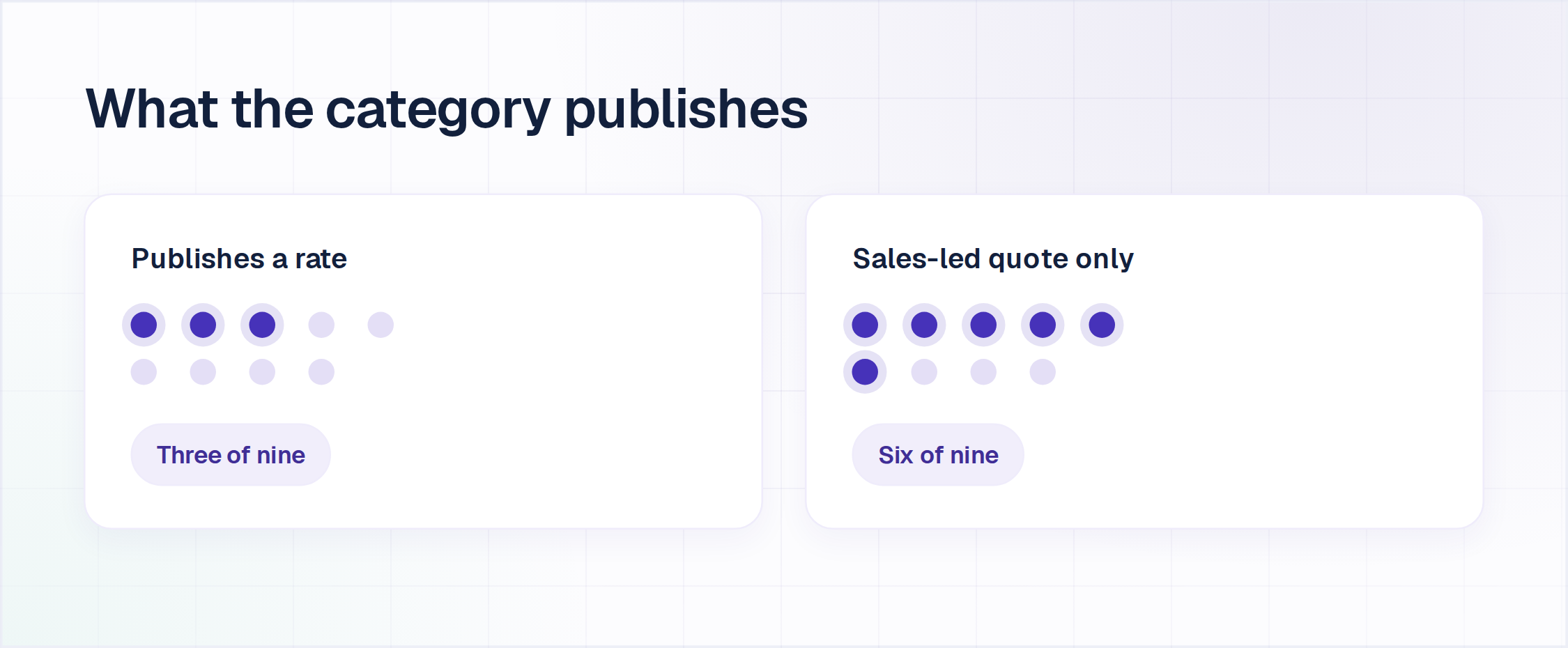
Seven of the twelve platforms here require a sales conversation before you know the number. For the wider market picture, our customer service statistics roundup collects the 2026 figures with sources attached. That is normal for the category and it is worth naming, because it decides whether procurement can model total cost before committing budget.
Every figure in this article is either published by the vendor or explicitly labelled as an unconfirmed third-party estimate. Ask any vendor for the same thing in writing: cost per resolved request at twice your current volume.
How to Choose the Best Conversational AI Platform?
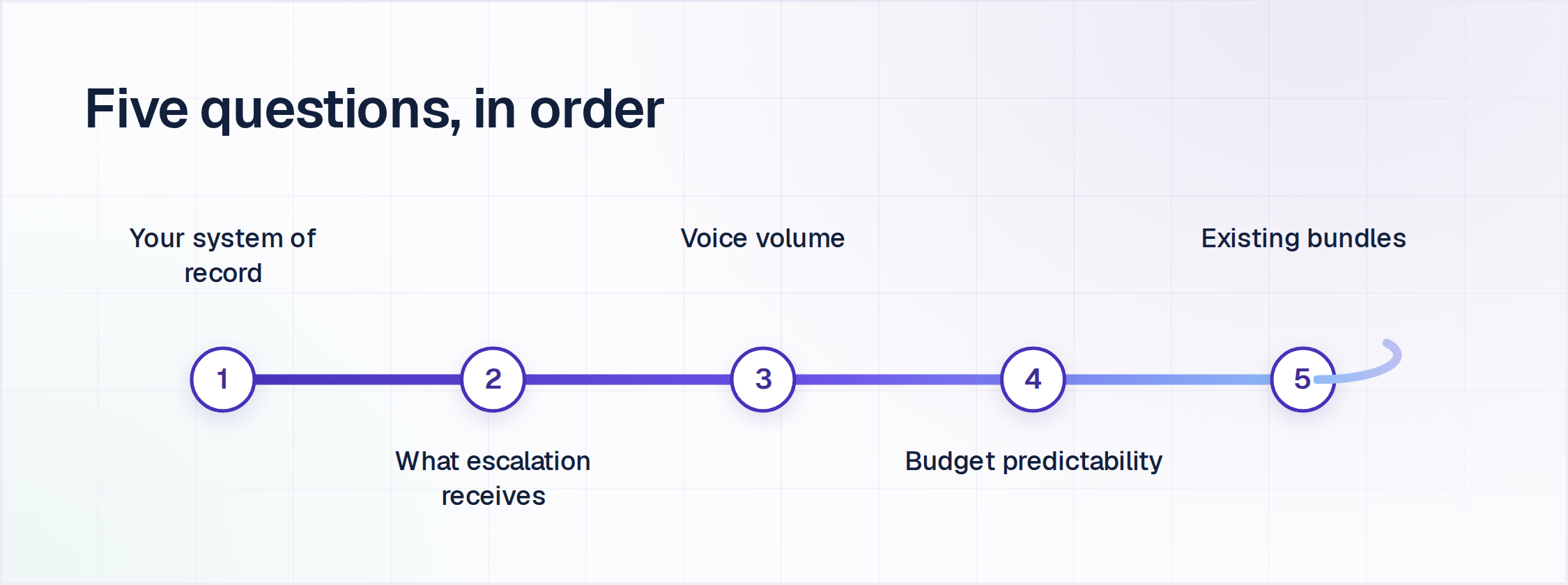
Is your team already standardised on Salesforce, Zendesk, Jira or ServiceNow? If the AI layer needs to plug into that stack without migration and escalate back into it with full context, Enjo is built for exactly this. Most other platforms here require middleware or professional services to reach the same depth.
Does the human still need help on what escalates? Every platform here escalates something. What the person receives on handoff, and whether an Agent Assist layer drafts the reply for them, decides how much that escalation actually costs.
Do you need voice at contact-center scale? Cognigy, Kore.ai, Talkdesk and Boost.ai all ship telephony-grade voice infrastructure, which is what a contact-centre-first architecture is built around. Where volume is primarily chat, Slack and Microsoft Teams, that infrastructure is cost without a corresponding use.
How predictable does your budget need to be? Only Enjo, Talkdesk, Watsonx Assistant, Retell AI and ElevenLabs Agents publish pricing. The rest require a sales conversation before you know what you are paying; the one vendor-listed figure among them, Aisera's Azure Marketplace listing, starts at $200,000 a year.
Are you comparing agents rather than platforms? If the decision is about which vendor resolves tickets rather than which infrastructure to build on, our ranking of ai customer service agents covers ten of them on pricing and knowledge reach.
Is an existing enterprise relationship already dictating your options? NiCE CXone, Automation Anywhere and IBM Cloud each bundle a platform on this list, so an existing contract changes the vendor-count maths before capability enters the comparison. Price the bundled option against what it actually reaches in your stack rather than against its licence cost.
The Bottom Line
Most conversational AI platforms were built contact-center-first: strong on voice and channel breadth, weaker on native helpdesk integration and pricing transparency. If your support org runs on Salesforce, Zendesk, Jira or ServiceNow and needs a platform that resolves autonomously and hands off with full context when it cannot, that is the gap Enjo is built to close. For the IT-side equivalent of this comparison, see our ranking of agentic AI tools for help desk automation.
See Enjo resolve requests inside your Salesforce, Zendesk, Jira or ServiceNow instance and escalate back into the same ticket with the full conversation, account context and suggested next steps, with no migration.

Frequently Asked Questions
What is a conversational AI platform for customer service?
A conversational AI platform is the infrastructure a team builds virtual agents on top of: natural language understanding, dialog orchestration, and channel connectors for chat and voice. It differs from a single AI chatbot in that it is the layer a company's own designers configure, rather than a pre-built agent.
What is the difference between a conversational AI platform and a chatbot?
A chatbot is usually a specific deployed agent, built to answer a defined set of questions or resolve a defined set of requests. A platform is the underlying toolkit from which multiple chatbots, voice bots and agents are built. See our breakdown of chatbots vs conversational AI for the full distinction.
How much do conversational AI platforms cost in 2026?
Pricing ranges from free entry tiers to six-figure annual enterprise contracts. Seven of the twelve platforms in this comparison do not publish pricing at all. Enjo, Talkdesk, Watsonx Assistant, Retell AI and ElevenLabs Agents are the exceptions, which is why total cost can be modelled before committing budget with those five.
Do these platforms integrate with Salesforce, Zendesk, Jira and ServiceNow?
Most platforms here list connectors for at least one of them: Talkdesk for Salesforce and Zendesk, Yellow.ai for Salesforce, Zendesk and ServiceNow, Kore.ai for Salesforce, ServiceNow, Zendesk and Jira. The difference is where the work happens. Enjo embeds inside all four, resolves requests in the workflow the team already uses, and escalates back into the same ticket with the full conversation, account context and suggested next steps.
How do you choose a conversational AI platform for a customer service team?
It depends on which side of the divide your requests arrive on. Where support runs through Salesforce, Zendesk, Jira or ServiceNow, and requesters reach it in Slack, Microsoft Teams or Slack Connect shared channels, Enjo resolves inside that stack and escalates back into it with the full conversation, account context and suggested next steps. Enjo is an AI layer, not a ticketing platform. It does not replace the helpdesk as the system of record, which is the point rather than a limit.