Transform complex support workflows
Chatbot vs. Conversational AI: Differences, Examples & How to Choose in 2026
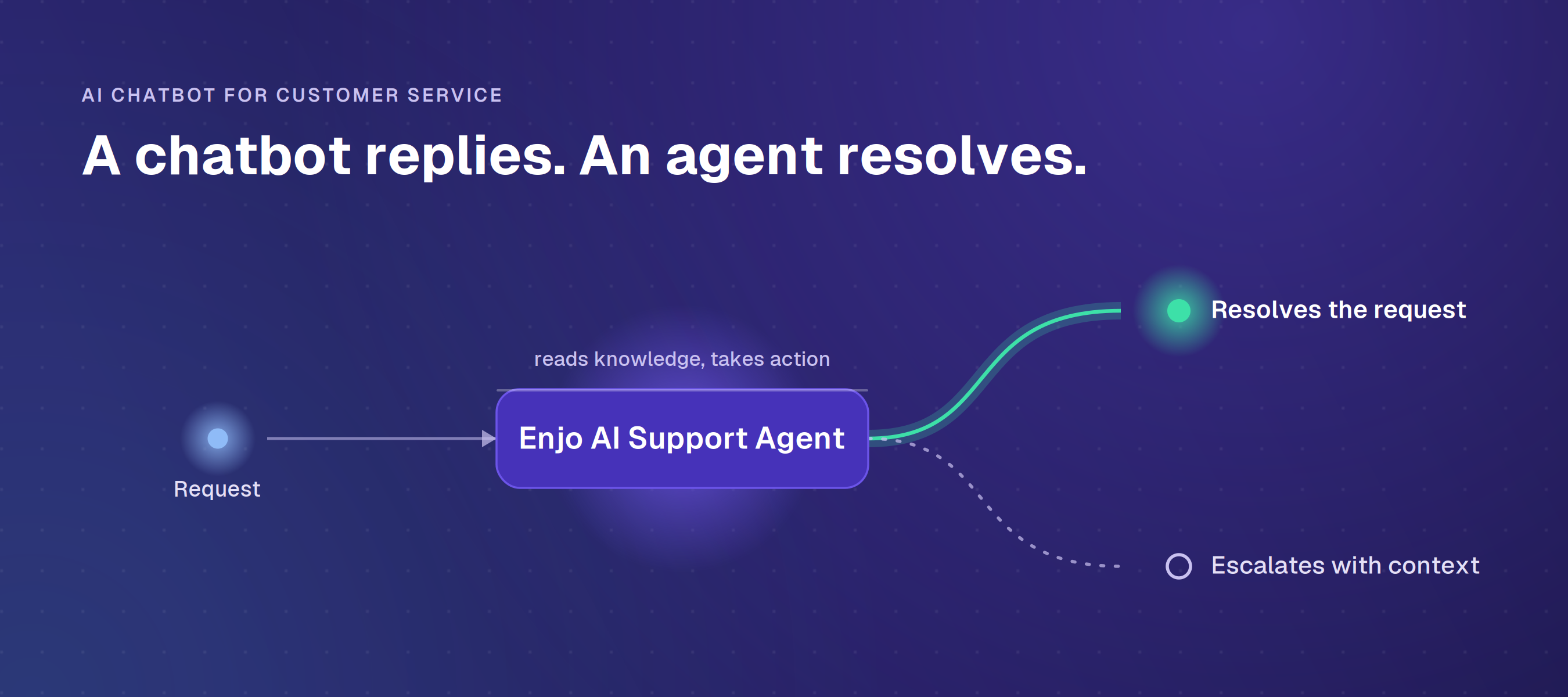
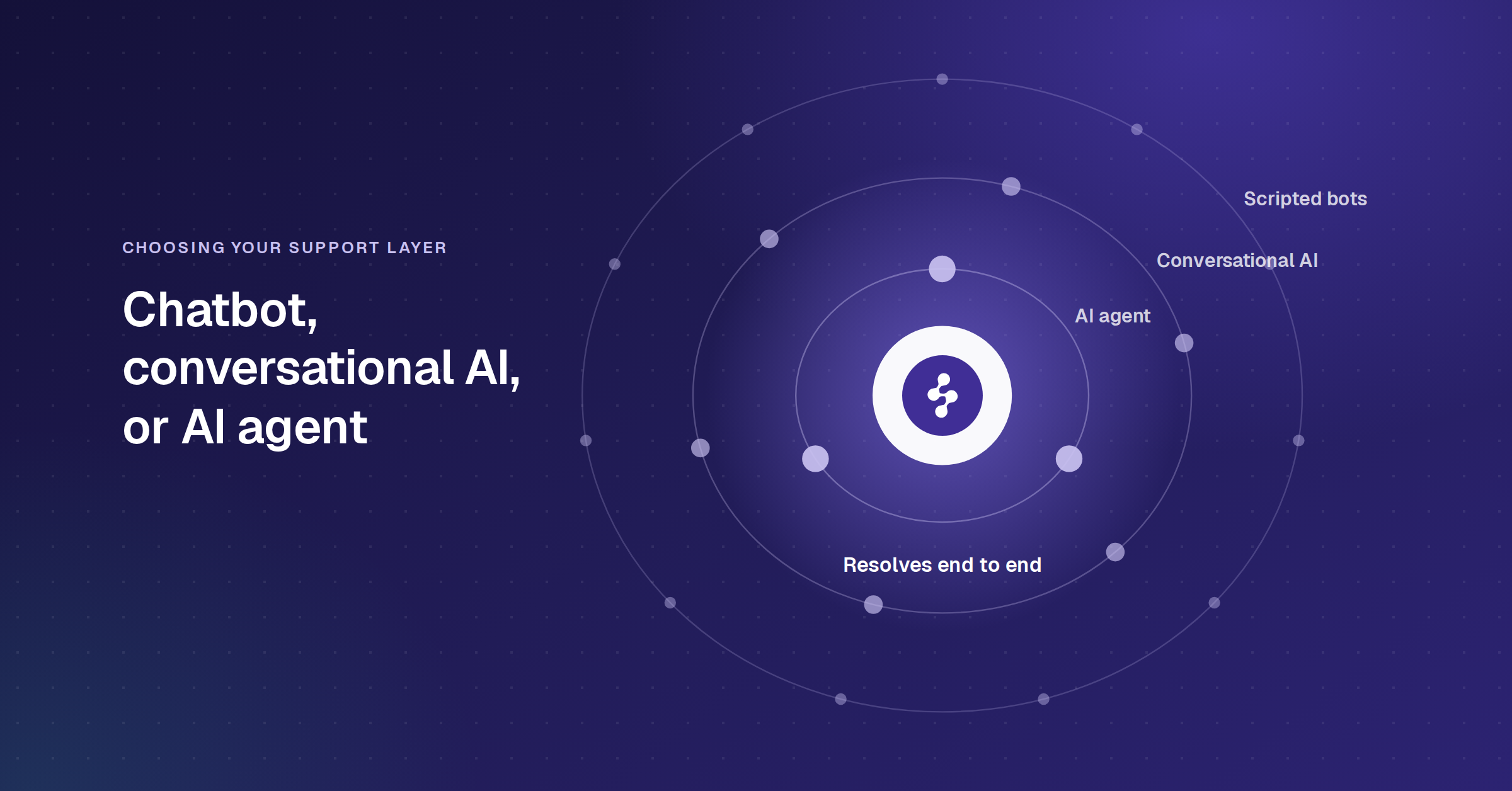
A chatbot is a program that holds a conversation, either by following a script or by using AI to understand language. Conversational AI is the technology that lets machines understand and respond to natural language in text or voice. Every AI chatbot runs on conversational AI; rule-based chatbots do not. AI agents go one step further and take action in connected systems to resolve the request.
The two terms get used interchangeably in vendor demos, and in 2026 "AI agent" has joined the mix. They describe related but different technologies, and in customer service, picking the wrong one quietly burns budget, frustrates customers and stalls your automation roadmap.
This guide explains the difference between a chatbot and conversational AI, what each one actually does, where each one fails, and how to map your ticket mix to the right tier, including where AI agents fit.
Chatbot vs. conversational AI at a glance (and where AI agents fit)
Here's the short version. The rest of the article unpacks the details.
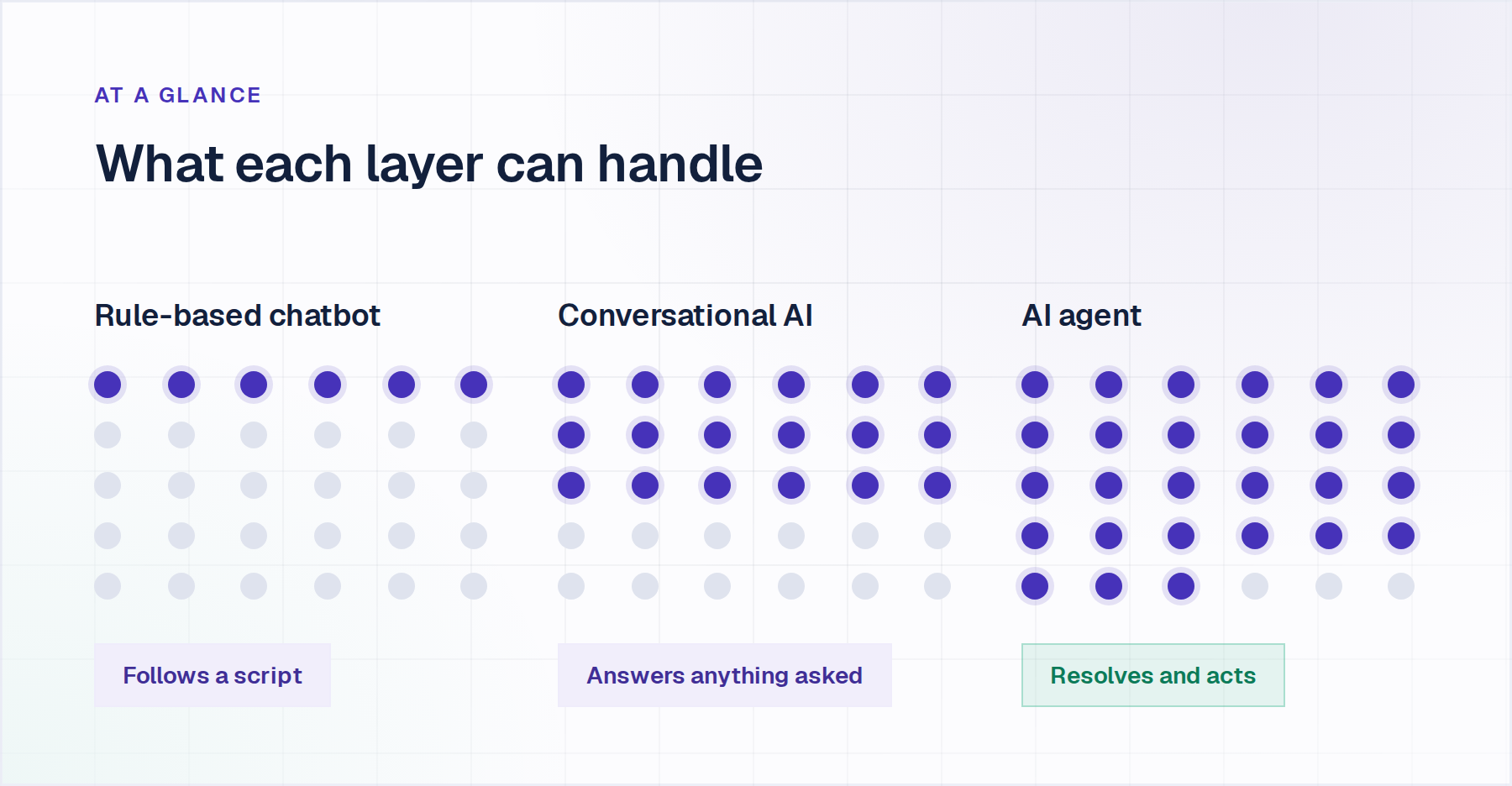
Rule-based chatbots follow pre-written scripts and decision trees. They run on if-then rules and keyword matching, have no memory across turns, and fail the moment a customer phrases something outside the script. They take action only through rigid forms. They are built for FAQs, menu navigation, and lead capture. Setup is fast and cheap; the typical failure mode is sounding robotic and dead-ending quickly.
AI chatbots and conversational AI understand language and answer in natural conversation. They use NLU, NLP, NLG, and machine learning, usually layered on top of a large language model. They hold context within a session, handle novel phrasings, and generate relevant responses without a scripted match. Their ability to take action is limited, so they usually hand complex requests off to a human. They are the right fit for self-service across a broad range of questions. Setup takes a few weeks; the typical failure mode is being confidently wrong when answers aren't grounded in real content.
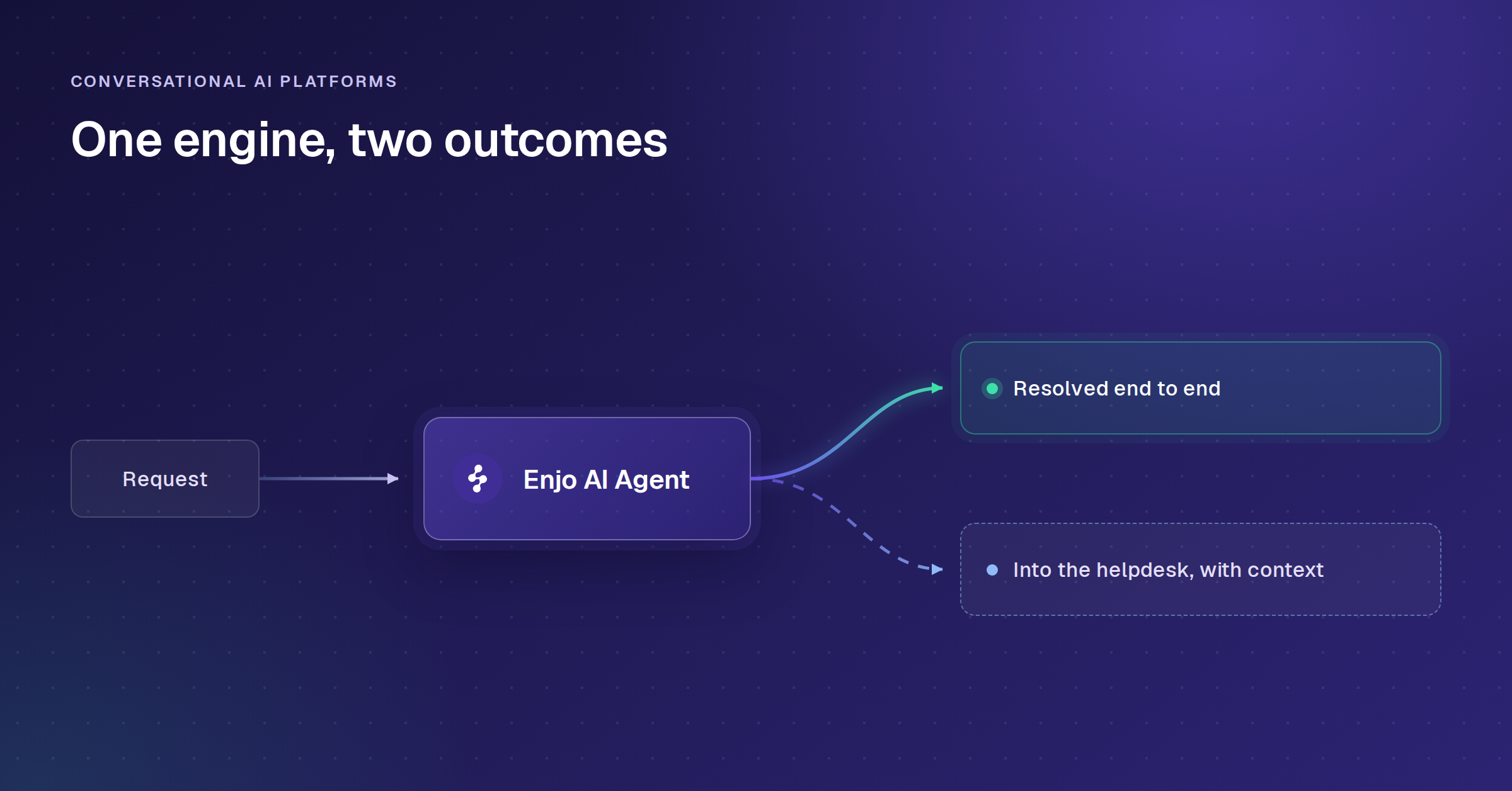
AI agents reason, plan, and take action across connected systems to resolve an issue end-to-end. They combine an LLM with tools, memory, and policy guardrails. They maintain context across sessions and channels, fetch new data when needed, and execute multi-step workflows: refunds, account changes, ticket creation, and escalations. They are built for resolving mid- to complex requests without a human in the loop. Setup time depends on integrations (Aptean brought its initial cohort live on Enjo in a single day); the typical failure mode is taking the wrong action when guardrails are weak.
The simplest mental model: every AI agent is built on conversational AI. Conversational AI runs text chatbots and voice assistants alike. But most chatbots are not conversational AI, and most conversational AI is not yet an AI agent.
What is a chatbot?
A chatbot is a piece of software that holds a conversation with a person, usually via text in a website widget, a messaging app, or an SMS thread, sometimes via voice. The label "chatbot" covers a wide range of sophistication, which is exactly why the term has become muddy.
In practice, chatbots fall into two camps.
Rule-based chatbots
Rule-based chatbots, also called scripted, decision-tree, or menu-driven bots, operate on explicit logic written by a human. The bot scans the user's input for keywords, matches them to a node in a flowchart, and returns the response attached to that node. If you've ever clicked a button on a support widget that said "Track my order" and been walked through a four-step menu, you've used one.
What rule-based bots are good at:
- Answering a small set of very common questions ("What are your hours?", "Where's my order?")
- Collecting structured information through forms (name, email, issue category)
- Routing tickets to the right queue
- Qualifying leads before they hit a sales rep
What they're bad at:
- Anything phrased in a way the designer didn't anticipate
- Multi-turn conversations where context carries forward
- Anything that requires real understanding instead of keyword matching
Rule-based bots haven't gone away. For narrow, high-volume use cases, order tracking, appointment booking, simple FAQs, they're cheap, predictable, and easy to govern. The mistake is using them as your primary support channel and being surprised when customers abandon at high rates.
AI chatbots
AI chatbots, sometimes called contextual bots or virtual agents, use natural language processing and machine learning (and in modern stacks, large language models) to understand intent rather than just match keywords. A customer who asks "When can I drop by?" gets the same answer as one who asks "What time do you open?" because the bot recognizes the intent behind both.
AI chatbots can hold a multi-turn conversation, remember what was said three messages ago, handle novel phrasings, and produce responses that don't sound like a Mad Lib. When people loosely say "chatbot" today and mean something good, this is usually what they mean.
This is also where chatbot territory starts to overlap with the broader category of conversational AI.
What is conversational AI?
Conversational AI is the umbrella technology category that makes natural, human-like conversation possible between people and machines, across text and voice, on websites, in apps, on phone calls, and through smart speakers.
It's a stack rather than a single product. The typical conversational AI system includes:
- Natural Language Understanding (NLU): figures out what the user actually means, including intent and entities ("book a flight to Tokyo on Friday")
- Natural Language Generation (NLG): composes a response in fluent human language instead of selecting a canned reply
- Dialogue management: keeps track of what's been said, what the user wants, and what the system should ask next
- Machine learning: improves the system over time as more interactions are logged
- Speech recognition and text-to-speech: used when the interface is voice
Conversational AI isn't a single product you buy; it's the foundation that makes AI chatbots, voice assistants, and modern interactive voice response (IVR) systems work. When a Bank of America customer asks Erica to send a budget summary, that's conversational AI. When someone tells Alexa to add milk to the shopping list, that's conversational AI. When a Sephora shopper chats with the brand's product-recommendation bot and gets a personalized suggestion, that's conversational AI.
So while all AI chatbots use conversational AI, conversational AI itself shows up in more places than just a chat widget. We compared nine conversational AI platforms on channels, helpdesk integration and pricing transparency.
Where AI agents change the equation (and why this matters in 2026)
Here's the part most "chatbot vs. conversational AI" articles haven't caught up to.
For the last few years, the upper bound of "good" customer service automation was an AI chatbot for business that gave a natural-sounding answer pulled from your help center. Useful, but limited. The bot could explain how to update billing info, but it couldn't actually update it. It could describe the refund policy, but it couldn't issue the refund. The handoff to a human was still the answer for anything that required action.
AI agents close that gap. The design pattern behind them is agentic AI: systems that pursue a goal, choose their own steps, and act rather than answer.
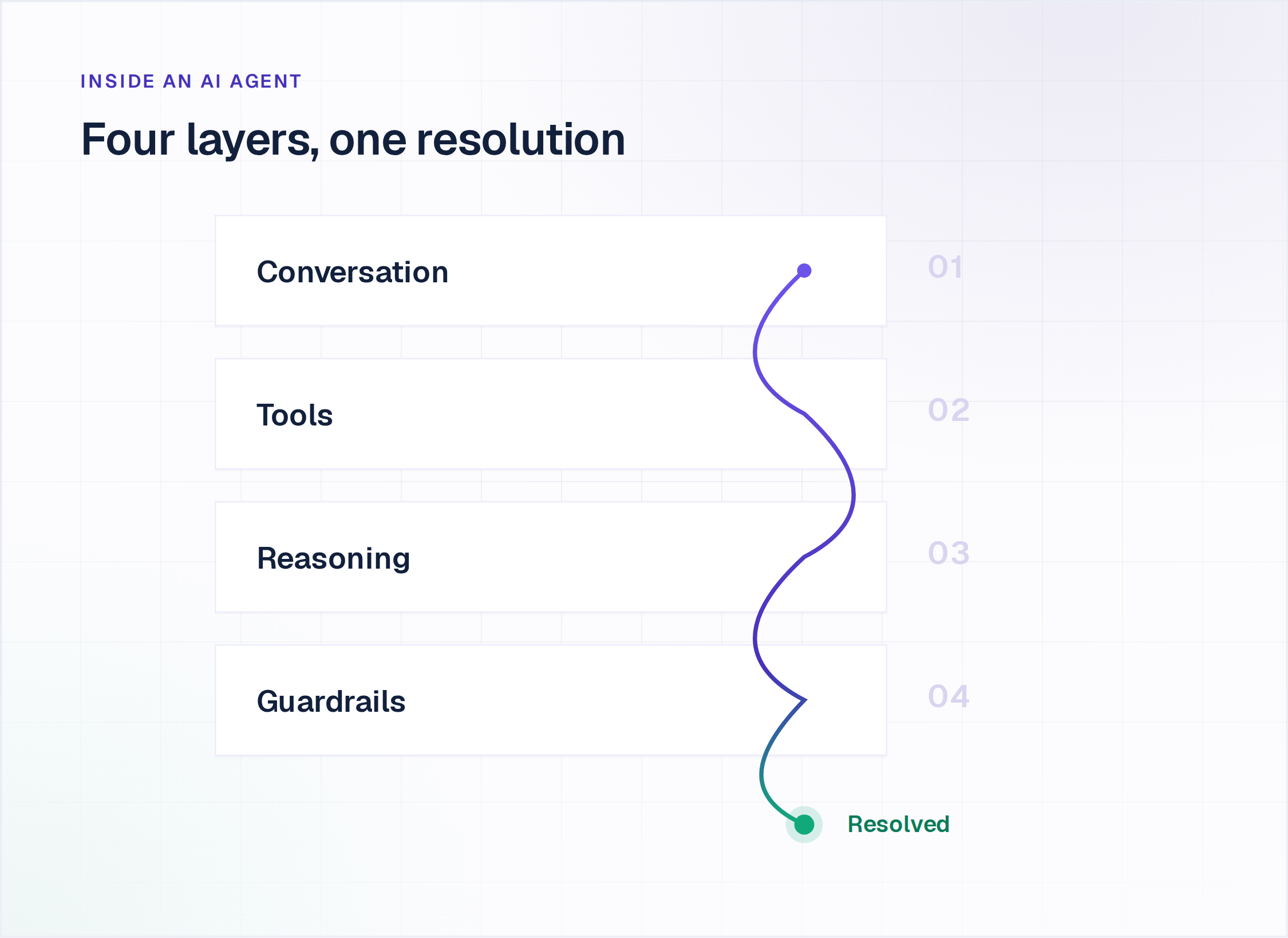
An AI agent is conversational AI plus three new ingredients:
- Tool use. The agent is connected to real systems, your helpdesk, CRM, billing platform, identity provider, order management system, and can call them to read or change data, not just talk about it.
- Reasoning and planning. Given a goal ("resolve this ticket"), the agent breaks it into steps, decides which tool to call, evaluates the result, and either continues or hands off. This is closer to how a human support agent works than how a chatbot works.
- Memory and guardrails. The agent remembers context across the session (and ideally across channels), and it's bounded by policy: what it's allowed to say, do, and escalate.
The practical result: an AI agent can take a customer from "my subscription charge looks wrong" to "you've been refunded $48.32, and I've adjusted your renewal date" in a single conversation, without a human touching the ticket. Klarna's deployment is the most instructive case, in both directions. Its assistant handled 2.3 million chats in its first month in 2024, a volume Klarna equated to roughly 700 agents. By May 2025, the company was rehiring human agents, with CEO Sebastian Siemiatkowski conceding that cost had been weighted too heavily and that the result was lower quality.
The lesson is not that AI agents do not work. It is that volume and quality are different measurements, and Klarna scaled on the first without tracking the second. High deflection is achievable on the right ticket categories; whether CSAT holds depends entirely on which categories those are and how cleanly the rest escalate.
For CX leaders, this reframes the question. It's no longer "should we deploy a chatbot or conversational AI?" It's "where on the stack, from scripted bots to AI agents, should each of our use cases live, and how do we make sure they all hand off to each other and to humans cleanly?"
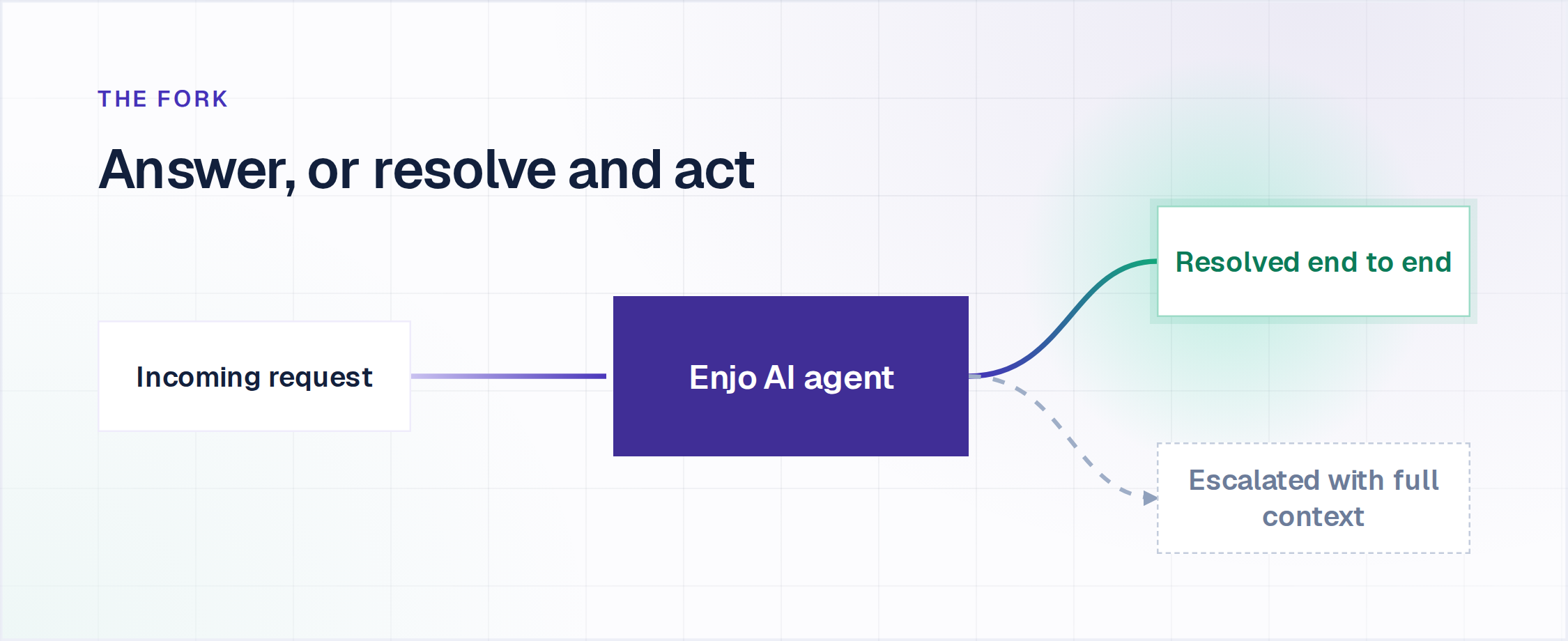
This is the layer where modern support platforms like Enjo's AI agent sit: built on conversational AI, but designed to resolve requests end-to-end rather than just answer them. We ranked the agentic AI tools that clear that bar and the ones that do not.
It is important to note that the distinction between chatbots and AI agents matters at buying time, which is why we scored the leading AI customer service agents on whether they resolve end-to-end or hand off at the first ambiguity.
Side-by-side: how chatbots and conversational AI actually differ
The at-a-glance summary at the top gave you the headlines. Here's the depth.
1. Language understanding
Rule-based chatbots match keywords. "Refund," "money back," and "return" might be three separate trigger words you have to maintain in three separate rules. If a customer types "I want my cash back," the bot may miss it entirely.
Conversational AI understands intent. It recognizes that all four phrases mean the same thing, and it picks up on entities (the order number, the product, the timeframe) in the same pass. That single capability is what makes conversational AI feel like a real conversation instead of a phone tree.
2. Context and memory
A rule-based chatbot starts every turn from scratch. Ask "What's the weather today?" and then "What about tomorrow?", it has no idea what "tomorrow" refers to.
Conversational AI carries context across the session. AI agents go further, carrying context across sessions: if a customer chatted with you on Monday and emailed on Wednesday, an AI agent connected to the same record can pick up where the conversation left off. That continuity is one of the most underrated UX gains in CX automation: customers stop having to repeat themselves.
3. Personalization
Rule-based bots greet every customer the same way. Conversational AI tailors responses to the user, pulling in name, tier, recent activity, and sentiment when it's wired into CRM data. The personalization isn't cosmetic. A customer recognized as a 5-year subscriber asking about churn gets a different response than a 30-day trial user with the same question, and that difference is the whole point.
4. Learning over time
Rule-based bots don't learn. Every improvement is a new rule, written by a human, deployed via a release. Conversational AI learns from interaction data, though "learns" needs an asterisk. Most production systems don't update their core model in real time; they capture interaction data, surface gaps, and use that data to retrain or fine-tune in cycles. The practical effect is the same: the system gets better as more people use it.
5. Scalability and cost shape
Rule-based bots have a cost ceiling. Past a few hundred intents, maintaining the decision tree becomes its own engineering project. Conversational AI scales sub-linearly, the same model handles 10x more intents at roughly the same maintenance burden.
But conversational AI has a different cost shape: per-conversation inference cost (LLM tokens), the cost of grounding it in your content (so it doesn't hallucinate), and the cost of guardrails. At meaningful volume the math still favors AI, but it's not free.
6. Failure modes
This is the one most articles skip. Different bots fail in different ways, and the failure mode determines which governance you need.
- A rule-based bot fails by dead-ending: "I didn't understand that. Try one of these options." Annoying, but safe.
- An AI chatbot can fail by being confidently wrong, also called hallucinating. If it's grounded in your knowledge base via retrieval-augmented generation (RAG) the risk drops sharply, but it doesn't go to zero.
- An AI agent can fail by taking the wrong action, issuing a refund it shouldn't have, or changing a setting it shouldn't have changed. The blast radius is bigger, which is why production AI agents need strong policy guardrails, audit logs, and clear escalation paths.
When you're evaluating vendors, ask specifically about each failure mode. Anyone who says their AI never hallucinates is selling something other than reality.
Real-world examples on each side
Some of these are well-trodden but worth grounding the abstraction.
Rule-based chatbots in the wild
- HelloFresh's "Freddy", handles Facebook Messenger queries with scripted flows and routes complex cases to humans. HelloFresh reported response times 76% faster after launch.
- Ask Benji, an SMS bot that helps Arizona students navigate the FAFSA process, for structured prompts and deadline reminders.
- Most banking IVRs ("Press 1 for balance, 2 for..."), still rule-based, still everywhere.
Conversational AI in the wild
- Bank of America's Erica, answers balance questions, gives spending insights, schedules payments. Voice + text, in-app.
- Amtrak's Julie, books rail travel, fills out forms, provides station info.
- Sephora's Virtual Artist & chat assistants, personalized product recommendations driven by user inputs.
- Domino's "Dom", sits across web, Messenger, Alexa, and Google Assistant.
AI agents in the wild
- Klarna's AI assistant built on OpenAI, it handled two-thirds of customer service chats in its first month in 2024. Klarna has since rebalanced toward a hybrid model, keeping AI on high-volume tiers and reintroducing humans for complex cases.
- Fin, the AI agent from the company formerly called Intercom, acquired by Salesforce in September 2026. It runs standalone or on top of Zendesk, Salesforce, HubSpot and Freshworks, and bills per resolution.
- In-house support agents, an LLM combined with retrieval over the help center and scoped account-action permissions.
The pattern: rule-based bots handle one well-defined task. Conversational AI handles a domain (banking questions, travel questions, beauty advice). AI agents own the outcome: they resolve the request, complete the workflow, and escalate cleanly when they hit a wall.
What CX leaders actually gain from each
Forget the feature checklist for a moment. Here's what each tier moves on the metrics CX leaders are measured against.
Rule-based chatbots deflect a narrow slice of tickets: the well-defined requests they were scripted for. They have essentially no impact on average handle time for the human agents, who still handle everything else, and they yield only a small reduction in cost per contact. CSAT typically stays flat or trends slightly negative when customers feel trapped in a dead-end menu. The upside is speed and simplicity: you can stand one up in days to a couple of weeks, and governance is trivial because the bot can only say what you wrote.
Conversational AI and AI chatbots deflect a much broader share of the support inbox, because they answer questions phrased in ways no script anticipated. Average handle time on the tickets that still reach humans drops too, because agent assist and automated reply drafts speed up the work. First contact resolution rises meaningfully. CSAT is neutral to mildly positive when answers are well grounded. Expect weeks to launch and a medium governance burden: grounding the model on your real content and managing tone are ongoing jobs.
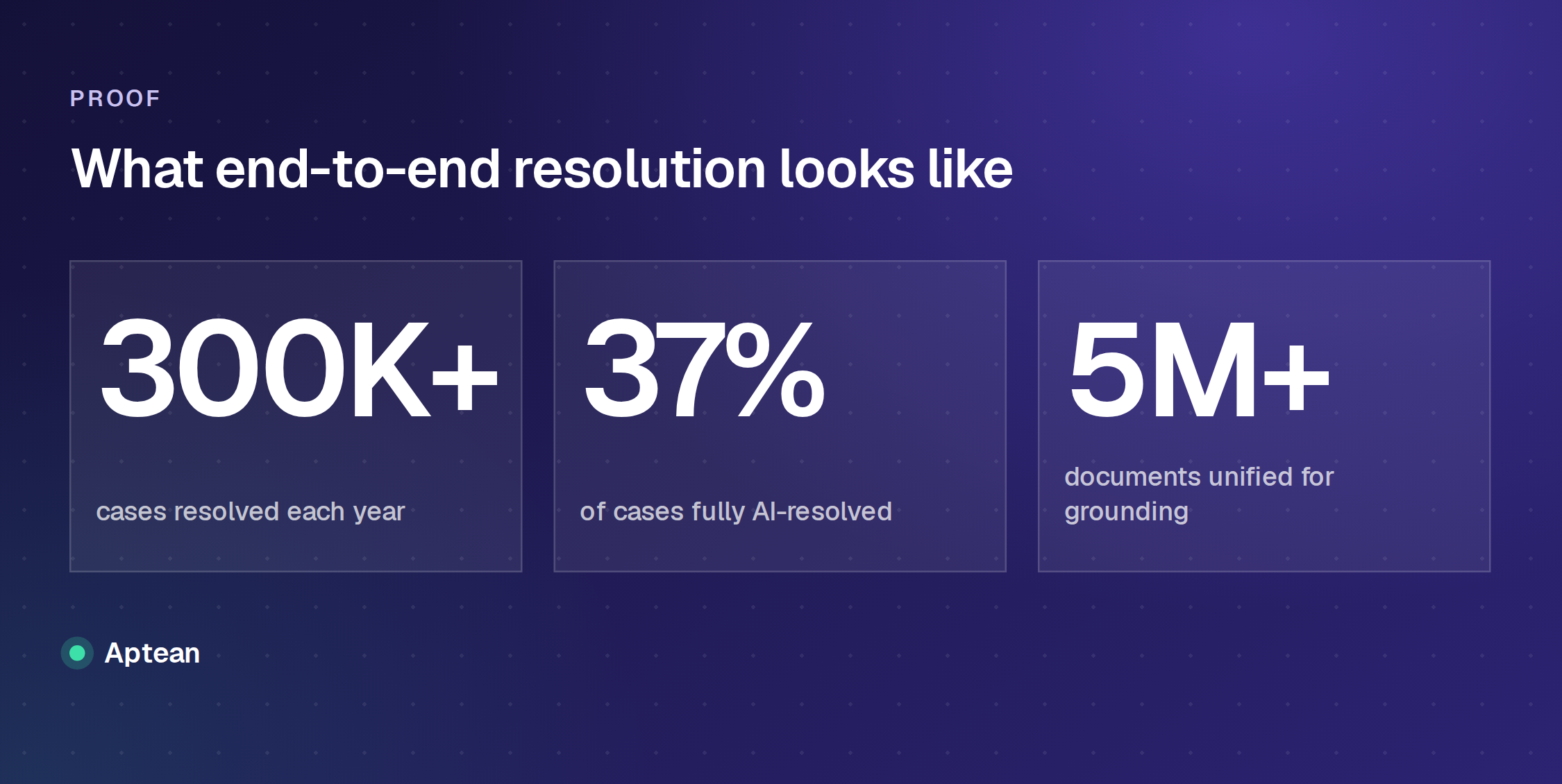
AI agents resolve the ticket categories they are built for end to end, because they answer the question and then take the action. Average handle time drops sharply, because the tickets they resolve never reach a human at all. First contact resolution becomes a step change rather than a marginal lift. CSAT holds when guardrails are tight and escalations carry full context. Aptean resolves 300K+ cases a year with Enjo, and 37% of its cases are resolved fully by AI without human involvement. Time to value depends on integrations, and the governance burden is higher: action-level guardrails and audit trails matter as much as answer quality.
Your results will vary with category complexity and how well-structured your support content is.
For the analyst view on where this lands, Gartner predicts agentic AI will autonomously resolve 80% of common customer service issues without human intervention by 2029, with a 30% reduction in operational costs. Forrester's 2026 assessment is the counterweight: roughly three-quarters of enterprise leaders report adopting agentic AI, while only a small minority run it at meaningful scale in production.
How to choose: a decision framework for CX leaders
Skip the binary "chatbot vs. conversational AI" framing. Instead, sort your inbound volume into three buckets and pick the right tier for each.
Bucket 1: Narrow, high-volume, low-risk question, Order status, return policy, hours, password reset directions. A rule-based bot or a thin AI chatbot is fine. Don't overbuild.
Bucket 2: Broad, conversational, mostly informational Anything where a customer asks a question phrased dozens of ways and you want one consistent answer pulled from your knowledge base. This is the conversational AI / AI chatbot sweet spot. Ground it in a Help Center knowledge base using RAG, monitor for hallucinations weekly, and route low-confidence answers to humans.
Bucket 3: Multi-step, requires actions across systems Subscription changes, refunds, account merges, address updates, exception handling. This is AI agent territory, and our guide to AI support agents covers how they resolve these requests end to end. The threshold question of whether you're ready is whether your systems expose stable APIs and whether you have a clear policy on what the agent is allowed to do without human approval.
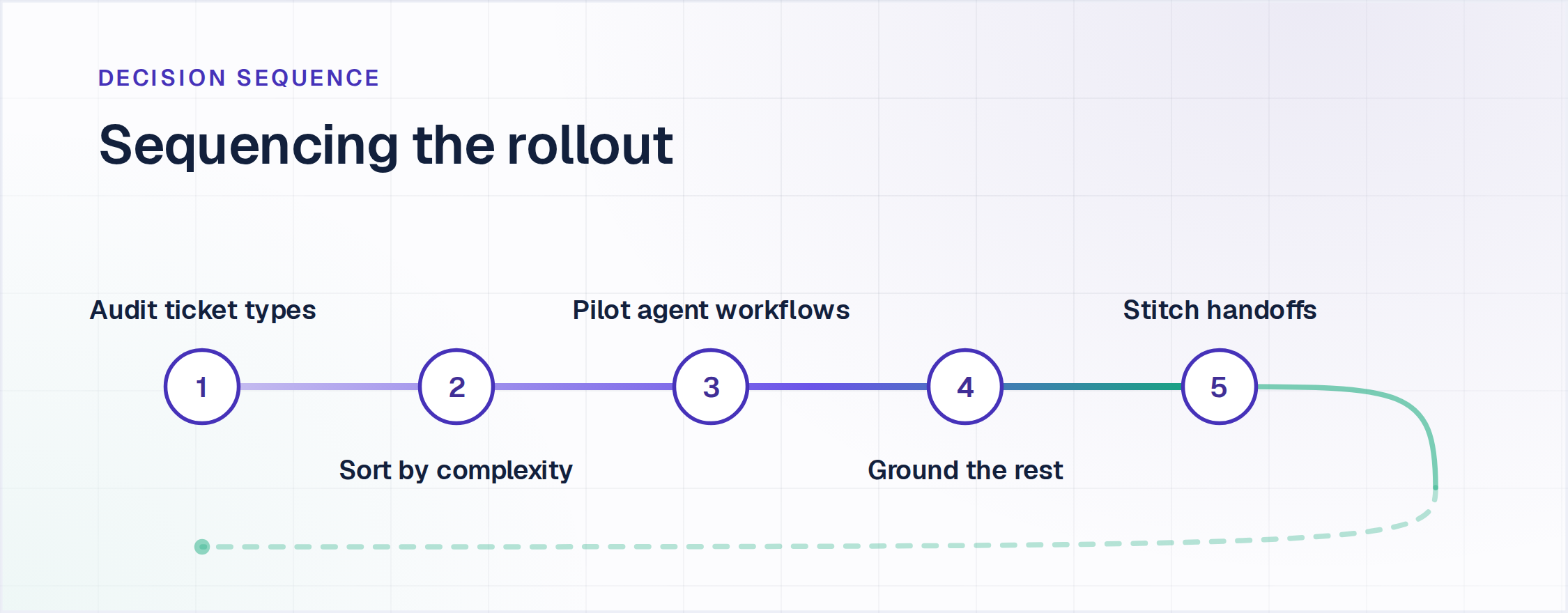
A practical sequence for most CX teams in 2026 looks like this:
- Audit your top 50 ticket types by volume and complexity.
- Map them to buckets 1, 2, or 3. Be honest, most teams over-classify into bucket 1 and miss the agent-able workflows.
- Pilot the highest-impact bucket-3 use case with an AI agent, typically a repetitive, multi-step ticket type like billing disputes or basic account changes.
- Cover bucket 2 with conversational AI grounded in your help center.
- Leave bucket 1 to lean rule-based flows where they're already working.
- Stitch handoffs together cleanly so a customer who escalates from bucket 1 → 2 → 3 → human doesn't have to repeat themselves at each transition.
The teams getting the most out of automation in 2026 aren't the ones who picked the "best" technology, they're the ones who matched the right technology to each slice of their workload and made the seams between them invisible to the customer.
Common pitfalls when rolling out conversational AI or AI agents
- Skipping the knowledge-base cleanup. Conversational AI grounded in messy docs gives messy answers. The pre-work matters more than the model choice.
- No clear escalation path. Every bot needs a way out. Customers should never feel stuck.
- Treating it as a deployment, not a product. AI chatbots and agents need ongoing tuning; review low-confidence interactions weekly; retrain on the gaps.
- Conflating channels. A chatbot on your website and a voice IVR sound the same to a customer if they're the same person calling twice. Conversational AI should share context across channels where possible.
- Over-rotating to the new shiny thing. If 30% of your inbox is "where's my order," that's still a rule-based problem, even in 2026.
- Ignoring guardrails for AI agents. "Can the agent issue refunds?" is a policy question, not a technical one. Decide before launch.
Bottom line
The "chatbot vs. conversational AI" debate is really three debates: rule-based bots vs. AI chatbots, AI chatbots vs. broader conversational AI, and conversational AI vs. AI agents. CX leaders who frame the decision as a single binary tend to over-buy in some categories and under-automate in others. The teams getting it right are auditing their actual ticket mix, mapping each slice to the right tier, and stitching the layers together so the customer never feels the transition.
If you're rethinking where AI fits in your support stack, and especially if you're trying to figure out which requests are ready to be resolved end-to-end by an AI agent rather than just answered by a chatbot, Enjo's AI agent is designed for exactly that decision.

Frequently Asked Questions
Is a chatbot the same as conversational AI?
No. A chatbot is one type of interface that can be powered by conversational AI, but doesn't have to be. Rule-based chatbots use scripted logic; conversational AI uses NLP and machine learning to understand language. All AI chatbots are conversational AI; most simple chatbots are not.
Is ChatGPT a chatbot or conversational AI?
ChatGPT is both. It's delivered through a chatbot interface, and the underlying technology, a large language model with conversational abilities, is conversational AI. It also has tool-use features (e.g., browsing and code execution) that push it into AI agent territory.
Is Alexa a chatbot?
Not in the typical sense. Alexa is a voice assistant built on conversational AI. The conversational AI category includes both text-based chatbots and voice-based assistants like Alexa, Siri, and Google Assistant.
What is the difference between an AI chatbot and an AI agent?
An AI chatbot answers questions in natural language. An AI agent answers questions and takes actions across connected systems to resolve the underlying request, issuing refunds, updating accounts, creating tickets, and completing multi-step workflows. The agent has tools, memory, and policy guardrails the chatbot doesn't.
When should you use a chatbot vs. conversational AI?
Conversational AI handles a wider range of customer questions and produces a more natural experience, which generally drives better deflection and CSAT than a rule-based chatbot. But for narrow, predictable use cases (order tracking, password reset directions), a simple chatbot is cheaper and easier to govern. Most mature CX teams use both.
How much does conversational AI cost compared to a chatbot?
Rule-based chatbots are usually cheaper up front: a flat platform fee, with no per-conversation cost. Conversational AI has a different cost shape: licensing plus per-interaction inference cost (driven by LLM tokens). Total cost of ownership favors conversational AI as volume grows, because it scales without a proportional increase in content maintenance work.
Can a chatbot and conversational AI work together?
Yes, and they often should. A common pattern is to use a rule-based bot as the front door for identity verification or simple routing, then hand the conversation to a conversational AI or AI agent for anything more complex. The customer never sees the seam.
What is the difference between conversational AI and generative AI?
Generative AI produces new content, such as text, images or code, from a prompt. Conversational AI holds a conversation: it works out what a person means, tracks context across turns and replies. Modern conversational AI uses generative AI (large language models) to write its replies, so the two overlap. Generative AI also powers tools that never hold a conversation, and older conversational AI ran on scripted or retrieved replies with no generative model at all.