Transform complex support workflows
Decagon Alternatives in 2026: 6 AI Agents Compared on Price, Setup and Escalation
The Decagon alternatives most buyers shortlist in 2026 are Sierra, Ada, Fin, Zendesk AI agents (which now include Forethought) and NiCE Cognigy, plus Enjo. They split by how you buy them. Sierra, Ada and Cognigy sell the way Decagon does: no published price, and a sales conversation before anything runs on your traffic. Fin and Zendesk publish a rate per outcome or per resolution and offer 14-day trials. Enjo publishes plans priced per AI reply and has a free plan that needs no credit card.
Every price, channel and ownership fact below comes from the vendor's own site, checked on 30 October 2026. For each alternative you get how it bills, how you start without a sales call, and what one month costs at the same volume, so you can price the shortlist before the first demo.
Why teams look past Decagon
Decagon builds AI agents for customer service across chat, email and voice. Teams define how the agent behaves in Agent Operating Procedures (AOPs), which mix natural language with code, and Decagon wraps them in testing, live experiments, always-on QA (Watchtower) and reporting. The customer stories on decagon.ai include Duolingo, Notion, Hertz and Chime.
The reasons buyers keep looking are visible on Decagon's own pages:
- No published price. decagon.ai has no pricing page (the /pricing address returns a 404), and the only route in for a new buyer is "Get a demo". Decagon's own post on pricing AI agents, from December 2024, describes two contract models: a fixed rate for every incoming conversation, or a higher fixed rate for each resolved conversation with no charge for escalations. It says most customers choose per conversation, and it gives no figures. The annual contract ranges that circulate on other lists come from procurement data, not from Decagon.
- No way to run it on your own traffic first. The site has no free plan or self-serve trial, so the first test on your own conversations runs through the sales process.
- Behavior lives in procedures you maintain. AOPs are written by your CX team, and Decagon describes Git-based version tracking for technical teams. That is real control, and every policy change becomes a procedure to edit and test.
- The helpdesk is a second contract. Decagon lists Salesforce, Intercom and Zendesk for ticketing, and Zendesk Sunshine and Salesforce for chat escalations. The people who pick up escalations work in that helpdesk, on its per-seat pricing.
Those four points are also the fastest way to sort the alternatives: some sell exactly the way Decagon does, and some you can price and run before anyone calls you.
Decagon alternatives at a glance
In the same order as the entries below:
- Enjo: AI Support Agent priced per AI reply, with a free plan and unlimited human agent seats.
- Sierra: outcome-priced agents, built with its agent-building agent, Ghostwriter.
- Ada: agentic customer experience platform across voice, messaging and email.
- Fin: $0.99 per outcome on the helpdesk you already run, now part of Salesforce.
- Zendesk AI agents and Forethought: per-resolution AI agents inside Zendesk plans.
- NiCE Cognigy: AI agents for contact centers, connected to the CCaaS you run.
| Tool | How It Bills | Published Price | Start Without Sales | Channels |
|---|---|---|---|---|
| Enjo | Per AI reply | Free; then from $95/month | Free plan, no card | Website chat, Help Center, Slack, Teams |
| Sierra | Per outcome | Not published | No; sales form | Chat, SMS, WhatsApp, email, voice |
| Ada | Not published | Not published | No; demo first | Voice, messaging, email |
| Fin | Per outcome | $0.99 per outcome | 14-day trial, no card | Voice, chat, email, Slack, social |
| Zendesk AI agents and Forethought | Per resolution | $1.50 to $2.00, plus seats | 14-day trial, no card | Web, mobile, social, email, voice |
| NiCE Cognigy | Not published | Not published | No; demo first | Voice, chat, messaging |
| Decagon (reference) | Per conversation or resolution | Not published | No; demo first | Chat, email, voice |
Scroll sideways to see every column.
Each vendor's own site and pricing page, checked 30 October 2026. Zendesk's rate is per automated resolution beyond the plan allowance ($1.50 committed, $2.00 pay as you go), on top of per-agent seats.
How to compare Decagon alternatives: six checks you can run yourself
Every list in the top results for this search is published by a vendor that sells in this category, and most put their own product first. This page is no exception, so here are the checks that do not depend on trusting anyone's ranking. Each one is a fact you can confirm on your own systems:
- What it reads: which knowledge sources the agent indexes, how often each one syncs, and whether every answer shows the source it came from.
- What it does in other systems: the list of write actions (a refund, an account unlock, an order change), who authorizes each one, and where the record of it is kept.
- Where requesters reach it: the channels your customers already use, such as website chat, a help center, email, voice, WhatsApp or Slack Connect shared channels.
- What an escalation carries: whether the person who picks it up gets the full conversation, the account context and suggested next steps, and in which tool.
- How the price behaves as volume grows: the billed unit (conversation, outcome, resolution, AI reply or seat) and what happens to the bill once automation starts working.
- Time to first resolved request: whether you can connect your knowledge and resolve a real request this week, or only after a contract.
The 6 Decagon alternatives in detail
1. Enjo: an AI Support Agent you can run on real requests before any contract
Best for: support teams measuring resolution on their own requests before signing anything.
Enjo is an AI Support Agent that resolves support requests end to end, including actions in your connected systems, and escalates to a person with full context when it cannot. It is sold self-serve on published plans that start free, with Enterprise quoted for teams that need custom terms.
- Grounded answers: every answer is grounded in your knowledge, with a citation, and Guardrails plus a full audit log govern what Enjo can say and do.
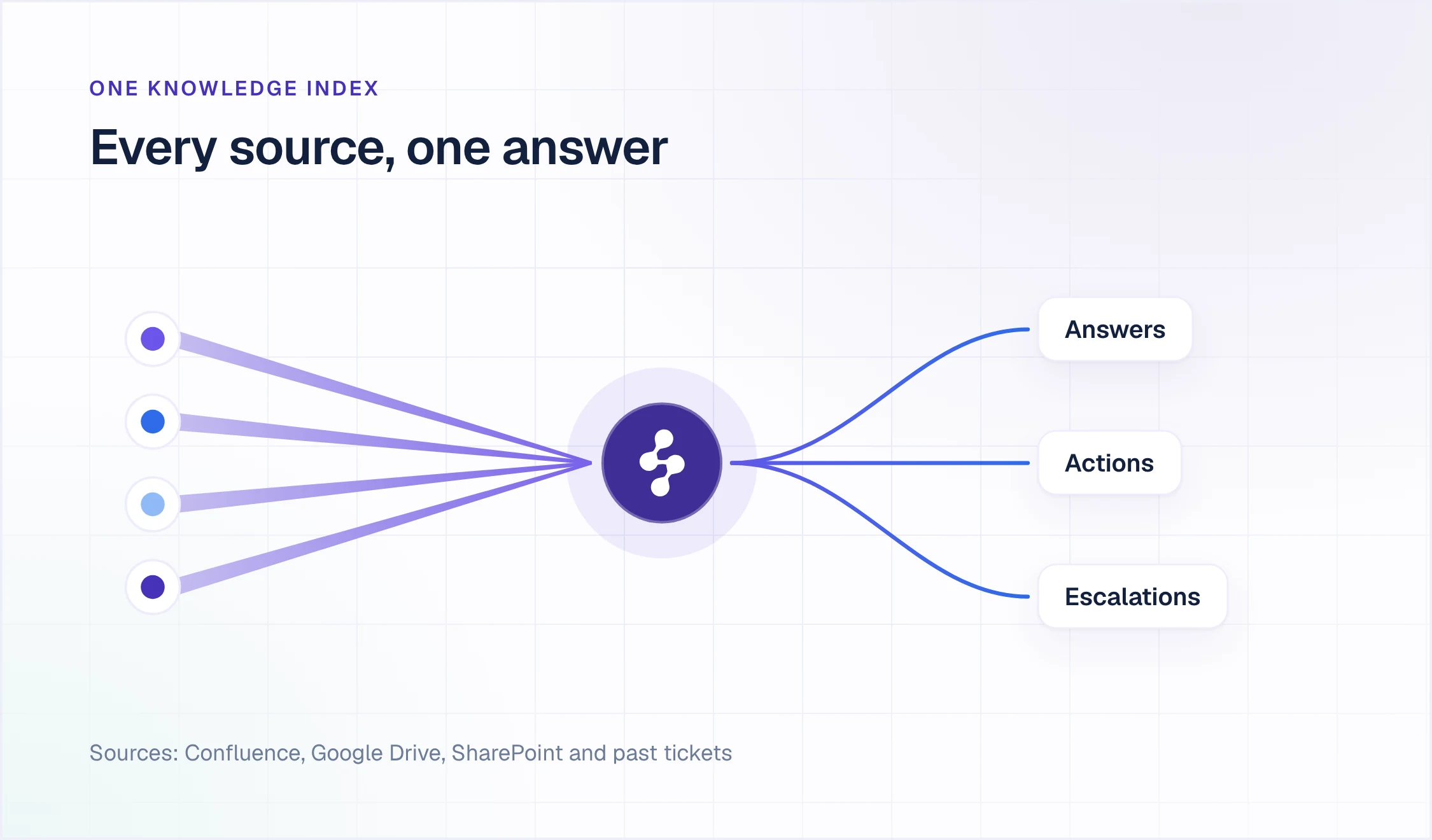
- One knowledge index: Confluence, Google Drive, SharePoint, Notion and Guru sync daily, and so do past tickets from Zendesk, Salesforce Service Cloud and ServiceNow; web pages and uploaded files load once. The same index grounds Enjo, the people working in Inbox and your Help Center, so what the AI says is what agents see and what requesters find.
- Actions, not only answers: AI Actions, included from the Starter plan, query and update connected systems: account unlocks in Okta, case lookups and updates in Salesforce, account and group changes in Google Workspace, Stripe through MCP, and custom API and webhook actions for anything else. Each action is configured, authorized, bounded by Guardrails and recorded in the audit trail.
- Escalation with full context: when Enjo cannot resolve a request, the person who picks it up in Inbox gets the full conversation, the account context and suggested next steps, and Agent Assist summarizes the case and suggests replies.
- Learning and testing: Enjo learns continuously from how your team responds, and Bulk Testing checks accuracy and coverage at scale before launch.
- Channels: website chat, the Help Center portal, Slack Connect shared channels, Slack and Microsoft Teams.
- Proof: autonomous resolution at scale. In Aurora's IT support, Enjo resolves 63% of requests autonomously, with 45% faster resolution and a 60% ESAT improvement.
- Security: SOC 2 Type II, ISO 27001 and GDPR compliant. Troopr Labs, the company behind Enjo, has 600+ enterprise deployments and 99.9% uptime over 7 years.
- Pricing (enjo.ai/pricing, 30 October 2026): Free at $0 a month with 200 AI replies, Starter at $95 a month with 1,000, Standard at $295 a month with 3,000, and additional replies at $0.05 each on Starter and Standard. Every published plan includes unlimited human agent seats and unlimited AI agents, and Free needs no credit card. At the Free limit, requests auto-escalate to your human agents and support keeps running in Inbox.
- Scope: Enjo is built agent-first. The AI Support Agent is configured before any queue exists, and Inbox is where escalations and human collaboration happen rather than the primary work surface. Teams that want a ticket queue first with AI attached later are describing the legacy model, which is the point rather than a limit.
Point Enjo at your help center URL or your docs and watch which of your own requests it resolves. Start free at enjo.ai.
2. Sierra: outcome-priced agents for large brands
Best for: large brands buying a managed, outcome-priced customer agent.
Sierra calls itself a conversational AI platform for businesses. It sells to large brands (its site shows logos including Wayfair, Vanguard, SiriusXM and Rocket Mortgage) on outcome-based pricing, through a "Learn more" form rather than a self-serve plan.
- Ghostwriter: an agent-building agent that drafts an agent from uploaded materials or a plain-English goal, then revises it from flagged issues in its Optimize stage.
- Insights: Explorer analyzes conversations, Monitors flags the ones that need attention, Experiments runs multivariate tests, and Observability shows tool calls, knowledge lookups and latency.
- One agent, many channels: the same agent runs across chat, SMS, WhatsApp, email, voice and ChatGPT.
- Compliance: the site shows SOC 2, ISO 27001, ISO 42001, HIPAA, GDPR, PCI DSS and FedRAMP badges.
- Pricing (sierra.ai, 30 October 2026): outcome-based, with no figures or tiers published.
- Limitation: there is no published price and no self-serve start, so both the cost and the time to your first resolved request are set inside a sales engagement, the same buying model as Decagon.
3. Ada: an agentic customer experience platform across voice, messaging and email
Best for: enterprise consumer brands automating high-volume customer service.
Ada describes itself as the agentic customer experience platform: AI agents that resolve, act and keep improving across voice, messaging and email, in many languages. It sells through a scheduled 30-minute demo, with an ROI model built on your volume during the call.
- Ada Computer: gives the agent tools to complete customer tasks rather than only answer questions.
- Playbooks: turns complex standard operating procedures into agent behavior.
- Integrations: open APIs and SDKs for connecting the systems the agent reads from and acts in.
- Published results: Ada's homepage reports an 84% automated resolution rate and 350+ global businesses.
- Pricing (ada.cx/pricing, 30 October 2026): the pricing page lists no plans or prices.
- Limitation: there is no trial and no published price; the first step is a call with Ada's team, and the business case is built in the demo.
4. Fin: $0.99 per outcome on the helpdesk you already run
Best for: customer service teams paying per outcome on an existing helpdesk.
Fin, the company formerly called Intercom, sells an AI agent for customer service that runs on the helpdesk you already use or on the Intercom helpdesk. Salesforce completed its acquisition of Fin on 10 September 2026, and Fin now sits in Salesforce's AI Labs alongside Agentforce.
- Procedures: Fin follows your policies and runs multi-step workflows through Procedures.
- Your current helpdesk: Fin names Salesforce, HubSpot, Freshworks, Front, Zoho, Gorgias, Dixa and Sprinklr among its integrations, and teammates on a non-Intercom helpdesk add no Fin seat costs.
- Channels: voice (on Apex Flash 2.0, its low-latency voice model), chat, email, Slack and social.
- Trial: 14 days with unlimited outcomes and no credit card.
- Pricing (fin.ai/pricing, 30 October 2026): $0.99 per outcome on your current helpdesk, with a minimum of 50 outcomes a month; qualification outcomes cost $9.99. On the Intercom helpdesk, outcomes start at $0.99 and seats are charged on top.
- Limitation: every outcome is billed, including Procedure handoffs and self-serve routings as well as resolutions, so the bill climbs with each conversation Fin finishes, which is exactly the point at which automation starts working.
Weighing Fin on its own?
Fin alternatives for enterprise support teams in 2026 →
5. Zendesk AI agents and Forethought: per-resolution AI inside Zendesk plans
Best for: support teams already running Zendesk Suite.
Zendesk includes AI agents in every Suite and Support plan and bills the resolutions they complete. It completed its acquisition of Forethought on 26 March 2026, and now presents Forethought's self-improving agents as deployable in Zendesk or in another service platform.
- AI agents in every plan: 5 automated resolutions per agent a month are included on Team plans and 10 on Suite Professional.
- Channels: messaging across web, mobile and social, plus email and voice.
- Forethought agents: Solve resolves issues end to end, Triage classifies tickets, Discover surfaces knowledge gaps, and QA scores human agent tickets.
- Copilot for the human side: $50 per agent a month, billed annually, on Professional plans and above.
- Pricing (zendesk.com/pricing, 30 October 2026): automated resolutions beyond the allowance cost $1.50 each committed or $2.00 pay as you go. Suite Team is $55 and Suite Professional $115 per agent a month billed annually ($69 and $149 billed monthly). The trial runs 14 days with no credit card. Forethought shows no prices on its own site.
- Limitation: the AI agents come inside a Zendesk plan, so the bill is per-agent seats plus every resolution past the allowance, and each person added to handle escalations is another seat.
6. NiCE Cognigy: AI agents for the contact center
Best for: contact centers running voice at scale on a CCaaS platform.
NiCE Cognigy is an enterprise platform for building AI agents for contact centers, across voice, chat and messaging, with a copilot for human agents. It connects to the CCaaS a contact center already runs, naming Genesys, Amazon Connect, Avaya, NiCE CXone, Five9 and 8x8 among its integrations.
- AI Agent Studio and Knowledge AI: where teams design agents and connect the knowledge they answer from.
- Voice at contact center scale: Cognigy cites 100+ languages out of the box and 25,000+ concurrent AI agent interactions.
- Integrations: 110+ prebuilt integrations and two-way MCP.
- Agent Copilot: assistance for the human agents who take over conversations.
- Pricing (cognigy.com, 30 October 2026): no prices or plans published.
- Limitation: there is no trial or published price; evaluation starts with a demo request.
Decagon pricing next to the rates you can check: one month, three bills
Decagon prices per conversation or per resolution under a contract, and Sierra, Ada and Cognigy publish no rates either. Three alternatives publish enough to run the math yourself. Here is one month for a team with 10 people handling escalations, where the AI agent handles 2,000 conversations and resolves 1,200 of them.
| Tool | Billed Unit | Human Agent Seats | This Month |
|---|---|---|---|
| Enjo Standard | AI reply, $0.05 past 3,000 | Unlimited, included | $445 |
| Fin on your helpdesk | Outcome, $0.99 each | Billed by your helpdesk | $1,188 + seats |
| Zendesk Suite Professional | Resolution, $1.50 past 100 included | $115 per agent, 10 agents | $2,800 |
| Decagon, Sierra, Ada, Cognigy | Set in the contract | Set in the contract | Quote only |
Scroll sideways to see every column.
How each line is worked out, so you can redo it at your own volume:
- Enjo: Enjo counts every AI reply, including replies in conversations that end with a person, so the example assumes 3 replies across each of the 2,000 conversations. That is 6,000 replies: 3,000 included in Standard, and 3,000 more at $0.05, which is $150, for $445 in total. At 2 replies per conversation the month is $345; at 4 it is $545. The number of people handling escalations does not change it.
- Fin: 1,200 resolutions at $0.99 is $1,188, before any Procedure handoffs or routings (also $0.99 each) and before the seats on the helpdesk you already pay for.
- Zendesk: 10 agents on Suite Professional is $1,150 a month billed annually, which includes 100 automated resolutions (10 per agent). The other 1,100 at the committed $1.50 rate add $1,650, for $2,800. At the pay-as-you-go $2.00 rate the month is $3,350.
The pattern holds at any volume: on per-outcome and per-resolution pricing the bill rises with each conversation the AI finishes, and on seat-based helpdesks it also rises with each person you add. On Enjo it rises with AI replies only.
Questions to put to every Decagon alternative, on your own stack
A demo environment shows the vendor's best case. These five questions show yours, and each one has an answer you can check before you sign:
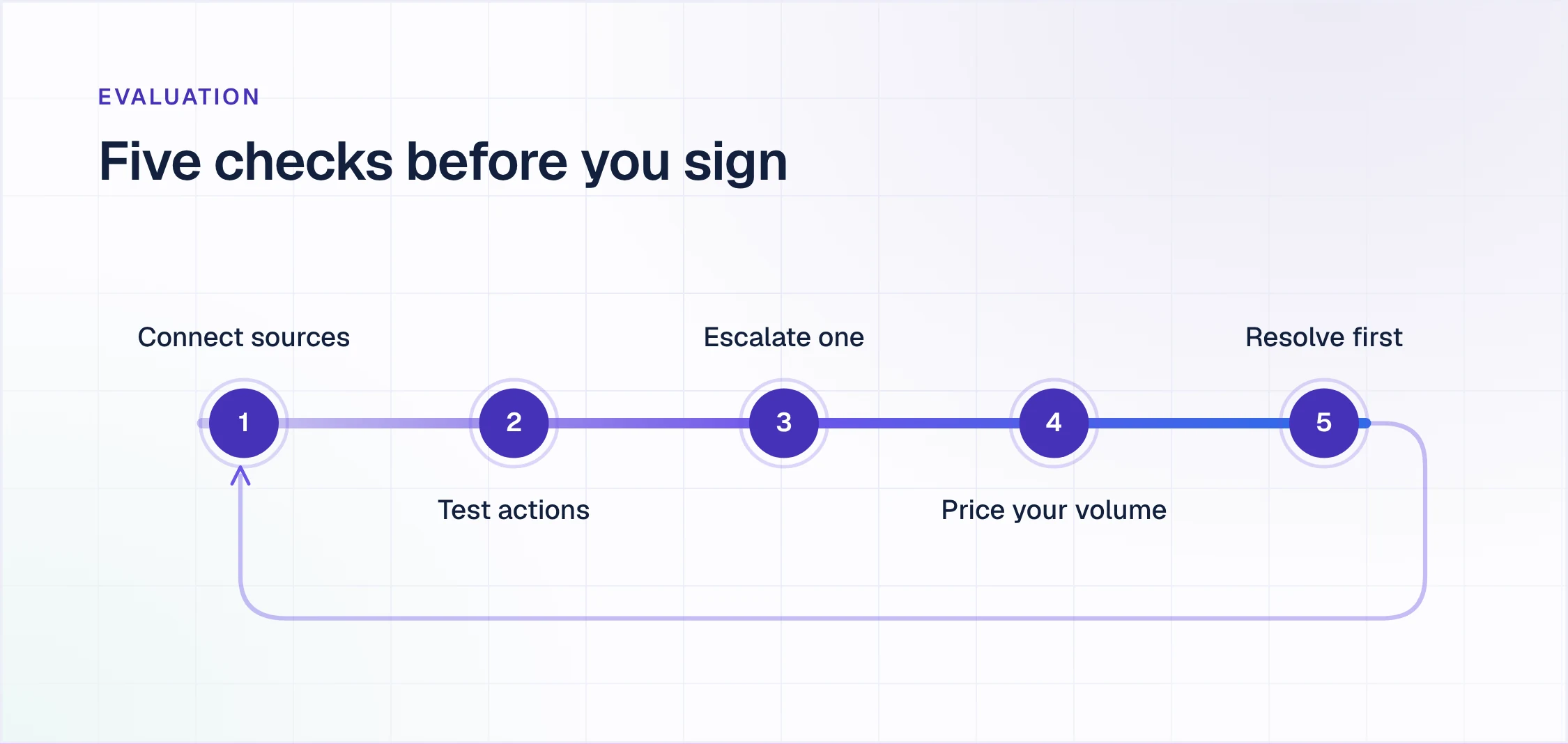
- Connect our help center and two knowledge sources. Which of last week's requests does the agent answer, and does each answer cite its source?
- Show the write actions. For a refund, an account change and an order lookup: who approves each one, and where is the record kept?
- Escalate one conversation. What does the person who picks it up see, and in which tool?
- Price our last three months. Which unit is billed, and what happens to the bill if the resolution rate doubles?
- Resolve a request before we sign. How many days from signup to the first resolved request, and what do we commit to before then?
Enjo answers all five before any contract. On the Free plan, connect your sources and every answer comes back with a citation, and escalations land in Inbox with the full conversation, the account context and suggested next steps. AI Actions, included from the Starter plan at $95 a month, are configured one by one, authorized and recorded in the audit trail. The price per AI reply is on enjo.ai/pricing, with unlimited human agent seats on every published plan. And same-day go-live is feasible, so the first resolved request can come before anyone signs.
200 AI replies a month, unlimited human agent seats, Inbox, Help Center and Insights. No credit card, no procurement.
Start free at enjo.aiFrequently asked questions about Decagon alternatives
What is Decagon AI?
Decagon is a company that builds AI agents for customer service across chat, email and voice. Teams define agent behavior in Agent Operating Procedures (AOPs), written in natural language with code where needed, and Decagon adds testing, experiments, QA monitoring and reporting. It sells through demos to companies such as Duolingo, Notion and Hertz.
How much does Decagon cost?
Decagon does not publish prices. Its own pricing post describes two contract models: a fixed rate per incoming conversation, or a higher fixed rate per resolved conversation with no charge for escalations, and it says most customers choose per conversation. The annual figures on third-party lists come from procurement data and are not confirmed by Decagon. The helpdesk where escalations land is a separate contract.
Who are Decagon's main competitors?
The vendors most often compared with Decagon are Sierra, Ada, Fin, Zendesk AI agents (now including Forethought) and NiCE Cognigy. Enjo is the alternative with published plans priced per AI reply, unlimited human agent seats and a free plan.
Decagon vs Sierra: what is the difference?
Both sell AI agents for customer service to large companies without published prices. Decagon has teams write Agent Operating Procedures in natural language and code, prices per conversation or per resolution, and covers chat, email and voice. Sierra builds agents with Ghostwriter, its agent-building agent, from uploaded materials or a plain-English goal, prices on outcomes, and covers chat, SMS, WhatsApp, email, voice and ChatGPT.
Is there a free alternative to Decagon?
Yes. Enjo's Free plan includes 200 AI replies a month, unlimited human agent seats, unlimited AI agents, Inbox, Help Center and Insights, with no credit card. Fin and Zendesk offer 14-day free trials.
Does Decagon replace a helpdesk?
Decagon's product pages list no helpdesk of its own. It connects to the one you run: Salesforce, Intercom and Zendesk for ticketing, and Zendesk Sunshine and Salesforce for chat escalations. The people who take escalations keep working in that helpdesk, on its own pricing.
Who owns Fin and Forethought now?
Both were acquired in 2026. Zendesk completed its acquisition of Forethought on 26 March 2026, and Salesforce completed its acquisition of Fin, formerly Intercom, on 10 September 2026.