Transform complex support workflows
Sierra AI Alternatives in 2026: 7 AI Agents Compared on Price and How You Start
The Sierra AI alternatives buyers shortlist most in 2026 are Decagon, Ada, Fin, Zendesk AI agents, NiCE Cognigy and Kore.ai, plus Enjo. They split on the question that sends most people looking past Sierra in the first place: can you see a price and start without a sales process? Enjo, Fin and Zendesk publish their prices and let you start today. Decagon, Ada, Cognigy and Kore.ai, like Sierra, begin with a demo.
We checked every one on its own website on 30 October 2026: how it bills, what it publishes, where requesters reach it, and which of them you can start today. Then we ran one month's bill at the published rates.
Sierra AI alternatives at a glance
Seven alternatives in the same order as the entries below, with Sierra on the first row for reference. Every cell comes from the vendor's own website on 30 October 2026. "Quote" means the site publishes no price.
| Tool | How It Bills | Published Price | Start Without Sales | Where Requesters Reach It |
|---|---|---|---|---|
| Sierra (reference) | Per outcome, set by contract | Quote | No, contact form | Voice, chat, SMS, WhatsApp, email, ChatGPT |
| Enjo | Per AI reply, unlimited human seats | Free; paid plans from $95/month | Yes, free plan | Website chat, Help Center, Slack, Teams |
| Decagon | Per conversation or per resolution | Quote | No, demo first | Chat, voice, email |
| Ada | Not published | Quote | No, demo first | Messaging, voice, email |
| Fin | Per outcome, one per conversation at most | $0.99 per outcome | Yes, 14-day trial | Chat, email, voice |
| Zendesk AI agents | Per agent seat plus per resolution | $55/agent/month plus $1.50 per resolution | Yes, buy online | Messaging, email, voice |
| NiCE Cognigy | Not published | Quote | No, demo first | Voice, chat, messaging |
| Kore.ai | Not published | Quote | No, demo first | Voice and digital channels |
What Sierra is, and why buyers look past it
Sierra builds AI agents that large companies use for customer service and engagement. It was co-founded by Bret Taylor, formerly co-CEO of Salesforce, and Clay Bavor, who led Google Labs. One Sierra agent runs across voice, website and app chat, WhatsApp, Apple Business Chat, SMS, email and ChatGPT. Teams build it in Agent Studio without code, or describe what they want to Ghostwriter, which Sierra calls the agent-building agent.
The scale is real. Sierra says 40% of the Fortune 50 work with it, that it began its third year, in February 2026, with over $150M in annual recurring revenue, and that one in four of its customers has revenue over $10 billion. Its compliance list includes SOC 2, HIPAA, GDPR, PCI, FedRAMP High, ISO 27001 and ISO 42001. The reasons people look elsewhere are about how you buy it, and they show up on Sierra's own pages.
No price you can model
sierra.ai has no pricing page; the address returns a 404. Sierra sells on outcome-based pricing, where "you pay only when the software achieves specific, valuable outcomes." In a June 2026 post, Sierra's own team called outcome-based pricing "more complex than seat-based or consumption pricing" (operationally, contractually and in accounting), and wrote that if an outcome "can't be cleanly attributed to the software, you'll get into an endless debate." What counts as an outcome is agreed in the contract, so nobody can size the bill before talking to sales.
The figures that circulate come from roundups written by other AI vendors, which put Sierra's entry contract at around $150,000 a year with implementation on top. Sierra has not published or confirmed any figure, so treat those as estimates.
No way to start without a sales process
Every "Learn more" and "Get started" button on sierra.ai leads to the same contact page. There is no sign-up, no free plan and no trial. Sierra describes the relationship as a "long-term partnership, priced by outcomes," with an expert agent development team working alongside yours.
A rollout measured in weeks
Sierra's product page promises to "deploy in weeks," and its February 2026 year in review cites one of the world's largest healthcare companies going live "just seven weeks after the project kickoff." That is quick for a company that size. It is still a project with a kickoff, which is a different thing from resolving your first real request the day you sign up.
Channels built for consumer conversations
Sierra's channel page lists voice, website and mobile app chat, WhatsApp, Apple Business Chat, SMS, email and ChatGPT, plus Live Assist for care representatives. Slack and Microsoft Teams appear only as places where Ghostwriter works with your own team. Its outcomes are consumer ones too: Sierra's examples include originating a mortgage, processing an insurance claim and retaining a subscriber. If your requesters are employees in Slack or Teams, or customers in Slack Connect shared channels, that channel list is the first thing to check.
How we compared the alternatives
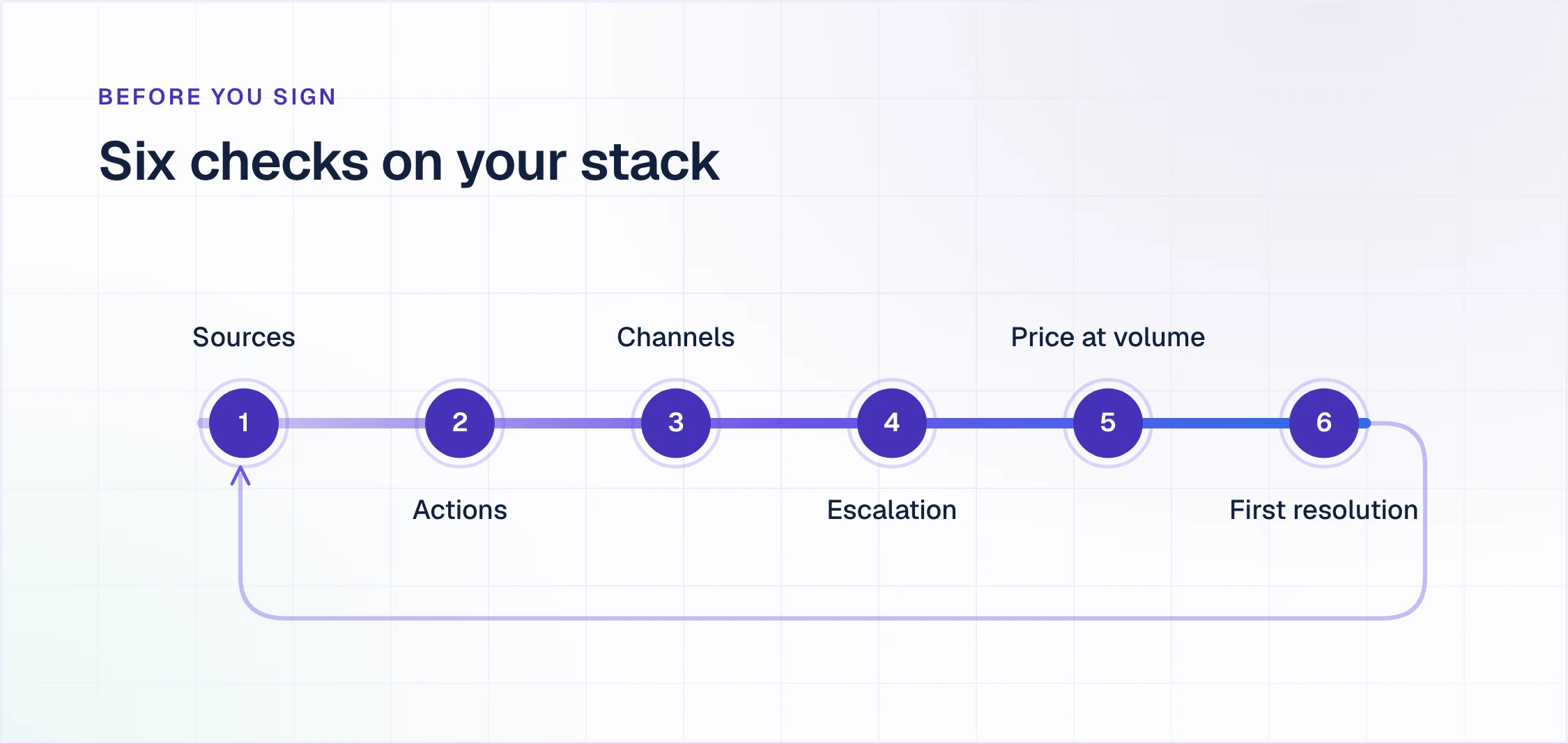
Each tool below was checked on its own website on 30 October 2026, against the six facts that decide a Sierra replacement:
- How it bills, and whether the price is published.
- How you start: a free plan, a trial, or a demo.
- What it reads: the knowledge sources the agent answers from.
- What it can do in other systems, beyond answering.
- Where requesters reach it.
- What an escalation carries to a human, and where it lands.
Every entry has the same shape: what the tool is, how it sells, its capabilities as concrete behavior, its published price, and one limitation checked on its own site. Enjo's entry carries its scope in that slot. Capability claims and resolution figures are each vendor's own.
The 7 best Sierra AI alternatives in 2026
1. Enjo
Enjo is an AI Support Agent that resolves requests end to end, including actions in your connected systems, and hands everything else to your team with the full conversation attached. It sells self-serve from a free plan, with published plans priced per AI reply rather than per seat.
- Agent first: you configure the AI Support Agent before any queue exists. Studio is where you design, test and deploy its tools and flows, and Bulk Testing checks response accuracy, consistency and coverage at scale before anything reaches a requester.
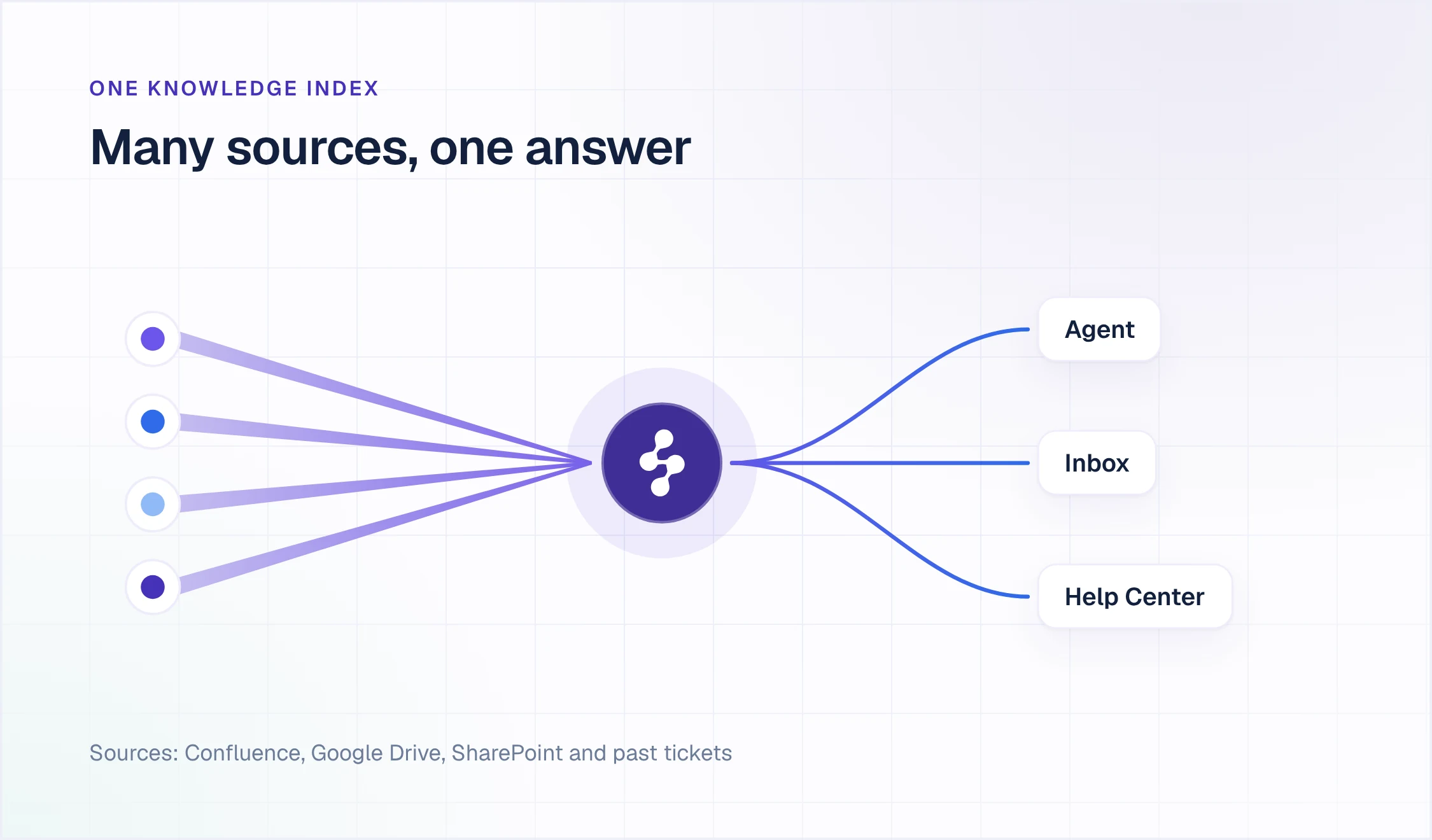
- One knowledge index: Enjo reads Confluence, Google Drive, SharePoint, Notion and Guru on a daily sync, plus past tickets from Zendesk, Salesforce Service Cloud, ServiceNow and Jira, web pages and uploaded files. The same index grounds Enjo, Inbox and Help Center, so what the agent says is what your team sees and what requesters find. Every answer is grounded in your knowledge, with citations.
- AI Actions: the agent looks up and updates cases and records in Salesforce, creates and updates tickets in ServiceNow and Jira, unlocks accounts and provisions access in Okta, manages accounts and groups in Google Workspace, and reaches any other system through API and webhook actions. Every action is configured, authorized, bounded by Guardrails and recorded in the audit trail.
- Escalation with context: when Enjo can't resolve a request, it lands in Inbox with the full conversation, account context and suggested next steps. Human agent seats are unlimited on every published plan, and Enjo learns continuously from how your team responds.
- Where requesters reach it: website chat, the Help Center portal, Slack, Microsoft Teams and Slack Connect shared channels.
- Proof: Aurora reached 63% autonomous resolution with Enjo, with 45% faster resolution and a 60% ESAT improvement.
- Pricing: Free is $0 a month with 200 AI replies, Inbox, Help Center and Insights, and needs no credit card. Starter is $95 a month with 1,000 AI replies, Standard is $295 a month with 3,000, and Enterprise is custom with yearly billing. At the Free limit, requests escalate to your human agents automatically, so support keeps running in Inbox.
- Security: SOC 2 Type II, ISO 27001 and GDPR compliant, with TLS 1.2+ in transit and AES-256 at rest. Troopr Labs, the company behind Enjo, has 600+ enterprise deployments and 99.9% uptime over 7 years.
- Scope: Enjo is built agent-first. The AI Support Agent is configured before any queue exists, and Inbox is where escalations and human collaboration happen rather than the primary work surface. Teams that want a ticket queue first with AI attached later are describing the legacy model, which is the point rather than a limit.
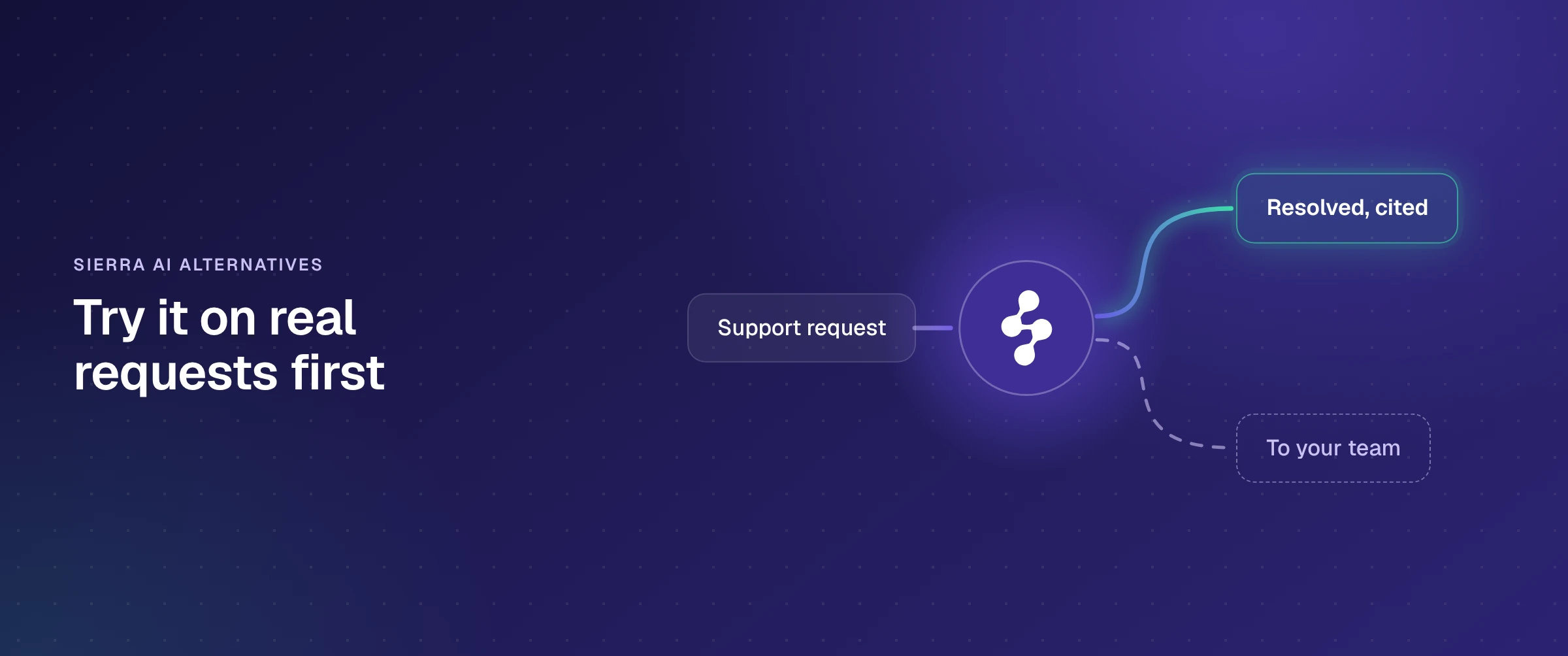
Start free at enjo.ai and run it on your own requests before anyone asks for a contract.
2. Decagon
Decagon builds AI agents for customer service across chat, voice and email, which it describes as "the AI concierge for every customer." It sells to enterprises through a demo: the site's calls to action are "Get a demo" and "Contact Sales."
- Agent Operating Procedures: teams write agent workflows as AOPs in natural language rather than a configuration language, and Duet works as an AI partner for building self-improving agents.
- Testing before release: simulations at scale, live A/B tests through Experiments, and Watchtower for always-on QA.
- Integrations: syncs tickets and customer data from Salesforce, Intercom and Zendesk, imports articles from Confluence, Contentful and Kustomer, connects voice through Amazon Connect or RingCentral, and reaches other systems through APIs and MCP.
- Pricing: no price on the site, and decagon.ai/pricing returns a 404. Decagon's own December 2024 post describes two contract models: a fixed rate per conversation, or a higher rate per resolution with no charge for escalations. It says most customers choose per conversation.
- Limitation: Decagon's product pages list no helpdesk of its own. Escalations hand off into Zendesk, Salesforce and similar tools, so your human agents keep working, and paying for seats, in a separate helpdesk.
3. Ada
Ada calls itself "the agentic customer experience platform": AI agents that resolve customer issues and take action across messaging, voice and email. It sells through a demo, and its main call to action is "Speak to an expert."
- Playbooks: automate complex standard operating procedures as agent workflows.
- Ada Computer: gives the agent tools to complete tasks for the customer rather than only answer.
- Coaching and testing: teams measure, test and coach the agent with built-in performance analysis, and Ada coordinates several large language models on complex requests.
- Resolution claim: Ada publishes an 84% automated resolution rate on its own site.
- Pricing: no published price. The pricing page (ada.cx/pricing) is a form to book a 30-minute demo call, with a reply promised within one business day.
- Limitation: there is no free plan, trial or self-serve sign-up, so the first step with Ada, as with Sierra, is a sales conversation.
4. Fin
Fin is an AI agent for customer service from the company formerly called Intercom, and Salesforce completed its acquisition of Fin on 10 September 2026. Fin sells self-serve with a 14-day free trial and no credit card, and runs natively in the Intercom helpdesk or on top of Zendesk, Salesforce, Freshdesk and others.
- Outcome billing: $0.99 per outcome, charged at most once per conversation, refunded if the conversation reopens, and not charged when Fin can't answer or the customer asks for a human.
- Procedures: Fin completes multi-step workflows, called Procedures, including ones that hand off to your team.
- Channels: chat, email and voice, with WhatsApp and SMS billed per message. Fin Voice is sold through sales at $1.99 per voice outcome.
- Helpdesk pricing: the Intercom helpdesk starts at $19 per seat a month. On a helpdesk you already run, Fin has a $49 monthly minimum that includes 50 outcomes, with no seat costs. Prices from fin.ai/pricing on 30 October 2026.
- Limitation: an outcome counts when the customer confirms the fix, when they don't ask for more help after Fin responds, or when Fin completes a Procedure, including one that ends in a handoff. A requester who gives up quietly is billed the same as one who confirms the fix.
Comparing Fin on its own?
8 Best Fin Alternatives for Enterprise Support Teams in 2026 →
5. Zendesk AI agents
Zendesk AI agents are built into the Zendesk Suite, Zendesk's helpdesk, and Zendesk now also sells Forethought AI agents, which it says work on any platform. They are bought online with a Suite plan, priced per agent seat.
- Included in Suite plans: AI agents come with every Suite and Support plan. Suite Team is $55 per agent a month billed yearly ($69 monthly), and Suite Professional is $115 ($149 monthly), per zendesk.com/pricing on 30 October 2026.
- Automated resolutions: the billing unit is a request the AI agent resolves with no escalation to a human. Each plan includes some, and the number varies by plan and agent count; more cost $1.50 each committed or $2.00 pay as you go.
- Procedures in plain language: teams create and deploy AI agents from natural-language procedure descriptions, with AI agents for messaging, email and voice.
- Resolution claim: Zendesk says its AI agents resolve "up to 80%+" of service issues.
- Limitation: the bill grows two ways at once: per human agent seat on the Suite plan, and per automated resolution beyond the plan's allowance.
6. NiCE Cognigy
NiCE Cognigy builds AI agents for contact centers across voice, chat and messaging, and runs natively inside NiCE CXone, NiCE's contact center platform. It sells through a demo; the main call to action is "See a demo."
- Hybrid agents: agentic reasoning combined with deterministic logic wherever predictability, control and regulatory compliance matter.
- Voice and digital: voice agents plus webchat, WhatsApp and SMS, in 100 languages out of the box.
- Agent Copilot: a copilot for every human agent in the contact center.
- Integrations and scale: 110 prebuilt integrations plus two-way MCP, and more than 2.6 billion interactions processed a year, by Cognigy's own count.
- Governance: full execution traceability and an audit history across AI and human interactions.
- Pricing: no published price; cognigy.com/pricing returns a 404.
- Limitation: Cognigy is built around the contact center and sold through a demo, so there is no plan or trial to start on before a sales conversation.
7. Kore.ai
Kore.ai sells an agent platform for three jobs: AI for service, AI for work and AI for process. It sells to large enterprises through a demo, and the site's call to action is "Get demo."
- AI for service: voice and digital AI agents that resolve customer cases from start to finish across channels and systems, plus a contact center product.
- AI for work and process: agents that complete employee requests, and agents that run multi-day, multi-system processes with a full audit trail.
- Autoloop: an optimization engine that builds, evaluates and improves an agent against goals you set, before and after launch, with StateTrace capturing the full execution path when a goal is missed.
- Analyst recognition: named a Leader in the Gartner Magic Quadrant for Conversational AI Platforms, and in The Forrester Wave for Conversational AI Platforms for Employee Services, Q3 2026.
- Pricing: no published price; kore.ai/pricing returns a 404.
- Limitation: Kore.ai is a programmable platform: agents are built, traced and tuned inside it, and the only way in is a demo.
What a month costs at published rates
Only three of the eight tools on this page publish enough to price a month without a sales call: Enjo, Fin and Zendesk. Here is the same month on each: 1,000 requests resolved by AI, and five human agents handling the rest.
| Tool | Billed Unit | Five Human Agents | AI Usage | Month Total |
|---|---|---|---|---|
| Enjo Standard | AI reply, 3,000 included | Included, unlimited seats | In the $295 plan | $295 |
| Fin with Intercom | Outcome, $0.99 each | $95 at $19 a seat | $990 | $1,085 |
| Zendesk Suite Team | Agent seat plus automated resolution | $275 at $55 a seat | Up to $1,500 beyond allowance | $275 to $1,775 |
| Sierra, Decagon, Ada, Cognigy, Kore.ai | Set per contract | Quote | Quote | Quote |
Two notes on the math. Enjo counts AI replies, not conversations: Standard's 3,000 replies cover 1,000 conversations that average three AI replies or fewer, and 1,000 one-reply answers fit Starter at $95. Zendesk plans include some automated resolutions, and the number varies by plan and agent count, so Zendesk's real figure sits between $275 and $1,775 with yearly billing. Fin on a helpdesk you already pay for is $990 plus that helpdesk.
Sierra, Decagon, Ada, Cognigy and Kore.ai quote per contract, so the only way to fill in their row is a sales conversation.
Questions to put to every Sierra alternative
A demo shows a vendor's best case on the vendor's data. These six questions only have useful answers on your own systems, so ask every vendor on your shortlist to answer them there, then hold Enjo to the same test.
What does it read, and how does it stay current?
Answer quality is capped by what the agent can reach. Ask for the list of sources it indexes and how often each one syncs. Enjo reads Confluence, Google Drive, SharePoint, Notion, Guru and past tickets on a daily sync, plus web pages and uploaded files, into the one index that grounds the agent, Inbox and Help Center.
What can it do in your systems, and who authorizes it?
Reading a record is not resolving a request, so ask for the write actions, not the read ones. Enjo's AI Actions update records in Salesforce, ServiceNow and Jira, unlock accounts and provision access in Okta, and reach any system with an API, each one configured and authorized by your team, bounded by Guardrails and recorded in the audit trail.
Where do your requesters reach it?
An agent on a channel your requesters don't use resolves nothing. Enjo runs in website chat, the Help Center portal, Slack, Microsoft Teams and Slack Connect shared channels, so a request is resolved where it was asked.
What does an escalation carry, and where does it land?
Ask to watch one escalation arrive in the queue your team actually works. In Enjo, it lands in Inbox with the full conversation, account context and suggested next steps, and seats for your human agents are unlimited on every published plan.
How does the price behave as volume grows?
Ask for the unit, the rate, and what happens at the edge of your plan. Enjo bills per AI reply on published plans with unlimited human agent seats, so the bill tracks support volume rather than headcount, and at the Free limit requests escalate to your team instead of stopping.
How soon is the first request resolved, and can you see it before signing?
Ask for the date of the first resolved request on your own systems, and whether you can watch it happen before a contract. Enjo starts on the free plan with no credit card and no procurement, Bulk Testing validates answers before launch, and same-day go-live is feasible: Aptean put its initial cohort live in a single day.
Frequently asked questions about Sierra AI alternatives
What is Sierra AI?
Sierra is a company that builds AI agents for customer service and engagement, co-founded by Bret Taylor and Clay Bavor. One Sierra agent works across voice, chat, messaging apps, email and ChatGPT, and Sierra prices it by outcome under an enterprise contract.
How much does Sierra AI cost?
Sierra does not publish a price. It sells on outcome-based pricing, where you pay when the agent achieves an agreed outcome, with the terms set per contract. Roundups written by other AI vendors estimate an entry contract around $150,000 a year with implementation on top; Sierra has not confirmed any figure.
Who are Sierra AI's competitors?
Decagon is the Sierra competitor that roundups name most often; like Sierra, it builds AI agents for enterprise customer service and sells through a demo. Others include Ada, Fin, Zendesk AI agents, NiCE Cognigy, Kore.ai and Enjo, and voice-first contact center tools such as Parloa and PolyAI appear in many roundups too.
What are the best Sierra AI alternatives?
The Sierra AI alternatives most often shortlisted in 2026 are Enjo, Decagon, Ada, Fin, Zendesk AI agents, NiCE Cognigy and Kore.ai. Enjo, Fin and Zendesk publish prices and can be started without a sales call; Decagon, Ada, Cognigy and Kore.ai quote per contract and start with a demo, as Sierra does.
Is there a Sierra AI alternative with a free plan?
Yes. Enjo has a permanent free plan: 200 AI replies a month with Inbox, Help Center and Insights, unlimited human agent seats, and no credit card. Fin offers a 14-day free trial with no credit card. Sierra, Decagon, Ada, Cognigy and Kore.ai offer neither on their sites.
What is the difference between Sierra and Decagon?
Both build AI agents for enterprise customer service and sell through a demo. Sierra bills by outcome under contract and runs one agent across voice, chat, SMS, WhatsApp, email and ChatGPT, built in Agent Studio or with Ghostwriter. Decagon defines agents in natural-language Agent Operating Procedures, covers chat, voice and email, and says most of its customers choose per-conversation pricing over per-resolution.
How long does it take to deploy a Sierra alternative?
It depends on how the vendor sells. Sierra says it deploys in weeks, citing a large healthcare company live seven weeks after kickoff, and the demo-led tools start with a sales process. Enjo starts on its free plan the day you sign up, and same-day go-live has been done in production: Aptean put its initial cohort live in a single day.
Run the test on your own requests
Every tool on this list can show a good demo. What separates them is how soon you can see one work on your own knowledge, your own systems and your own requesters, and what it costs once it does. Enjo's free plan answers both before anyone asks for a contract.
Read more