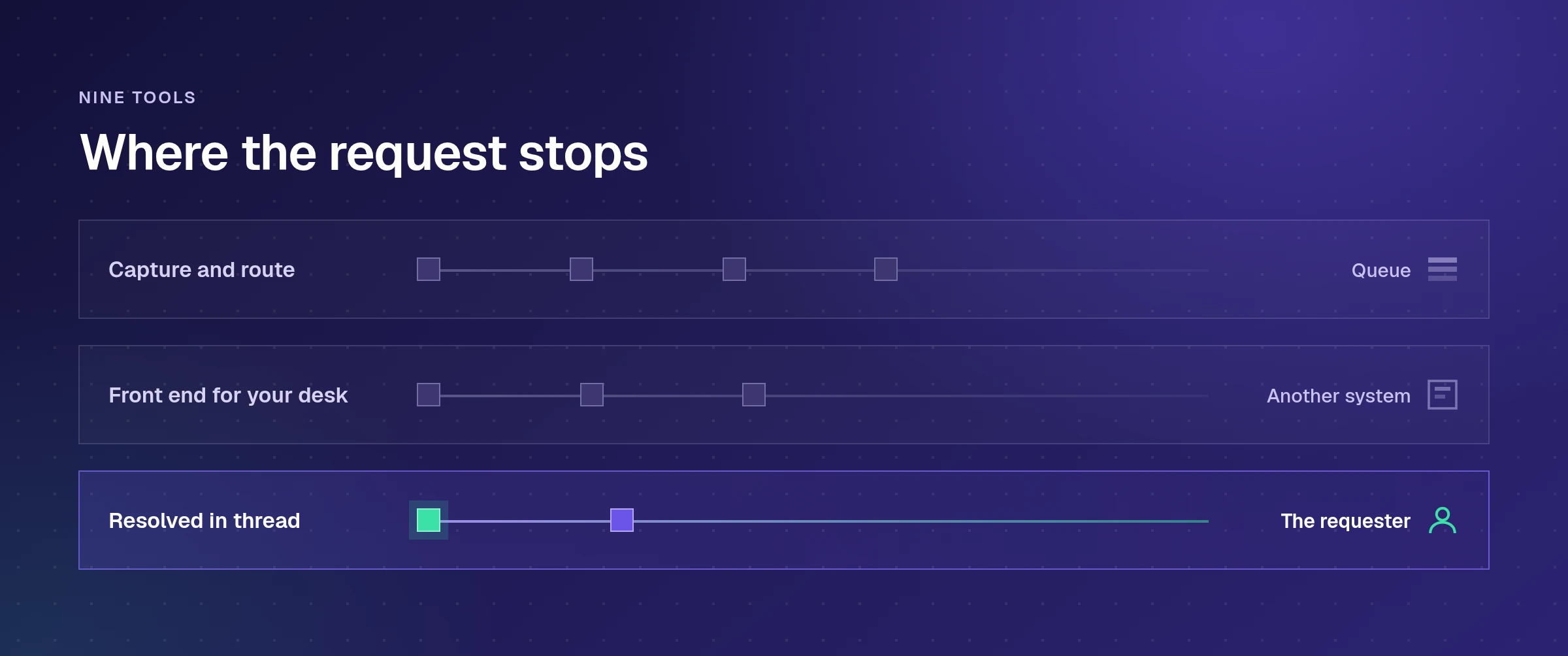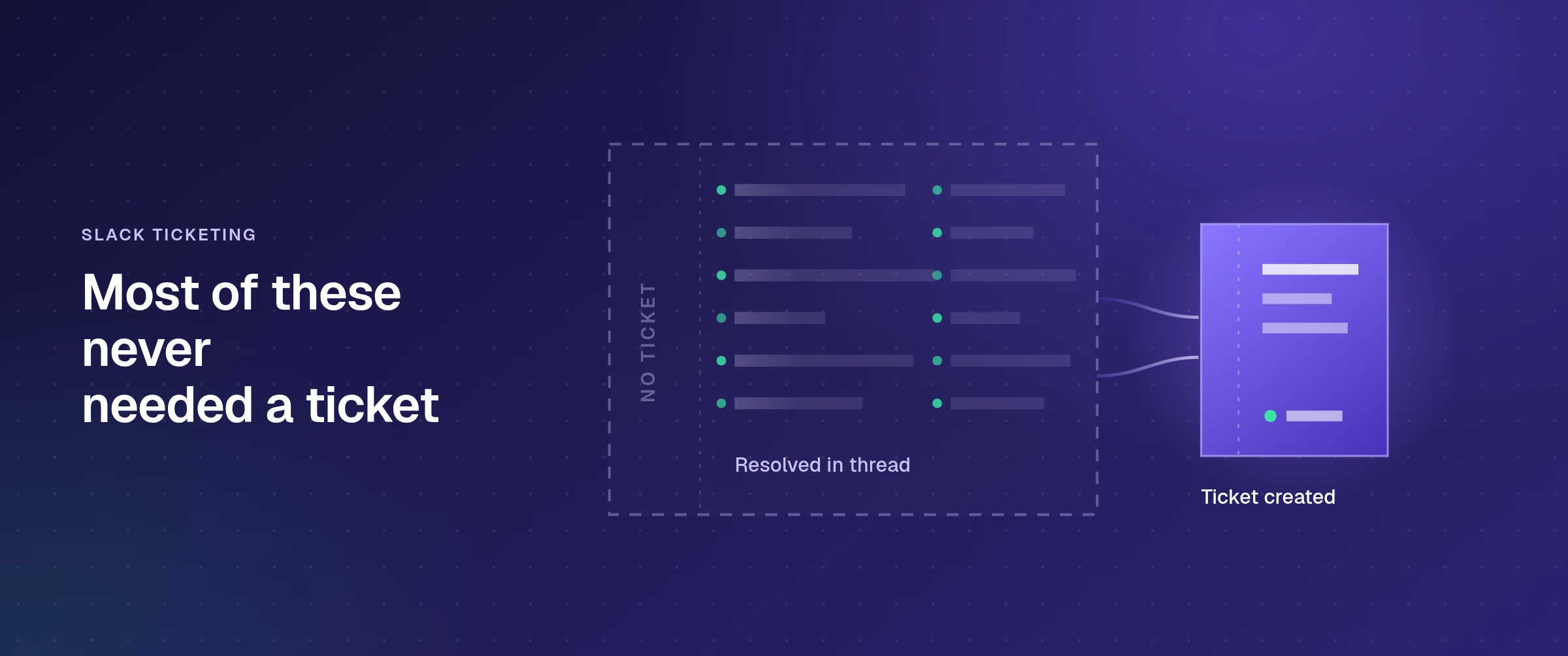
Transform complex support workflows
Slack Wiki: What It Is and How to Set One Up in 2026
A Slack wiki is a company knowledge base your team can read, search, and get answers from without leaving Slack. It takes one of three forms: a native Slack canvas, a wiki tool like Confluence or Notion connected through its official Slack app, or an AI agent that answers questions in the channel from whichever sources you already maintain.
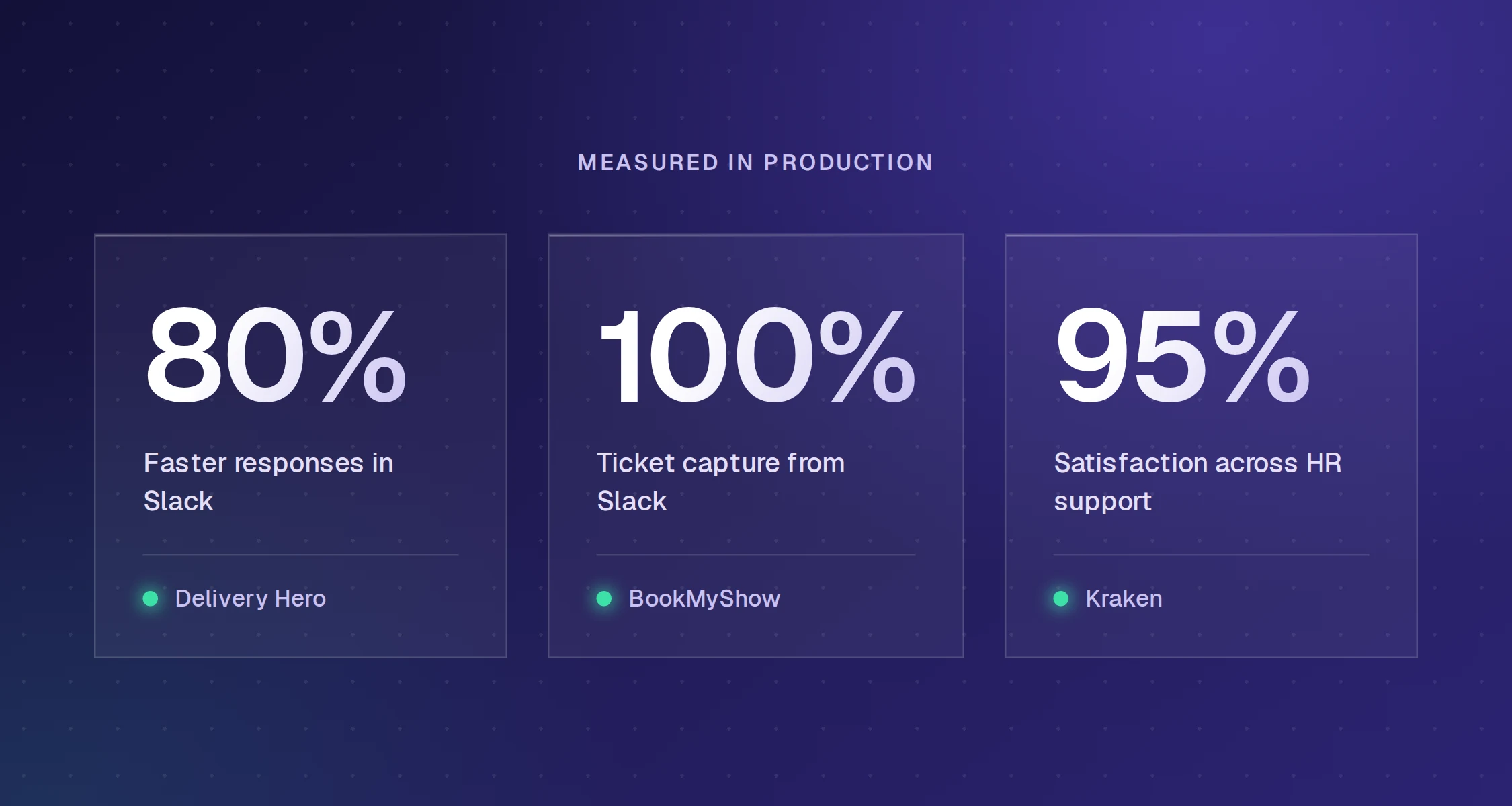
The problem it solves is familiar to anyone running IT, HR, or support through Slack. The documentation exists, but questions arrive in channels, and someone answers the same ten questions every week because opening the wiki is a context switch nobody makes mid-task. Delivery Hero hit this at 95,000+ Slack members and connected its Confluence knowledge to Slack with Enjo: responses got 80% faster, and average deflection reached 30%.
This guide compares the 8 best Slack wiki tools for 2026 and shows how to turn the wiki you already have into cited answers inside Slack.
What is a Slack wiki?
A Slack wiki is any system that makes your company's internal knowledge available inside Slack, where your team already works. The underlying content can live in a corporate wiki like Confluence, a flexible workspace like Notion, or a dedicated company wiki. What makes it a Slack wiki is the access pattern: people find and receive knowledge in the channel, in the thread, at the moment they ask.
That definition matters because the wiki itself was never the hard part. Companies have run internal wikis and company knowledge bases for two decades, and the same two failures repeat: employees stop visiting, and content goes stale because nobody sees what is missing. Moving access into Slack attacks the first failure directly, and with the right tooling it attacks the second one too, which the Insights section below covers.
The rest of this page compares the three routes to get there: Slack's native canvases, your wiki's official Slack app, and an AI answer layer that reads every source you have.
Does Slack have a built-in wiki?
No. Slack has no dedicated wiki, and the request has sat on user wishlists for years. What Slack ships natively is canvases (a formatted document attached to a channel or DM), Lists for lightweight tracking, and AI features that summarize and search Slack's own content.
Canvases are the closest thing to a built-in Slack wiki. Free teams can access canvases in channels, and paid teams can create unlimited canvases in channels and DMs, per Slack's canvas feature page (slack.com/features/canvas). A channel canvas works well as the single reference doc for that channel: onboarding steps, team norms, current owners, and links to deeper material.
Where canvases stop is exactly where wikis begin. There is no cross-workspace hierarchy, no verification workflow that marks content trusted or expired, no granular permissions for sensitive documentation, and no analytics showing what people searched and failed to find. Slack's AI features share the same boundary: Slackbot's AI answers draw on conversations and files inside Slack, not on the knowledge base you keep in Confluence, Notion, or Guru. Where canvases run out, the options in our free knowledge base software comparison pick up hierarchy, permissions and analytics.
Teams that outgrow canvases still want the wiki on Slack; they connect an external brain. The rest of this guide covers how.
Why teams add a wiki to Slack (and what they use it for)
The case is operational. When requests arrive through Slack, every answer that requires opening another tool costs minutes, and every question a document could have answered costs a person. Slack knowledge management is about closing that gap at the moment of the question.
Five workflows cover most of what teams do with a Slack wiki:
- Update notifications. The wiki's Slack app posts to a channel when pages you follow are created, edited, or commented on, so changes surface without anyone checking the wiki.
- Content previews. Paste a wiki link and the integration unfurls a preview, so the thread gets context without a click.
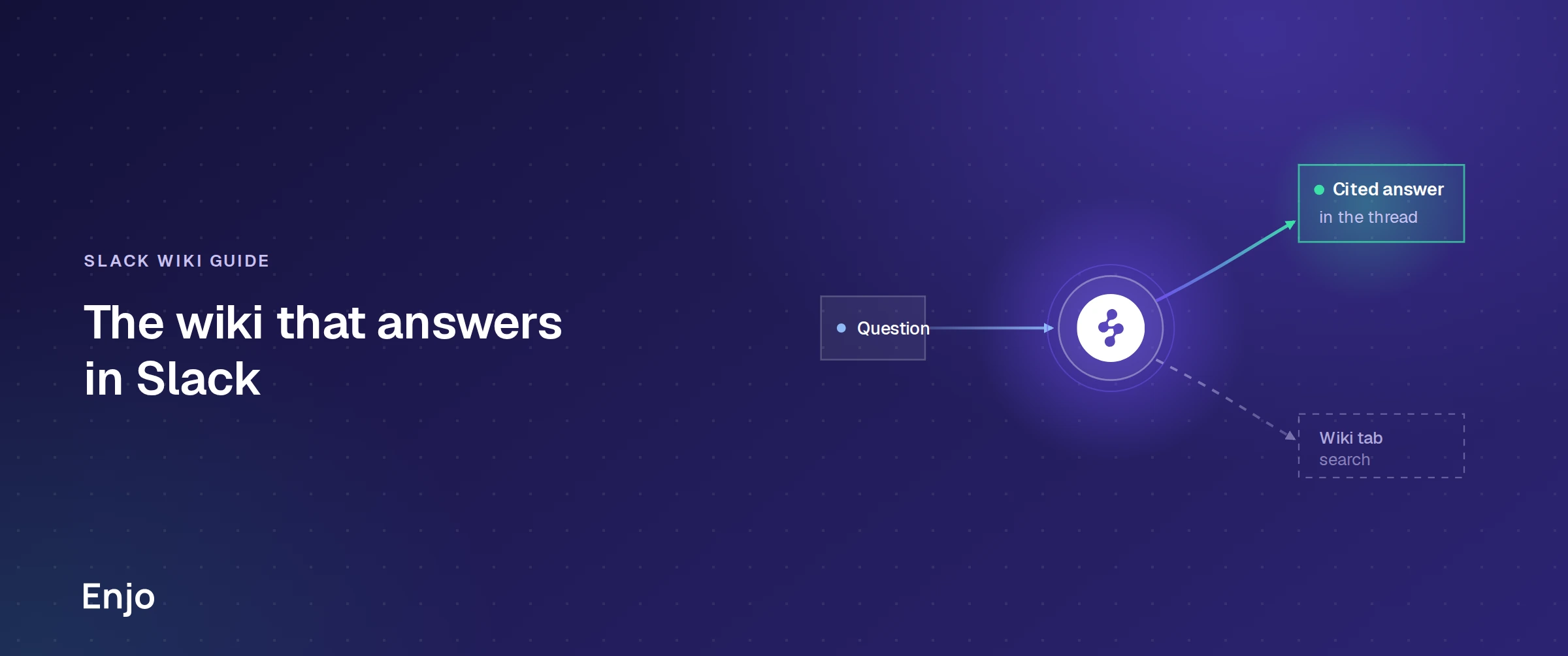
- Answering repeat questions automatically. An AI agent matches the question asked in the channel to your documentation and replies with the answer and its source. This is the workflow with the highest payoff, because it removes the human from the loop for known answers.
- Searching the wiki from Slack. A slash command or bot mention queries the knowledge base and returns results in the thread.
- Self-serve IT and HR support. Questions in #it-help get answered from documentation first; when the answer does not resolve the request, a ticket is created from the thread automatically and updates sync back into Slack.
Rank the five by return: automatic answers and self-serve support move real volume, while notifications and previews are conveniences. That ranking should drive which tool you pick, which is what the next section is for.
The 8 best Slack wiki tools in 2026
These are the Slack wiki apps and tools worth considering, reflecting what the current top-ranking pages cover plus what they miss. Two tools from older versions of this list are gone: Lessonly's Obie was absorbed into Seismic and no longer exists as a standalone product, and Outline remains a fine self-hosted wiki but has no meaningful Slack answering capability. Slab is new to the list. Every price and G2 rating below was checked on August 31, 2026; sources sit in the verification flags.
1. Enjo
Enjo is an AI Support Agent that connects to the knowledge you already maintain and answers questions directly in Slack channels and threads. It is not a wiki editor; it is the layer that makes whichever wiki you keep actually answer people.
Best for: teams with documentation already in Confluence, Notion, Guru, SharePoint, or Google Drive that want it answering questions in Slack this week.
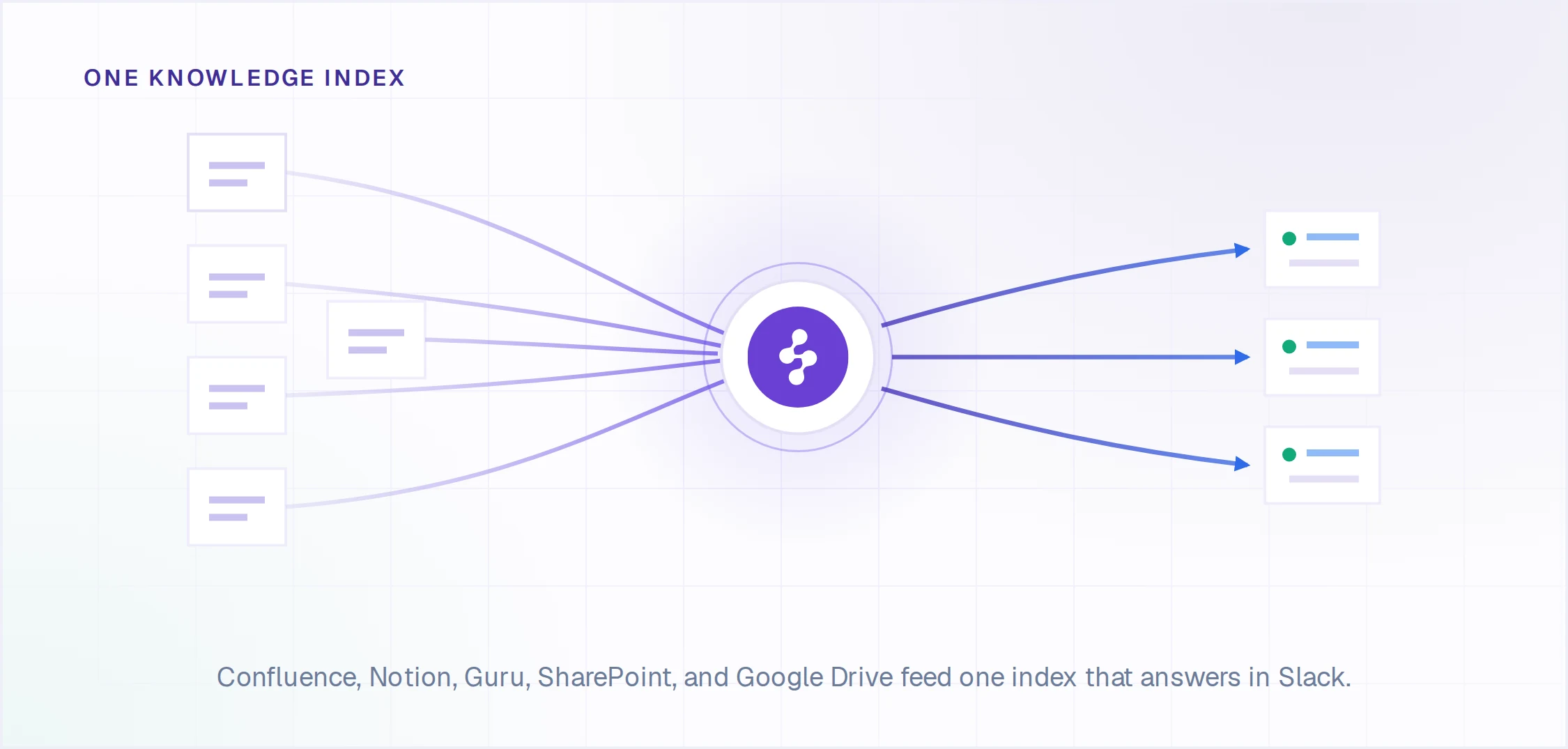
- Knowledge: one index across Confluence, Notion, Guru, SharePoint, Google Drive, web pages, uploaded files, and past tickets. Connected tools and past tickets sync daily; web pages and uploaded files are indexed once.
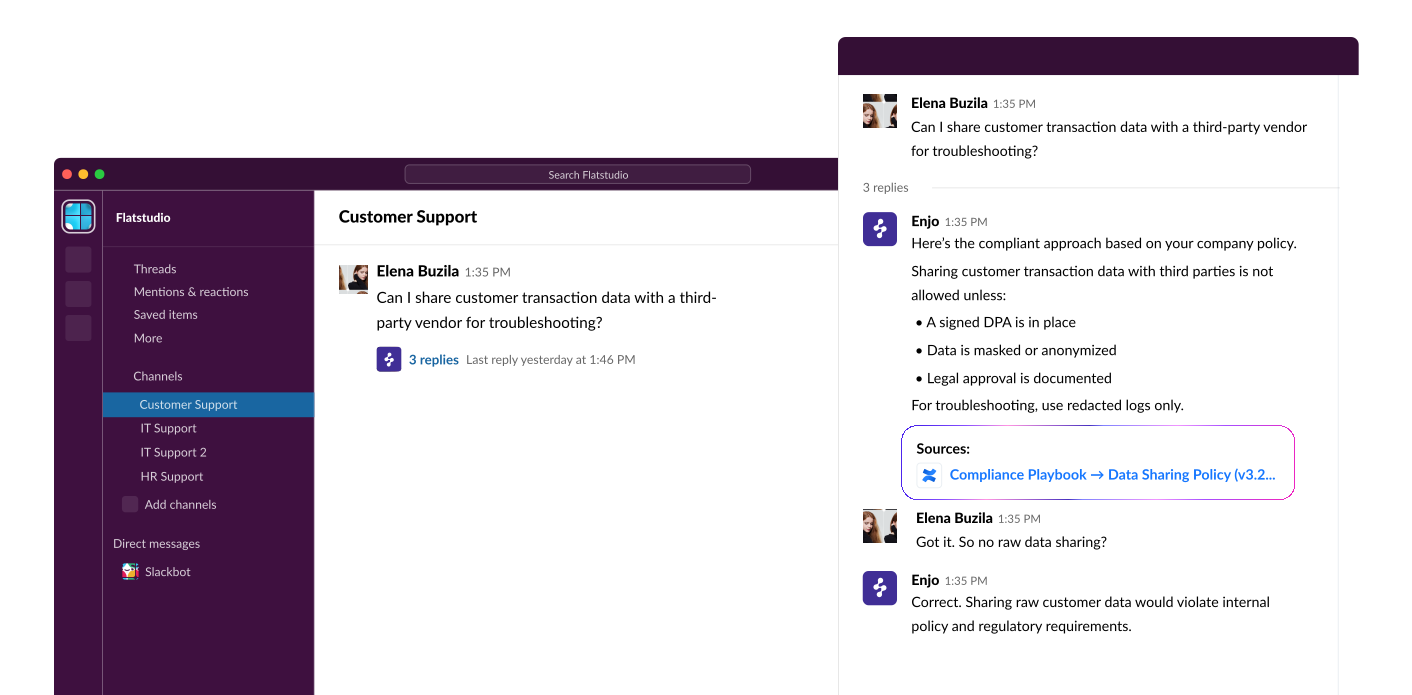
- In-channel answers: Enjo replies in the thread with the answer and a citation to the source page, so requesters verify without leaving Slack.
- Continuous learning: when your team corrects or improves an answer, Enjo learns from that response, with nothing extra to configure.
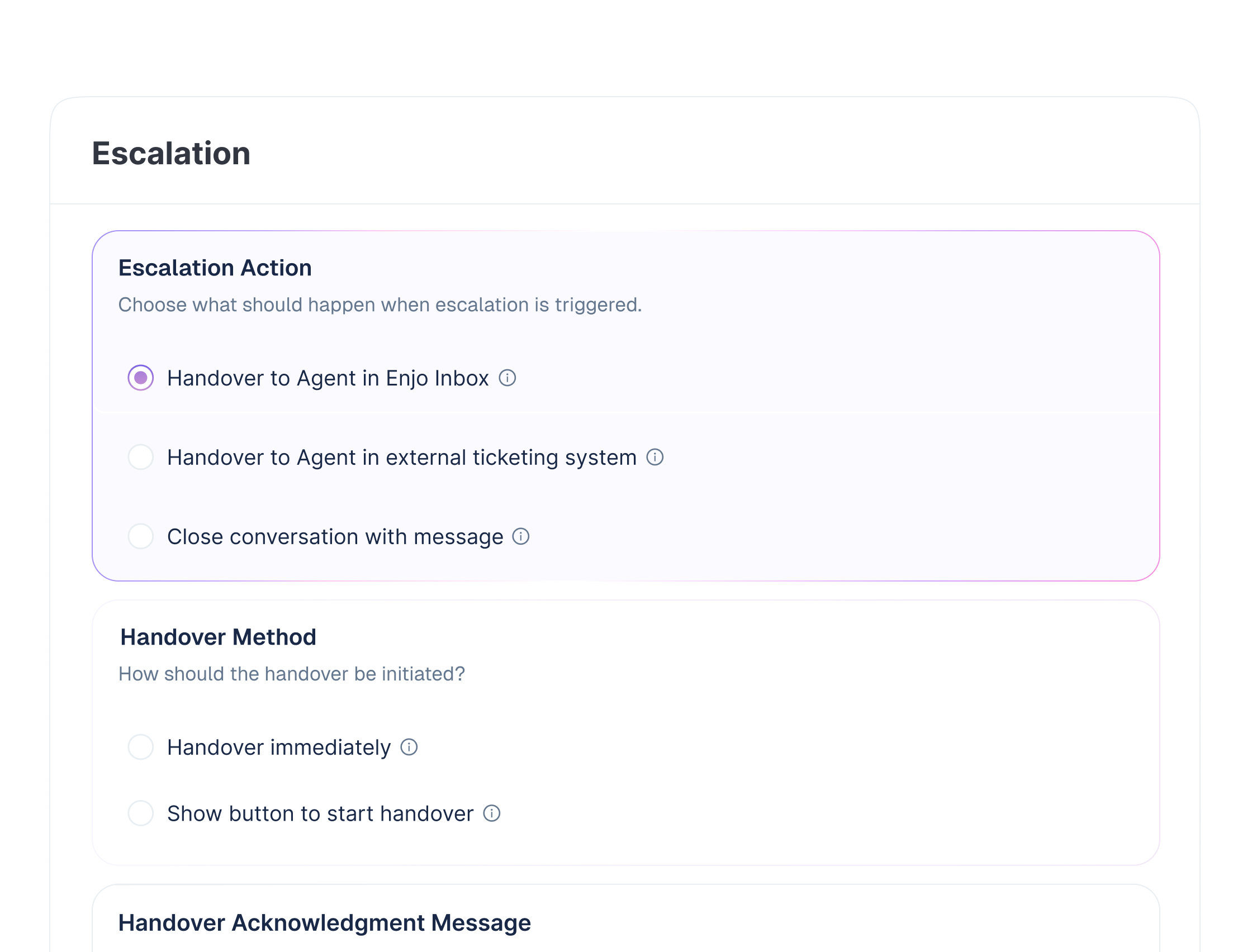
- Escalation: when Enjo cannot resolve a request, the human receives the full conversation, account context, and suggested next steps; slash commands and emoji reactions create tickets from the thread.
- Guardrails and audit log: restrictions on what the agent may answer, and a searchable history of every response.
- Insights: reports on what people asked, what went unanswered, and which documents carry the load.
- Free plan: 200 AI replies per month, unlimited human agent seats and channels, plus a shared Inbox, Help Center, and Insights, with no credit card. At the limit, requests auto-escalate to human agents, so nothing drops.
Kraken, the global cryptocurrency exchange, runs HR support this way: employees ask in Slack, Enjo answers from Confluence, and response times fell from 2 to 3 days to minutes, with 80% of employees self-serving HR queries. Paid pricing starts at $95 per month for 1,000 AI replies and scales with usage rather than seats. Start free at enjo.ai.
Where it falls short: Enjo does not replace your wiki's editor. You still author content in your wiki, or in Enjo's Answers and Help Center if you have none.
2. Slack Canvas
Slack Canvas is Slack's own document surface, a formatted page attached to a channel or DM. For a team that needs shared reference notes exactly where the conversation happens, it is the zero-setup option.
Best for: small teams documenting per-channel basics without adopting another tool.
- Channel canvases: every channel gets a canvas for norms, links, owners, and FAQs.
- Rich content: text, files, images, checklists, and link unfurls.
- Access follows Slack: visibility mirrors channel membership, with nothing separate to manage.
- Plan coverage: free teams access canvases in channels; paid teams create unlimited canvases in channels and DMs.
Pricing: included with Slack; paid Slack starts at $7.25 per user per month (Pro, annual billing), per slack.com.
Where it falls short: a canvas is a page, not a wiki. No hierarchy, no verification, no usage analytics, and nothing answers questions; people still have to open and read it.
3. Confluence
Confluence is Atlassian's wiki and the most common system of record for structured internal documentation. Its official Slack app is built for staying informed rather than for answering.
Best for: teams already inside the Atlassian stack (Jira, JSM) that want a full wiki with spaces, page trees, and permissions.
- Spaces and page trees: deep hierarchy with granular permissions per space and page.
- Native Slack app: posts notifications for new pages, edits, and comments into chosen channels, and unfurls previews of pasted links.
- Personal notifications: mentions and watched-page updates arrive as Slack DMs.
- Template library: meeting notes, decision docs, runbooks, and hundreds more.
Pricing: free forever for up to 10 users; the Standard plan is $5.42 per user per month on monthly billing, per atlassian.com, which quotes annual billing as a yearly total by user tier instead.
Where it falls short: the native Slack app does not answer questions, and search still happens inside Confluence, which is the context switch a Slack wiki exists to remove. Teams keep Confluence as the system of record and put an answering layer such as Enjo over it.
4. Notion
Notion is a flexible workspace where docs, wikis, and databases share one editor. Teams that live in Notion get a capable wiki with light Slack connectivity.
Best for: teams that want documentation and project work in one flexible tool.
- Wiki pages and databases: documentation that carries structured properties, owners, and verification dates.
- Slack notifications: database automations and page updates post into channels.
- Link previews: pasted Notion links unfurl for members with access.
- Notion AI: answers questions about workspace content inside Notion, with access varying by plan.
Pricing: free plan for individuals and small trials; paid plans start at $10 per user per month (Plus), with fuller AI access on the $20 Business plan, per notion.com.
Where it falls short: the Slack integration pushes updates out; it does not answer questions in the channel. Getting Notion content to answer in Slack requires an external layer.
5. Guru
Guru is a knowledge management platform built around trust: cards, verification cycles, and named experts who confirm content is still true. Its Slack integration is among the deepest of the standalone tools.
Best for: teams whose core problem is knowledge accuracy and expiration, especially in support and sales.
- Verification workflows: owners re-verify cards on a schedule, so readers see whether content is current.
- Slack answers: the Guru knowledge base Slack integration answers questions with cards in the channel.
- Capture from Slack: turn channel answers into reusable cards.
- Browser extension: knowledge surfaces inside the tools where work happens.
Pricing: custom. Guru no longer publishes per-seat prices and routes buyers to a sales conversation, per getguru.com.
Where it falls short: no published pricing means a procurement cycle before you can start, and the platform assumes you author knowledge in Guru's card format rather than reading your existing wiki as it stands.
6. Tettra
Tettra is an internal knowledge base designed Slack-first, with a bot called Kai that answers questions in channels and DMs from your Tettra pages. Of the standalone wikis here, it is the one built most directly around the Slack Q&A loop. Tettra is one of ten options in our comparison of internal knowledge base software, where identity-gated access separates the category from a help center.
Best for: small to mid-sized teams that want a simple wiki whose main interface is Slack itself.
- Kai bot: AI answers in DMs and channels, drawing on Tettra content.
- Question capture: unanswered questions route to knowledge experts, and their answers become pages.
- Verification: pages carry owners and freshness checks.
- Thread summarization: AI summaries of Slack threads stored as reusable knowledge.
Pricing: $8 per user per month (Scaling, annual billing) with a 10-user minimum and a 30-day trial; there is no permanent free plan, per tettra.com.
Where it falls short: the answering loop only reads Tettra. Knowledge already living in Confluence, Notion, or Google Drive has to migrate in before Kai can use it.
7. Slab
Slab is a documentation tool known for a clean editor and fast, accurate search. Its Slack app covers search and creation rather than answering.
Best for: teams that want low-friction structured docs with topic-based organization.
- Topics over folders: posts organize by topic, so one page stays findable from several paths.
- Unified search: Slab search also indexes connected tools.
- Slack search and /newpost: query the knowledge hub from Slack and create posts with a slash command.
- Update notifications: configurable Slack alerts for edits, mentions, comments, and new posts.
Pricing: free for up to 10 users; paid plans start at $6.67 per user per month (Startup, annual billing), per slab.com.
Where it falls short: no AI answering in channels. Slack usage is search and retrieve, so requesters must know to ask, and someone still fields the questions that never become searches.
8. Perfect Wiki
Perfect Wiki is a wiki built to live natively inside chat platforms, best known on Microsoft Teams and now available for Slack. The whole wiki, editing included, stays inside the chat tool.
Best for: teams that want wiki authoring and reading to happen entirely inside the chat platform.
- In-chat wiki: create, edit, and read pages without leaving the workspace.
- AI answers: a bot answers questions from wiki content.
- Import: bring content in from Confluence, Notion, or files.
- Multi-platform: Microsoft Teams, Slack, and Mattermost.
Pricing: $9 per editor per month with a 5-editor minimum on the Basic plan, billed on a 3-year term, with a 14-day trial, per perfectwikiforteams.com.
Where it falls short: the product's center of gravity is Microsoft Teams; the Slack app is newer, and the 3-year billing term on the entry plan is unusual for this category.
How to set up a Slack wiki: three routes
Match the route to the ranking from earlier: previews and notifications are cheap conveniences, and automatic answers are where the hours come back. If your organization runs on Microsoft Teams instead, the same decision tree is covered in our guide to using Microsoft Teams as a knowledge base.
Route 1: Document channels with Slack Canvas
Open the channel, click the canvas icon, and write the reference doc: owners, norms, links, top questions. Pin it, mention it in the channel description, and give every canvas one named owner so drift has a name attached. This takes an hour and is worth doing even if you adopt everything else on this page.
Route 2: Connect your wiki's native Slack app
Install your wiki's official app from the Slack App Directory (Confluence, Notion, Guru, Tettra, and Slab all have one), authenticate, and choose which spaces or pages post into which channels. You get update notifications, rich link previews, and personal mentions inside Slack; Atlassian's own documentation covers the self-hosted Confluence Data Center variant (confluence.atlassian.com). For the full Confluence walkthrough, including the Enjo option, see our Slack Confluence integration page.
Set expectations correctly: this kind of Slack knowledge base integration informs the channel, it does not answer it.
Route 3: Add an AI answer layer in one afternoon
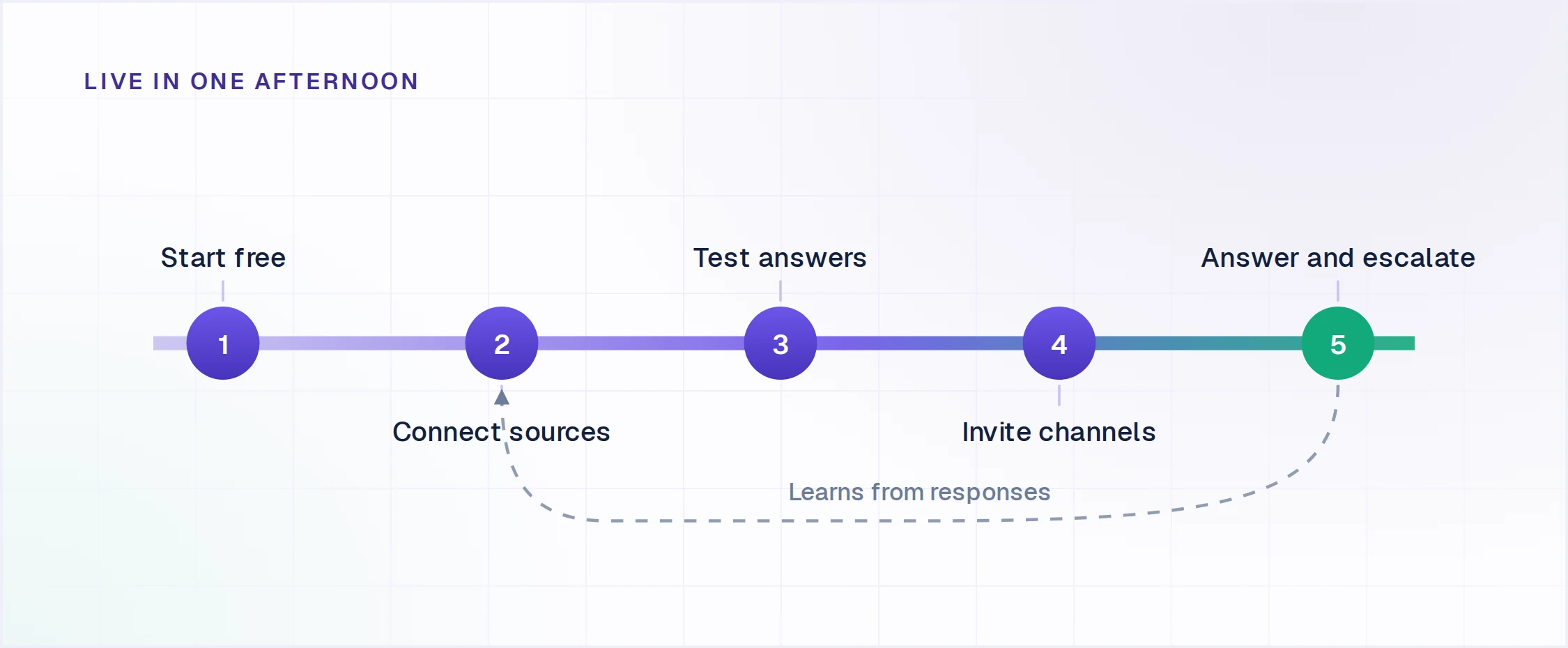
This is the route that changes the numbers, and it is a same-day job. With Enjo:
- Start free at app.enjo.ai, no credit card, and add Enjo to your Slack workspace.
- Connect sources in the Knowledge hub: Confluence, Notion, Guru, SharePoint, Google Drive, web pages, or uploaded files. Connected tools sync daily; web pages and uploaded files are indexed once.
- Test in the Playground: ask the questions your team fields weekly and check each answer and its citation.
- Invite Enjo to the channels where questions actually arrive: #it-help, #people-ops, #support.
- Let the knowledge base bot answer; when it cannot resolve a request, the escalation carries the thread with it.
Aptean, an enterprise ERP provider, took an initial cohort live in a single day, indexing the knowledge sources it already ran rather than moving them.
How Enjo turns your existing wiki into answers in Slack
Four mechanisms matter, and each maps to a named module.
One knowledge index across every source
Enjo's Knowledge module builds a single AI knowledge base index across Confluence, Notion, Guru, SharePoint, Google Drive, past tickets, and uploaded files. One index means zero drift: what the agent answers in Slack matches what a human agent sees and what self-service surfaces. Your Slack knowledge base stops being one more thing to maintain; it is a live view over what you already have.
Grounded answers with citations in the channel
Every answer is grounded in your knowledge, with a citation, so the requester opens the source page straight from the thread. Guardrails restrict what the agent may answer, and the audit log records every response for review. Before launch, Bulk Testing runs your real question patterns against the index, so you see accuracy before your team does.
Escalation that hands humans full context
When Enjo cannot resolve a request, the human receives the full conversation, account context, and suggested next steps rather than a bare ticket. From Slack, slash commands and emoji reactions create and update tickets without leaving the thread. BookMyShow runs internal support this way across Slack and Jira, with 100% ticket capture and zero manual ticket creation.
Insights that keep the wiki from going stale
Stale content is the failure mode that kills wikis, and it stays invisible until something measures it. Enjo's Insights reports show which questions went unanswered, which documents carry the most load, and where requesters gave up, turning Slack knowledge management into a feedback loop: gaps surface as a to-do list for your writers. Combined with continuous learning from your team's corrections, the wiki improves because it is being used.
Enjo is SOC 2 Type II, ISO 27001, and GDPR compliant, and it is built by Troopr Labs, which has 600+ enterprise deployments and 99.9% uptime over 7 years across its products.
How to choose: Canvas vs native integration vs AI layer
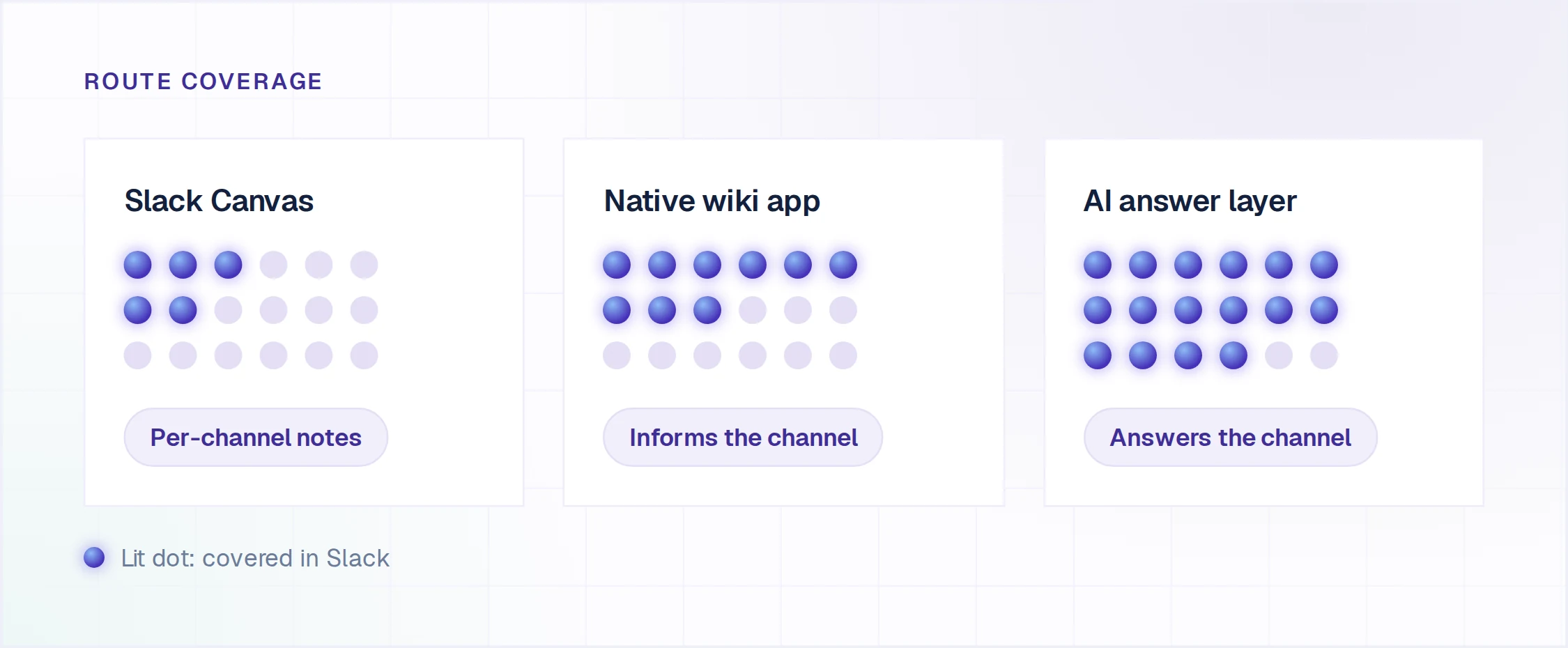
Six questions settle it. Where do questions arrive (if the answer is Slack, weight in-channel answering heavily)? Does content need structure and permissions (spaces, trees, and roles point to a full wiki)? Must answers arrive without a human (only an AI layer does this)?
Then the operational three. How will you catch stale content (verification workflows or usage analytics)? What does the pricing model punish (per-seat pricing grows with headcount, usage pricing grows with volume)? How fast does it need to be live (a canvas is an hour, a wiki migration is a quarter, an AI layer over existing content is a day)?
The honest verdicts: a 15-person team with light documentation needs canvases and nothing else. A documentation-heavy engineering org committed to Atlassian should run Confluence and accept that answering in Slack needs a layer on top. A team fielding the same questions daily in #it-help should put the AI layer over whatever wiki exists today, because that volume is where Slack knowledge management pays for itself.
Get your Slack wiki answering this week
The order of operations that works: write the canvas for each busy channel today, keep your wiki where it is, and put an answering layer over it before the next sprint. Enjo connects to your sources in an afternoon, answers in-channel with citations from day one, and the free plan, with 200 AI replies a month and no credit card or procurement cycle, is enough to prove it on your real questions.

Frequently asked questions
Is Slack Canvas a wiki?
Partly. A canvas works as the reference doc for one channel, and free teams can use canvases in channels. It lacks what defines a wiki: hierarchy across topics, permissions depth, verification, and usage analytics. Small teams can run on canvases alone; most organizations pair them with a dedicated knowledge base. If the incumbent is GitBook rather than Slack canvases, our roundup of GitBook alternatives covers the help-center angle.
Can I use Slack itself as a knowledge base?
Yes, with limits. Pinned messages, canvases, and searchable history make Slack a workable knowledge store for a small team, and past Slack conversations can even ground an AI agent's answers. Structure, permissions, and versioning eventually demand a real wiki; our guide to setting up a Slack knowledge base covers that approach in full.
What is the best wiki for Slack?
It depends on where your content lives. If you already run Confluence, Notion, or Guru, keep it and add an answering layer like Enjo rather than migrating. If you are starting from zero and want Slack-first, Tettra is built for exactly that. If you only need per-channel notes, Slack Canvas is free and immediate.
Can AI answer questions from my Confluence or Notion wiki in Slack?
Yes. Enjo connects Confluence, Notion, Guru, SharePoint, and Google Drive into one index and answers questions in Slack channels with a citation to the source page. Slack's own AI does not do this; it reads content inside Slack, not your external wiki.
How much does a Slack wiki cost?
Slack Canvas costs nothing beyond your Slack plan. Standalone wiki tools run per user: Confluence from $5.42, Slab from $6.67, Tettra from $8, and Notion from $10, all per user per month. Slab, Tettra, and Notion quote those rates on annual billing; Confluence's $5.42 is its monthly rate. Enjo prices by usage instead: free for 200 AI replies a month, then from $95 per month, with unlimited human agent seats.