Transform complex support workflows
Benefits of AI Support Agents: 4 Deployments, Real Numbers
Most articles on the benefits of AI support agents list adjectives. Faster. Cheaper. Always available. Almost none attach a number to the claim, which makes them impossible to budget against.
This one uses figures from four live deployments: Aurora, Kraken, Delivery Hero and Aptean. Where a benefit has no measurement behind it, we say so rather than padding the list.
The benefits of AI support agents land in three places: cost, speed and the people you keep. Start free at enjo.ai to measure them on your own queue.
.png)
The Numbers, Before the Argument
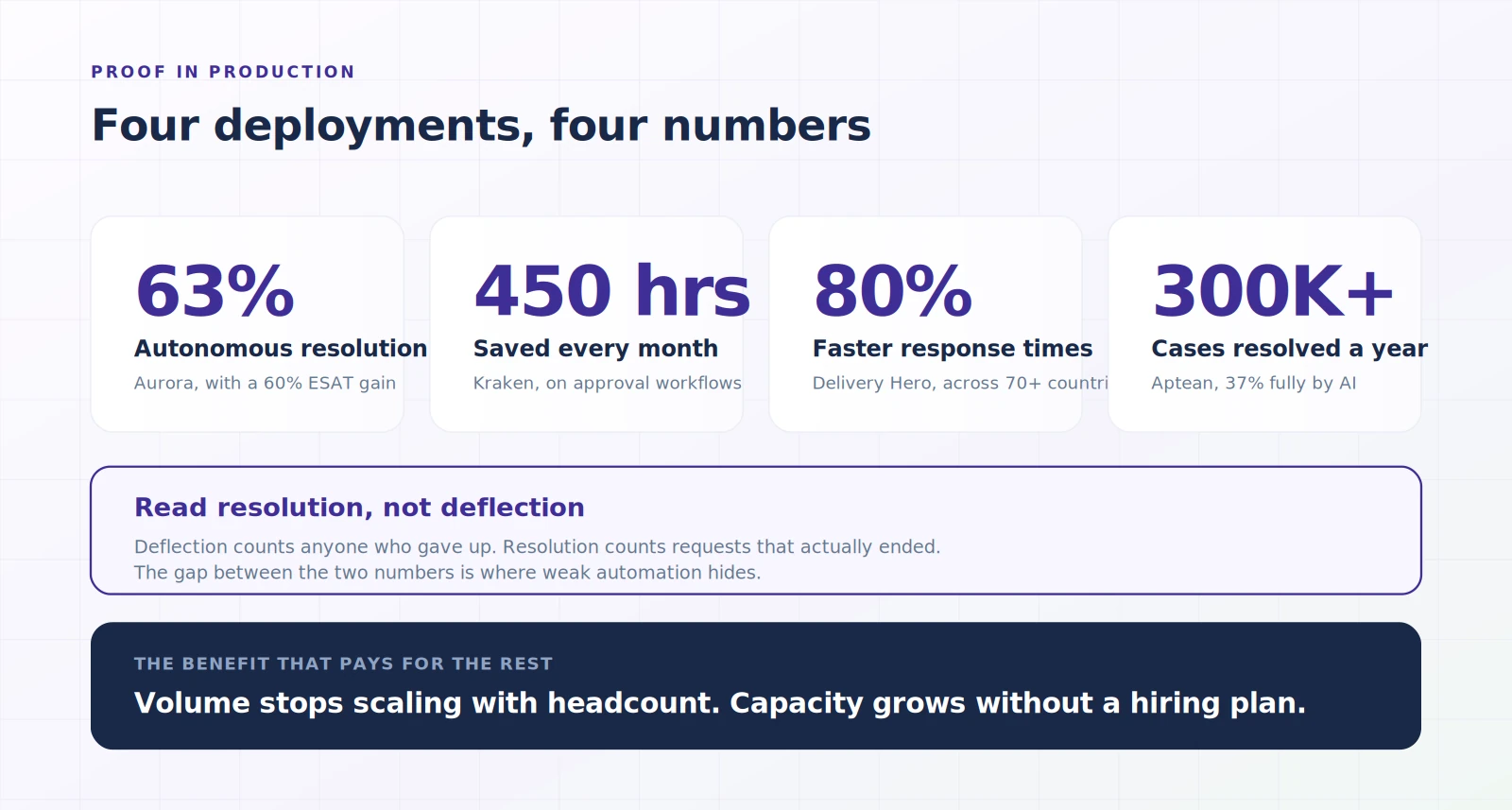
Four deployments, four different shapes of return.
Aurora, a 2,500-employee autonomous vehicle company, reached 63% autonomous resolution across frontline requests, alongside a 60% ESAT improvement and 45% faster resolution.
Kraken automated approval workflows and saves 450 hours a month. Response times fell from two to three days down to minutes, and 95% satisfaction was reached with 80% of requesters self-serving their queries.
Delivery Hero runs support across 70+ countries and multiple languages without region-specific teams, seeing 30% deflection, a 25% employee satisfaction lift and 80% faster response times.
Aptean, an ERP provider with 600+ support reps, resolves 300K+ cases a year, 37% of them fully by AI, having indexed 5M+ documents across Salesforce case feeds, knowledge bases and SharePoint.
One caution on reading these. Deflection and resolution are different numbers. Deflection counts anyone who stopped asking, including the people who gave up. Resolution counts requests that actually ended. Delivery Hero's 30% is deflection; Aurora's 63% is resolution. Track both, and treat a widening gap between them as a warning.
Where the Value Lands
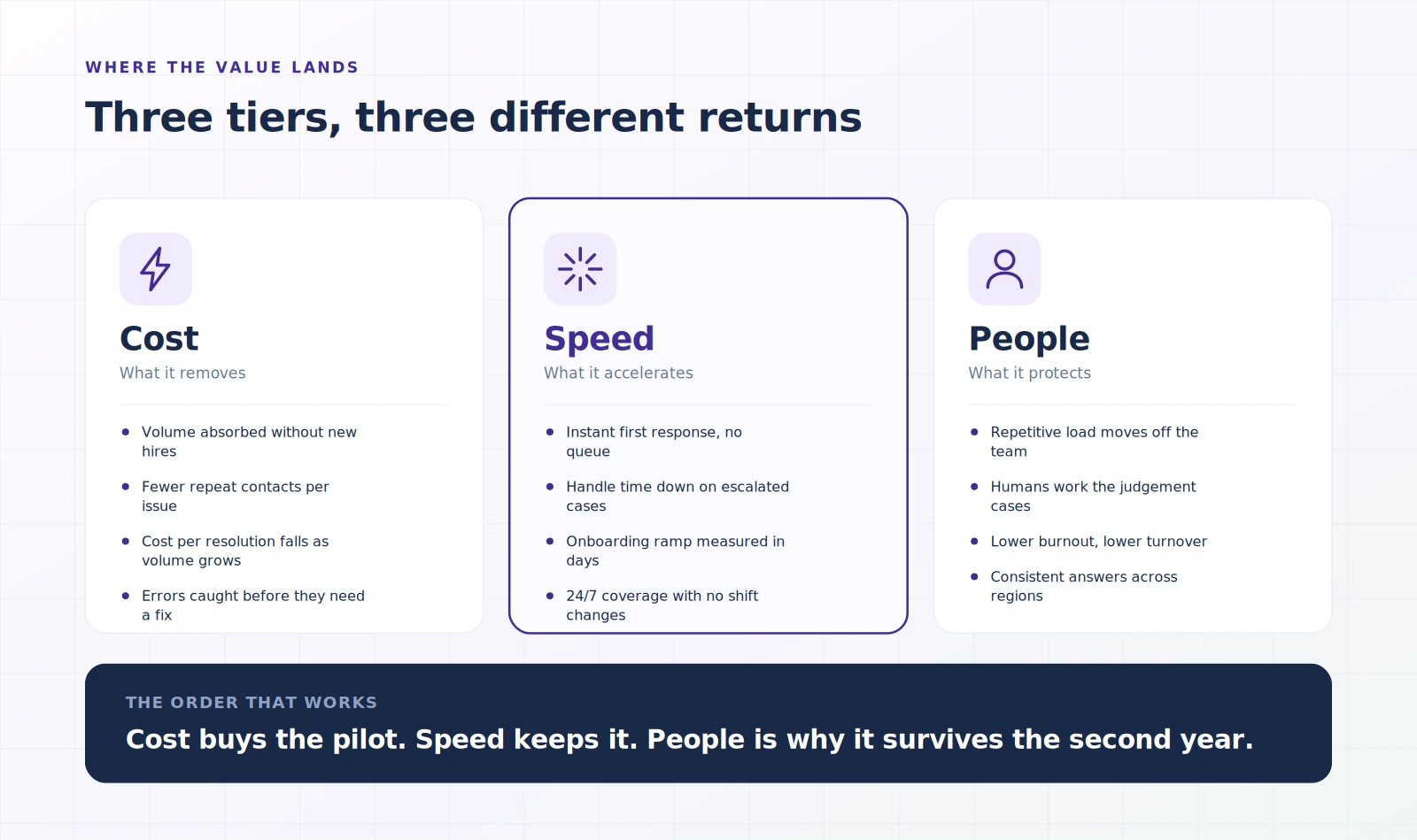
The returns fall into three tiers, and they arrive in a predictable order.
Cost: What It Removes
Capacity stops scaling with headcount. This is the benefit that pays for the others. Support volume grows with every customer you add; the team answering it does not have to. Aptean handles volume equivalent to 120 agents through AI, which is a capacity statement rather than a headcount one.
Cost per resolution falls as volume grows. Usage-priced automation changes the maths structurally, because capacity stops being tied to seats. Once the system is configured, the marginal cost of the next routine ticket is a fraction of a human hour.
Errors get caught before they need fixing. Billing mistakes, misrouted requests and missed follow-ups are expensive to correct downstream. Consistent handling reduces the rework that never appears on a support dashboard.
What to measure: cost per resolution with platform costs included, not labour savings alone. Our guide to customer service KPIs covers the framework to agree before deployment.
Speed: What It Accelerates
First response goes to zero wait. Requests get an answer immediately rather than a queue position, at any hour and in any timezone. Kraken went from two to three days down to minutes.
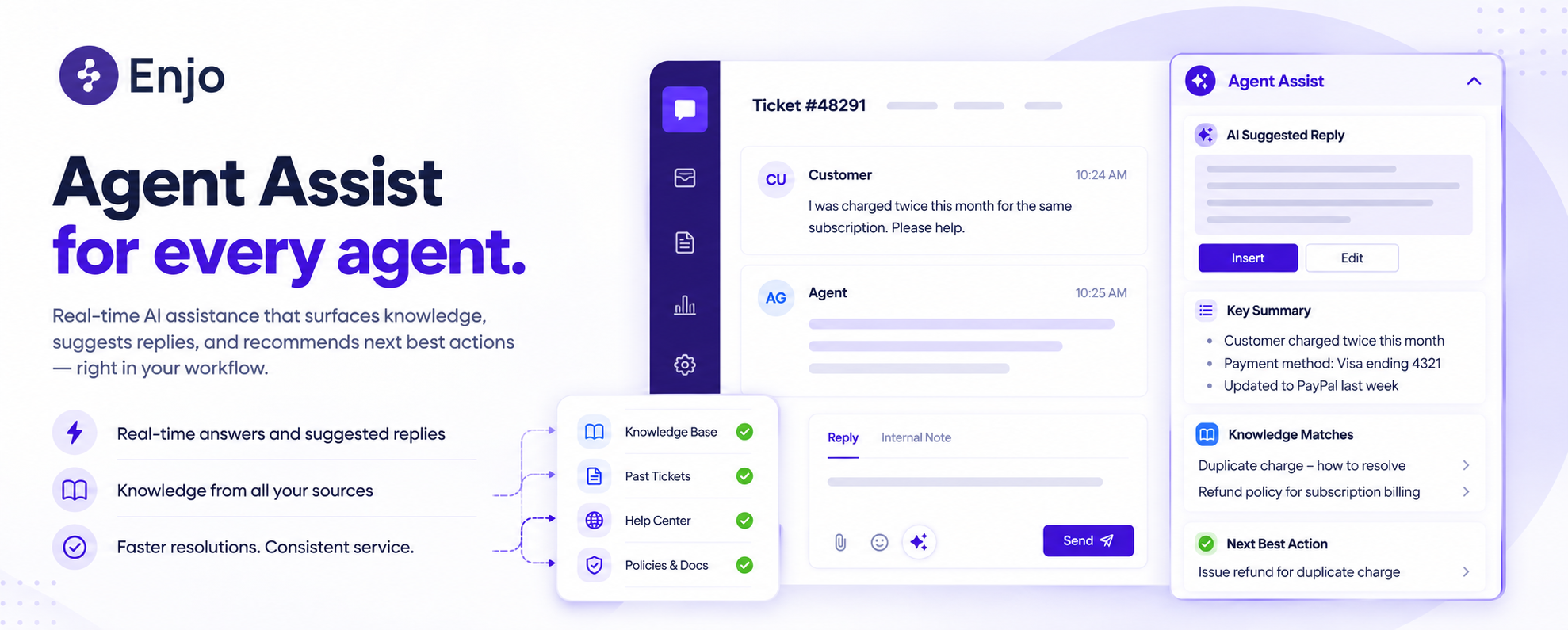
Handle time drops on the cases humans still take. Agent Assist surfaces a case summary, a drafted reply and the relevant knowledge inside the agent's existing ticket view, so the work is reviewing rather than researching and retyping.
Onboarding ramps in days, not weeks. New hires work live tickets with guided context and suggested answers instead of shadowing. This is the quiet benefit that rarely makes a vendor deck and shows up clearly in a team's second quarter.
Deployment itself is faster than the category implies. Aptean took its initial cohort live in a single day. Amber Group reached full production in five weeks.
People: What It Protects
The repetitive load moves off the team. Volume framing matters here: AI absorbs the requests that repeat so humans work the cases that need judgement. Aptean's figure is volume equivalent to 120 agents handled by AI, which is a capacity measure rather than a headcount one.
Burnout and turnover fall. Password resets and "where is my order" questions are the work that drives people out of support. Removing them is a retention lever, and retention is expensive to lose.
Quality holds steady across shifts, regions and languages. Every agent works from the same grounded knowledge rather than personal memory, so a customer in Singapore gets the answer a customer in London gets. Delivery Hero runs this across 70+ countries with no region-specific team.
Escalation stops being a restart. When AI cannot resolve a request, the human receives the full conversation, the account context and the suggested next steps, rather than a blank ticket. How often a human has to restart a conversation the AI began is the truest measure of handoff quality.
The Benefits That Need a Caveat
Not every claimed benefit holds up equally, and the honest version of this list includes the conditions.
Personalization depends on data access. An agent that cannot read the account record cannot personalize anything. The benefit is real and it is conditional on integration depth.
Analytics only help if someone reads them. Every automated interaction generates signal about knowledge gaps and process failures. That signal is worth nothing sitting in a dashboard nobody opens on a Monday.
Continuous improvement is a mechanism, not a promise. Systems improve from the feedback they receive, which means the feedback loop has to be designed as deliberately as the automation is. Point one of these tools at stale content, and it will surface stale answers faster.
Security benefits cut both ways. Anomaly detection and audit trails are genuine advantages, but they exist only if the platform enforces role-based access and logs every action. Ask for the evidence rather than the claim. Enjo runs on SOC 2 Type II, ISO 27001, and GDPR compliance.
Where the Benefits Land First
AI support agents deliver first where volume is high and the resolution is rule-bound.
Customer service starts with order status, delivery updates and returns. IT service starts with password resets, software access and VPN issues, which is where Aurora's 63% came from. HR service starts with policy questions, leave requests, and onboarding tasks.
The pattern is the same across all three: pick one high-volume, well-defined request type, measure autonomous resolution on it, and expand on evidence. Our customer service automation guide covers the sequencing in full, and the AI support agents guide covers how the agents themselves work.
How to Measure Any of This
Agree on the metrics before deployment, or the results will be argued about afterward.
Resolution rate is the headline metric: the share of requests the AI resolved end to end, with no human touch and no customer bounce-back. Deflection rate is not the same number, and the gap between the two is where bad automation hides. For the sourced figures worth benchmarking against, see our roundup of customer service statistics for 2026. Cost per resolution with platform costs included. Escalation quality, measured by how often a human restarts a conversation. And satisfaction measured separately for AI-resolved and human-resolved requests, because blending them hides problems in both directions.
Establish a baseline before you switch anything on. Without it, every number above is unprovable on your own queue. The top customer service metrics breakdown covers which ones actually move.
Start With One Request Type
The benefits in this article came from teams that started narrow and expanded on evidence, not from broad rollouts. Pick the request type your team answers most often, measure autonomous resolution on it, and add the next one when the number holds.
Enjo has a permanent free tier with 200 AI Replies a month and unlimited seats, which is enough to test one request type end to end before any procurement conversation.
Frequently Asked Questions
What are the main benefits of AI support agents?
Cost, speed, and retention. Capacity stops scaling with headcount, first response drops to no wait, and the repetitive load moves off the team so people work the cases that need judgment. In production, Aurora reached 63% autonomous resolution, and Kraken saves 450 hours a month.
Do AI support agents reduce costs?
Yes, though the mechanism matters more than the headline. Cost per resolution falls because capacity stops being tied to seats, so volume growth does not require proportional hiring. Model platform costs into the calculation rather than counting labor savings alone.
What is the difference between deflection and resolution?
Deflection counts anyone who stopped asking, including people who gave up. Resolution counts requests that actually ended with an answer and no bounce-back. A dashboard can report high deflection while customers quietly churn, so track both and treat a widening gap as a warning.
Do AI support agents replace human agents?
No. AI absorbs the repetitive volume so humans handle the cases that need judgement. Aptean's figure is volume equivalent to 120 agents handled by AI, which is a capacity measure, not a headcount reduction.
How long before the benefits appear?
Faster than the category implies when the knowledge already exists in connected sources. Aptean took its initial cohort live in a single day and Amber Group reached full production in five weeks. Teams that start with one high-volume request type see a measurable resolution rate within the first weeks.
How do you measure the benefits of AI support agents?
Resolution rate, deflection rate, cost per resolution with platform costs included, escalation quality, and satisfaction measured separately for AI-resolved and human-resolved requests. Establish a baseline before deployment or none of it is provable.