Launch your AI Help Centre in minutes
Get it now


.svg)
This guide covers the 10 best AI customer support software platforms for B2B teams in 2026. Learn pricing, honest limitations & which fits your helpdesk.
Choosing AI customer support software in 2026 means asking which platform fits your stack, resolves tickets end-to-end, and avoids a per-resolution billing cliff as volumes grow. The category now spans free-tier platforms that go live in a day and enterprise contracts that start at $150,000 a year. Picking the wrong one means a locked knowledge layer, a helpdesk you cannot leave, or an implementation that outlasts your Q3 roadmap.This guide covers the 10 best AI customer support software platforms for B2B teams in 2026. Learn pricing, honest limitations & which fits your helpdesk.
This assessment is shaped by six key criteria, each representing a question that every customer service leader faces before wrapping up an evaluation of AI vendors.

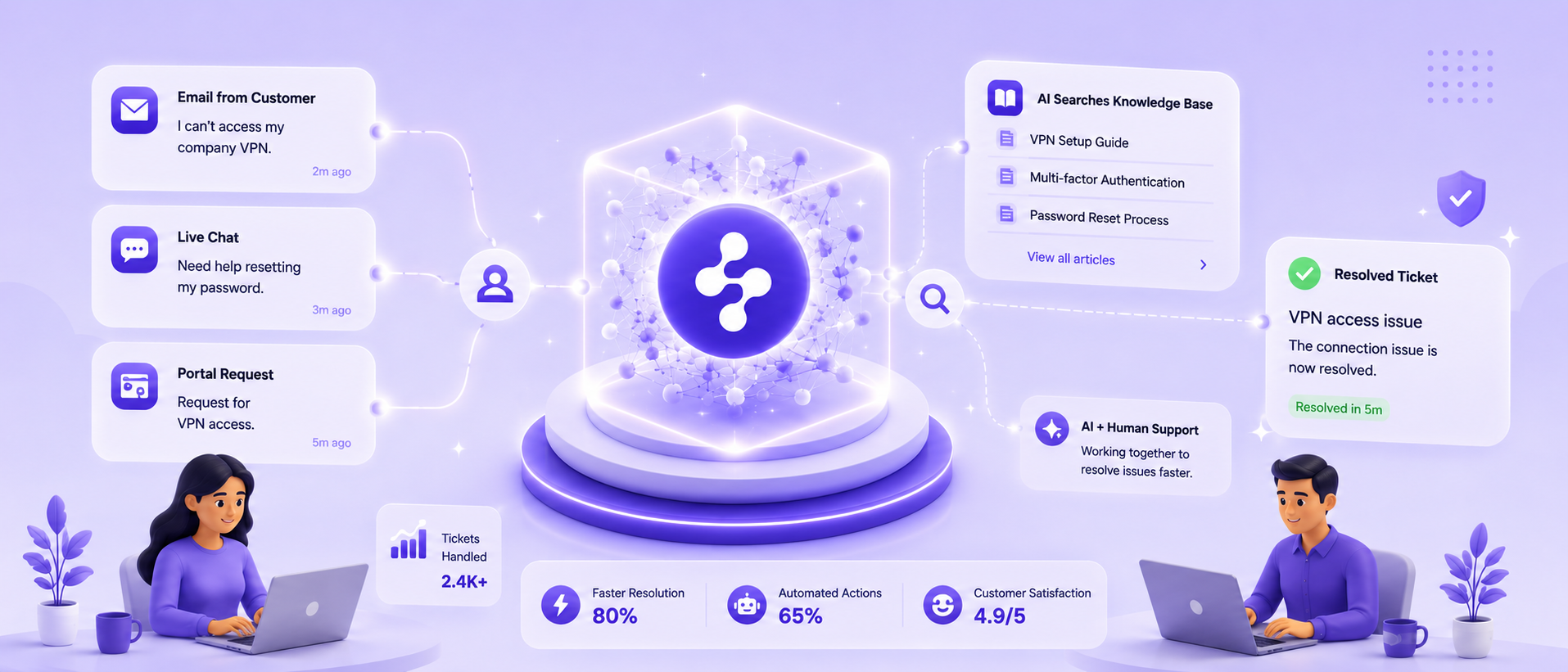
What it is: Enjo is an AI-native customer support software platform for B2B teams. An AI Agent resolves requests end-to-end across email, chat, web, Slack, and Teams. When a request requires a human, the AI escalates it to your existing helpdesk or Enjo Inbox, with the full conversation attached, so human agents can pick up where the AI left off. For a deeper look at how this works, see our guide to AI support agents.
Best for: B2B CS teams on Salesforce, Zendesk, Jira, or ServiceNow whose knowledge spans multiple systems (Confluence, SharePoint, Google Drive, past tickets) and who need AI customer support software that does not require helpdesk migration.
How it works as AI customer support software:
Pricing: Free: $0/month, 200 AI Replies/month, unlimited human agent seats, no credit card. Starter: $95/month, 1,000 AI Replies. Standard: $295/month, 3,000 AI Replies. Enterprise: custom. Overages on paid plans: $0.05 per AI Reply. Unlimited human agent seats on every plan. See full plan details at enjo.ai/pricing.
Customer proof: Aptean (enterprise ERP, 3,500+ employees, CS vertical) deployed Enjo in a single day. 2M+ documents indexed. AI handles the equivalent of 120 agents across 200,000+ requests per year. 80%+ reduction in information retrieval time.
Where it falls short: Enjo's CS vertical launched in 2026. IT and HR deployments are more mature at 600+ enterprise deployments. The CS case study portfolio is at an earlier stage. Teams requiring a mature voice channel should evaluate platforms with longer track records in voice before committing.
What it is: Fin is Intercom's AI customer support software agent, built on and optimized for the Intercom platform. It can also run as a standalone AI agent on other helpdesks (Zendesk, Salesforce, HubSpot, Freshworks) without requiring a full Intercom subscription.
Best for: B2C SaaS and consumer teams already standardized on Intercom, or teams running high-volume deflection where Intercom's messaging UX is the right fit.
How it works as AI customer support software:
Pricing: $0.99 per outcome. Standalone (non-Intercom stack): $49.50/month minimum (50 outcomes). Inside Intercom: requires at least one paid seat ($29–$139/seat/month depending on plan). Copilot add-on: $35/user/month. At 2,000 monthly outcomes, AI fees alone reach approximately $1,980/month before seat costs. To check the latest pricing, visit fin.ai/pricing.
Where it falls short: The full feature set requires Intercom as the helpdesk platform. Per-resolution billing scales steeply at B2B request volumes. B2B-grade context (Slack Connect, complex multi-system approval workflows, cross-system knowledge ingestion) is more limited than on platforms built for B2B environments. Knowledge sources are largely limited to the Intercom knowledge base, with no significant custom setup. Teams evaluating alternatives can compare options in our guide to Intercom alternatives.
What it is: Agentforce is Salesforce's native AI customer support software, built directly on and bound to the Service Cloud platform. It is the natural path for enterprises fully committed to Salesforce as their single system of record for customer data and actions.
Best for: Enterprise CS teams fully standardized on Salesforce Service Cloud with no requirement to ingest knowledge or execute actions outside the Salesforce ecosystem.
How it works as AI customer support software:
Pricing: Approximately $2.00 per conversation for enterprise deployments. Enterprise contracts required; no self-serve entry point. (To check the latest pricing, visit salesforce.com/agentforce/pricing.
Where it falls short: Knowledge is locked to the Service Cloud data model; ingesting Confluence, SharePoint, or Google Drive requires significant custom development. Actions outside Salesforce-native objects need custom API work. Most expensive per-unit pricing in the AI customer support software category. 'Resolved conversation' is defined by Salesforce's own logic, which creates billing unpredictability at high volumes per enterprise user reviews.
What it is: Zendesk AI is the native AI customer support software layer built into the Zendesk helpdesk suite. The March 2026 acquisition of Forethought (Zendesk's largest deal in two decades) added self-improving agentic AI and autonomous workflow execution to the Resolution Platform.
Best for: Teams fully standardized on Zendesk Suite with no cross-system knowledge or action requirements, and teams where single-vendor consolidation is the primary buying criterion.
How it works as AI customer support software:
Pricing: Approximately $1.50 per automated resolution. AI agents are included on the Suite Team plan ($55/agent/month) and above; the Support Team plan ($19/agent/month) does not include AI agents. All Suite plans include a baseline resolution allowance; overages are billed at the per-resolution rate. Tiered resolution pricing was introduced in May 2026. To check the latest pricing, visit zendesk.com/pricing.
Where it falls short: Knowledge ceiling is Zendesk's own knowledge base; ingesting Confluence, SharePoint, or Google Drive requires custom development. Actions are limited to Zendesk objects and do not include custom API work. AI investment does not travel if the helpdesk ever changes. Per-resolution billing definition is Zendesk-set, creating unpredictability at high volumes. The Forethought integration is recent; full capability rollout is still in progress as of June 2026.
What it is: Ada is an enterprise AI customer support software platform with a CS-only focus. Its Reasoning Engine handles multi-step workflows across chat, messaging, and voice, connecting to backend systems via Playbooks to take actions on customer data without hardcoded scripting.
Best for: Large consumer-brand CS teams at high volume (retail, DTC, financial services) with at least 300,000 annual customer service conversations and a budget for a contract-first engagement.
How it works as AI customer support software:
Pricing: No public pricing. To get an exact quote, visit ada.cx.
Where it falls short: CS-only; no multi-vertical consolidation for teams also running IT or HR automation on the same platform. No self-serve entry point or free tier. Pricing opacity makes budget planning difficult during the evaluation process. Trustpilot reviews (2.0/5) flag context loss between conversation turns as a recurring complaint. The $30K+ entry point effectively excludes mid-market CS teams evaluating self-serve options.
What it is: Freddy AI is Freshworks' native AI customer support software layer across its Freshdesk (customer support) and Freshservice (IT) suites. It covers triage automation, reply drafting, and deflection within the Freshworks ecosystem as part of the full helpdesk package.
Best for: Mid-market teams pursuing single-vendor consolidation onto the Freshworks suite, or teams moving off Zendesk or Intercom who want AI customer support software included in the helpdesk tier fee rather than billed per resolution.
How it works as AI customer support software:
Pricing: Growth: $15/agent/month. Pro: $49/agent/month. Enterprise: $79/agent/month. Freddy AI capabilities scale with tier. To check the latest pricing, visit freshdesk.com/pricing.
Where it falls short: Same ceiling as any helpdesk-native AI customer support software: knowledge and actions stay inside the Freshworks ecosystem. Cross-system actions (Okta, Jira, Salesforce, custom APIs) require custom development. Teams whose knowledge lives in Confluence or SharePoint will quickly hit limitations. Does not embed as an agent-assist plugin within third-party help desks.
What it is: Decagon is an enterprise AI customer support software platform founded in 2023, valued at $4.5 billion in January 2026 following a $250 million Series D. It builds AI agents for high-volume complex customer service across chat, email, voice, and SMS, with clients including Notion, Duolingo, Rippling, Chime, and Deutsche Telekom.
Best for: Enterprise CS teams with complex multi-step workflows in regulated industries (fintech, insurance, telecom) where resolution depth, auditability, and voice parity matter more than time-to-value or pricing transparency.
How it works as AI customer support software:
Pricing: No public pricing. To get an exact quote, visit https://decagon.ai.
Where it falls short: No self-serve entry point, no free tier, no published pricing. Requires a separate helpdesk for human-agent workflows, adding $55–$175+/agent/month to the total cost. White-glove onboarding means a longer time to production. Enterprise-only positioning effectively excludes mid-market CS teams evaluating AI customer support software this quarter.
What it is: Sierra is an enterprise AI customer support software platform founded in 2023 by Bret Taylor (former Salesforce co-CEO) and Clay Bavor (former VP at Google). It reached $150 million ARR by early 2026 and raised a $950 million Series C at a $15.8 billion valuation in May 2026, with clients including Roku, Panasonic, Urban Outfitters, Rocket Mortgage, and SoFi.
Best for: Fortune 500 CS teams that prioritize conversational depth and voice AI quality as primary selection criteria, where a Year-1 budget of $150,000–$350,000+ and a multi-month implementation timeline are acceptable.
How it works as AI customer support software:
Pricing: No public pricing. To get an exact quote, visit https://sierra.ai.
Where it falls short: No self-serve entry point, no published pricing, no free tier. Year-1 cost puts Sierra out of reach for most mid-market CS teams evaluating AI customer support software. Significant implementation overhead. Requires a separate helpdesk for human agent workflows. Pricing opacity means most CS leaders use Sierra as a benchmark for evaluation rather than as a first-deployment choice.
What it is: Tidio is an AI customer support software platform for SMBs and e-commerce teams. Its AI agent, Lyro, automates customer queries using website content and help articles, deflecting repetitive questions before they reach a human agent. Over 300,000 businesses use Tidio globally.
Best for: Small to mid-sized e-commerce businesses, D2C brands, and SMBs looking for accessible AI customer support software with a transparent low entry price and a quick setup that requires no dedicated technical resources.
How it works as AI customer support software:
Pricing: Free: 50 Lyro AI conversations total (not per month). Starter: $29/month (100 conversation base). Growth: $59–$349/month depending on conversation volume. Lyro AI add-on: from $39/month for 50 AI conversations; required for ongoing AI beyond the free cap. AI plus automation in practice costs $105–$150/month at typical SMB volumes. Plus plan (unlimited AI included): $749/month. To check the latest pricing, visit tidio.com/pricing.
Where it falls short: Tidio is built for SMB and e-commerce; the CS Leader persona at mid-market to enterprise B2B will quickly hit its ceiling. AI (Lyro) is a paid add-on, not included in base plans, meaning advertised prices understate real cost. Self-serve plans cap at 10 agent seats. Knowledge sources are limited to website content and help articles; it cannot ingest Confluence, SharePoint, or multi-system ticket history. No SOC 2 Type II or ISO 27001 certification confirmed for enterprise compliance requirements.
What it is: Kore.ai is an enterprise AI customer support software platform built on its XO (Experience Optimization) Platform. It combines traditional intent-based automation with generative AI through a technology-agnostic architecture that lets organizations choose their preferred LLM, NLU, and speech providers. Clients include Morgan Stanley, Pfizer, and Coca-Cola.
Best for: Fortune 500 organizations in regulated industries (financial services, healthcare, pharma) that need AI customer support software with deep customization, multi-LLM flexibility, and enterprise-grade multi-channel orchestration, and where procurement complexity is not a constraint.
How it works as AI customer support software:
Pricing: No public pricing. To get an exact quote, visit https://www.kore.ai/.
Where it falls short: Session-based 15-minute billing leads to unpredictable costs in high-engagement support scenarios. Upgrade paths from earlier XO versions are complex; teams with legacy bots face migration overhead. No self-serve entry point or free tier. Implementation complexity is high; this is not a platform for teams that need AI customer support software to go live in weeks. Per-session pricing is harder to forecast than per-resolution or per-AI-Reply models.
The right AI customer support software depends less on feature lists and more on two questions: what helpdesk does your team actually live in, and where does your knowledge actually live?
Already on Salesforce, weighing Agentforce. Agentforce is a straightforward choice if your knowledge and actions are all within Service Cloud. However, if your knowledge is scattered across Confluence, SharePoint, or past tickets from different systems, or if you need to integrate with tools like Okta, Jira, or custom APIs, you might hit some limitations with Agentforce pretty quickly. On the other hand, Enjo operates within Salesforce Cases through Agent Assist and can pull knowledge from various sources. If you’re looking for a standalone option, Fin works on Salesforce at just $0.99 per resolution, especially if your main goal is to reduce the number of inquiries.
For those fully committed to Zendesk and not needing to connect with other systems. Zendesk AI is the way to go with minimal integration hassle. The recent acquisition of Forethought adds even more depth for agents. If your knowledge and actions are contained within Zendesk, sticking with the native solution is the simplest route. But if they aren’t, you might find limitations cropping up during your first major workflow. Teams that need cross-system capability on top of Zendesk can explore Enjo for Zendesk.
If you’re in a B2C, high-volume environment and already using Intercom, Fin is tailored for you. Its per-resolution pricing model works well when deflection rates are high, and the B2C messaging experience is well developed. However, the economics can get tricky if your resolution rate drops below 50% or if you need B2B-level context.
For teams dealing with multi-system knowledge in a B2B setup, especially if you plan to consolidate IT and HR automation later, Enjo is a great fit. It provides a single knowledge layer that integrates with whatever systems your team is already using. Agent Assist can be embedded right into your existing helpdesk, and when you’re ready to automate IT and HR, you won’t need to bring in a second vendor. For a broader view of how this works, see our guide to customer service automation.
Finally, if you’re dealing with complex enterprise workflows and budget isn’t a concern, you might want to look at Decagon or Sierra. Both are geared towards enterprise use, have unclear pricing, and require a significant implementation effort. However, Sierra’s conversational capabilities and high-quality AI voice make it a popular choice among enterprises, even with a starting cost of over $150K in the first year.
If you're part of an SMB or e-commerce team looking to get started on a tight budget, Tidio is a great place to start. Just keep in mind the costs associated with the AI add-on and the 10-seat limit on self-serve plans. If you anticipate your team will outgrow Tidio within a year, it might be wise to consider AI customer support software with a free tier and no seat cap from the get-go, such as Enjo Free, to avoid the hassle of migrating later. See free customer service software options for a full comparison.
For Fortune 500 companies in regulated industries that need flexibility with multiple LLMs, Kore.ai is the way to go. The XO Platform's tech-agnostic setup and extensive enterprise NLU capabilities make the procurement process worthwhile for organizations that face compliance or risk issues due to LLM provider lock-in.
For B2B customer service teams using Salesforce, Zendesk, Jira, or ServiceNow, whose knowledge spans multiple systems, Enjo is the AI customer support software that seamlessly integrates autonomous resolution into your existing tools without requiring migration or risking unexpected billing.
If your team is fully committed to a single helpdesk ecosystem and content with it, opting for native AI solutions such as Zendesk AI, Agentforce, or Freddy AI is the easier route. For enterprise teams dealing with complex workflows and budget constraints, Decagon and Sierra are solid options. And for SMBs just starting out, Tidio provides an accessible AI customer support solution at a low entry point.