Transform complex support workflows
10 Best Intercom Alternatives for Customer Service Automation in 2026
Teams looking at Intercom alternatives usually start from two numbers: the per-seat bill, and the share of conversations the bot still hands back to a human. Microsoft's 2025 Work Trend Index, a survey of 31,000 knowledge workers across 31 markets, found that 82% of leaders call this a pivotal year to rethink core parts of strategy and operations.
This guide scores each platform on automation depth, AI quality, governance, channel coverage and cost at scale, with every price read from the vendor's own page. Compare the 10 best Intercom alternatives on automation depth, AI capability and fit, then start free at enjo.ai.
How We Evaluated These Intercom Alternatives
To help you identify the strongest replacements for Intercom, each platform in this guide was assessed using a clear set of criteria that reflect modern customer service needs, especially as teams shift from chatbots to autonomous AI-driven support.
Here’s how we evaluated every Intercom alternative:
- Automation Depth & Autonomous Resolution
How well the platform handles repetitive questions, multi-step tasks, and real issue resolution without human agents. - AI Quality: Knowledge Retrieval, Accuracy, and Action Capability
The strength of its AI models, context retrieval, hallucination controls, and ability to trigger system actions, not just generate text. - Workflow Automation: Simple to Complex
Whether the platform supports multi-step workflows, edge-case logic, approvals, and dynamic data lookups. - Enterprise Readiness (SOC 2, RBAC, Uptime, Governance)
The level of security, compliance, auditability, and reliability expected by mid-market and enterprise support teams. - Omnichannel Coverage
Support for chat, email, web widgets, SMS, Slack/Teams, and voice and whether automation works consistently across channels. - Speed to Implement & No-Code Configuration
How quickly teams can deploy, tune, and maintain automation without engineering support. - Cost Efficiency at Scale
Transparency of pricing, usage-based economics, and affordability as volumes grow.
Integrations with CRMs, Helpdesks & Ticketing Systems
Breadth and depth of integrations with tools like Zendesk, Salesforce, HubSpot, Jira, Shopify, and internal systems.
If you have not settled on Intercom yet, start with the intercom vs zendesk comparison before evaluating alternatives to either.
1. Enjo: Best Intercom Alternative for Autonomous Customer Service
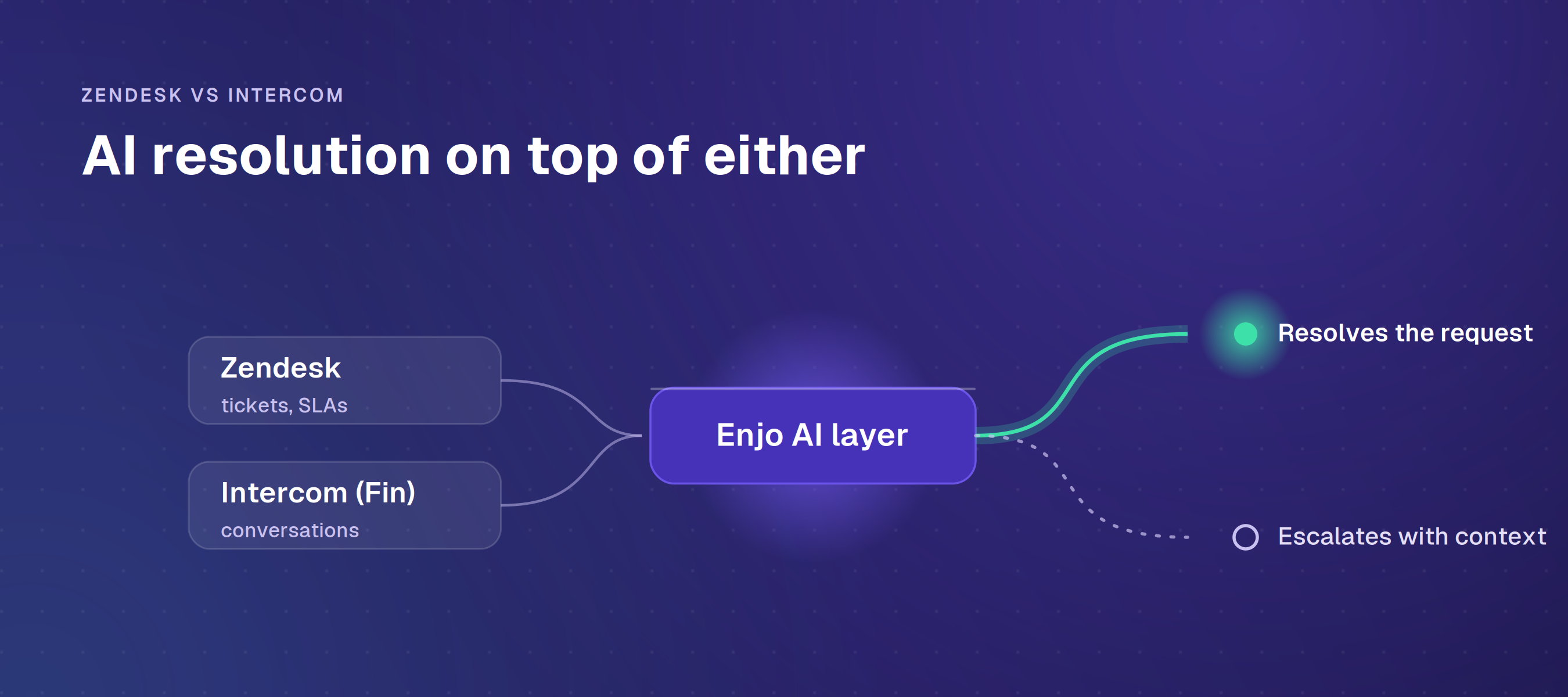
Enjo is an AI Support Agent that resolves support requests end-to-end, including actions in your connected systems, rather than routing them to a scripted chatbot. It enables AI Agents to understand issues, access company data, trigger workflows, and fully resolve a large share of customer requests end-to-end.
Why Enjo Is Better Than Intercom (Including Intercom Fin)
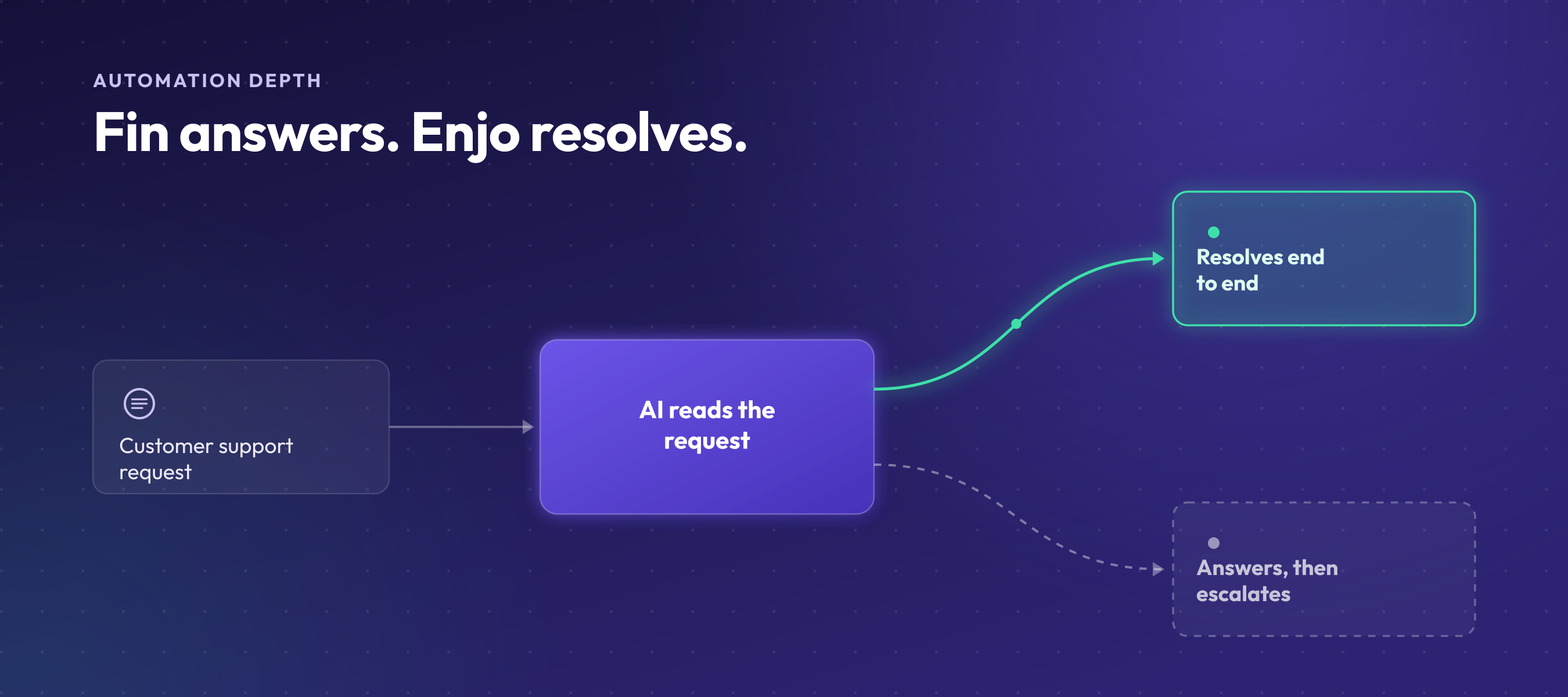
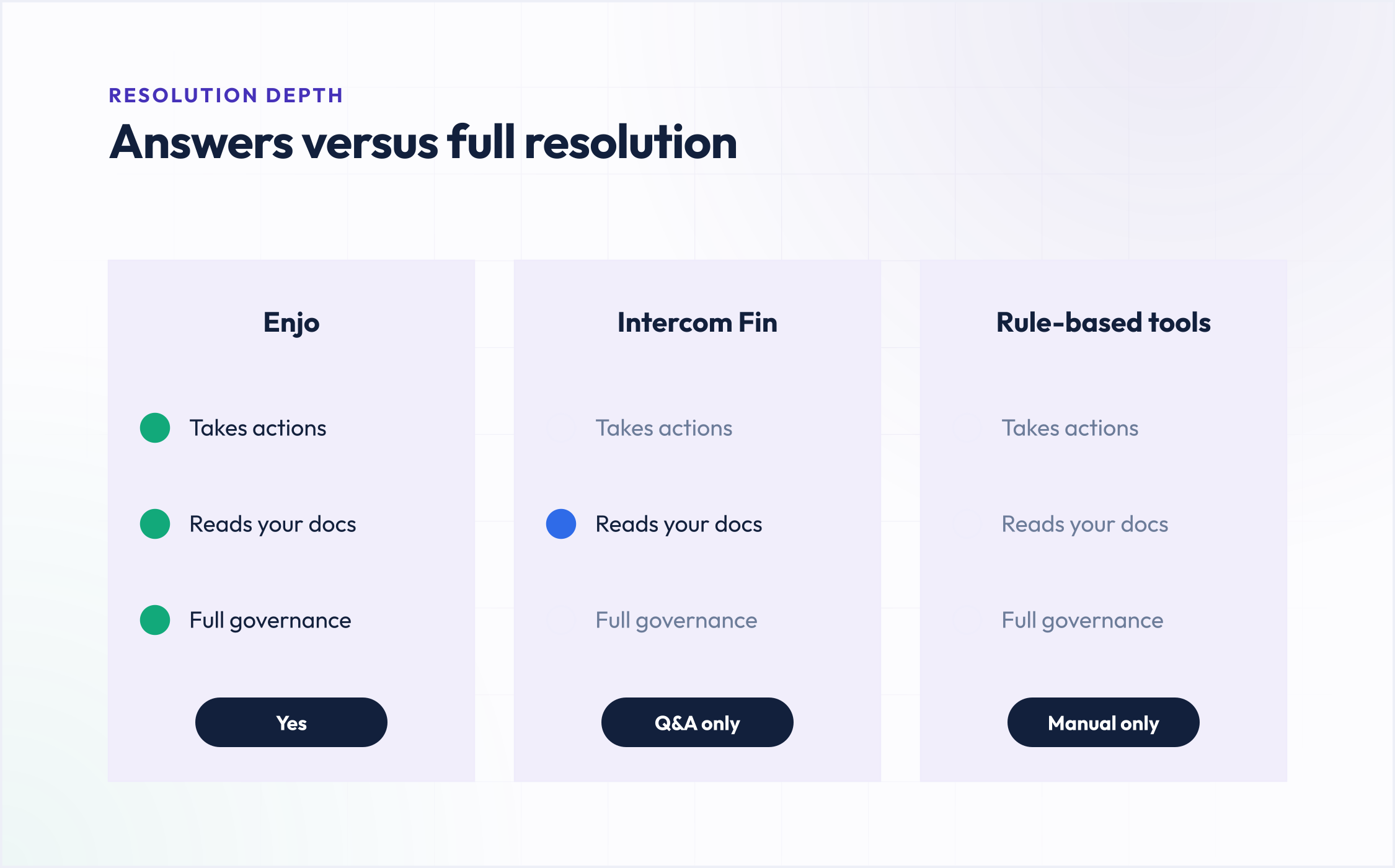
Intercom offers strong chat and inbox tools, and its AI bot Fin is a meaningful upgrade over legacy bots, but Fin is still fundamentally a Q&A assistant, not an autonomous resolver. It cannot orchestrate multi-step workflows, call external systems reliably, or take real actions beyond surface-level responses.
Enjo’s architecture is built for deeper automation:
- Autonomous AI Agents, not chatbots, are capable of interpreting complex issues and resolving them without human involvement.
- Action-taking AI that can run workflows such as order lookups, refunds, subscription checks, entitlement validation, profile updates, and more.
- Natural-language multi-step workflows through AI Flows and AI Actions, without brittle rule-based logic.
- Enterprise-grade governance with SOC 2 Type II, RBAC, audit logs, and proven 99.9% uptime.
- Every answer grounded in your knowledge with a citation, tested before launch, bounded by Guardrails, and written to the audit log.
- Studio, a no-code builder where support teams design, test and deploy AI tools and flows without engineering. Same-day go-live is possible: Aptean's first group of users was live in one day.
In short: Fin answers; Enjo resolves.
This is the fundamental gap most teams discover when comparing Intercom alternatives.
Best For
- Mid-market and enterprise companies
- High-volume support teams that need automation at scale
- Teams looking to replace chatbots with real autonomous AI
- Organizations prioritizing security, governance, and reliability
Key Capabilities
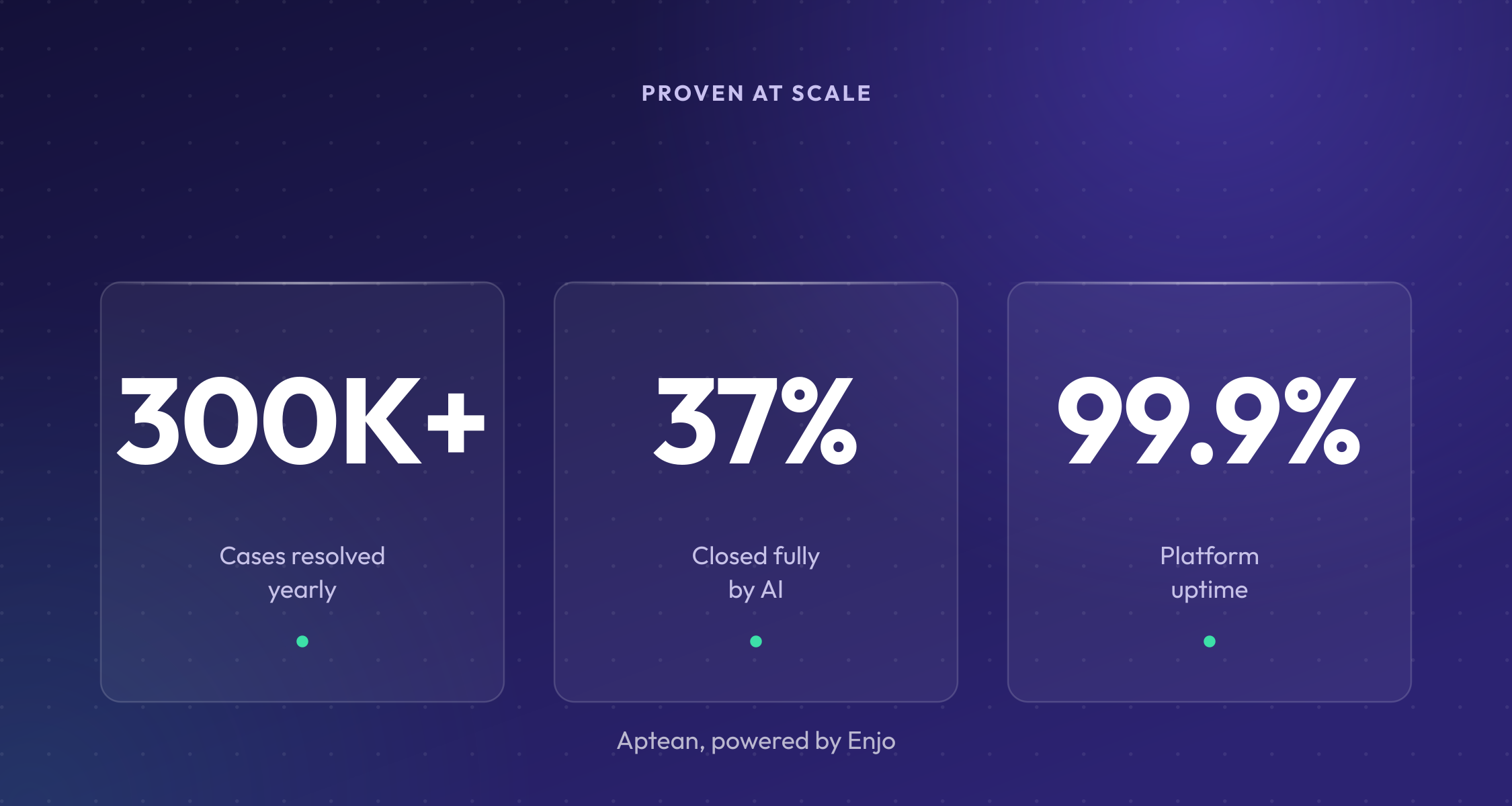
- Autonomous resolution for repetitive requests. Aptean, an ERP provider with 3,500+ employees and 600+ support reps, resolves 300K+ cases a year with Enjo AI, with 37% resolved fully by AI and no human involvement.
- AI Actions that connect to CRMs, subscription systems, payment tools, and order management platforms to complete tasks end-to-end.
- Resolution across Slack, Microsoft Teams, website chat, the Help Center portal, and Slack Connect shared channels, with the same knowledge layer behind every channel.
- Agent Assist provides recommended replies, relevant knowledge, and contextual insights when escalations require human judgment.
- AI Insights & performance analytics to surface volume trends, automation opportunities, sentiment patterns, and knowledge gaps.
2. Zendesk: Best Multichannel Intercom Alternative
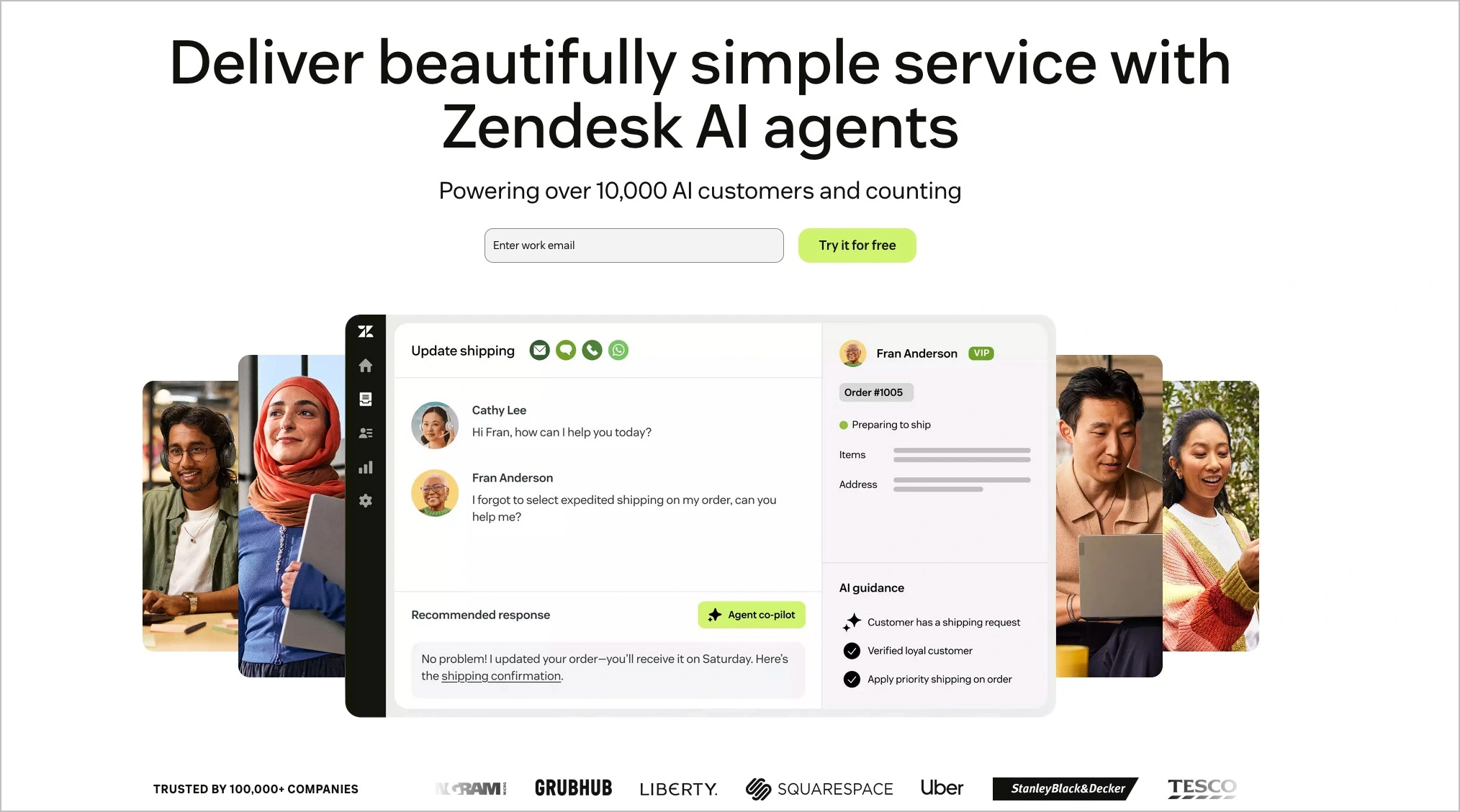
Zendesk is one of the most established customer service platforms, known for its mature ticketing system, strong multichannel support, and enterprise-grade reliability. For teams looking beyond Intercom’s chat-first model, Zendesk offers a broader suite for email, chat, help center, and workflow management.
Where Zendesk Performs Well
- Full omnichannel support across email, chat, voice, social, and embedded experiences.
- Mature ticketing + case management, ideal for scaled support operations.
- Powerful routing, SLAs, and agent performance tooling, stronger than Intercom’s workflows.
- Extensive integrations through the Zendesk Marketplace (hundreds of apps).
- Better fit for enterprise support operations with strict process and reporting requirements.
Where Zendesk Falls Short vs Intercom
- UI is less modern and intuitive, especially for smaller teams.
- Setup and maintenance can feel heavy, especially compared to Intercom’s plug-and-play chat experience.
- Automation relies heavily on rules and macros, not autonomous AI.
- Native AI is still evolving; many teams rely on third-party AI layers to fill gaps.
- Costs can escalate as channels, agents, and add-ons are layered in.
Why Zendesk Isn’t a Full Replacement for Intercom Fin
Zendesk’s AI bots provide structured, rules-based automation, but they lack:
- Deep retrieval
- Contextual reasoning
- Multi-step action execution
- Dynamic workflow orchestration
Teams wanting a Fin alternative or autonomous AI will find Zendesk’s bot capabilities insufficient without a third-party AI agent layer.
Best For
- Large or process-heavy support teams
- Companies needing strong email- and ticket-first workflows
- Organizations that already run a Zendesk ecosystem and don’t want to migrate away
Key Capabilities
- Omnichannel ticketing + agent workspace
- Help center + knowledge management
- SLA management, skill-based routing, QA tooling
- App marketplace with integrations for CRM, commerce, and telephony
- Reporting and dashboards for operational visibility
3. Freshchat (Freshworks): Affordable Intercom Alternative for Growing Teams
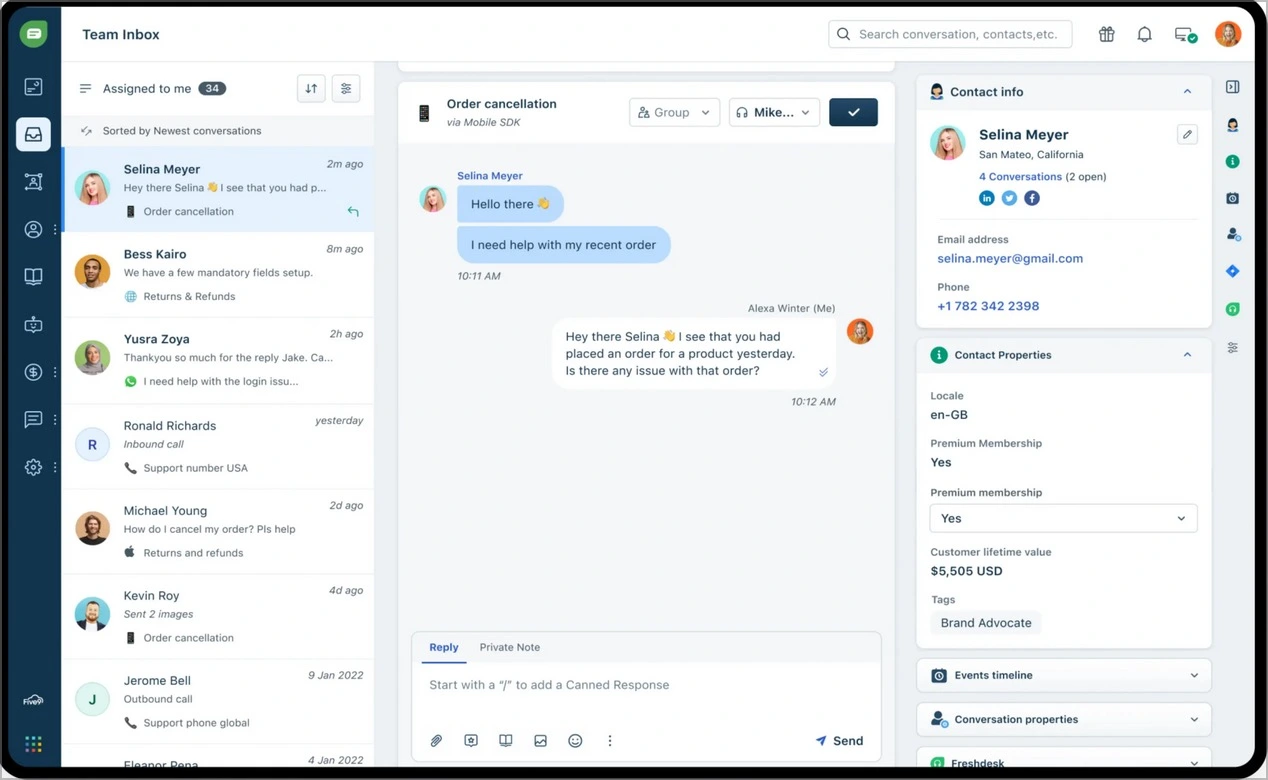
Freshchat is Freshworks’ conversational support platform, offering a similar chat-first experience to Intercom but at a more accessible price point. It combines messaging, basic bots, shared inbox features, and lightweight automation suited for SMB and mid-market teams.
Where Freshchat Performs Well
- Lower cost compared to Intercom, especially for early-stage and growth-stage companies.
- Simple, intuitive chat interface with fast onboarding.
- Decent out-of-the-box bots for FAQs, routing, and scripted workflows.
- Works with the broader Freshworks ecosystem (Freshdesk, Freshsales). Note that's Freshchat's live chat tool, not the separate Freshdesk helpdesk product; if it's Freshdesk itself you're evaluating alternatives to, see our dedicated comparison of Freshdesk alternatives instead.
- Good for teams that want “Intercom-like chat” without the premium price tag.
Where Freshchat Falls Short vs Intercom
- Bot automations are rule-based and shallow, not suitable for complex queries.
- AI capabilities lag behind Intercom Fin and fall far short of autonomous agent systems.
- Limited ability to trigger backend actions (e.g., order lookups, subscription checks).
- Knowledge retrieval and accuracy can be inconsistent.
- May struggle with high-volume enterprise workloads and multi-step processes.
Why Freshchat Isn’t a True Fin Alternative
Freshchat’s bot system is built on predefined flows and keyword/intent triggers. This means:
- No multi-step reasoning
- No workflow orchestration
- No deep API-driven action-taking
- Limited accuracy when handling variations in phrasing or edge cases
Teams looking specifically for a Fin alternative or AI-driven, autonomous resolution will find Freshchat too limited.
Best For
- Budget-conscious teams that want a chat-first experience
- SMBs and mid-market companies with predictable support queries
- Teams that want a lightweight Intercom-style tool with minimal setup complexity
Key Capabilities
- Messaging inbox + team collaboration tools
- Chatbot templates for FAQs and routing
- Mobile SDKs, web widgets, and WhatsApp support
- Integrations with Freshdesk and Freshsales
- Basic analytics and team performance reporting
4. Help Scout: Best Intercom Alternative for Email-Led, Human-Centric Support
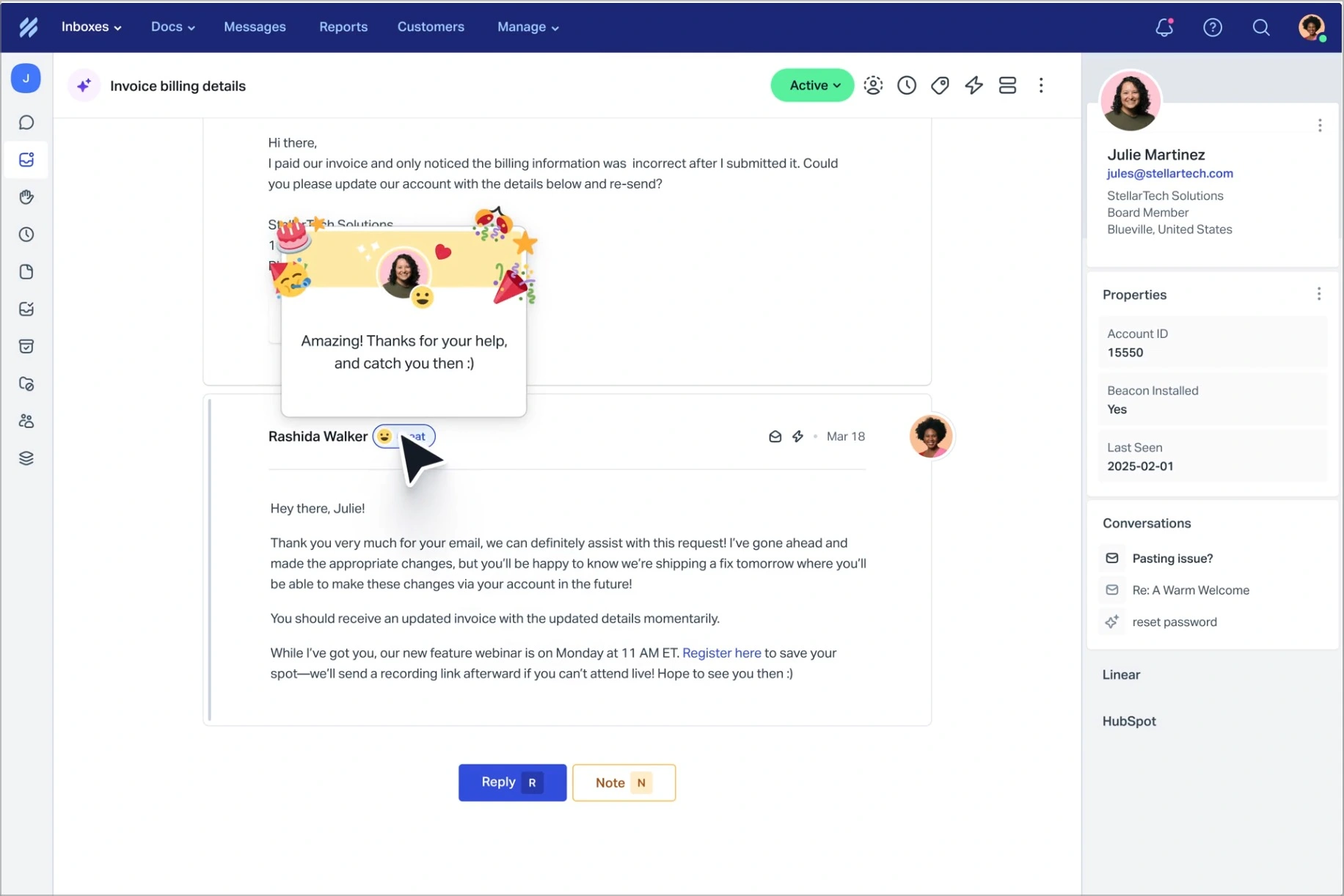
Help Scout is a simple, email-first customer support platform built for teams that value human, conversational service over complex automation. It offers a clean shared inbox, a lightweight help center, and minimal setup overhead, making it a popular Intercom alternative for smaller teams or organizations that don’t need advanced AI capabilities.
Where Help Scout Performs Well
- Extremely easy to onboard, especially for support teams transitioning from Gmail or Outlook.
- Clean, minimalistic shared inbox that feels familiar to support agents.
- Strong for email-heavy workflows, ticket triage, and personal support interactions.
- Knowledge base tools are simple and effective for smaller teams.
- Predictable, lower-cost pricing compared to Intercom.
Where Help Scout Falls Short vs Intercom
- No advanced automation, workflows rely on rules and tags, not AI.
- Chat and real-time messaging are basic compared to Intercom’s Messenger.
- No autonomous resolution capability or deep AI retrieval.
- Limited ability to scale into complex support operations.
- Reporting and insights are lighter than Intercom’s analytics suite.
Why Help Scout Isn’t a Fin Alternative
Help Scout’s bot features are minimal, they handle:
- Basic suggestions
- Simple routing
- FAQ linking
But they cannot:
- Interpret nuanced customer queries
- Trigger backend actions
- Handle multi-step workflows
- Autonomously resolve issues
Teams searching for a Fin alternative or AI-driven automation platform should look to tools built for deeper reasoning and orchestration.
Best For
- Small to mid-sized teams
- Email-first or conversation-focused support models
- Organizations that prefer human-led service over automation-heavy systems
- Teams that want a simple, low-maintenance Intercom alternative
Key Capabilities
- Shared inbox with collaboration tools
- Simple live chat widget
- Knowledge base + Docs site
- Basic workflow automation (tags, assignments, triggers)
- Customer satisfaction (CSAT) surveys
5. Tidio: Best Budget-Friendly Intercom Alternative for Small Businesses
Tidio is an affordable, easy-to-deploy customer service platform combining live chat, chatbot flows, and lightweight AI features. It’s popular among ecommerce stores and small businesses that want simple automation without the cost or complexity of Intercom.
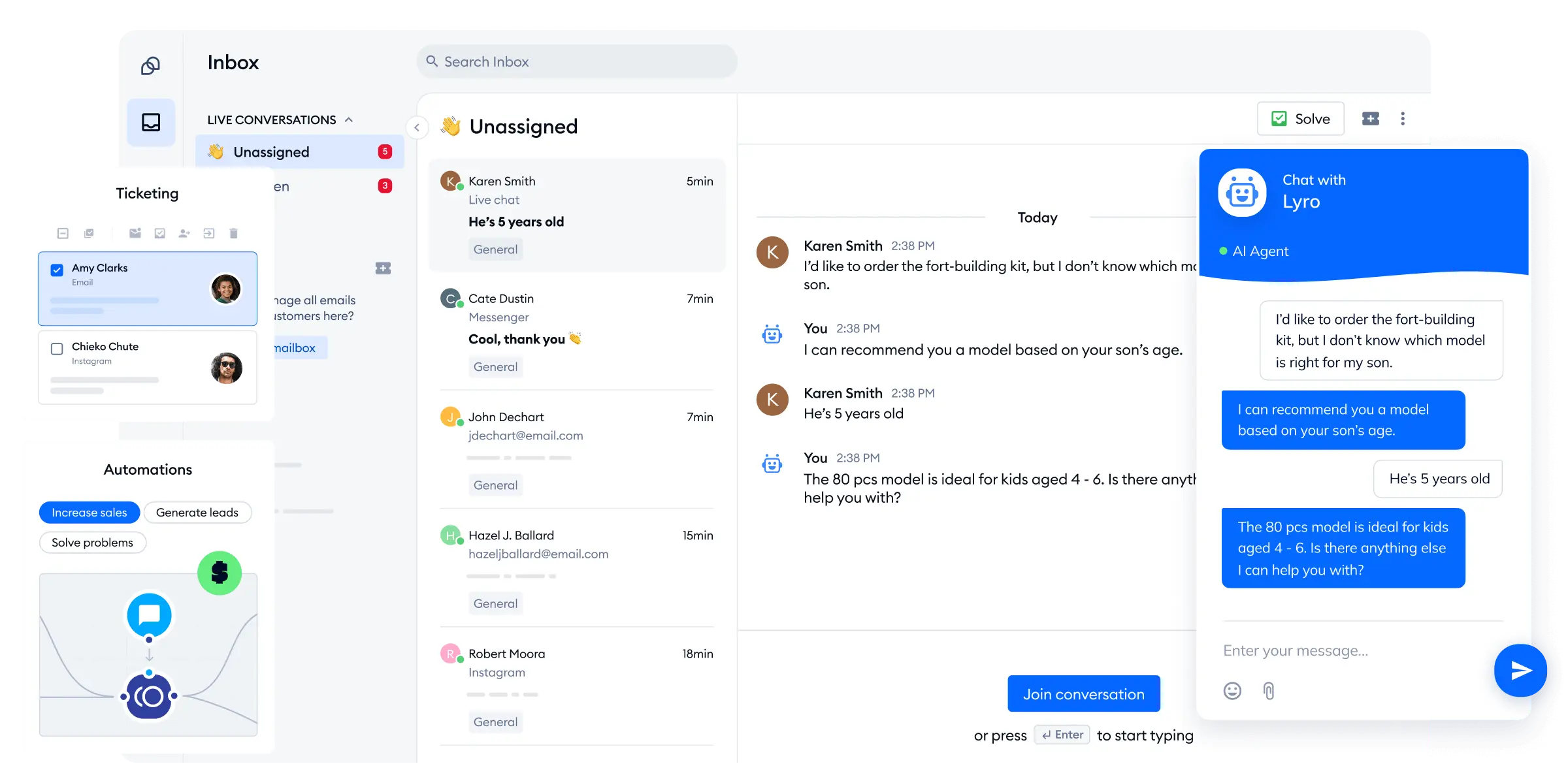
Where Tidio Performs Well
- Very low pricing, especially attractive for startups and small ecommerce brands.
- Offers a plug-and-play live chat widget that resembles Intercom’s Messenger.
- Decent chatbot builder with templates for FAQs, lead capture, routing, and basic automation.
- Strong adoption specifically in Shopify and WooCommerce ecosystems.
- Quick to deploy, with a team can be live in under an hour.
Where Tidio Falls Short vs Intercom
- Automation is flow-based and shallow, unable to handle nuanced or multi-step tasks.
- AI features (Lyro) have limited ability to understand complex queries or retrieve deep knowledge.
- Not built for enterprise scale, lacks advanced routing, SLAs, RBAC, and operational governance.
- Reporting and analytics are far lighter compared to Intercom.
- Often requires manual intervention for most customer issues, leading to higher agent workload.
Why Tidio Isn’t a Fin Alternative
Tidio’s AI (Lyro) sits closer to a FAQ assistant than a fully-fledged AI Agent. It cannot:
- Perform backend lookups (orders, subscriptions, payments)
- Trigger multi-step workflows
- Reason across documents
- Provide consistent, policy-aligned answers
- Resolve high-frequency customer issues autonomously
Teams evaluating Intercom Fin alternatives or automation-led support platforms will quickly hit Tidio’s capability ceiling.
Best For
- Small ecommerce stores
- Businesses needing inexpensive live chat + basic chatbots
- Teams experimenting with automation before upgrading to enterprise platforms
- Use cases centered on lead capture and simple pre-sales chat
Key Capabilities
- Live chat + messaging inbox
- Chatbot templates for FAQ + lead capture
- Ecommerce integrations (Shopify, WooCommerce, PrestaShop)
- Basic AI answering using Lyro
- Simple automations based on triggers and conditions
6. Gorgias: Best Intercom Alternative for Ecommerce Support Automation
Gorgias is a Shopify-first customer support platform built specifically for ecommerce brands. It centralizes tickets from chat, email, social channels, and storefront widgets, offering strong macros, ecommerce integrations, and agent productivity tools. For online stores, it’s one of the closest Intercom alternatives but with deeper native commerce data access.
Where Gorgias Performs Well
- Deepest Shopify integration on this list, pulling order details, shipping status, and customer history directly into the inbox.
- Strong templating and macro system for repetitive ecommerce workflows.
- Supports chat, email, Instagram DMs, Facebook comments, and other social commerce channels.
- Excellent for pre-sales + post-sales workflows like “where is my order?”, refunds, exchanges, subscription questions.
- Easy for ecommerce teams to onboard; everything is optimized for fast agent responses.
Where Gorgias Falls Short vs Intercom
- Automation is heavily reliant on rules, macros, and manual workflows.
- Chat experience is more utilitarian; Intercom still offers a more polished Messenger UI.
- AI features are limited, they don’t handle complex reasoning or multi-step workflows.
- Lacks enterprise governance tools for larger support organizations.
- Not ideal for non-ecommerce companies; the feature set is tightly focused on online retail.
Why Gorgias Isn’t a Fin Alternative
Gorgias is excellent for ecommerce operations but not built as an autonomous resolution platform. Compared to Intercom Fin:
- No deep knowledge retrieval
- No multi-step reasoning
- No autonomous action-taking (e.g., cannot dynamically validate subscriptions or trigger workflows without prebuilt automations)
- Limited ability to handle non-structured customer queries
- Requires agents to intervene in most conversations
For teams seeking a true Fin alternative or an AI Agent platform capable of end-to-end autonomous resolution, Gorgias will not meet those requirements.
Best For
- Shopify, Shopify Plus, WooCommerce, BigCommerce brands
- Ecommerce teams handling large volumes of “WISMO,” refunds, exchanges, and delivery questions
- Companies that want a support tool tightly embedded into their store + commerce stack
- Fast-growing D2C brands optimizing pre-sales conversion and post-sales support
Key Capabilities
- Unified inbox for chat, email, social comments, and DMs
- Shopify-native macros pulling order + customer context
- Automated tagging, routing, and basic ticket deflection
- Live chat widget + proactive messaging
- Revenue analytics tied to support conversations
7. HubSpot Service Hub: Best Intercom Alternative for CRM-Integrated Support
HubSpot Service Hub is a customer service platform built on top of HubSpot’s CRM. It offers ticketing, live chat, a help center, and workflow automation, all tightly integrated with marketing and sales data. For companies already using HubSpot, it’s a natural Intercom alternative that centralizes customer engagement across the full lifecycle.
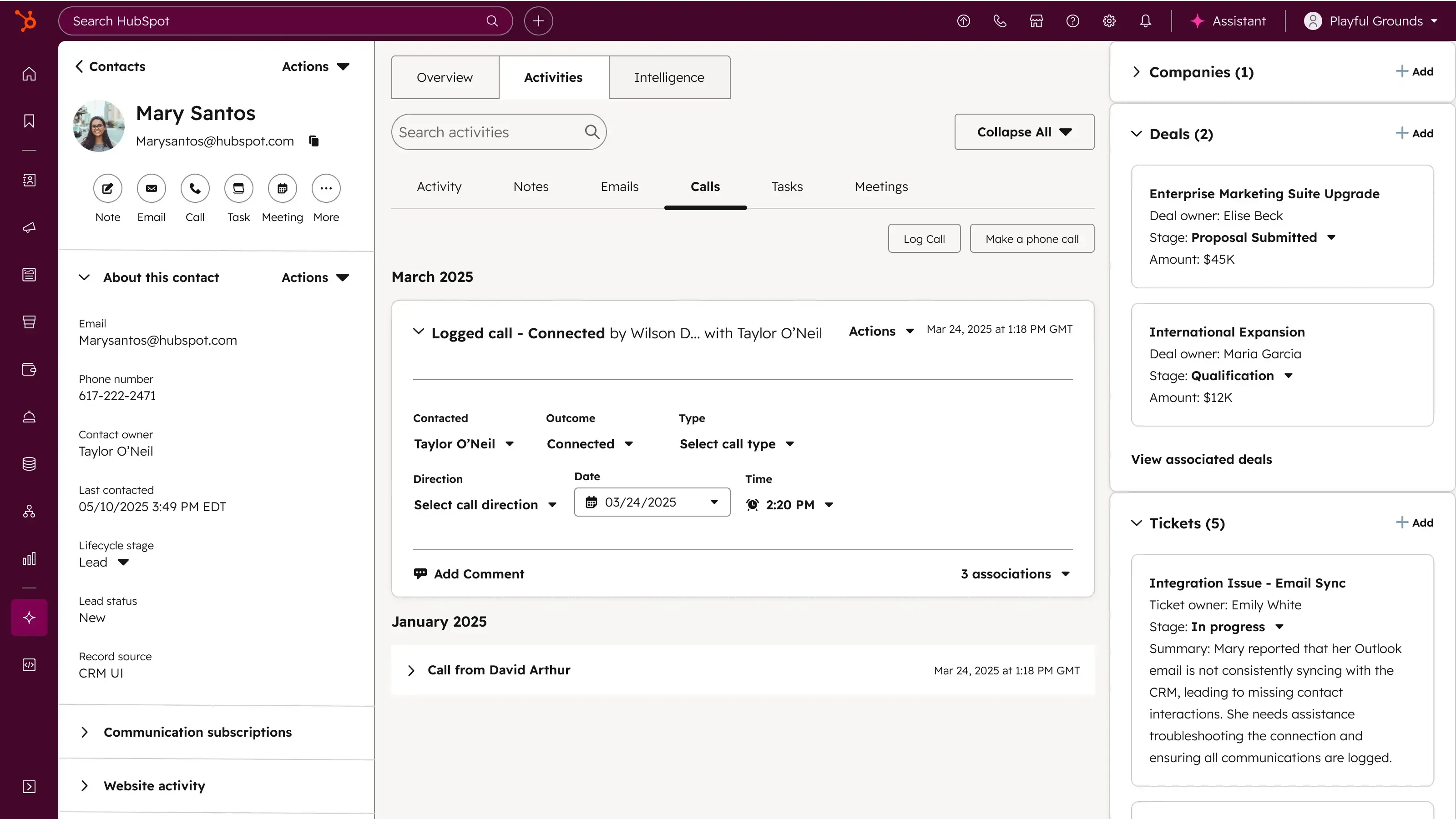
Where HubSpot Service Hub Performs Well
- Deep CRM integration, giving agents a full view of customer lifecycle data (sales, marketing emails, deal history).
- Strong automation through HubSpot Workflows, particularly for lead handoff, customer follow-up, and ticket routing.
- Unified customer record across marketing, sales, and support.
- Excellent for support teams that double as revenue or growth teams, where sales conversations and support insights overlap.
- Good for SaaS, agencies, and B2B teams already using HubSpot’s ecosystem.
Where HubSpot Falls Short vs Intercom
- Chat and inbox experience is less polished compared to Intercom’s Messenger.
- AI capabilities are basic, mostly suggestion-based, not capable of multi-step workflows.
- No autonomous resolution or AI Agents; automation depends on predefined rules and workflows.
- Can become expensive quickly as usage scales and additional hubs or contacts are added.
- Setup for advanced workflows requires more configuration than Intercom.
Why HubSpot Isn’t a Fin Alternative
HubSpot's AI tools are not designed to operate as end-to-end automation engines. Compared to Fin and platforms built for autonomous resolution:
- No dynamic retrieval from knowledge or past tickets
- No ability to orchestrate multi-step queries
- No direct action-taking beyond workflow triggers
- No autonomous reasoning or contextual problem-solving
- Limited conversational accuracy for complex customer questions
HubSpot is a strong CRM-led support solution, not a Fin alternative or a replacement for fully autonomous AI Agents.
Best For
- SaaS companies and B2B teams using HubSpot CRM
- Support teams that collaborate closely with sales or marketing
- Organizations want a unified customer data platform rather than point tools
- Mid-market teams looking for workflow automation tied to CRM data
Key Capabilities
- Unified CRM + service ticketing
- Live chat + chatbot builder
- Knowledge base + customer portal
- HubSpot Workflows for routing and follow-up
- CSAT, NPS, and customer feedback automation
- Omnichannel inbox for email, chat, and forms
8. Kustomer: Best Intercom Alternative for Timeline-Based, CRM-Style Support
Kustomer is a customer service platform that blends helpdesk functionality with CRM-like context. Its standout feature is the unified customer timeline, which gives agents a 360° view of every interaction across channels. For teams managing complex, multi-touch conversations, Kustomer offers deeper context visibility than Intercom’s conversation threads.
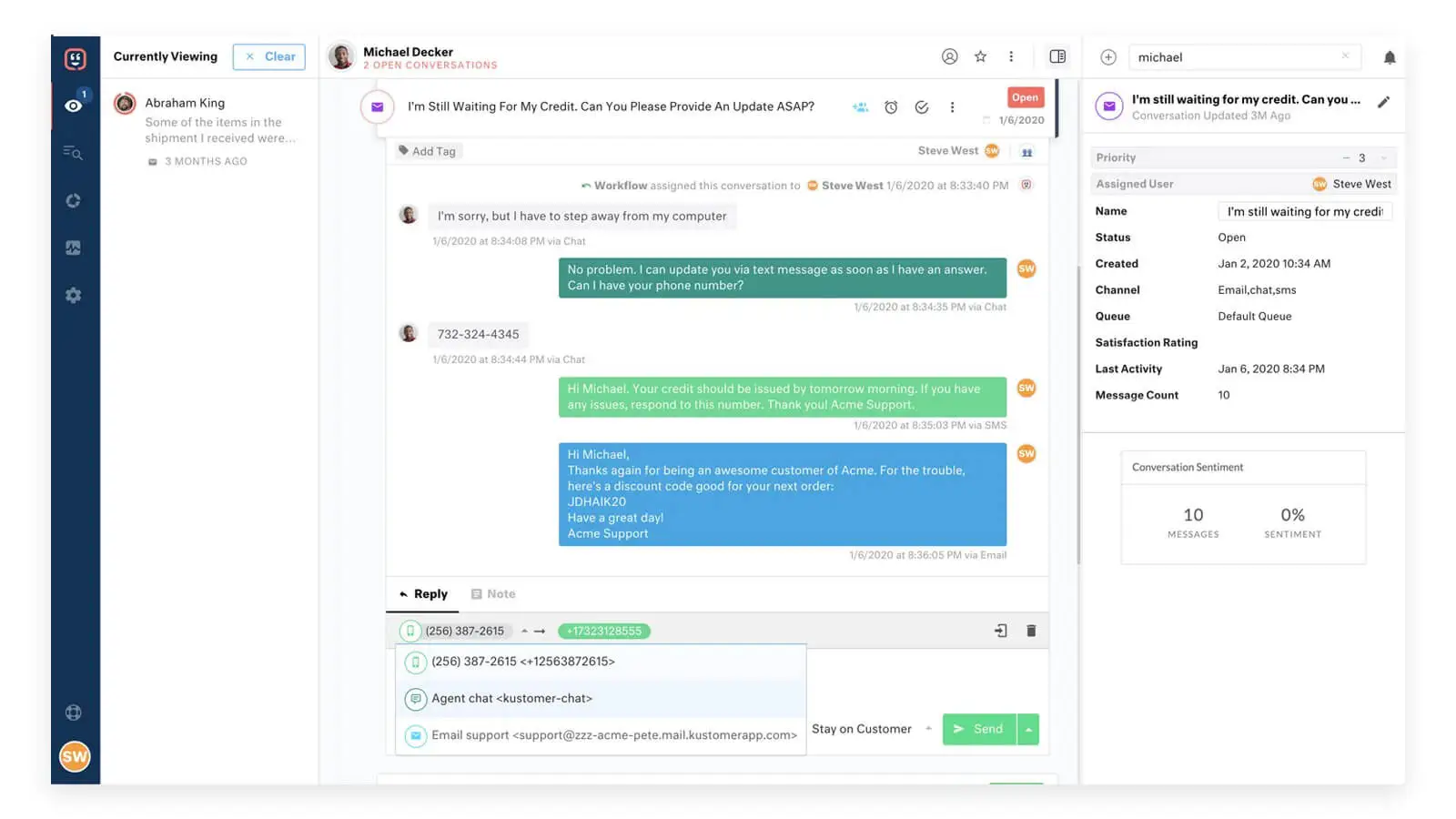
Where Kustomer Performs Well
- Customer timeline view provides a complete, historical record of every interaction, purchase, and event, ideal for agents handling complex accounts.
- Strong omnichannel support, including chat, email, SMS, social channels, and voice.
- Better suited than Intercom for long-running, multi-agent conversations or issue threads that require continuity.
- Tickets can be managed like CRM objects, enabling custom objects and flexible data modeling.
- Notable for industries like logistics, marketplaces, and multi-step service operations.
Where Kustomer Falls Short vs Intercom
- Messenger and chat experience is less modern and less customizable than Intercom’s UI.
- Automation capabilities rely on workflows and rules, not autonomous AI.
- The platform can feel heavy and complex for smaller teams.
- Meta bought Kustomer in a deal announced in 2020 and completed in early 2022, then spun it back out to its original investors in May 2023 at a valuation of around $250M. Kustomer has been independently venture backed since, raising a $30M Series B led by Norwest in August 2025. Some buyers still weigh those transition years when judging product velocity.
- Implementation and maintenance require more configuration effort.
Why Kustomer Isn’t a Fin Alternative
Kustomer excels at data organization, not AI automation. Compared to Intercom Fin:
- No dynamic retrieval-based AI
- Limited ability to resolve queries autonomously
- Cannot interpret complex issues or orchestrate multi-step workflows
- No action-taking “agent” architecture
- AI features mainly assist humans, they don’t replace manual effort
For companies evaluating Fin alternatives or platforms capable of end-to-end automation, Kustomer primarily enhances agent experience, not automation depth.
Best For
- Support teams handling long, complex, multi-step cases
- Marketplaces, delivery/logistics, financial services, or any business with multi-threaded customer journeys
- Organizations requiring deep context and CRM-like data modeling
- Teams scaling beyond simple chat-based workflows
Key Capabilities
- Unified customer timeline with full history
- Custom object creation (CRM-like flexibility)
- Omnichannel messaging (chat, email, SMS, social, voice)
- Routing, prioritization, and automation rules
- Agent tools for faster case resolution
- Integrations with major CRMs and custom backend systems
9. Gladly: Best Intercom Alternative for Human-Centric Conversation Management
Gladly is a customer service platform designed around people, not tickets. Its identity-first model gives every customer a lifelong conversation thread across channels, which makes it one of the strongest Intercom alternatives for brands that prioritize personalized, human-led support over automation-heavy workflows.
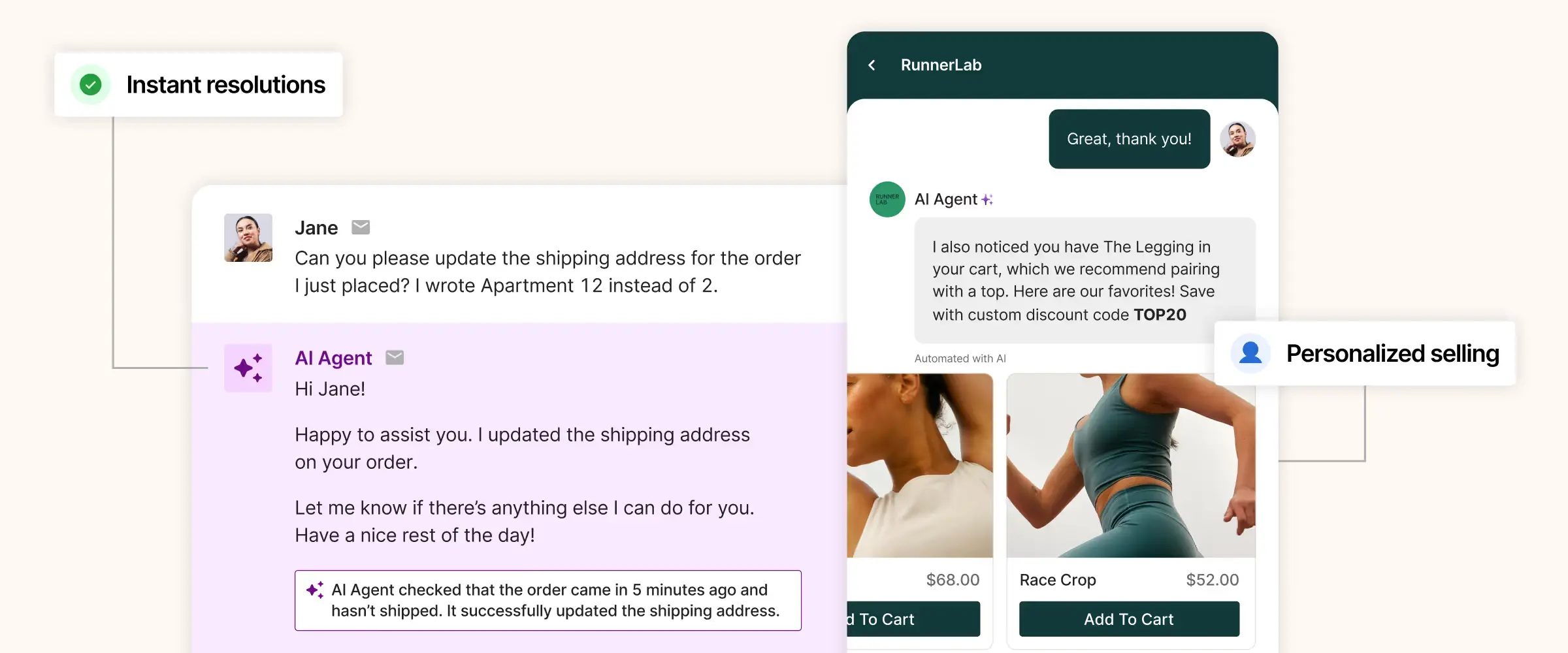
Where Gladly Performs Well
- Single, continuous conversation history across all channels (email, chat, SMS, voice, social).
- Excellent fit for high-touch, relationship-driven support teams, such as hospitality, travel, and premium retail
- Built-in voice offering, which Intercom lacks natively.
- Clean UI designed to help agents maintain context without switching between tickets or views.
- Strong customer loyalty + CX orientation, where service quality matters more than raw efficiency.
Where Gladly Falls Short vs Intercom
- Automation capabilities are light compared to Intercom and significantly limited compared to AI-native tools.
- No autonomous resolution or dynamic, retrieval-driven AI.
- Platform is more expensive than many other alternatives, especially for teams handling high volumes.
- Reporting and analytics are solid but not as granular as data-heavy helpdesks like Zendesk.
- Not ideal for organizations that require scalable AI automation or complex workflows.
Why Gladly Isn’t a Fin Alternative
Gladly focuses on improving human agent workflows, not replacing manual steps with AI. Compared to Intercom Fin:
- No AI agent architecture
- No deep knowledge retrieval or reasoning
- No multi-step automation
- No backend action-taking
- AI is limited to suggestions, not resolution
Teams specifically looking for an Intercom Fin alternative or an autonomous AI platform will find Gladly more aligned with traditional, human-first service operations.
Best For
- Hospitality, luxury retail, travel, and membership-based businesses
- Teams prioritizing relationship-driven, human-centric support
- Brands where long-term customer lifetime value is tied to personalized service
- Organizations that want a unified customer communication history rather than fragmented tickets
Key Capabilities
- People-centered support model with unified lifetime conversations
- Omnichannel inbox: voice, SMS, chat, email, social
- Customer profiles enriched with preferences, history, and context
- Agent collaboration and shared context visibility
- Basic automation for routing and suggested responses
- Integration ecosystem for ecommerce, loyalty, and CRM platforms
10. Front: Best Intercom Alternative for Collaborative, Email-Led Support Teams
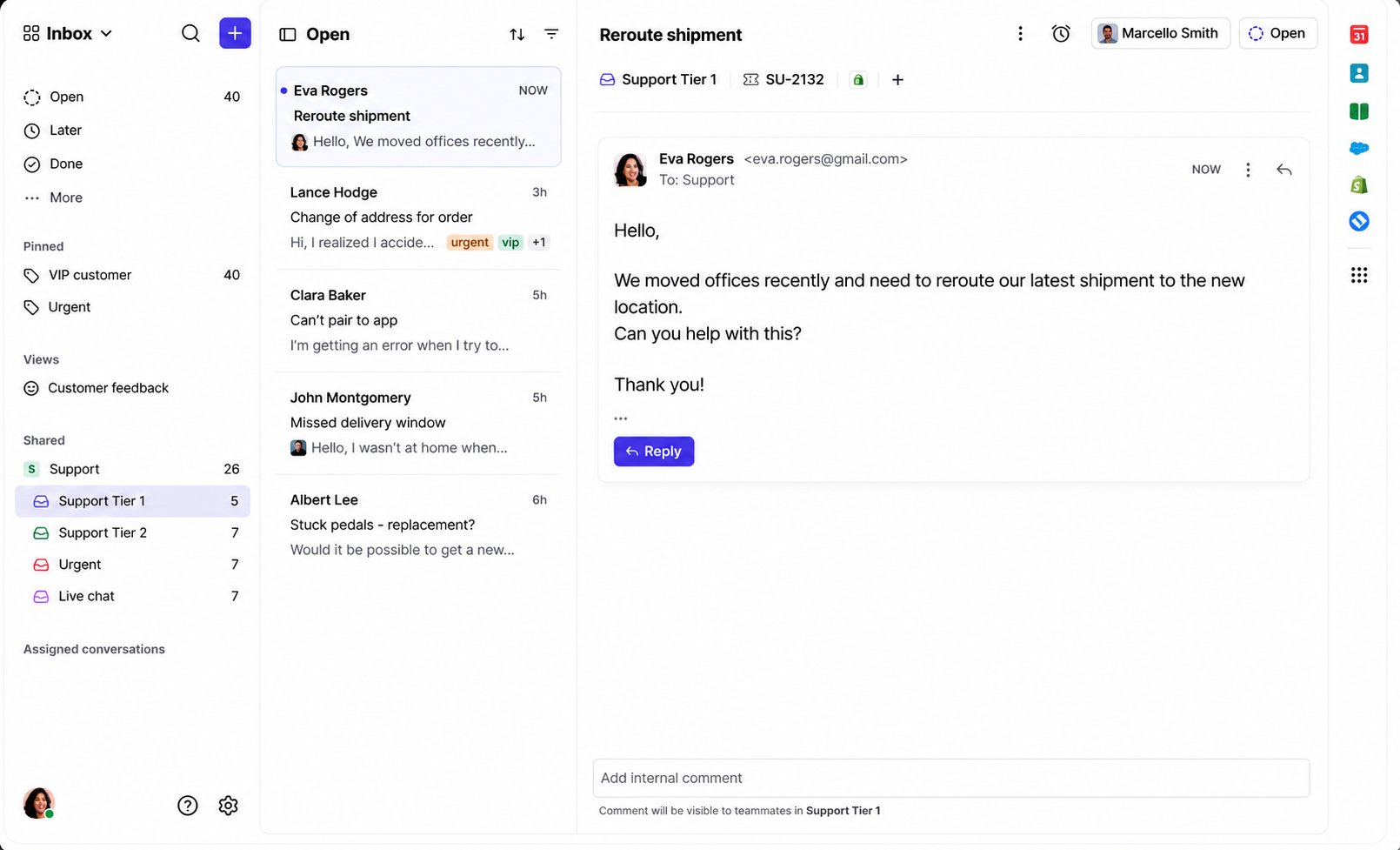
Front is a collaborative team inbox platform that blends the familiarity of email with lightweight helpdesk and messaging features. It’s designed for teams that rely heavily on shared inboxes, internal collaboration, and personalized customer communication, making it a compelling Intercom alternative for email-first organizations.
Where Front Performs Well
- The strongest shared inbox experience on this list, ideal for teams that collaborate heavily on customer conversations.
- Email interface feels natural to agents, reducing onboarding friction.
- Strong internal collaboration tools (comments, assignments, shared drafts).
- Works well for account management heavy workflows, where support often blends with operations or sales.
- Offers API and rules-based automation for routing and triage.
Where Front Falls Short vs Intercom
- Not built as a conversational support platform; messaging tools are simpler than Intercom’s chat widget and Messenger flows.
- Automation is limited to rules, tags, and routing, with no advanced AI or autonomous workflows.
- No knowledge retrieval or integrated helpdesk-style ticket lifecycle.
- Lacks native multichannel depth compared to Intercom (voice, advanced chat, and bot experiences).
- Can become expensive for large teams with many collaborators.
Why Front Isn’t a Fin Alternative
Front is fundamentally an email-first collaboration tool, not an autonomous resolution platform.
- No large-language-model-driven reasoning
- No multi-step automation
- No backend action-taking or dynamic workflows
- No autonomous resolution capability
- AI assists humans but does not replace repetitive tasks
Teams evaluating Fin alternatives or looking to reduce human workload through automation will find Front useful for collaboration but, not for AI-led resolution.
Best For
- B2B companies with account management workflows
- Teams where support, operations, and sales frequently collaborate
- Organizations that handle most customer communication through email
- Companies wanting a modern shared inbox rather than a full helpdesk suite
Key Capabilities
- Shared inbox with deep collaboration tooling
- Email + basic chat widget support
- Comment threads, drafts, assignments, and SLAs
- Rules-based routing and categorization
- Integrations with CRMs and workflow tools (Salesforce, HubSpot, Airtable)
- Analytics for team performance and response times
Other Intercom Alternatives Worth Knowing
Five more platforms surface in Intercom alternative shortlists without earning a full entry above, either because their scope is narrower or because their AI stops at suggestion rather than resolution.
DevRev. Sold to product-led SaaS teams that want support tickets and engineering work on one object model, with a retrieval-grounded chatbot included rather than metered per resolution. Its scope is the support-plus-product-development workflow, so IT and HR request handling sits outside it.
Crisp. Priced per workspace rather than per seat, combining a shared inbox, chat widget and knowledge base for small teams. Its bots run on scripted flows, so a multi-step lookup in a billing or identity system still lands with an agent.
Zoho Desk. Sold as the support module inside the wider Zoho business suite, priced per agent with Zia AI and live chat gated to the upper tiers.
LiveAgent. Sold to teams that want a built-in call center alongside ticketing and chat in the base plan. Automation is rules and SLA based, with no retrieval-driven resolution layer.
Freshdesk. Freshworks' ticket-first helpdesk, distinct from the Freshchat entry above, priced per agent with Freddy AI as a paid add-on.
Why Switch From Intercom?
A naming note first. Intercom renamed the company to Fin in May 2026, taking the name of its AI agent, and Salesforce signed a definitive agreement to acquire Fin for roughly $3.6 billion on 15 June 2026. The deal is signed, not closed, and is expected to complete in Salesforce's fiscal Q4 2027 subject to regulatory clearance, so Fin operates as its own product today. Fin is also sold on its own and runs on Zendesk, Salesforce, HubSpot and Freshworks, so the question is no longer which helpdesk you are on. What separates these tools is scope and pricing model: Fin is a single-product AI agent for customer service messaging, billed per resolution. For consumer-heavy chat at high volume, Fin remains excellent, and teams already using it should weigh the per-resolution cost rather than the platform question.
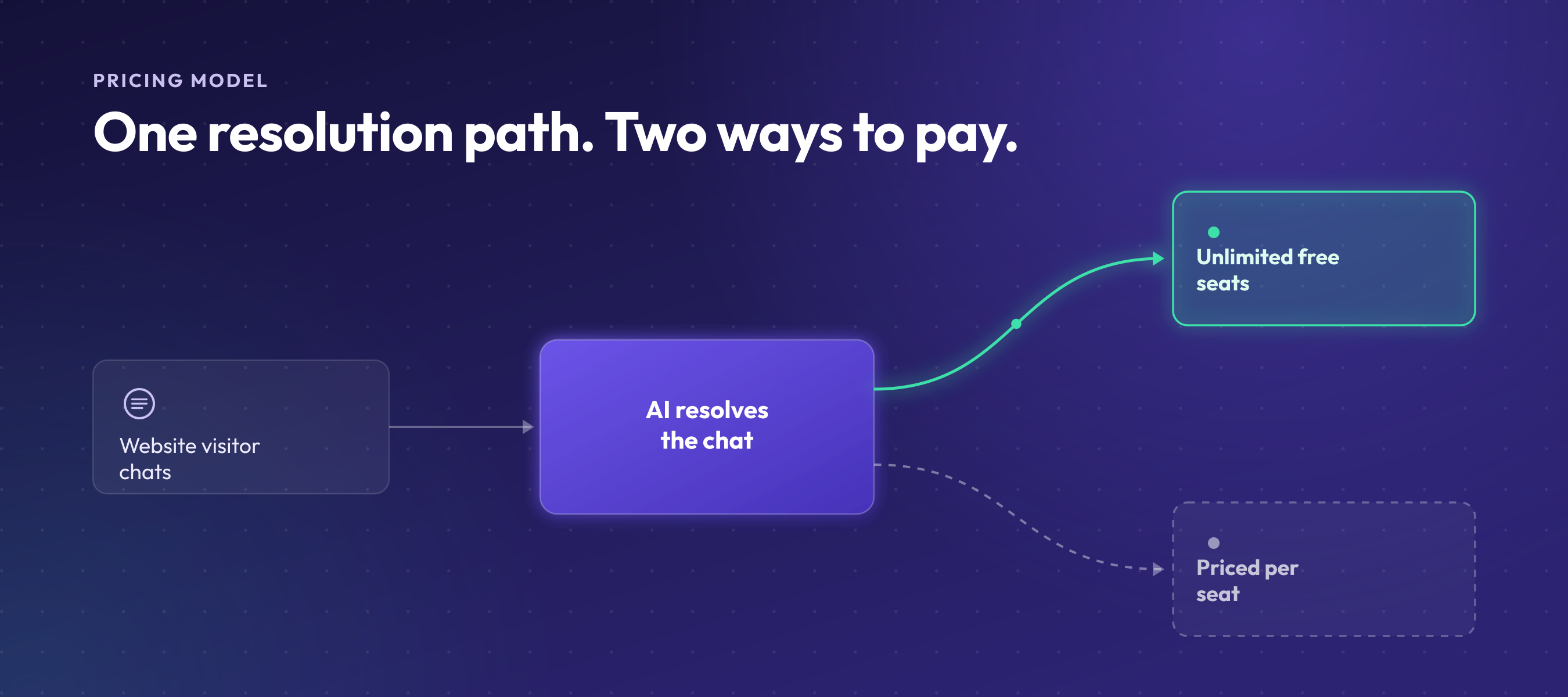
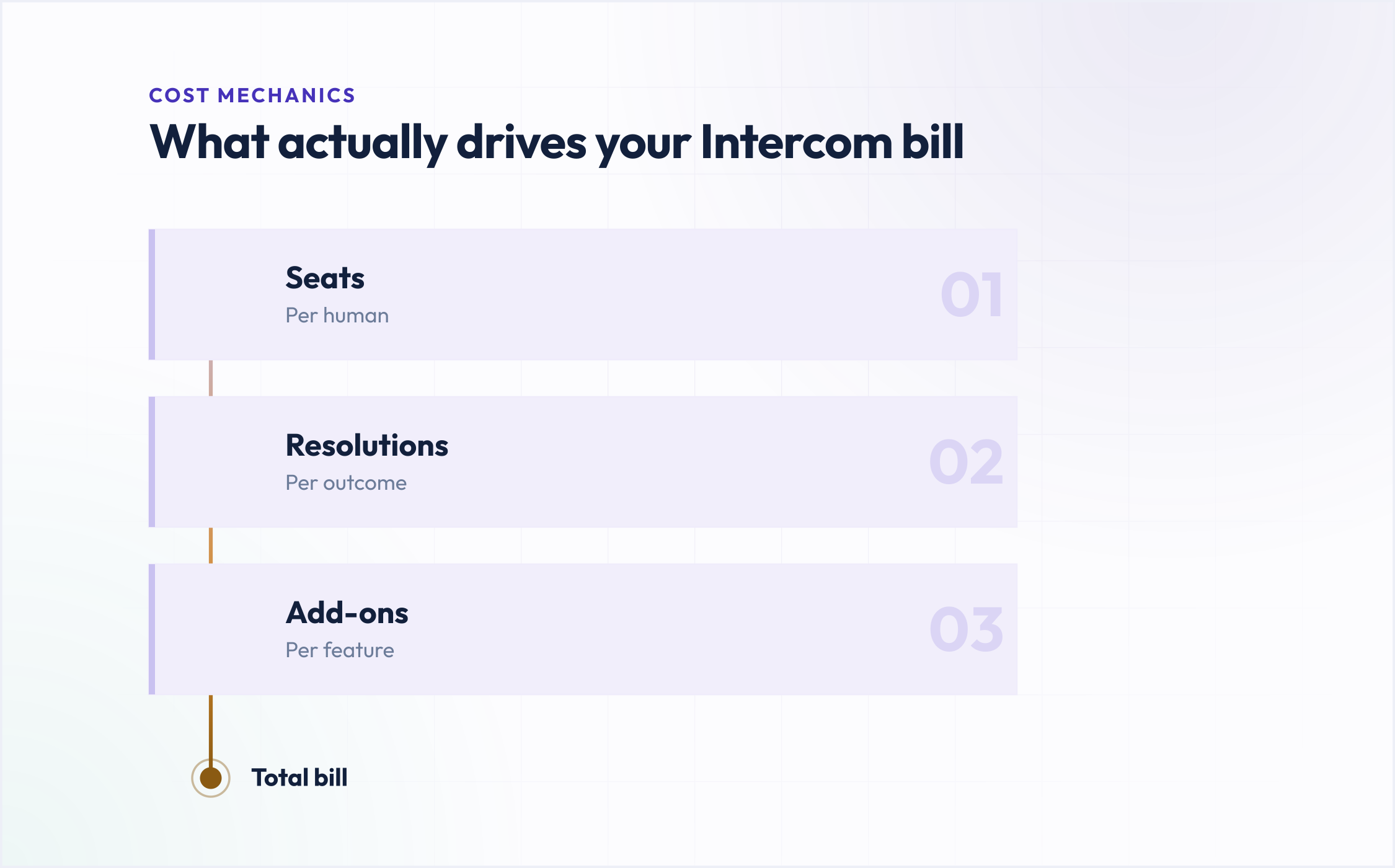
Rising Costs as Volume Grows: Fin bills AI resolutions at $0.99 each on top of seat pricing, so the bill rises at exactly the point automation starts working. High-growth teams find the total cost outpacing the efficiency gain, especially when the bot still escalates a large share of conversations to a human.
Limited Automation Depth (Even With Fin): Fin is a major improvement over legacy chatbots, but it still operates as a Q&A assistant, not an autonomous problem solver. Fin can’t orchestrate multi-step workflows, take backend actions, or fully resolve customer requests, which means human workload remains high.
Scalability Challenges for High-Volume Teams: As operations expand across channels, regions, and products, Intercom’s chat-first architecture can struggle with complex routing, enterprise workflows, cross-team collaboration, and large-scale process automation.
Inconsistent Responses Without Deep Knowledge Retrieval: Intercom’s bots rely heavily on predefined answers. Without deep retrieval or contextual understanding, they can produce inconsistent or shallow responses, especially when customer queries deviate from expected patterns.
What the bill actually looks like:
- Charges increase with contacts, seats, automation usage, and add-ons
- AI features, like Fin, can significantly increase monthly spend as volume grows
- High-growth companies often experience unpredictable billing spikes
- Scaling chat, bots, and support seats can make Intercom one of the most expensive platforms in this category
Teams trying to reduce support costs often find that Intercom does not scale economically, especially when its automation still relies heavily on human agents.
FAQ
Which Intercom alternative offers the most advanced workflow automation?
Enjo offers the deepest workflow automation among Intercom alternatives. Unlike traditional chatbot-based tools, Enjo's AI Agents run multi-step workflows, pull real-time data from your business systems, take actions like refunds, lookups, and account updates, and resolve issues end-to-end, not just deflect them.
Will I lose functionality by switching from Intercom to another platform?
In most cases, no. Leading Intercom alternatives offer comparable live chat, shared inbox, and knowledge base features. With platforms built for autonomous resolution, like Enjo, you gain stronger automation and more control over workflows than Intercom provides out of the box.
How long does it take to migrate from Intercom to an alternative?
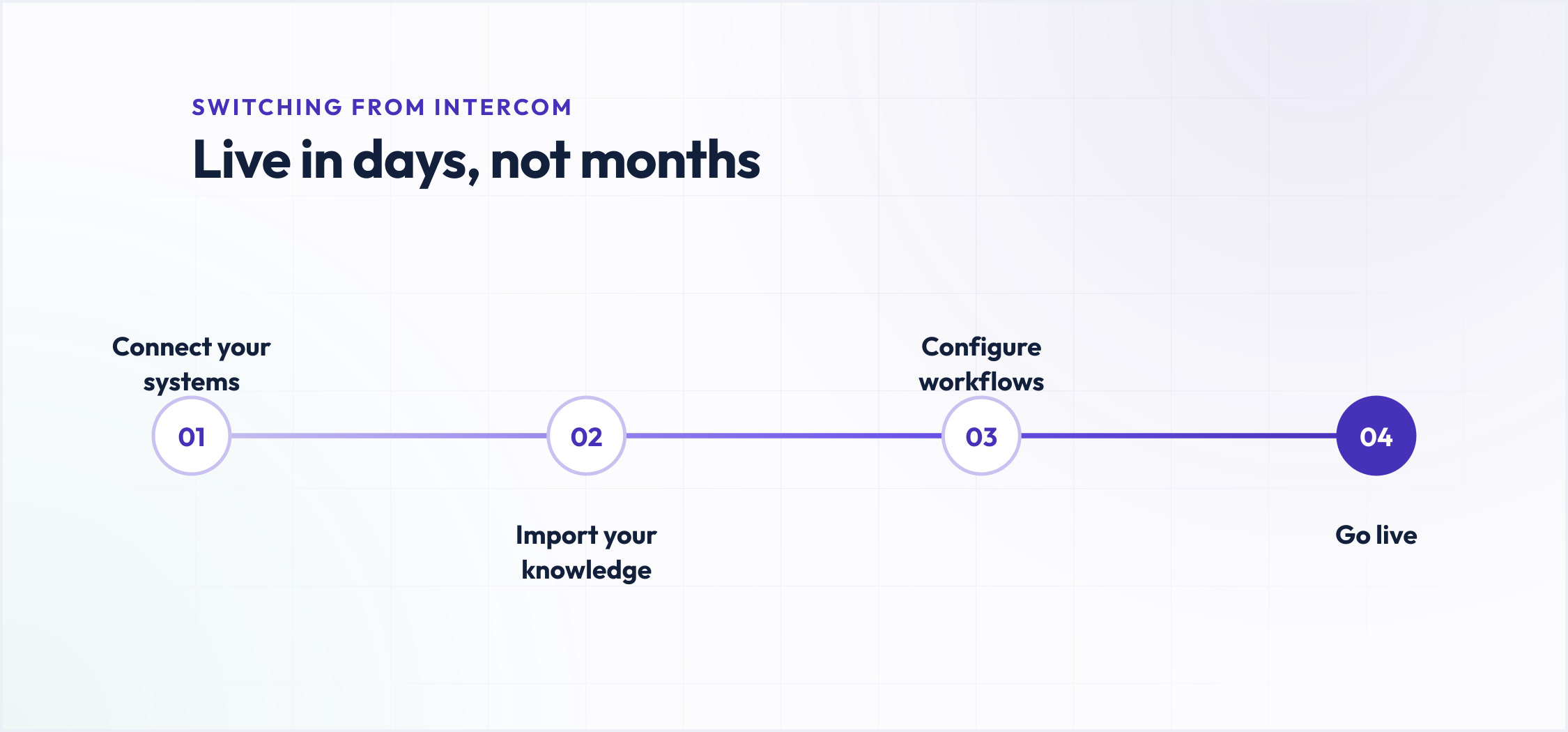
Most teams complete the switch from Intercom within 1 to 2 weeks. With Enjo, you can get core automation up and running in about a day, with full deployment typically completed within a week, including integrations, knowledge base setup, and workflow configuration.
What is the best Intercom alternative for autonomous AI automation?
If your goal is deeper AI automation than Intercom or Fin can provide, Enjo is the strongest option. It uses autonomous AI Agents that reason, retrieve context, trigger workflows, and complete tasks across your business systems, going far beyond simple FAQ answering or basic chatbot deflection.
Which Intercom alternative reduces customer support workload the most?
Platforms built on autonomous AI Agents, like Enjo, don't just retrieve answers from your knowledge base; they take direct action in your systems to resolve requests end-to-end (refunds, order updates, access changes, account modifications). This directly cuts support workload by eliminating manual handoffs. Most traditional Intercom alternatives rely on bots that surface information but still require human agents to perform the actual tasks, leaving requests stacked in your queue.
Are there free Intercom alternatives for small businesses?
Yes, several Intercom alternatives offer free tiers, though free plans typically cap automation, integrations and message volume. Enjo's free plan includes 200 AI replies a month, unlimited human agent seats, Inbox, Help Center and Insights, with no credit card required.
Can Intercom alternatives integrate with my existing tech stack?
Enjo connects to the systems your team already runs, including Salesforce, Zendesk, Jira Service Management, ServiceNow, Slack, Microsoft Teams, Confluence, Notion, SharePoint, Google Drive and Okta, so the AI Agent can retrieve data and execute actions rather than only messaging requesters.
A naming note first. Intercom renamed the company to Fin in May 2026, taking the name of its AI agent, and Salesforce signed a definitive agreement to acquire Fin for roughly $3.6 billion on 15 June 2026. The deal is signed, not closed, and is expected to complete in Salesforce's fiscal Q4 2027 subject to regulatory clearance, so Fin operates as its own product today. Fin is also sold on its own and runs on Zendesk, Salesforce, HubSpot and Freshworks, so the question is no longer which helpdesk you are on. What separates these tools is scope and pricing model: Fin is a single-product AI agent for customer service messaging, billed per resolution. For consumer-heavy chat at high volume, Fin remains excellent, and teams already using it should weigh the per-resolution cost rather than the platform question.
Rising Costs as Volume Grows: Fin bills AI resolutions at $0.99 each on top of seat pricing, so the bill rises at exactly the point automation starts working. High-growth teams find the total cost outpacing the efficiency gain, especially when the bot still escalates a large share of conversations to a human.
Limited Automation Depth (Even With Fin): Fin is a major improvement over legacy chatbots, but it still operates as a Q&A assistant, not an autonomous problem solver. Fin can’t orchestrate multi-step workflows, take backend actions, or fully resolve customer requests, which means human workload remains high.
Scalability Challenges for High-Volume Teams: As operations expand across channels, regions, and products, Intercom’s chat-first architecture can struggle with complex routing, enterprise workflows, cross-team collaboration, and large-scale process automation.
Inconsistent Responses Without Deep Knowledge Retrieval: Intercom’s bots rely heavily on predefined answers. Without deep retrieval or contextual understanding, they can produce inconsistent or shallow responses, especially when customer queries deviate from expected patterns.
What the bill actually looks like:
- Charges increase with contacts, seats, automation usage, and add-ons
- AI features, like Fin, can significantly increase monthly spend as volume grows
- High-growth companies often experience unpredictable billing spikes
- Scaling chat, bots, and support seats can make Intercom one of the most expensive platforms in this category
Teams trying to reduce support costs often find that Intercom does not scale economically, especially when its automation still relies heavily on human agents.
FAQ
Which Intercom alternative offers the most advanced workflow automation?
Enjo offers the deepest workflow automation among Intercom alternatives. Unlike traditional chatbot-based tools, Enjo's AI Agents run multi-step workflows, pull real-time data from your business systems, take actions like refunds, lookups, and account updates, and resolve issues end-to-end, not just deflect them.
Will I lose functionality by switching from Intercom to another platform?
In most cases, no. Leading Intercom alternatives offer comparable live chat, shared inbox, and knowledge base features. With platforms built for autonomous resolution, like Enjo, you gain stronger automation and more control over workflows than Intercom provides out of the box.
How long does it take to migrate from Intercom to an alternative?
Most teams complete the switch from Intercom within 1 to 2 weeks. With Enjo, you can get core automation up and running in about a day, with full deployment typically completed within a week, including integrations, knowledge base setup, and workflow configuration.
What is the best Intercom alternative for autonomous AI automation?
If your goal is deeper AI automation than Intercom or Fin can provide, Enjo is the strongest option. It uses autonomous AI Agents that reason, retrieve context, trigger workflows, and complete tasks across your business systems, going far beyond simple FAQ answering or basic chatbot deflection.
Which Intercom alternative reduces customer support workload the most?
Platforms built on autonomous AI Agents, like Enjo, don't just retrieve answers from your knowledge base; they take direct action in your systems to resolve requests end-to-end (refunds, order updates, access changes, account modifications). This directly cuts support workload by eliminating manual handoffs. Most traditional Intercom alternatives rely on bots that surface information but still require human agents to perform the actual tasks, leaving requests stacked in your queue.
Are there free Intercom alternatives for small businesses?
Yes, several Intercom alternatives offer free tiers, though free plans typically cap automation, integrations and message volume. Enjo's free plan includes 200 AI replies a month, unlimited human agent seats, Inbox, Help Center and Insights, with no credit card required.
Can Intercom alternatives integrate with my existing tech stack?
Enjo connects to the systems your team already runs, including Salesforce, Zendesk, Jira Service Management, ServiceNow, Slack, Microsoft Teams, Confluence, Notion, SharePoint, Google Drive and Okta, so the AI Agent can retrieve data and execute actions rather than only messaging requesters.