Transform complex support workflows
8 Best Agentic AI Tools for Help Desks in 2026
Every help desk vendor now has "agentic" somewhere on its homepage. Most of what they sell as agentic AI tools still does what a passable chatbot did in 2022: read the request, route it, maybe suggest a canned reply, and then hand the actual work to a human. A real agent resets the password, provisions the access, updates the ticket, and resolves the request without a person in the loop.
The gap matters because the outcomes do. Aurora's IT team hit 63% autonomous resolution after running an agent that acts on requests instead of forwarding them. Gartner estimates only about 130 of the thousands of vendors claiming agentic AI are real, calling the rest agent washing: assistants, RPA and chatbots rebranded without substantial agentic capability.
Telling a genuine agent apart from a chatbot wearing the label is the skill this guide builds, and it starts with the test below.
Agentic AI tools only count when they resolve help desk tickets end to end. Compare the 8 that do, and book a demo to see it on your own tickets.
What agentic AI actually means for a help desk
Every vendor slaps "AI service desk" or "agent" on the box, so you need a fast way to cut through the marketing. Ask what happens after the agent understands the request. If the answer is "it suggests a reply" or "it routes the ticket," you are looking at assist, not resolution. If the answer is "it takes the action and resolves the request," you have an agent.
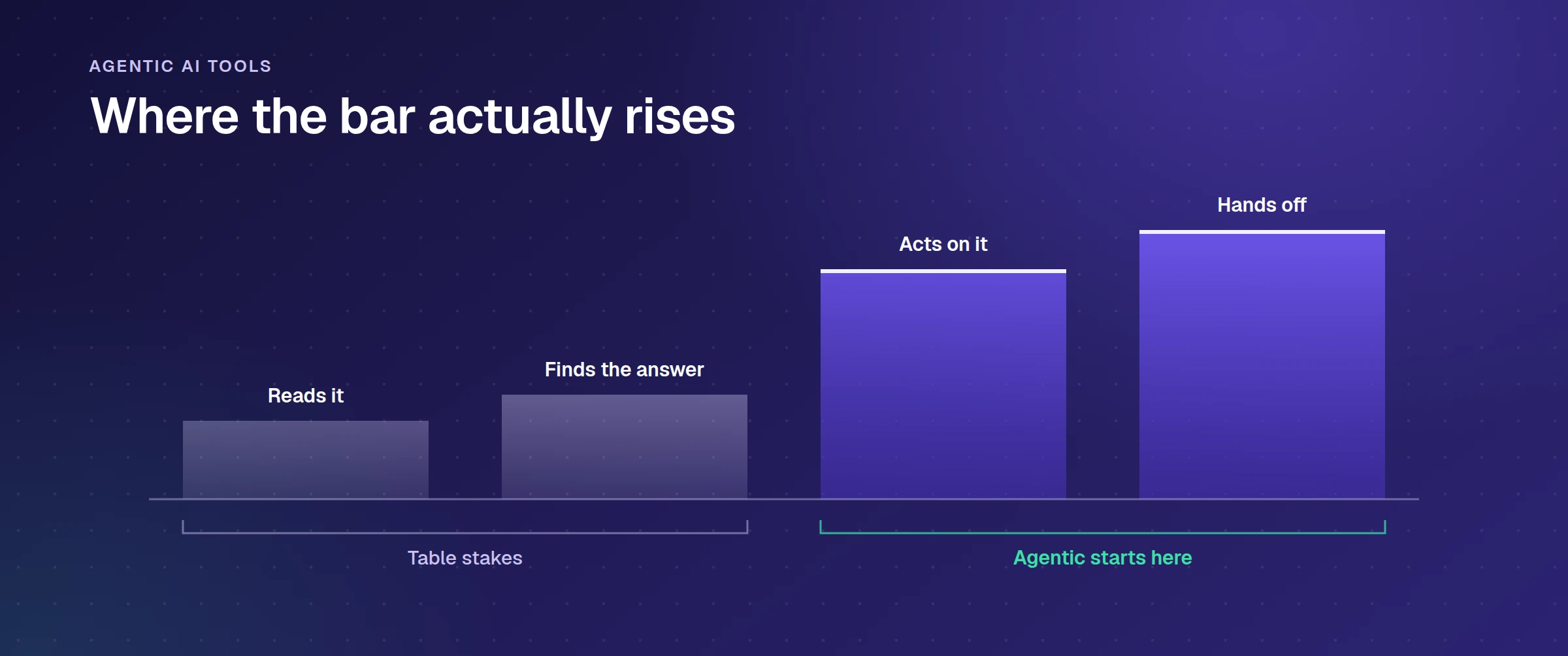
A real agent clears four bars on its own.
Is it actually agentic? The four-bar test
- It reads the request in plain language.
- It finds the right answer from wherever your knowledge lives.
- It takes the action in the connected system, unlocking the Okta account or opening the Jira ticket, instead of explaining how.
- When it is not confident, it hands the request to a person with full context.
That last habit is what separates a useful agentic AI system from a reckless one.
The industry has settled on roughly three stages of help desk automation: rules-based routing, AI-assisted suggestions, and agentic resolution. A rules-based AI ticketing system routes and tags, then breaks the moment someone phrases a request differently. Assist speeds up humans, but still needs them on every ticket. Resolution is the only stage that removes work rather than reshuffling it.
Gartner projects that by 2029, agentic AI will autonomously resolve 80% of common customer service issues without human intervention, which is why so many vendors are repositioning around the word agentic this year.
The mechanics under the hood are worth understanding before you buy, because they decide whether the agent can act or only talk. If you want the deep version, we broke down how multi-step agentic workflows execute a request from trigger to verified action.
How we picked these agentic help desk tools
Six things separate an agent that runs a help desk from an AI ticketing system that only decorates one:
End-to-end resolution. Does it resolve common requests on its own, or only route and suggest?
Action-taking. Can it operate in Okta, Jira, ServiceNow, and custom APIs, not merely answer questions?
Stack flexibility. Does it work across your help desks and knowledge sources, or lock you into one platform?
Governance. Guardrails, role-based access, audit trails, and control over hallucinations.
Deployment and pricing. Weeks or months to go live, and whether the model is per seat, per usage, or per resolution.
Channel fit. Does it live in Slack and Teams where employees already are, or only in a portal?
Every tool below is judged against those six. None of them is right for everyone, and the honest limitations are part of each entry.
The 8 agentic AI tools compared
1. Enjo
Enjo adds autonomous resolution to the helpdesk and knowledge sources you already run, or works as a standalone support platform. It is the strongest fit for mid-market IT teams that want an AI Agent live in weeks without ripping out ServiceNow, Jira, or Zendesk.
Best for: Deploys into Salesforce, Zendesk, Jira and JSM or ServiceNow and leaves the incumbent as the system of record. Runs at any size, from a few hundred people to Delivery Hero's 95,000 in Slack.
- End-to-end resolution: AI Agents handle common requests such as password resets, software access, and VPN issues, and resolve them rather than forwarding them. AI Flows chains the multi-step ones with explicit fallbacks.
- Action-taking: AI Actions reach into Okta, Jira, ServiceNow, Salesforce, and custom APIs, so the agent unlocks the account or files the ticket rather than describing how.
- Stack flexibility: a single knowledge layer spans Confluence, SharePoint, Google Drive, and past tickets across systems, and escalations create tickets in your existing helpdesk with the full conversation and account context attached.
- Governance: Guardrails, role-based access, and audit trails on every action, backed by SOC 2 Type II, ISO 27001, and GDPR compliance.
Pricing: A permanent free tier with 200 AI replies a month, unlimited human agent seats, and no credit card. Paid plans start at $95 a month for 1,000 replies. (Source: enjo.ai/pricing.)
Proof this holds up in production: Aurora achieved 63% autonomous resolution and a 60% ESAT improvement; Amber Group went from proof of concept to production in five weeks; and BookMyShow captures 100% of its IT tickets through Slack with zero manual creation. If you run IT support in Slack or Teams, you can see it on your own tickets and book a demo.
Where it falls short: Enjo is an AI layer, not a ticketing platform. It does not replace the helpdesk as the system of record, which is the point rather than a limit.
2. Moveworks
Moveworks is an enterprise employee support assistant that resolves IT and HR requests using natural language, with deep integration into large ITSM environments. ServiceNow completed its acquisition of Moveworks in December 2025, which reshaped the buying decision. The category label for this layer is AI ITSM, and the explainer covers what it resolves and what it does not.
Best for: Sold to large enterprises with mature ITSM, on a multi-quarter rollout.
- End-to-end resolution: resolves common IT and HR requests and executes tasks across connected business systems.
- Action-taking: broad enterprise integrations and a reasoning engine that plans multi-step actions.
- Channel fit: works in Slack and Microsoft Teams with a polished employee-experience surface.
Pricing: Custom and sales-led, with no public per-seat price. Third-party estimates put it at $100 to $200 per employee per year; treat that as unconfirmed until the vendor publishes.
Where it falls short: G2 reviewers flag real uncertainty for teams not on ServiceNow, as the roadmap is expected to prioritize the ServiceNow platform following the acquisition. Setup is heavy and pricing is out of reach for most mid-market teams. Teams not on ServiceNow tend to end up on our list of Moveworks alternatives.
3. Aisera
Aisera is an enterprise AI service management platform spanning IT, HR, and customer service on one conversational layer. It treats each department equally, which suits large orgs consolidating point solutions.
Best for: Positioned as a single AI layer across IT, HR and customer service, sold to large enterprises.
- End-to-end resolution: automates tier-1 ticket handling and resolves common multi-department requests.
- Action-taking: integrates across the enterprise SaaS stack, including ServiceNow and Microsoft Teams.
- Stack flexibility: helpdesk-agnostic, so it is not tied to a single ITSM vendor.
Pricing: Custom and sales-led. G2 reviewers describe the pricing as opaque, with extra charges for setup and expansion.
Where it falls short: the same reviewers cite a complex onboarding, constant fine-tuning, and slow support. This is an enterprise commitment, not a tool a mid-market team buys and runs in a few weeks.
4. ServiceNow Now Assist
Now Assist is ServiceNow's native generative AI, layered onto the Now Platform for IT, HR, and customer workflows. For an org already standardized on ServiceNow, it is the path of least resistance.
Best for: Sold to organizations already standardized on the Now Platform.
- End-to-end resolution: resolves and acts on requests inside ServiceNow's own data and workflows.
- Action-taking: deep, native access to ServiceNow objects, records, and flows.
- Governance: inherits ServiceNow's enterprise controls and audit posture.
Pricing: Custom, tied to ServiceNow licensing, and typically gated behind higher Now Platform tiers.
Where it falls short: it reads ServiceNow knowledge and acts on ServiceNow objects. Our ServiceNow AI agents buyer's guide covers where that boundary sits in practice. If your answers live in Confluence or your actions need Okta and custom systems, you are working against the grain, and the pricing uplift is real.
5. Atomicwork
Atomicwork is a modern service management platform with an agentic assistant built for mid-market teams moving off legacy ITSM. It ranks first in the search results for this keyword, and it is a genuine alternative worth mentioning.
Best for: Sold as a replacement for an incumbent ITSM platform.
- End-to-end resolution: the assistant handles common IT requests via Slack and Microsoft Teams and executes them, not merely deflects them.
- Action-taking: integrates with Jira, ServiceNow, Okta, Azure AD, and Slack.
- Deployment: teams report going live in weeks rather than months.
Pricing: Custom and usage-oriented, positioned for mid-market and generally below Moveworks and Aisera. The vendor page does not publish a fixed per-seat price.
Where it falls short: it is a newer platform still building its reference base, so complex enterprise edge cases are less proven. If you are replacing ServiceNow outright rather than layering on it, our list of ServiceNow alternatives covers nine platforms.. It leans toward replacing your ITSM rather than adding AI to the stack you already run.
6. DevRev
DevRev's Computer unifies customer support, product, and engineering on a knowledge graph data layer, with AI agents that resolve and route issues across both CX and IT. It is a strong fit for product-led organizations.
Best for: Positioned for teams putting support tickets and product work on one system.
- End-to-end resolution: resolves common tickets and routes complex ones with full context to the right owner.
- Action-taking: connectors and a workflow engine that file tickets, trigger systems, and update records.
- Stack flexibility: a knowledge graph that ties customer issues directly to product and engineering work.
Pricing: Consumption-based on a credit model, with a free Mini plan in open beta. Paid tiers are quote-based and not published per seat.
Where it falls short: the developer-centric interface is a bigger lift for a traditional support team, and reviewers note that support-first orgs wanting a polished, mature helpdesk today may struggle with the setup.
7. Freshservice Freddy AI
Freddy AI is the native AI layer inside Freshservice, Freshworks' ITSM product. It handles classification, suggested responses, basic auto-resolution, and agent assist.
Best for: Sold as an add-on to an existing Freshservice subscription.
- Ticket handling: classifies incoming tickets, drafts replies, and auto-resolves a slice of common requests.
- Agent assist: surfaces suggestions and summaries inside the agent's existing workspace.
- Deployment: low friction for existing Freshservice customers.
Pricing: Freshservice starts at $19 per agent a month on annual billing, and Freddy AI Copilot is a separate add-on at $29 per agent a month, so adding the AI more than doubles the per-agent cost.
Where it falls short: the design augments agents rather than replacing them on common requests, so it is assist-first. Its reach is bounded by the Freshworks suite, and cross-system actions in Okta, Jira, or custom tools are limited.
8. Leena.ai
Leena.ai is an autonomous agent for employee services, strongest on the HR side but capable of handling IT requests as well. It targets large organizations automating internal support.
Best for: Positioned for HR-first employee service, sold to large enterprises.
- End-to-end resolution: resolves common employee queries and executes multi-step requests autonomously.
- Action-taking: integrates across HR and IT systems for provisioning and approvals.
- Stack flexibility: works across multiple help desks rather than with a single vendor.
Pricing: Custom and sales-led, with no public per-seat price.
Where it falls short: the center of gravity is HR-first employee service, and it is shaped for enterprise buyers rather than a lean mid-market IT team.
How to choose an agentic help desk tool
Start with your stack, not the feature list. For the wider picture of how agents are changing enterprise IT support, start there instead. If you are locked into ServiceNow and plan to stay, Now Assist is the low-friction default, and Moveworks now points in the same direction. If you run Freshservice and want a modest lift, Freddy AI is already in the box.
Match the rest to your size and speed. Very large IT orgs with multi-year budgets and patience for a long rollout can weigh Moveworks and Aisera. A product-led org that wants support and engineering on one graph should look at DevRev. Mid-market IT teams that need autonomous resolution within weeks, on the helpdesk and knowledge sources they already run, are the sweet spot for Enjo and Atomicwork, with Enjo's free tier and helpdesk-agnostic layer as the lower-commitment way in.
There is a reason to be conservative about scope. Forrester's 2026 assessment of the category found roughly three-quarters of enterprise leaders reporting agentic AI adoption while only a small minority ran it in meaningful production beyond chatbot-like use. Pick the tool you can get into production on one request type, not the one with the longest capability list.
For most teams, the goal is an AI service desk that resolves the routine requests, not one more automation project that stalls in configuration. Whatever the shortlist, pressure-test the resolution claim on your own tickets before you sign. If you want a structured way to run that evaluation, the guide to help desk automation covers the three categories of tool, the nine questions that separate vendors, and the ten metrics to baseline first.
The verdict
The eight above are not interchangeable, and what separates them is not on anyone's feature page. It is the last two bars.
Run the same three checks on whatever you shortlist, on your own systems rather than the vendor's.
Ask for the list of write actions, not read actions. Reading a ticket is not resolving a request. A demo built on classification, routing and summarization is showing you the first two bars.
Ask where your knowledge lives, and whether the tool reads all of it. If the answer is one platform, answer quality is capped at whatever sits inside that platform, however good the model is.
Ask to see one escalation land in your helpdesk. Not a transcript pasted into a description field. The full conversation, the account context and the suggested next steps, in the queue your team actually works.
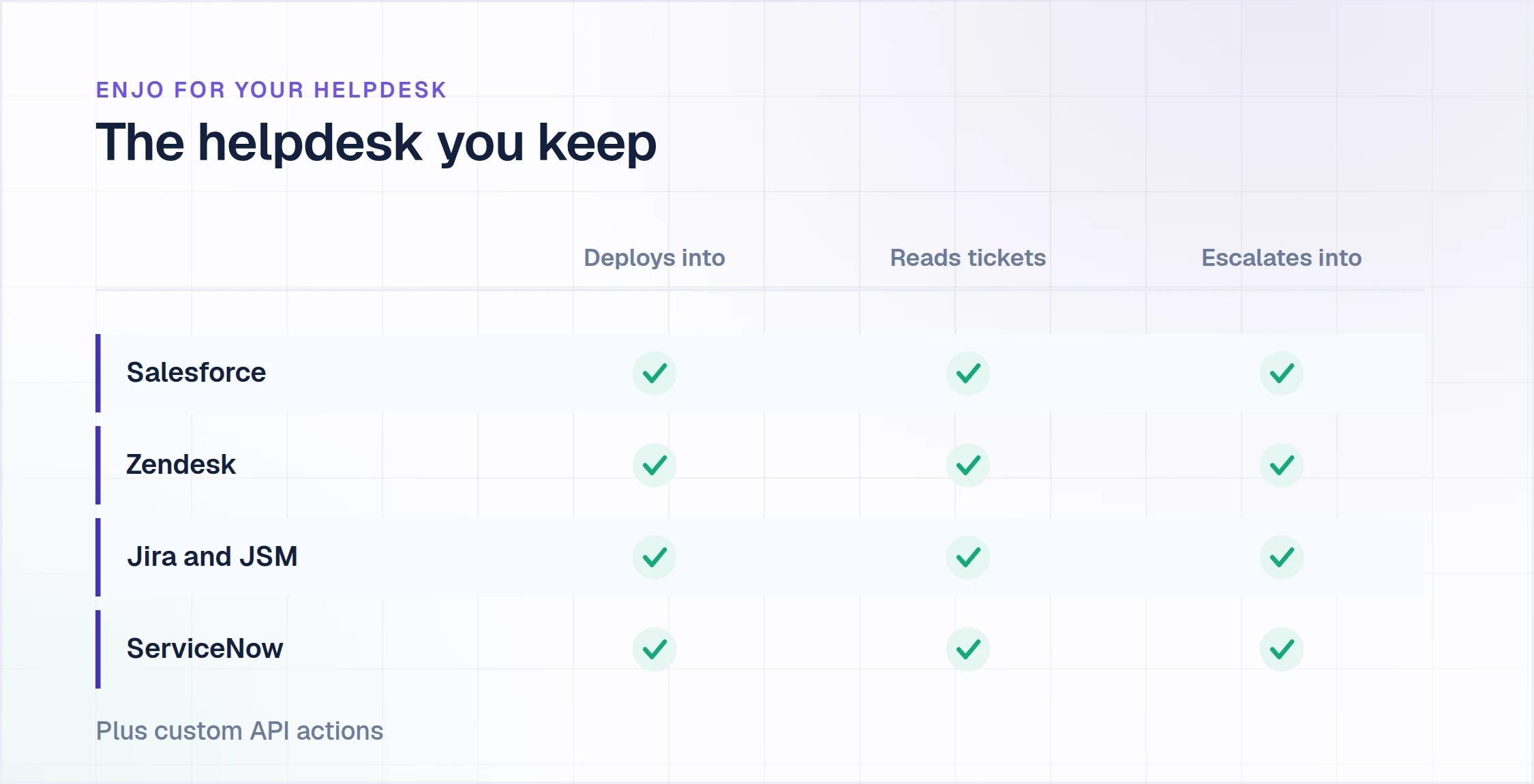
Enjo answers all three on the stack you already run. It deploys into Salesforce, Zendesk, Jira and JSM or ServiceNow and leaves the incumbent as the system of record, with nothing migrated. Teams choosing between those two systems of record should start with our Zendesk vs Salesforce Service Cloud comparison.
The knowledge index reads Confluence, SharePoint, Google Drive, Notion and Guru alongside past tickets from all four helpdesks. AI Actions covers ticket creation, lookup, updates and approvals in Jira and JSM, ticket creation, lookup and updates in ServiceNow, account unlock and access provisioning in Okta, identity lookup and provisioning in Entra ID, account and group management in Google Workspace, and custom API actions for anything else.
Delivery Hero runs it across more than 30 Jira service desks with 30% average deflection and 80% faster response. Aptean runs it on Salesforce at 3,500+ employees, with the initial cohort live in a single day.
The fastest way to settle it is your own ticket history rather than a shortlist.
See it on your own tickets
Connect a knowledge source and watch Enjo resolve real requests in Slack or Microsoft Teams. Free, no card.
Frequently asked questions
What is agentic AI for help desk automation?
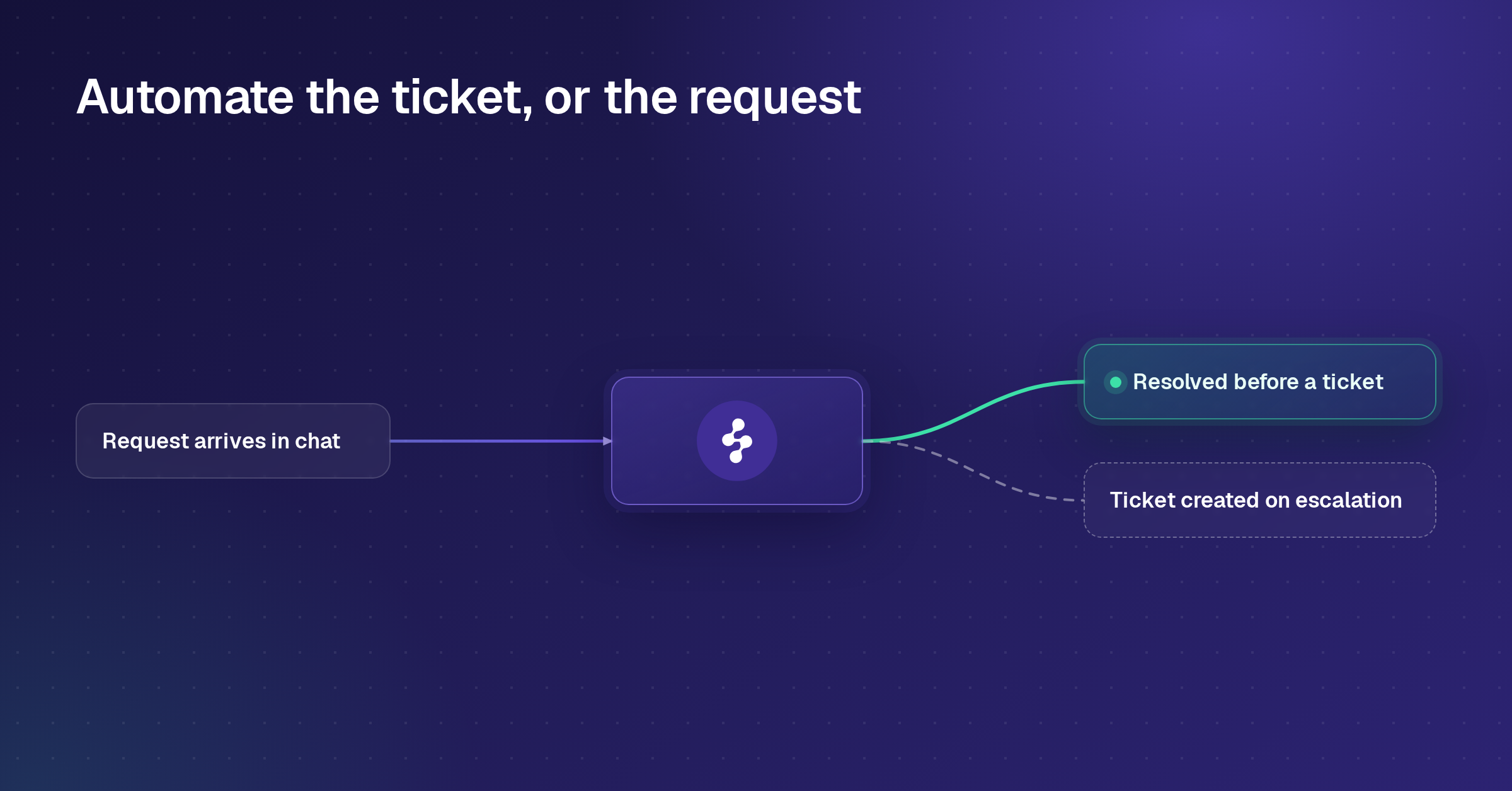
It is AI that resolves a support request end to end: it understands the request, pulls the right answer from your knowledge, takes the action in a connected system, and resolves the request. When it is not confident, it escalates to a human with full context. That is different from a chatbot that only answers or routes.
How is agentic AI different from a help desk chatbot?
A chatbot, or a basic AI ticketing system, answers questions or deflects them. An agentic AI system takes the next step, acting in Jira, Okta, or ServiceNow to actually complete the request, then updates and resolves it. The dividing line is whether work gets removed or just reshuffled.
Can agentic AI resolve IT tickets without a human?
Yes, for common requests like password resets, software access, and VPN issues. Aurora's IT team reached 63% autonomous resolution this way. Anything the agent is unsure about escalates to a person with the conversation and context attached, so nothing falls through.
Is agentic AI safe for an IT help desk?
It is when the platform enforces guardrails, role-based access, and audit trails on every action. Enjo runs on SOC 2 Type II, ISO 27001, and GDPR compliance, and every action the agent takes is logged and reviewable.
How fast can you deploy an AI service desk?
Faster than the multi-month timelines legacy platforms need. Amber Group went from proof of concept to production in five weeks, and mid-market teams commonly cover password resets, access, and ticket creation first, then expand from there.