Freshdesk vs Salesforce Service Cloud: Which Fits Your Support Stack in 2026
Most teams comparing Freshdesk vs Salesforce Service Cloud are deciding between two philosophies: a help desk you can stand up in an afternoon, or a CRM suite you build your whole operation around. That framing held for years, but it misses the part of the decision that now moves the resolution rate the most. The variable that matters is the AI doing the resolving, and both platforms tie their native AI to their own ecosystem.
By the end of this guide, you will know which platform fits a team of your size, what each one actually costs once the AI add-ons are counted, and when the better move is to stop optimizing the helpdesk choice at all. So the sections ahead weigh Freshdesk and Salesforce Service Cloud on AI, pricing, and setup, and then make the case for a resolution layer that neither vendor gets to fence in.
Freshdesk overview
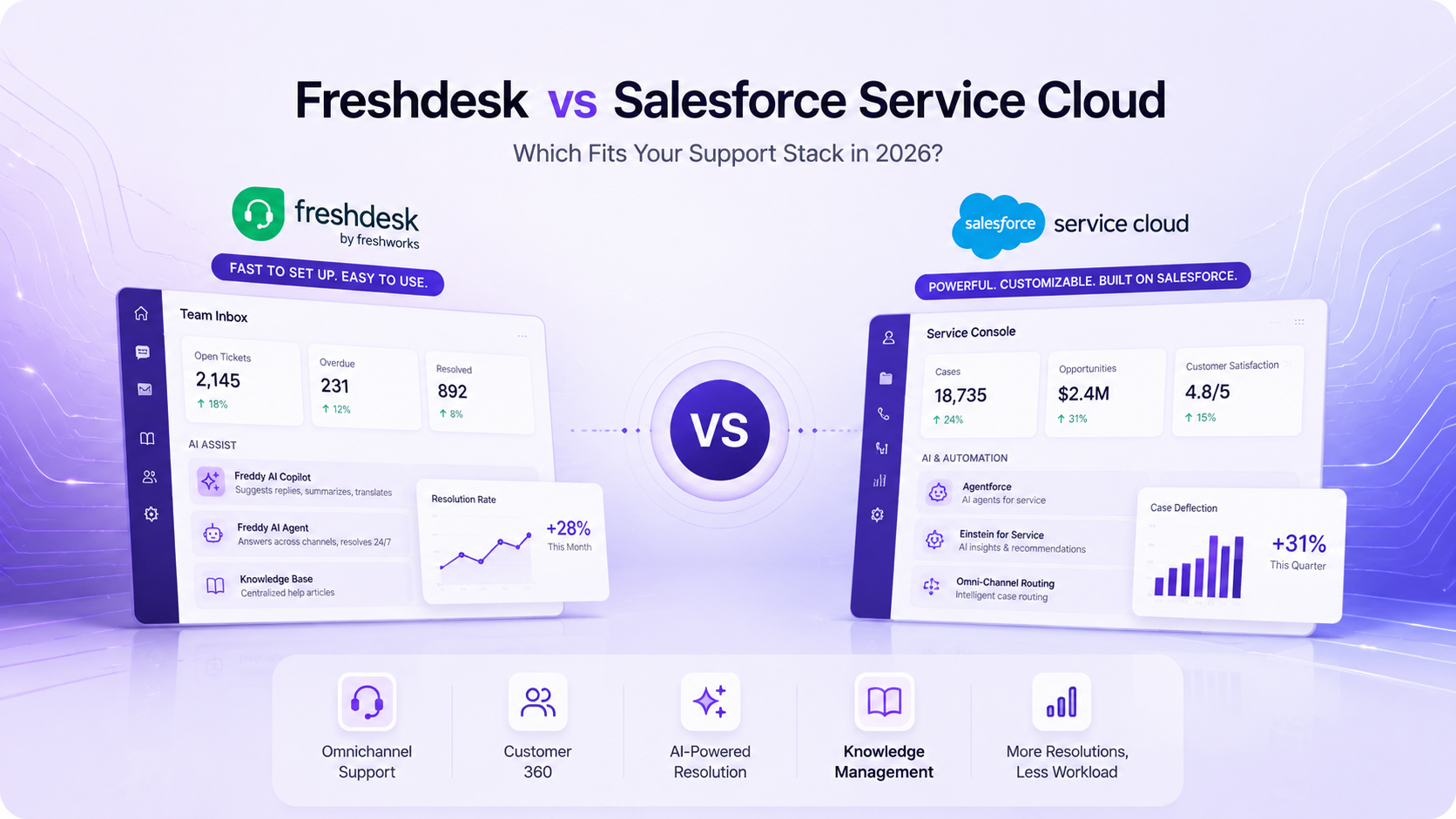
Freshdesk is the cloud help desk from Freshworks, and its entire design is focused on getting support live fast. It pulls email, chat, phone, social, and web-form tickets into a single inbox, then layers in automations, SLAs, a knowledge base, and customer portals on top. Agents get collision detection and canned responses without heavy configuration, which is why teams describe setup in hours and days rather than in project plans. When a team needs broader channels unified, Freshdesk Omni is the omnichannel edition that adds web, SMS, and messaging.
The native AI is Freddy, and it comes in two parts. Freddy AI Copilot is the agent-assist layer that suggests replies, summarizes tickets, and translates inside the workspace. Freddy AI Agent is the autonomous bot that answers questions across email, chat, and the portal, then escalates when it cannot resolve them. Both are based mainly on knowledge connected inside Freshworks, and both are priced and gated separately from the base plan, which is where the sticker price stops telling the whole story.
Salesforce Service Cloud overview
Salesforce Service Cloud is the customer service product inside the Salesforce platform, and its defining trait is the unified customer record. Agents, sales, and marketing all work from the same data, so a support case sits next to the account, the open opportunity, and the marketing history. On top of that foundation, it handles advanced case routing, omni-channel queues, CTI telephony, and deep customization across objects, workflows, and dashboards.
That depth is the trade you are making. Service Cloud expects configuration time and admin expertise, and many teams bring in a certified partner to implement it. Its native AI runs through Agentforce and Einstein for Service, covering case classification, recommended replies, summarization, sentiment, and autonomous agents. Agentforce reads from Salesforce Data Cloud and connected knowledge, and it acts most fluently on Service Cloud objects. As with Freddy, the AI is billed separately from the seat license.
Freshdesk vs Salesforce Service Cloud: feature comparison
The capabilities below were live-verified in June 2026, with sources listed in the verification flags. Confirm plan-level eligibility at checkout, because both vendors gate features by tier.
Pricing comparison
Both vendors publish a low starting price and then charge for the parts that make the tool useful at scale, so the only honest way to compare Freshdesk and Salesforce Service Cloud pricing is with the AI and add-ons counted in. The figures below were live-fetched in June 2026, and you should verify current rates before any purchase.
Freshdesk's base plans for Email and Ticketing are billed per agent per month and billed annually: Growth is $19, Pro is $55, and Enterprise is $89. Freshdesk Omni sits higher, at roughly $29, $79, and $119. AI is a separate line item. Freddy AI Copilot costs about $29 per agent per month on an annual billing plan and is limited to Pro and Enterprise plans. Freddy AI Agent is session-based, with 500 trial sessions per account, then roughly $49 per 100 sessions for the email agent, or about $0.49 per session, up from $0.10 in Q4 2025. Sessions expire each billing cycle with no rollover, so AI cost moves with a volume you do not fully control.
Salesforce Service Cloud is priced per user per month, billed annually, and it climbs steeply. Starter Suite is $25, and Pro Suite is $100, while Enterprise lists at around $165 to $175 after Salesforce raised most prices by roughly 6% in late 2025, making older quotes stale. Unlimited runs around $330 to $350, and the AI-bundled top tier, Einstein 1 Service or Agentforce 1 Service, lands around $500 to $550. Agentforce itself is billed on its own, at roughly $2 per conversation or $500 per 100,000 Flex Credits, and you choose one model per org rather than both. The Agentforce for Service add-on has reportedly cost around $125 per user per month. Per-channel add-ons, such as Digital Engagement, Voice, and Field Service, each add $50 to $200 per user per month, and partner implementation commonly runs $50,000 to $150,000.
The pattern is the same on both sides. Freshdesk's total creeps up through Freddy session packs and per-agent Copilot, while Salesforce's climbs through tier, add-ons, Agentforce consumption, and implementation. Either way, price the workflow you actually run, not the entry tier.
Where Freshdesk wins
Freshdesk earns its place on this shortlist by being the fastest to go live. A small team can turn it on in a day and run it without a dedicated admin, which matters when the alternative is a rollout that stretches into a quarter. Its entry tiers also sit well below Service Cloud's, so teams that mainly need clean ticketing and a searchable knowledge base are not paying for CRM depth they will never touch. And when support, IT, and basic automation already live inside Freshworks, adding Freddy is the least disruptive way to layer on AI without onboarding another vendor.
Where Salesforce Service Cloud wins
Salesforce Service Cloud earns its complexity when support cannot be an island. Because a case sits on the same customer record as the account, the opportunity, and the marketing history, agents act with context that a standalone help desk cannot assemble. That same platform depth carries advanced routing, telephony, and multi-department workflows at a volume that would overwhelm a lighter tool. For teams that have already committed to keeping their knowledge and actions within Salesforce, Agentforce's tight integration with the Service Cloud data model is the most direct route to native AI.
The variable both options share: the AI is locked to the helpdesk
Here is what the standard Freshdesk vs Salesforce Service Cloud comparison leaves out. Freddy and Agentforce are both good at what they do, but each one mostly reads its own platform's knowledge and acts on its own platform's objects. When you pick the helpdesk, you are also picking the boundary of your AI, and if you change helpdesks later, that AI investment does not come with you.
A dedicated AI resolution layer removes that constraint. Enjo runs in Salesforce or stands alone, and it is grounded in a single knowledge layer that spans Confluence, SharePoint, Google Drive, and past tickets across systems, not just one vendor's knowledge base. Its AI Actions integrate with Okta, Jira, ServiceNow, Salesforce, and custom APIs, so the agent resolves requests rather than just answering them, and AI Flows run multi-step workflows with an explicit fallback when the agent is not confident. That is the difference between a feature that lives inside a helpdesk and a layer that outlives whichever helpdesk you choose.
That architecture is what enables Aptean, running on a Salesforce stack, to go live in a single day, index more than 2 million documents, and process over 200,000 requests per year. The cost model differs by design as well: Enjo prices per AI Reply rather than per seat, and every plan includes unlimited human agent seats, so growing the team does not grow the bill.
Book a demo to see Enjo resolve a real ticket on your current stack.
FAQ
Q : Is Freshdesk or Salesforce Service Cloud better for a small team?
A: For most small teams, Freshdesk is the better fit because it sets up faster, costs less at the entry tier, and asks for far less admin work. Salesforce Service Cloud is usually only worth it for a small team that is already deep in the Salesforce ecosystem.
Q : Is Salesforce Service Cloud worth the cost compared to Freshdesk?
A : It is worth the cost when unified customer data across sales, service, and marketing is a genuine requirement, or when you need deep customization at high volume. For standalone support, it tends to be more platform- and price-intensive than the job actually needs.
Q : Can I add AI to Freshdesk or Salesforce without switching helpdesks?
A : Yes, and that is exactly what a dedicated AI layer like Enjo is for. It runs on top of your existing stack and is grounded in knowledge that lives beyond the helpdesk, instead of relying on the helpdesk's native AI, and it can even generate help center articles from your existing ticket patterns, including Freshdesk tickets. You can read more in our guide to AI chatbots for customer service.
Q : Do Freddy AI and Agentforce work outside their own ecosystems?
A :They are both optimized for their respective products and data, so their strengths do not carry over. Cross-system actions such as Okta, Jira, and custom APIs, along with knowledge that lives outside the platform, typically require additional integration work.
Q: How fast can each one deploy?
A: Freshdesk usually goes live in hours to days, while Salesforce Service Cloud expects configuration time and often a partner. For comparison, Enjo deployed on Aptean's Salesforce stack in a single day.
Verdict and next step
Choose Freshdesk for speed and simplicity, and choose Salesforce Service Cloud for CRM-unified depth at scale. If the outcome you are really buying is autonomous resolution, though, the helpdesk becomes the smaller decision and the AI layer becomes the larger one, and that layer should not be hostage to either vendor's ecosystem. If you are weighing all three options, it is worth reading our roundups on free customer service software and AI support agents.
Book a demo. Walk through your support workflow and watch Enjo resolve tickets on top of Salesforce, Zendesk, or your existing helpdesk, all on one knowledge layer.
Freshdesk overview
Freshdesk is the cloud help desk from Freshworks, and its entire design is focused on getting support live fast. It pulls email, chat, phone, social, and web-form tickets into a single inbox, then layers in automations, SLAs, a knowledge base, and customer portals on top. Agents get collision detection and canned responses without heavy configuration, which is why teams describe setup in hours and days rather than in project plans. When a team needs broader channels unified, Freshdesk Omni is the omnichannel edition that adds web, SMS, and messaging.
The native AI is Freddy, and it comes in two parts. Freddy AI Copilot is the agent-assist layer that suggests replies, summarizes tickets, and translates inside the workspace. Freddy AI Agent is the autonomous bot that answers questions across email, chat, and the portal, then escalates when it cannot resolve them. Both are based mainly on knowledge connected inside Freshworks, and both are priced and gated separately from the base plan, which is where the sticker price stops telling the whole story.
Salesforce Service Cloud overview
Salesforce Service Cloud is the customer service product inside the Salesforce platform, and its defining trait is the unified customer record. Agents, sales, and marketing all work from the same data, so a support case sits next to the account, the open opportunity, and the marketing history. On top of that foundation, it handles advanced case routing, omni-channel queues, CTI telephony, and deep customization across objects, workflows, and dashboards.
That depth is the trade you are making. Service Cloud expects configuration time and admin expertise, and many teams bring in a certified partner to implement it. Its native AI runs through Agentforce and Einstein for Service, covering case classification, recommended replies, summarization, sentiment, and autonomous agents. Agentforce reads from Salesforce Data Cloud and connected knowledge, and it acts most fluently on Service Cloud objects. As with Freddy, the AI is billed separately from the seat license.
Freshdesk vs Salesforce Service Cloud: feature comparison
The capabilities below were live-verified in June 2026, with sources listed in the verification flags. Confirm plan-level eligibility at checkout, because both vendors gate features by tier.
Pricing comparison
Both vendors publish a low starting price and then charge for the parts that make the tool useful at scale, so the only honest way to compare Freshdesk and Salesforce Service Cloud pricing is with the AI and add-ons counted in. The figures below were live-fetched in June 2026, and you should verify current rates before any purchase.
Freshdesk's base plans for Email and Ticketing are billed per agent per month and billed annually: Growth is $19, Pro is $55, and Enterprise is $89. Freshdesk Omni sits higher, at roughly $29, $79, and $119. AI is a separate line item. Freddy AI Copilot costs about $29 per agent per month on an annual billing plan and is limited to Pro and Enterprise plans. Freddy AI Agent is session-based, with 500 trial sessions per account, then roughly $49 per 100 sessions for the email agent, or about $0.49 per session, up from $0.10 in Q4 2025. Sessions expire each billing cycle with no rollover, so AI cost moves with a volume you do not fully control.
Salesforce Service Cloud is priced per user per month, billed annually, and it climbs steeply. Starter Suite is $25, and Pro Suite is $100, while Enterprise lists at around $165 to $175 after Salesforce raised most prices by roughly 6% in late 2025, making older quotes stale. Unlimited runs around $330 to $350, and the AI-bundled top tier, Einstein 1 Service or Agentforce 1 Service, lands around $500 to $550. Agentforce itself is billed on its own, at roughly $2 per conversation or $500 per 100,000 Flex Credits, and you choose one model per org rather than both. The Agentforce for Service add-on has reportedly cost around $125 per user per month. Per-channel add-ons, such as Digital Engagement, Voice, and Field Service, each add $50 to $200 per user per month, and partner implementation commonly runs $50,000 to $150,000.
The pattern is the same on both sides. Freshdesk's total creeps up through Freddy session packs and per-agent Copilot, while Salesforce's climbs through tier, add-ons, Agentforce consumption, and implementation. Either way, price the workflow you actually run, not the entry tier.
Where Freshdesk wins
Freshdesk earns its place on this shortlist by being the fastest to go live. A small team can turn it on in a day and run it without a dedicated admin, which matters when the alternative is a rollout that stretches into a quarter. Its entry tiers also sit well below Service Cloud's, so teams that mainly need clean ticketing and a searchable knowledge base are not paying for CRM depth they will never touch. And when support, IT, and basic automation already live inside Freshworks, adding Freddy is the least disruptive way to layer on AI without onboarding another vendor.
Where Salesforce Service Cloud wins
Salesforce Service Cloud earns its complexity when support cannot be an island. Because a case sits on the same customer record as the account, the opportunity, and the marketing history, agents act with context that a standalone help desk cannot assemble. That same platform depth carries advanced routing, telephony, and multi-department workflows at a volume that would overwhelm a lighter tool. For teams that have already committed to keeping their knowledge and actions within Salesforce, Agentforce's tight integration with the Service Cloud data model is the most direct route to native AI.
The variable both options share: the AI is locked to the helpdesk
Here is what the standard Freshdesk vs Salesforce Service Cloud comparison leaves out. Freddy and Agentforce are both good at what they do, but each one mostly reads its own platform's knowledge and acts on its own platform's objects. When you pick the helpdesk, you are also picking the boundary of your AI, and if you change helpdesks later, that AI investment does not come with you.
A dedicated AI resolution layer removes that constraint. Enjo runs in Salesforce or stands alone, and it is grounded in a single knowledge layer that spans Confluence, SharePoint, Google Drive, and past tickets across systems, not just one vendor's knowledge base. Its AI Actions integrate with Okta, Jira, ServiceNow, Salesforce, and custom APIs, so the agent resolves requests rather than just answering them, and AI Flows run multi-step workflows with an explicit fallback when the agent is not confident. That is the difference between a feature that lives inside a helpdesk and a layer that outlives whichever helpdesk you choose.
That architecture is what enables Aptean, running on a Salesforce stack, to go live in a single day, index more than 2 million documents, and process over 200,000 requests per year. The cost model differs by design as well: Enjo prices per AI Reply rather than per seat, and every plan includes unlimited human agent seats, so growing the team does not grow the bill.
Book a demo to see Enjo resolve a real ticket on your current stack.
FAQ
Q : Is Freshdesk or Salesforce Service Cloud better for a small team?
A: For most small teams, Freshdesk is the better fit because it sets up faster, costs less at the entry tier, and asks for far less admin work. Salesforce Service Cloud is usually only worth it for a small team that is already deep in the Salesforce ecosystem.
Q : Is Salesforce Service Cloud worth the cost compared to Freshdesk?
A : It is worth the cost when unified customer data across sales, service, and marketing is a genuine requirement, or when you need deep customization at high volume. For standalone support, it tends to be more platform- and price-intensive than the job actually needs.
Q : Can I add AI to Freshdesk or Salesforce without switching helpdesks?
A : Yes, and that is exactly what a dedicated AI layer like Enjo is for. It runs on top of your existing stack and is grounded in knowledge that lives beyond the helpdesk, instead of relying on the helpdesk's native AI, and it can even generate help center articles from your existing ticket patterns, including Freshdesk tickets. You can read more in our guide to AI chatbots for customer service.
Q : Do Freddy AI and Agentforce work outside their own ecosystems?
A :They are both optimized for their respective products and data, so their strengths do not carry over. Cross-system actions such as Okta, Jira, and custom APIs, along with knowledge that lives outside the platform, typically require additional integration work.
Q: How fast can each one deploy?
A: Freshdesk usually goes live in hours to days, while Salesforce Service Cloud expects configuration time and often a partner. For comparison, Enjo deployed on Aptean's Salesforce stack in a single day.
Verdict and next step
Choose Freshdesk for speed and simplicity, and choose Salesforce Service Cloud for CRM-unified depth at scale. If the outcome you are really buying is autonomous resolution, though, the helpdesk becomes the smaller decision and the AI layer becomes the larger one, and that layer should not be hostage to either vendor's ecosystem. If you are weighing all three options, it is worth reading our roundups on free customer service software and AI support agents.
Book a demo. Walk through your support workflow and watch Enjo resolve tickets on top of Salesforce, Zendesk, or your existing helpdesk, all on one knowledge layer.

Transform complex support workflows


Stay Informed and Inspired



Start Free. Prove Value. Scale When Ready.
Use Enjo for real customer conversations and see how it fits your support workflow. Scale as your support grows.