Transform complex support workflows
AI Customer Service Software: 11 Best Platforms for 2026
AI customer service software splits into two architectures, and the split sets the ceiling. A dedicated AI layer reads across every system a resolution touches. A helpdesk's built-in AI is bounded to its own objects, its own knowledge base, and its own licensing.
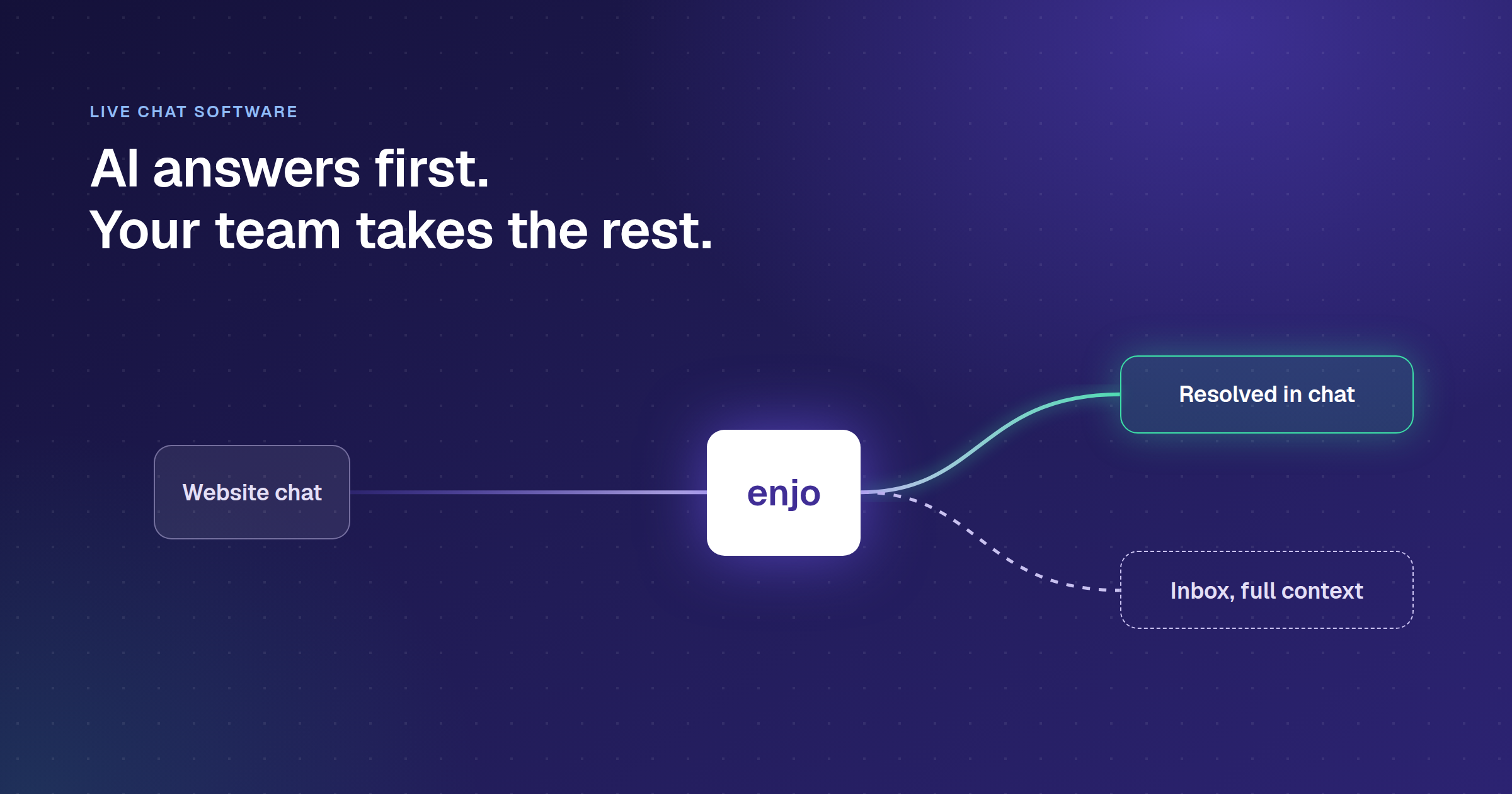
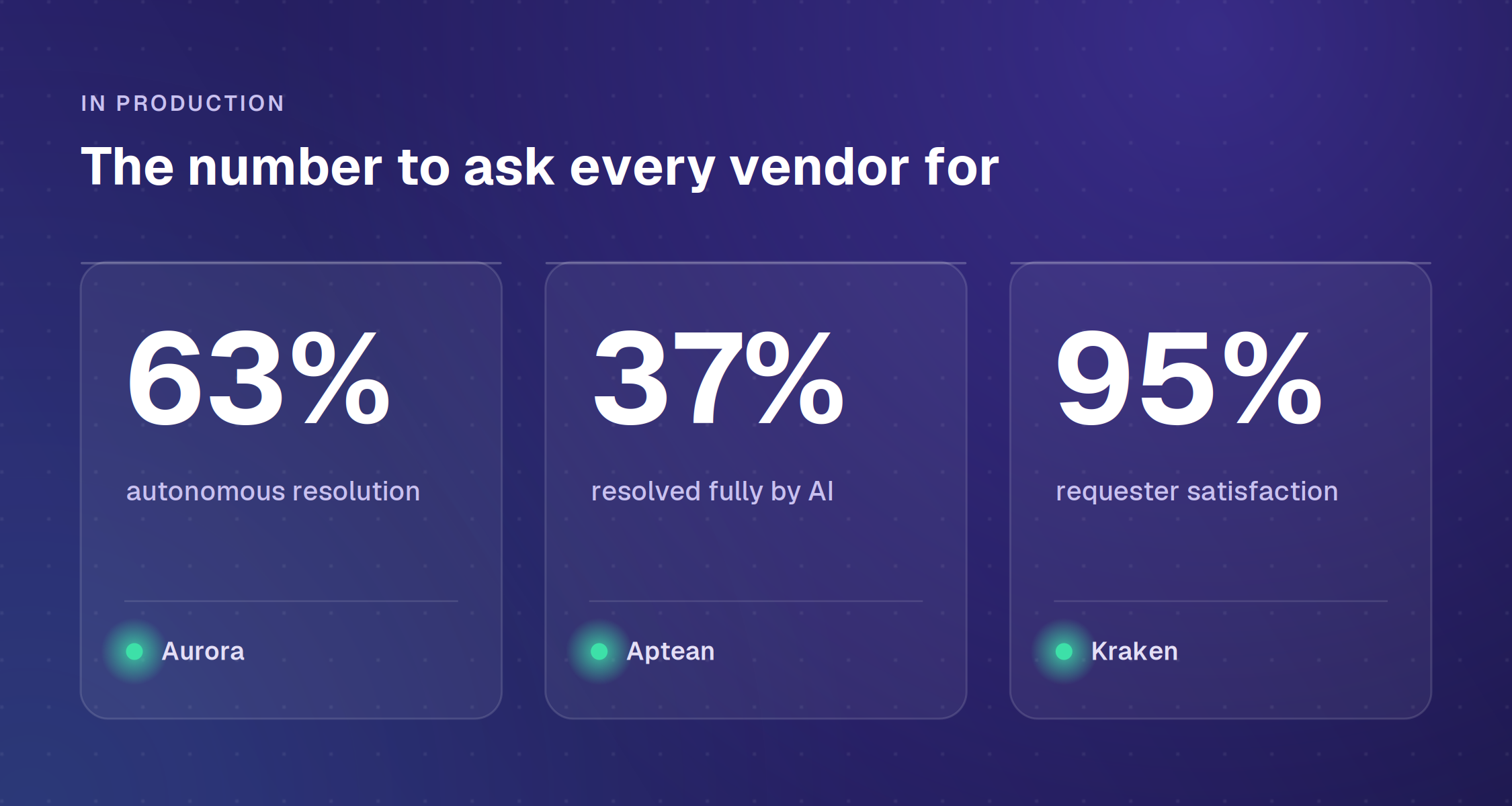
Enjo is first on this list as the layer. It resolves inside Salesforce, Zendesk, Jira, or ServiceNow while indexing knowledge from outside them. Aptean brought its initial cohort live in a single day and now resolves 37% of its cases with no human involvement, volume equivalent to 120 agents handled by AI. If you want the category explained rather than compared, start with our ai support agents guide.
What Is AI Customer Service Software?
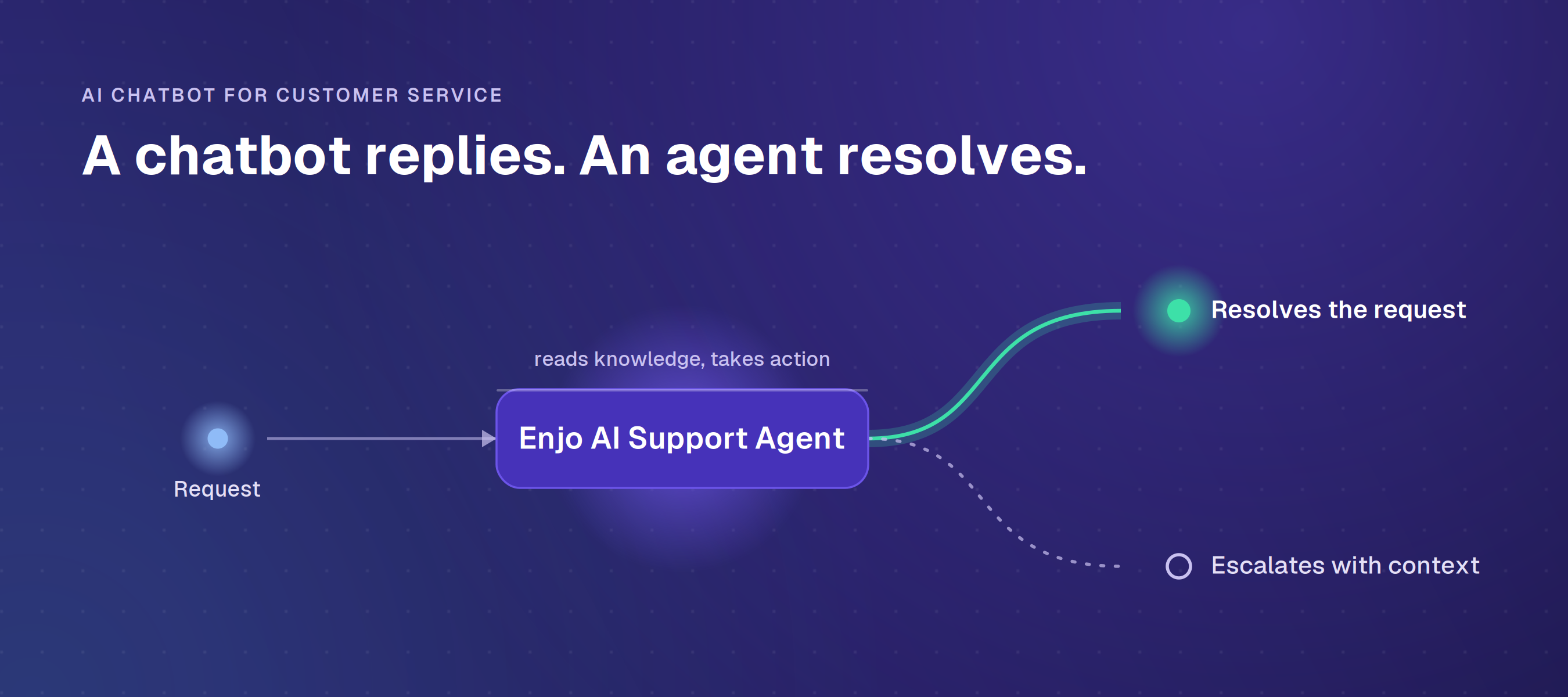
AI customer service software resolves inbound support requests without a human agent. It interprets the request, retrieves the answer from connected knowledge sources, and takes the action required by the resolution in the systems that hold the data.
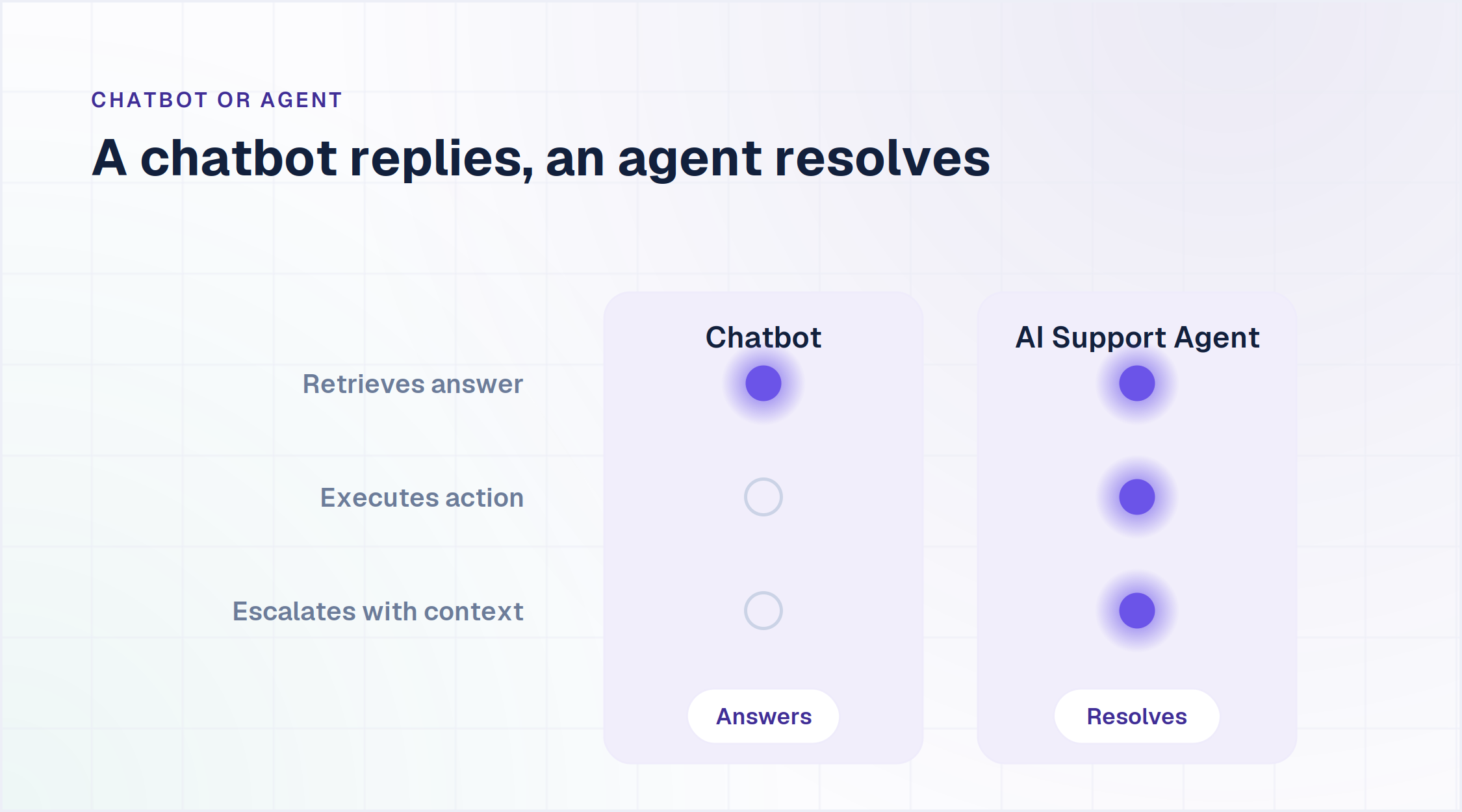
A chatbot matches a request against scripted answers and hands off when no match is found. AI customer service software completes the request and escalates with full context when it cannot. We draw that line in more detail in chatbots vs conversational AI.
Gartner predicts that agentic AI will autonomously resolve 80% of common customer service issues by 2029, without human intervention. Getting there is an evaluation problem rather than a technology one. For ten concrete workflows, from order lookups to password resets, see our customer service automation examples.
Forrester's 2026 assessment of the category found that roughly three-quarters of enterprise leaders reported adopting agentic AI, while only a small minority ran it in meaningful production beyond chatbot-like use.
We shortlisted from more than 30 platforms and kept the eleven with active product motion in customer service and verifiable capability claims. We priced all eleven ourselves on each vendor's pricing page in September and October 2026 and modeled the AI cost across three support volumes. Where a vendor publishes no rate, we say so rather than quoting a third-party estimate. If you need the helpdesk suites themselves rather than an AI layer, see our ranking of the 10 best customer service software.
How We Evaluated These AI Customer Service Platforms
Most rankings of AI tools for customer service score on features. These six criteria score on evidence you can produce without a demo.
Resolution versus deflection. AI customer service agents are sold on one of these two numbers, and they are not the same. A deflected request is one the requester gave up on. A resolved request is one that ended. These are different numbers, and vendors often publish the friendlier one.
Knowledge reach. Which sources the AI indexes. An agent grounded only in its own vendor's knowledge base hits a ceiling the first time an answer lives in Confluence, SharePoint, or a past ticket in another system. Our guide to the AI knowledge base covers how that index gets built and kept current.
Write actions and authorization. Reading a case is not resolving a request. We looked for the list of operations each platform performs in outside systems, and who authorizes each one. Designing those workflows is a separate exercise, covered in our customer service automation guide.
Billing unit and behavior at volume. Customer service AI software meters in at least five different units. Per resolution, per conversation, per action, per credit, and per AI reply look similar in a deck. They produce very different invoices once volume moves.
Time to first resolved request. Hours, days, weeks, or months. This is the number CS leaders are held to when a board asks for AI results this quarter.
Governance posture. Guardrails on inputs and outputs, an audit trail on every AI decision, role-based access control, and the certifications a security review will ask for.
The 11 Best AI Customer Service Software Platforms in 2026
| Platform | G2 Rating | Knowledge It Reads | How the AI Bills |
|---|---|---|---|
| Enjo Our pick | 4.8/5 | Confluence, SharePoint, Drive, Notion and past tickets | Per AI reply, unlimited seats, free plan |
| Intercom Fin | 4.5/5 | Fin content plus host platform sources | $0.99 per outcome on top of seats |
| Zendesk AI | 4.3/5 | Zendesk Guide and ticket history | $1.50 to $2.00 per resolution |
| ClearFeed | 4.6/5 | Atlas, Confluence, Notion, Zendesk and past Slack requests | Per-agent or per-channel plans with AI requests included on Professional |
| Salesforce Agentforce | 4.3/5 | Salesforce data, more via Data 360 | $2 per conversation or Flex Credits |
| Freshdesk Freddy AI | 4.4/5 | Freshworks knowledge and tickets | Copilot per agent, sessions in blocks |
| Ada | 4.6/5 | Connected knowledge, Zendesk and Salesforce sync | Contract only, no published rate |
| Decagon | 4.8/5 | Sources configured per build | Contract only, no published rate |
| Sierra | 4.5/5 | Company-wide, via its Agent Data Platform | Outcome-based, no published rate |
| HubSpot Breeze | 4.4/5 | HubSpot knowledge base and CRM | $0.50 per resolved conversation |
| Tidio Lyro | 4.6/5 | Help centre content and uploads | Metered separately, 50 free conversations |
List rates from each vendor's own pricing page, checked September and October 2026; G2 ratings checked October 2026. Visit each vendor's site directly to verify.
Ada, Decagon, and Sierra publish no rate at all. That is itself a finding: three of the eleven cannot be budgeted without a sales conversation.
1. Enjo
Enjo is an AI Support Agent that resolves requests end-to-end and takes action in connected systems, deployed either into an existing helpdesk or inside the Enjo Platform.
Enjo covers IT, HR, and customer support on one knowledge layer. That is what separates it from the single-vertical agents on this list when a team is consolidating vendors rather than adding one.
How it goes to market: Sold to IT, HR, and customer support teams keeping their existing helpdesk. Priced per AI reply, with unlimited human agent seats and a permanent free tier that needs no credit card.
Key capabilities
- One knowledge index that keeps learning: one index grounds AI resolution, human agent workflows, and Help Center self-service, so what the agent says is what agents see is what requesters find. Every human reply teaches the system in real time, with no additional configuration required.
- Knowledge outside the helpdesk: Confluence, SharePoint, Google Drive, Notion and Guru sync daily, alongside past tickets from Jira, JSM, Zendesk, ServiceNow and Salesforce Service Cloud.
- AI Actions in outside systems: unlocks an Okta account, provisions group access, creates and updates Jira and ServiceNow tickets, and looks up and updates Salesforce records. Custom API and webhook actions reach systems outside the named vendor list.
- Escalation that carries context: an unresolved request lands in the incumbent queue with the full conversation, the account context, and suggested next steps attached.
- Agent Assist inside the agent's own workspace: case summaries, reply suggestions and knowledge surface in the JSM, ServiceNow, Zendesk and Salesforce case views rather than in a separate tool.
- Grounded answers you can inspect and test first: a citation on every response, plus synthesis data showing how the conclusion was reached. Bulk Testing validates accuracy and coverage before launch; Guardrails run on inputs and outputs; and role-based access control, plus a searchable audit log, cover every AI decision.
- Channels where requests already arrive: Slack with slash commands, emoji actions, and approval flows; Microsoft Teams; website chat; the Help Center portal; and Slack Connect shared channels.
Pricing: Free at $0 a month with 200 AI replies, unlimited human agent seats, and no credit card. Starter: $95 a month for 1,000 AI replies. Standard $295 a month for 3,000. Enterprise is custom on yearly billing. Additional AI replies are $0.05 each on Starter and Standard. At the Free limit, requests auto-escalate to human agents in Inbox, and no requests are dropped.
Scope: Enjo is an AI layer, not a ticketing platform.
It does not replace the helpdesk as the system of record, which is the point rather than a limit. Enjo also addresses the objection that every AI evaluation runs into: pilots never leave the sandbox. Troopr engineers build and run the first agent on the team's real systems for 30 days at no cost. Success criteria are agreed at kickoff, including a committed 20% automation target. When those are met, the pilot tenant becomes the production tenant, with nothing rebuilt and nothing migrated. Insights then report time saved and cost savings, which is the number a transformation lead has to take to a board.
Aptean runs an ERP business spanning 80+ products and 15,000+ customers, supported by 600+ support reps. Its initial cohort went live in a single day. Enjo now indexes 5M+ documents across Salesforce case feeds, knowledge bases, and SharePoint, resolves 300K+ cases a year, and handles 37% of cases fully without human involvement. That is volume equivalent to 120 agents handled by AI.
Enjo is built by Troopr Labs, which has 600+ enterprise deployments and 99.9% uptime across its products over 7 years, with SOC 2 Type II, ISO 27001, and GDPR compliance.

2. Intercom Fin
Fin is a single-product AI agent for customer service messaging, sold both as a standalone product and as a layer on other help desks. The company rebranded from Intercom to Fin in May 2026, taking the name of its agent. Teams weighing Fin against Zendesk directly can start with our Zendesk vs Intercom comparison.
How it goes to market: Sold standalone and through Fin for platforms on Zendesk, Salesforce, HubSpot, and Freshworks. Billed per resolved outcome on top of seats, with a 50-outcome monthly minimum.
Key capabilities
- Runs without an Intercom seat: Fin for platforms installs as a standalone app on Zendesk, Salesforce, HubSpot, and Freshworks.
- Procedures in plain language: multi-step policies are written as instructions, and the agent executes them.
- 45+ languages across chat, email, voice, and SMS, with Fin Voice handling phone conversations.
- Copilot for human agents: drafts replies, surfaces knowledge, and summarizes threads on live conversations.
Pricing: Fin AI at $0.99 per resolved outcome with a 50-outcome monthly minimum. Seat plans start at around $29 per seat per month on an annual billing plan. Copilot is a separate per-agent add-on. Visit fin.ai directly to verify current rates.
Teams weighing whether Intercom still fits can compare the field in our roundup of intercom alternatives.
Limitation: Fin's own published case studies cluster between 42% and 50% conversation resolution. The per-outcome bill is therefore hard to forecast until a stable baseline is established for your own ticket mix.
Salesforce completed its acquisition of Fin in September 2026, for approximately $3.6B, and Fin now sits inside Salesforce AI Labs. A team choosing Fin to escape helpdesk-native AI should model where its roadmap now sits.
3. Zendesk AI
Zendesk AI is the native AI layer inside the Zendesk suite, covering autonomous resolution, agent copilot, and workflow automation. Zendesk acquired Forethought in March 2026, adding triage, QA, and resolution capabilities that it now sells as Forethought AI agents.
How it goes to market: Sold as an omnichannel suite subscription priced per agent seat, with Copilot as a per-agent add-on and AI agent usage billed per automated resolution.
Key capabilities
- Resolution Learning Loop: the agent improves from each resolved ticket without a manual retraining step.
- Agent Builder: builds and tests custom AI agents in a no-code interface.
- Forethought agents run cross-platform: per Zendesk's own announcement, they work on other platforms without requiring Zendesk.
- 1,800-app marketplace with mature workforce management and QA add-ons.
Pricing: Support Team $19 per agent per month, Suite Team $55 and Suite Professional $115, all on annual billing, with Suite Enterprise + Copilot sold through sales. Each plan includes automated resolutions (5 per agent per month on Suite Team, 10 on Professional, 15 on Enterprise); beyond that, they are $1.50 each on committed volume or $2.00 pay-as-you-go. Copilot is $50 per agent per month. Visit zendesk.com directly to verify current rates.
Limitation: native Zendesk AI is grounded in Zendesk Guide and Zendesk ticket history. Reaching knowledge held in Confluence, SharePoint, or a second helpdesk requires additional configuration, and the per-resolution charge adds to the per-seat cost during peak months.
Teams staying on Zendesk who need the AI to read outside it can run Enjo for Zendesk as the layer above it. If the contract is up and the platform itself is in question, our roundup of zendesk alternatives covers the standalone options.
4. ClearFeed
ClearFeed is an AI-powered helpdesk for teams that support customers in Slack and Slack Connect. Its AI agents answer questions using connected documentation and pull information from business tools. They can also take actions, such as creating Jira issues or updating Zendesk tickets.
How it goes to market: ClearFeed serves B2B customer support and internal service teams working in Slack. Teams can use its built-in ticketing or connect their existing helpdesk. AI handles common questions, and human responders take over requests that need more attention.
Key capabilities
- AI replies in Slack, Teams, email, and web chat. Virtual Agent replies publicly in the customer's request thread. Agent Assistant drafts private replies for a human to review and send. Customers stay in the channel where they asked for help.
- Actions in connected support tools. The AI Agent can create or update Zendesk tickets, Jira issues, HubSpot contacts, and GitHub issues from the customer conversation. In Interactive Agent Mode, it asks follow-up questions and makes multiple tool calls before escalating to a human. This mode works in Slack and web chat.
- Customer-confirmed resolution. Before creating a ticket, Virtual Agent can answer the question and ask the customer to choose "Yes, mark as solved" or "No, create a ticket." Virtual Agent inbox filters separate deflected and escalated requests, helping support leads track what the agent resolved.
- Documentation updates with Atlas. Doc Updater Agent reviews support tickets to flag missing or outdated content. Atlas, ClearFeed's public knowledge base, hosts the articles and supports custom domains. The Virtual Agent can then use those articles to answer future requests, keeping the documentation and the agent within ClearFeed.
- Knowledge access by customer. One agent can support multiple customer segments while limiting which knowledge sources each customer can access. Public help docs remain public. Enterprise or premium playbooks are available only to customers who meet defined conditions.
- Insights Agent (beta). Customer success leaders can ask about first response time, resolution time, CSAT trends, or recurring customer issues in plain language. The agent turns each question into a live query against ClearFeed data.
Pricing: Starter, Professional, and Enterprise Helpdesk plans offer per-agent or usage-based pricing, measured by channels or ticket volume. Professional and Enterprise include the AI Pack, with 50 GPT requests per agent per month or 10 per channel. Additional usage costs $2 per 10 requests. On Starter and Integrations Edition, the AI Pack costs $20 per month for 100 requests, then $2 per additional 10 requests.
5. Salesforce Agentforce
Agentforce is Salesforce's native AI agent platform, built on the Salesforce platform and scoped to Service Cloud objects and flows. It reported $1.2B ARR, growing 205% year over year in Q1 FY27.
How it goes to market: Sold into the existing Salesforce estate on three concurrent buying models: per conversation, Flex Credits, and per-user licensing, with Data 360 as a separate purchase.
Key capabilities
- Atlas Reasoning Engine: handles multi-step autonomous decisions against native CRM data including cases, contacts, entitlements and orders.
- Agent Builder in natural language, so a service admin configures the agent without engineering support.
- Flex Credits: standard actions consume 20 credits at $0.10 each, voice actions 30 credits at $0.15 each.
- Foundations at $0 for testing before any commitment.
Pricing: $2 per conversation for a 24-hour session, or Flex Credits at $500 per 100,000 credits. The Agentforce add-on is $125 per user per month, Agentforce Industries is $150 per user per month, and Agentforce 1 editions start from $550 per user per month. Foundations is $0. Service Cloud licensing and Data 360 are priced separately, and Data 360 list price varies by contract and usage. Visit salesforce.com directly to verify current rates.
Limitation: the AI reads Salesforce data and acts on Salesforce objects. Knowledge sitting outside Service Cloud comes in through Data 360, which is a prerequisite for full capability and a separate annual cost that initial budgets routinely miss.
Teams on Salesforce whose workflows extend past Service Cloud can evaluate Enjo for Salesforce alongside it.
6. Freshdesk Freddy AI
Freddy AI is the native AI layer across the Freshworks suite, covering an autonomous agent for email and chat plus a copilot for human agents.
How it goes to market: Sold as a single-vendor Freshworks suite priced per agent, with Freddy Copilot as a per-agent add-on and Freddy Agent sessions metered in blocks.
Key capabilities
- Freddy AI Agent resolves over email and chat using Freshdesk knowledge and past ticket data.
- Freddy Copilot surfaces reply suggestions, ticket summaries, and knowledge during live tickets.
- Freddy AI Insights produces trend and sentiment reporting from ticket history.
- A six-month starter program for one to two agents, which is a fixed window rather than a permanent free plan.
Pricing: Freshdesk Growth $19 per agent per month, Pro $55, Enterprise $89, all on annual billing. Freddy AI Copilot is $29 per agent per month on Pro and Enterprise only. Freddy AI Agent sessions include 500 one-time sessions on Pro and Enterprise, then $49 per additional 100. Visit freshworks.com directly to verify current rates.
Limitation: Freddy reads Freshworks data and cannot index knowledge from other systems. Session-based billing carries no rollover, so a team with variable monthly volume pays for blocks it does not finish.
7. Ada
Ada is an AI customer service agent platform sold to enterprise consumer brands, handling the conversation layer across chat, email, voice, WhatsApp, SMS, and Instagram.
How it goes to market: Sold to enterprise brands in retail, direct-to-consumer, financial services, and subscription businesses, on custom quotes through a sales cycle, with no published rate.
Key capabilities
- Multi-LLM Reasoning Engine across chat, email, voice, WhatsApp, SMS, and Instagram, in 50+ languages across 85+ countries.
- Native knowledge sync to Zendesk and Salesforce, so the agent stays current with the helpdesk's own content.
- Playbooks define structured workflow logic while the Reasoning Engine handles cases that fall outside it.
- Authenticated actions: verifies identity with sign-in and token-based methods before touching sensitive data.
Pricing: custom enterprise, no published rate. Contact Ada directly at ada.cx.
Limitation: Ada is scoped to customer service and has no coverage in IT or HR. There is no free tier either, so every evaluation begins with a sales conversation rather than a live test.
8. Decagon
Decagon builds one custom agent per customer, designed around that customer's policies, escalation paths, and brand voice rather than configured from a shared template.
How it goes to market: Sold to enterprise brands as a custom-built agent per customer on custom quotes, with a six-week white-glove deployment as the standard engagement.
Key capabilities
- Agent Operating Procedures are authored in plain language, so policy changes do not require a rebuild.
- Watchtower monitors agent behavior in production and flags drift.
- Experiments A/B tests policy changes before they roll out to live traffic.
- Decagon Voice 2.0 handles inbound and outbound voice at sub-second latency in 15+ languages.
Pricing: custom enterprise, no published rate. Contact Decagon directly at decagon.ai.
Limitation: there is no self-serve entry, no public pricing, and no free tier. The standard six-week deployment rules it out for a team that needs a resolved request this month.
9. Sierra
Sierra is an enterprise AI agent platform for customer service, built around persistent customer memory across sessions and channels.
How it goes to market: Sold to large enterprise consumer brands on custom outcome-based contracts, with no self-serve entry point and no published pricing.
Key capabilities
- Agent Data Platform gives the agent memory of prior conversations and access to company-wide information across sessions, channels, and systems.
- Agent Studio 2.0 builds agents without code, including Journeys, Workspaces, and pre-built integrations.
- Production voice at scale, which has overtaken text as Sierra's primary interaction channel.
- Agent SDK for custom workflow logic not covered by the no-code builder.
Pricing: custom and outcome-based, no published rate. Contact Sierra directly at sierra.ai.
Voice-first contact center platforms are a separate category this list does not cover; see our ranking of conversational AI platforms for those.
Limitation: Sierra has no native helpdesk and sits on top of an existing stack. Complex workflows require engineering time via the Agent SDK, and there is no self-serve trial to test them first.
10. HubSpot Breeze
Breeze Customer Agent is HubSpot's customer-facing AI agent, resolving tickets and chats inside Service Hub using Smart CRM context.
How it goes to market: Sold as part of the HubSpot platform to Service Hub Professional and Enterprise customers, with the agent billed per resolved conversation through HubSpot Credits.
Key capabilities
- Resolves using Smart CRM context, so the agent sees relationship history alongside the ticket.
- Outcome billing: a conversation the agent does not resolve is not chargeable.
- Knowledge base grounding with searchable help articles feeding agent answers.
- 28-day trial on live traffic before the credit meter starts.
Pricing: $0.50 per resolved conversation, charged as 50 HubSpot Credits, effective 14 April 2026 and down from $1.00 per conversation under the previous model. Service Hub Professional includes 3,000 HubSpot Credits a month, enough for 60 resolved conversations, and Enterprise includes 5,000. Available on Service Hub Professional and Enterprise only. Visit hubspot.com directly to verify current rates and seat pricing.
Limitation: Breeze reads HubSpot data, and the agent is gated behind Professional and Enterprise seats, so the low per-resolution rate assumes an existing paid HubSpot plan. A conversation that reopens after the 72-hour window can also be billed a second time.
11. Tidio Lyro
Lyro is Tidio's AI agent for small and mid-sized support teams, built on its live chat product and answering from help center content on the day it is switched on.
How it goes to market: Sold self-serve to small and mid-sized teams on published monthly tiers, with Lyro conversations metered as a separate add-on on every plan except Premium.
Key capabilities
- Same-day activation: connect help center content, turn it on, and the agent answers without a configuration project.
- 50 free Lyro conversations on every account, which is a live production test rather than a sandbox.
- Multi-channel inbox across chat, email, Instagram, Messenger, and WhatsApp.
- No-code Flows builder for guided multi-step conversations.
Pricing: free tier available. Starter: $29 a month; Growth: $59; Plus: from $749; Premium: priced through sales, with lower annual rates on the self-serve tiers. The Lyro AI add-on starts at $32.50 per month on an annual plan for 50 conversations, and the Plus tier covers up to 5,000 Lyro conversations. Visit tidio.com directly to verify current rates.
Limitation: Lyro answers questions but does not take cross-system actions. An Okta unlock, a Jira ticket, or a Salesforce update still lands on a human. Pricing also jumps steeply from Growth to Plus with no tier in between.
What AI Customer Service Software Costs at 5, 15 and 50 Agents
Published tiers are not a budget. AI agents for customer service meter usage in at least five different units, and the unit only shows up on the invoice once volume moves. Below is the monthly AI cost plus seats at three volumes, using each vendor's published rates.
| Platform | 5 Agents, 400 Resolutions | 15 Agents, 1,500 Resolutions | 50 Agents, 6,000 Resolutions |
|---|---|---|---|
| Enjo Our pick | $95Starter, 1,000 replies; still $95 at 2 replies per resolution | $295Standard, 3,000 replies; still $295 at 2 replies per resolution | $445Standard plus 3,000 extra replies; $745 at 2 replies per resolution |
| Intercom Fin | $541$145 seats plus $396 outcomes | $1,920$435 seats plus $1,485 outcomes | $7,390$1,450 seats plus $5,940 outcomes |
| Zendesk AI | $838$275 Suite Team plus $563 after 25 included resolutions | $2,963$825 plus $2,138 after 75 included | $11,375$2,750 plus $8,625 after 250 included |
| ClearFeed | $275$245 Professional seats plus $30 after 250 included requests | $885$735 plus $150 after 750 included | Quote onlyOver 15 agents is Enterprise, priced through sales |
| Salesforce Agentforce | $800AI only | $3,000AI only | $12,000AI only |
| Freshdesk Freddy AI | $616$420 Pro and Copilot seats plus $196 sessions | $1,995$1,260 plus $735 | $7,140$4,200 plus $2,940 |
| HubSpot Breeze | $170AI only, after 60 included | $720AI only, after 60 included | $2,970AI only, after 60 included |
| Tidio Lyro | From $749Plus, covers up to 5,000 | From $749Plus, covers up to 5,000 | Quote onlyPremium, priced through sales |
| Ada, Decagon, Sierra | Cannot be modelled | Cannot be modelled | Cannot be modelled |
Monthly cost, AI plus seats, from each vendor's published rates, after each plan's included AI resolutions. Enjo bills per AI reply, so its figures assume one reply per resolved request, with the cost at two replies noted. ClearFeed figures assume one AI request per resolution. Agentforce and Breeze show the AI layer only.
Four things fall out of this math.
Every platform here except Enjo stacks AI cost on top of per-seat cost. Enjo includes unlimited human agent seats on published plans. Growing the team does not move the bill. On per-seat platforms, hiring three agents raises the floor before a single extra request is resolved.
Per-resolution billing gets more expensive exactly when automation starts working. Fin, Zendesk AI, and Breeze all charge more as the agent succeeds more. That is defensible as a model, and it is also the opposite of a forecast.
Agentforce and Breeze figures above are the AI layer alone. Service Cloud licensing plus Data 360 sit under Agentforce, and Service Hub Professional or Enterprise seats sit under Breeze. Neither publishes a single all-in rate.
Three of eleven cannot be budgeted at all. Ada, Decagon, and Sierra publish no rate, which means the shortlist itself cannot be priced without three sales cycles. Any ranking of the best AI customer support software that quotes a figure for those three is quoting a third party.
Across those three profiles, Enjo lands at roughly a tenth of the cost of the leading incumbent platforms. The basis is a ten-person support team handling 3,000 conversations a month, in which per-seat helpdesk licenses and per-resolution AI fees are replaced by a single usage-based plan.
Free AI Customer Service Software
Most AI customer service software is sold on quotes or per-seat plans, but a few let you test AI on real requests for free:
- Enjo: free with 200 AI replies a month and unlimited human agent seats, no credit card. Requests the AI can’t resolve escalate to your team in Inbox, so nothing is dropped.
- Tidio Lyro: 50 free Lyro conversations on every account, a live test rather than a sandbox.
- Salesforce Agentforce: Foundations at $0 for testing before any commitment, on top of a Salesforce licence.
- Freshdesk Freddy AI: a six-month starter program for one to two agents, which is a fixed window rather than a permanent free plan.
- ClearFeed: a 14-day free trial with no credit card, which ClearFeed says can be extended on request.
Ada, Decagon and Sierra have no free tier, so every evaluation starts with a sales conversation.
What Each Vendor Claims for Resolution Rate, and Who Is Counting
Every one of these AI customer service platforms publishes a resolution or automation percentage. None of the pages ranking for this category put those claims side by side, which makes them easy to misread. Each number is self-reported, and each vendor defines the denominator differently.
| Platform | Published Claim | What It Appears to Count | Source |
|---|---|---|---|
| Enjo Our pick | 37% of cases fully resolved by AI at Aptean | Share of total cases with no human involvement | Enjo case study |
| Intercom Fin | 41% average, up to 50% on named accounts | Conversation resolution | Vendor blog, January 2026 |
| HubSpot Breeze | 65% of conversations resolved | No human takeover for 72 hours | Vendor announcement, April 2026 |
| Freshdesk Freddy AI | Up to 80% of routine tickets | Routine tickets only, not total volume | Vendor-supplied on G2 |
| Ada | Up to 85% on a named account | One promotional period, denominator not published | Vendor-supplied on G2 |
| Tidio Lyro | Up to 67% average resolution rate | Common questions from help centre content | Vendor website, 2026 |
| Zendesk AI, ClearFeed, Agentforce, Decagon, Sierra | No single published figure | Not applicable | Not applicable |
Every figure is self-reported by the vendor, and each defines the denominator differently.
Three things to take from this. A percentage of routine tickets and a percentage of all cases are not the same measurement, and the vendors quoting the former will always look stronger. A resolution counted after a 72-hour no-takeover window, as HubSpot defines it, is a stricter test than a conversation marked resolved at the end of the session. And where the denominator is not published at all, the number cannot be compared to anything.
Run the check on your own ticket mix rather than accepting any figure here, including ours.
Enterprise AI Customer Service Agents Worth Knowing
Five more platforms sit next to this list: enterprise AI customer service agents that mostly sell through a sales cycle. Most reach a shortlist only after a discovery call, and three of the five have changed owners since 2024. They are named here so an evaluation is complete, and kept separate from the eleven above because the buying motion, and in several cases the owner, is different.
LivePerson. LivePerson runs conversational AI at contact-center scale through its Conversational Cloud and Syntrix platforms. In September 2026 its stockholders approved an acquisition by SoundHound AI. How it goes to market: enterprise, sales-led, custom-quoted.
Cognigy. Cognigy is a conversational and voice AI platform strong in contact-center and IVR work, with connectors into Genesys, Salesforce, and Amazon Connect. NICE acquired it in September 2025, and it now sells as NiCE Cognigy inside the NICE CXone platform. How it goes to market: enterprise, sales-led, through NICE's distribution.
Amelia. Amelia is a long-tenured enterprise conversational AI vendor sold to regulated sectors such as banking, insurance, and telecom, and part of SoundHound AI since 2024. It is positioned around a digital-employee framing across service and operations. How it goes to market: enterprise, sales-led, professional-services heavy.
Yellow.ai. Yellow.ai runs multichannel chat and voice automation in 100+ languages, strongest in retail, banking, and telecom across APAC and EMEA. It publishes a free tier with a per-resolution overage, then quotes its Enterprise tier through sales. How it goes to market: self-serve free entry, then enterprise sales.
Kustomer. Kustomer is a CRM-based customer service platform with a native AI agent, built around a customer-timeline model rather than a ticket queue, sold to consumer and eCommerce brands. Its own pricing page routes to a demo rather than published tiers. How it goes to market: per-agent seats, quoted through sales.
Two of these five now sit inside SoundHound AI, and a third inside NICE. The roadmap a buyer evaluates today may belong to a different vendor within a year. These five also raise the same two questions this list runs on. The first is whether the agent reads only its own platform's data, or every system that holds your answers. The second is whether you can test it on real tickets now, or only after a contract. Enjo answers both: it reads across your connected systems, and the free plan puts it on real tickets today.
How to Run the Evaluation on Your Own Stack
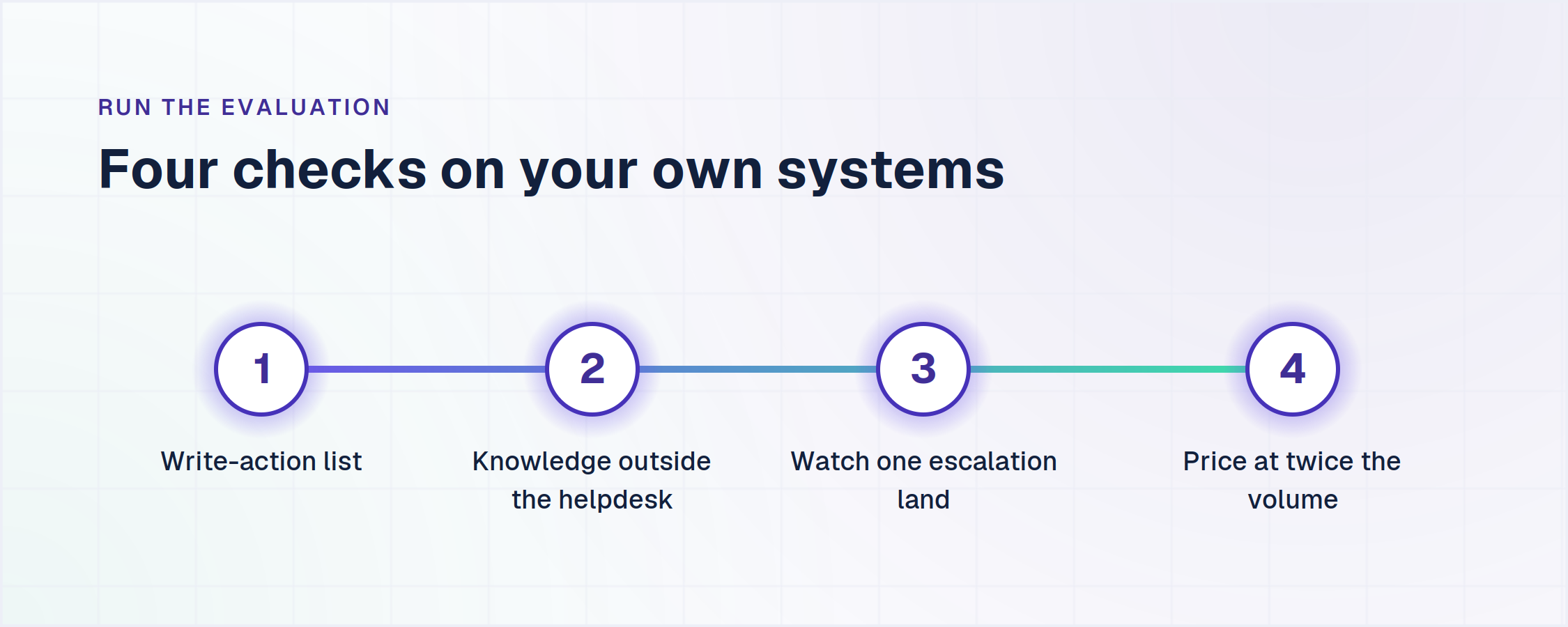
The criteria above separate these platforms on paper. The best AI software for customer service in your stack is determined by four checks, and none of them can be answered during a vendor demo.
Ask for the write actions, not the read actions. Reading a ticket is not resolving a request. Get the list of operations each platform performs in Okta, Jira, Salesforce, and your own APIs, and who authorizes each one. Tidio publishes that Lyro takes no cross-system actions at all, which is a clear answer.
Map where your answers actually live. Pull your top twenty case types and mark which system holds the resolution for each. Wherever a mark lands within a vendor's platform, that vendor's native AI reaches it. Where marks land in Confluence, Google Drive, or a helpdesk you are leaving, price what it costs each platform to reach them.
Model the bill at your peak month, not your average. Take the table above and substitute your own numbers. A team averaging 1,200 resolutions with a 2,500 December will discover the difference between billing units in the month it can least afford to.
Watch one escalation land. Ask to see an unresolved request arrive in the queue your team actually works, carrying the full conversation, the account context, and suggested next steps. Most vendors cannot run this on your stack, and it is where a resolution layer separates from a deflection layer.
Enjo answers all four on the helpdesk you already run. The free plan carries 200 AI replies a month and unlimited human agent seats, so the test costs nothing to start. For the wider zero-cost field, see our ranking of free customer service software.
Frequently Asked Questions
What Are the Best AI Customer Service Platforms?
Eleven platforms have active product motion in this category and verifiable claims of capability. They are Enjo, Intercom Fin, Zendesk AI, ClearFeed, Salesforce Agentforce, Freshdesk Freddy AI, Ada, Decagon, Sierra, HubSpot Breeze, and Tidio Lyro. They split into two groups: dedicated AI layers that read across systems, and helpdesk-native AI bounded by one vendor's data. Which group fits depends on how much of your resolution knowledge already sits inside a single platform.
Which Customer Service Software Uses AI?
Effectively all customer service AI software now ships some form of it, but the depth varies enormously. Zendesk, Freshdesk, HubSpot Service Hub and Salesforce Service Cloud each ship a native AI layer that reads their own data.
Fin, Ada, Decagon, Sierra and Enjo are dedicated AI customer service agents. Of those, Fin and Enjo also deploy into an incumbent helpdesk rather than requiring their own.
How Much Does AI Customer Service Software Cost in 2026?
The billing unit matters more than the headline rate. Per resolution runs $0.99 at Fin, $1.50-$2.00 at Zendesk AI, and $0.50 at HubSpot Breeze. Agentforce charges $2 per 24-hour conversation.
Enjo charges $0.05 per AI reply above the plan volume, with plans at $95 and $295 per month. Every platform except Enjo adds AI cost on top of per-seat fees, so model both layers at your peak month rather than your average.
Will AI Replace Customer Service?
AI will not replace customer service teams; it changes what they spend their day on. The repetitive load moves to AI, and human agents handle cases that require judgment, account history, or a decision.
Aptean is a concrete example. 37% of its cases are fully resolved by AI without human involvement, which is equivalent in volume to 120 agents handled by AI. Its support organization handles the remaining complexity.
Can You Use ChatGPT for Customer Service?
You can use ChatGPT to draft replies, but it is not connected to your systems, so it cannot look up an order or update a record. That is the line between a general assistant, a chatbot, and AI customer service software.
A chatbot matches intent against a scripted set of answers and hands off when no match is found. AI customer service software understands the request, pulls the answer from live knowledge sources, and takes the action the resolution requires in the systems that hold the data. The test is whether it can look up an order, apply a credit, and summarize the thread for the next agent without a human step. For the chatbot category specifically, see our ranking of the best AI chatbot for customer service.
What Type of AI Is Used for Customer Service?
Most AI customer service software combines three layers: a large language model that understands the request and writes the reply, retrieval that grounds the answer in your own knowledge sources, and actions that let the agent complete the task in connected systems. Older chatbots used only scripted rules, which is why they fail when a customer phrases something differently.
What Is the Best AI Helpdesk Software?
The best AI helpdesk software depends on whether you are replacing your helpdesk or adding AI to the one you have. Helpdesk-native AI like Zendesk AI and Freshdesk Freddy works inside one platform, while an AI layer like Enjo resolves requests on top of Salesforce, Zendesk, Jira or ServiceNow and reads knowledge from outside them.