Launch your AI Help Centre in minutes
Get it now

IT Service Management

.svg)
Compare the 8 best enterprise IT service management systems of 2026 on AI resolution, pricing, and deployment speed to find the right fit for your stack.
An enterprise IT service management system used to mean one platform you migrated everything onto, then configured for six months before it did anything useful. That definition is coming apart. The place where your tickets, change requests, and assets live, and the AI that actually resolves the requests, have become two separate purchases in 2026. Most buying guides still bundle the two into a single recommendation. That is how teams end up paying enterprise-platform prices for AI they can never move to a different helpdesk later, or bolting a chatbot onto a system that can barely read its own knowledge base. Which of those two layers you actually need is the decision that shapes your entire shortlist. Compare the 8 best enterprise IT service management systems of 2026 on AI resolution, pricing, and deployment speed to find the right fit for your stack.
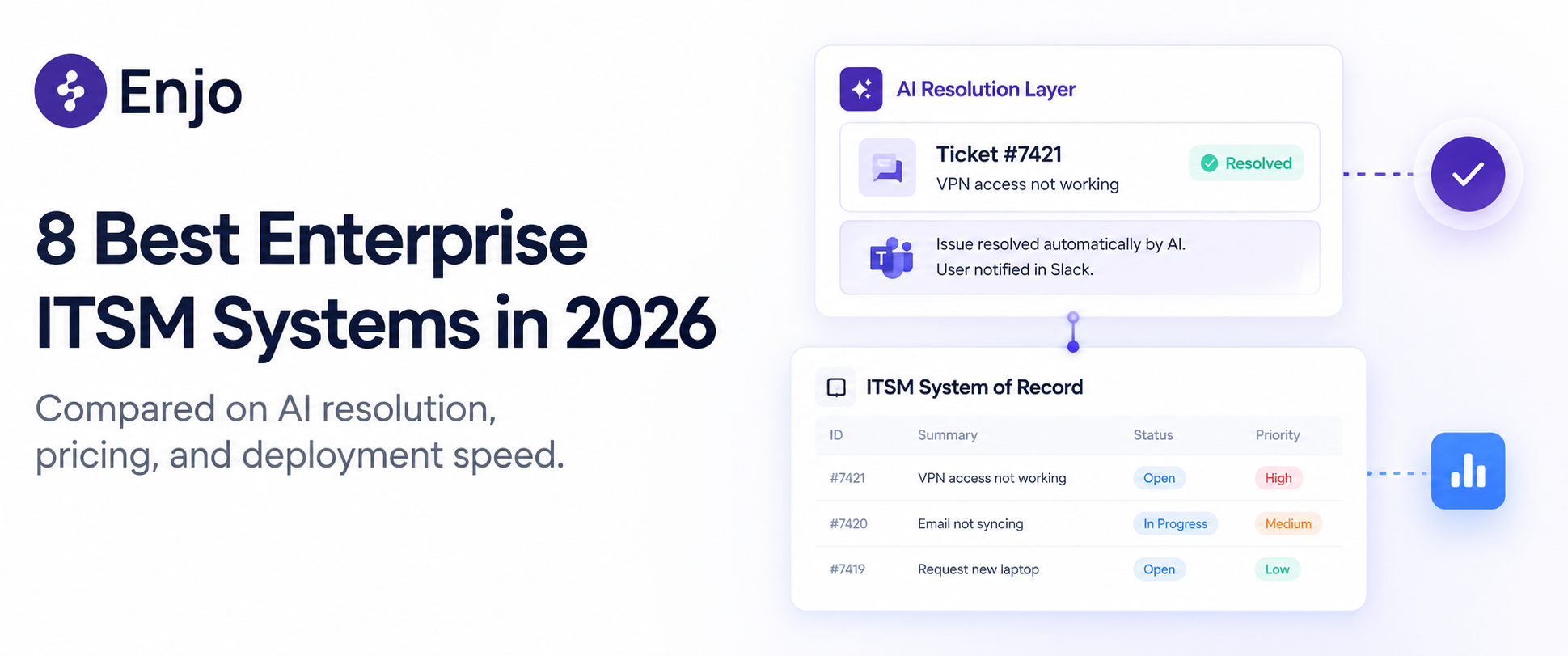
At its core, an enterprise IT service management system handles the lifecycle of an IT request: someone reports a problem or asks for access, the request gets logged, prioritized, routed, and either resolved or escalated, and every step is tracked. Around that sit the classic ITIL processes, incident, request, change, problem, and asset management, plus a self-service portal so employees can help themselves. When those same workflows get extended to HR, finance, or facilities, vendors call it enterprise service management (ESM). Same engine, more departments.
That much has not changed in a decade. What changed is where the intelligence lives.
For years the AI in IT service management software was a feature of the platform. You bought ServiceNow, you got ServiceNow's virtual agent, and it read ServiceNow's data. Now there is a second category: an AI resolution layer that sits on top of whatever system of record you already run, reads knowledge from wherever it lives (Confluence, SharePoint, past tickets across tools), and resolves the request in the chat app where employees actually are. One layer keeps the records straight. The other does the work. You can buy them from the same vendor or from two.
The reason this distinction matters for a shortlist is money and mobility. Native AI is convenient and hits a ceiling fast, because it only knows what its own platform knows. A dedicated AI layer for ITSM costs more to add, but it keeps working if you switch helpdesks later. Keep that tension in mind as you read the list.
The best ITSM tools in 2026 win on execution, not feature counts, and the AI ITSM layer they ship is now a bigger differentiator than the ticketing engine underneath it. We scored every tool on five things that decide the buy:
Enjo is the AI layer that resolves IT and HR requests inside Slack and Teams and escalates to your existing helpdesk when a human is needed. It does not ask you to replace ServiceNow, Jira, or Freshservice. It runs on top of them.
Best for: mid-market to enterprise IT teams that want autonomous resolution without ripping out their system of record or standing up a new portal.
Key capabilities:
Proof: Aurora resolves 63% of requests autonomously and cut resolution time 45%. Amber Group, a crypto-finance firm valued at $3B, went from proof of concept to production in five weeks, which is the number that matters if a legacy rollout has burned you before.
Pricing: usage-based, priced per AI Reply rather than per seat, with unlimited human agent seats on every plan. The Free tier includes 200 AI Replies a month with no credit card; paid plans start at $95/month. Enjo is SOC 2 Type II compliant, ISO 27001 certified, GDPR compliant, and has held 99.9% uptime for six years across 600+ deployments.
Where it falls short: Enjo is not an RPA or infrastructure tool. It will not patch servers, monitor a network, or manage device configuration. It resolves service requests; for systems management you want a different category. Because the free tier is permanent and takes minutes to set up, you can test it on real tickets before anyone signs anything. Book a demo →
ServiceNow is the reference point for enterprise ITSM. Its CMDB and single data model let very large organizations run incident, change, problem, and asset management with a level of governance nothing else on this list matches. In December 2025 it closed its acquisition of Moveworks and folded that conversational front end into the ServiceNow AI Platform, so its native AI story is now considerably stronger than it was a year ago.
Best for: 10,000-plus-employee IT organizations that need the deepest native ITSM and already have administrators to run it.
Key capabilities:
Pricing: custom, quote-only. ServiceNow does not publish list pricing, and the effective per-user number typically lands well above the rest of this list.
Where it falls short: the native AI reads ServiceNow's data and runs on ServiceNow's runtime and licensing tier. If your knowledge lives in Confluence and SharePoint, or you want to resolve requests in Slack without a Now Platform license uplift, you are working against the grain. Deployment and administration also assume dedicated headcount.
Jira Service Management (JSM) is the natural choice if your organization already lives in Jira and Confluence. Incident, change, and service requests flow into the same projects your engineers work in, which is a real advantage for dev-heavy IT.
Best for: technical teams standardized on Atlassian who want ITSM tight to their development workflow.
Key capabilities:
Pricing: Free for up to 3 agents, Standard at $20/agent/month (annual), Premium at roughly $48 to $51/agent/month, Enterprise custom. You pay only for agents, not the employees who submit requests, which keeps it competitive at scale. Budget for Atlassian Marketplace apps, which most teams end up buying.
Where it falls short: the AI virtual agent and CMDB sit behind the Premium tier, so the useful ITSM features cost more than the entry price suggests. Integrations outside the Atlassian ecosystem are weaker, and heavily customized instances get complex to navigate.
Freshservice packs ITSM, IT asset management, and Freddy AI into one Freshworks suite, and it consistently earns high marks for being easy to set up. For a mid-market team consolidating several tools into one, it is a sensible anchor.
Best for: 50 to 1,000-employee IT teams that want a single, approachable suite for ticketing, assets, and AI.
Key capabilities:
Pricing: per agent, billed annually: Starter $19, Growth $49, Pro $99, Enterprise custom. There is no permanent free tier, only a trial. Freddy AI is a paid add-on, commonly around $29/agent/month, so the AI you actually want sits on top of the base price.
Where it falls short: per-agent pricing scales with your headcount, not the work automated, and Freddy is metered separately. Like any helpdesk-native AI, it does its best work inside Freshworks and is limited when you need cross-system actions in Okta or custom tools.
BMC Helix is a mature enterprise platform with a strong story around AI, machine learning, and automation across incident correlation and proactive resolution. It shows up on shortlists for large, process-heavy IT organizations, often the ones already invested in BMC.
Best for: enterprises that want deep automation and can support a heavier platform.
Key capabilities:
Pricing: custom, quote-only. BMC does not publish list pricing.
Where it falls short: implementation weight and complexity are real, and this is not a platform a small IT team stands up on its own. Like ServiceNow, it rewards organizations that already have the operational maturity to run it.
Ivanti Neurons pairs service management with endpoint management and security, which is its distinguishing angle. If your IT function owns devices, patching, and compliance alongside the service desk, having those in one family is useful.
Best for: IT teams where endpoint security and asset compliance sit in the same org as the service desk.
Key capabilities:
Pricing: custom, quote-only. Ivanti does not publish list pricing.
Where it falls short: the breadth that makes it attractive also makes it heavier than a team that only needs service management should take on. Buyers looking for a focused, fast-to-deploy service desk usually find it more than they need.
ManageEngine ServiceDesk Plus delivers a broad ITSM feature set at a fraction of enterprise pricing, which is why one G2 reviewer summed it up as "80% of the features at 20% of the price." It is a practical pick for mid-market teams watching the budget.
Best for: cost-sensitive IT teams that want solid ITIL coverage without an enterprise contract.
Key capabilities:
Pricing: a free Standard edition covers up to 5 technicians. Paid cloud plans start around $13 to $16/technician/month, with Professional and Enterprise editions layering in asset, change, and project management. Several capabilities (CMDB, change management) are sold as add-ons.
Where it falls short: the AI is less mature than newer entrants, the interface feels dated to some teams, and the add-on model means the real cost climbs as you turn on the modules you actually want.
Atomicwork is a newer, agentic service management platform built for teams leaving a legacy ITSM behind. Its AI coworkers work in Slack and Teams, and it can run on top of ServiceNow or Jira Service Management without a platform fee while you decide whether to switch fully.
Best for: companies modernizing off Cherwell, ServiceDesk Plus, or an aging JSM deployment who want an AI-first system.
Key capabilities:
Pricing: Professional starts at $25,000/year for up to 250 users, with Business and Enterprise on custom terms. Pricing on the AI side is outcome- and usage-based.
Where it falls short: it runs an enterprise sales motion with a longer cycle than a mid-market team usually wants, pricing is not fully transparent, and as a newer platform its user community and integration catalog are smaller than the incumbents'.
Start with a single question: do you need a new system of record, or an AI layer on the one you already have?
If your records already live somewhere you are happy with, do not migrate to add AI. That is the expensive mistake. Add a resolution layer like Enjo on top, keep ServiceNow or Jira as the source of truth, and resolve requests in Slack and Teams. You get autonomous resolution in weeks, not the multi-quarter rollout a new platform demands, and Delivery Hero runs exactly this pattern across 70+ countries with a 30% deflection rate and 80% faster response. The ROI math on AI service desks usually favors the layer over the migration.
If you genuinely need a new system of record, match it to your stack and size. ServiceNow for the largest, most process-heavy enterprises with admins to run it. Jira Service Management if you are an Atlassian and engineering shop. Freshservice for a mid-market team consolidating tools. ManageEngine when budget is the deciding factor. BMC Helix and Ivanti for enterprises with automation or endpoint-security needs already in those families. Then decide the AI question separately, because the native AI you inherit is rarely the AI you would pick on its own.
One more filter for any AI ITSM shortlist: how much IT service desk automation you actually get out of the box versus what sits behind a higher tier or an add-on. On several platforms here, the AI that closes tickets costs extra on top of the seat. Price the thing you want to use, not the entry plan.
The enterprise IT service management system market split into two layers, and your best move depends on which one you are shopping for. Among the best ITSM tools here, if you are choosing a system of record, ServiceNow, Jira Service Management, and Freshservice cover the enterprise-to-mid-market range, with ManageEngine, BMC Helix, and Ivanti filling the budget and specialist ends. If you already have a system of record and want AI that resolves requests without a migration, Enjo is the layer built for exactly that, with a free tier you can prove on real tickets today. See it run against your own stack.