
Launch your AI Help Centre in minutes
Get it now

Comparison

.svg)
A straight comparison of Freshservice and ServiceNow on pricing, native AI, and deployment, plus why the AI layer is a separate decision that runs on top of either.
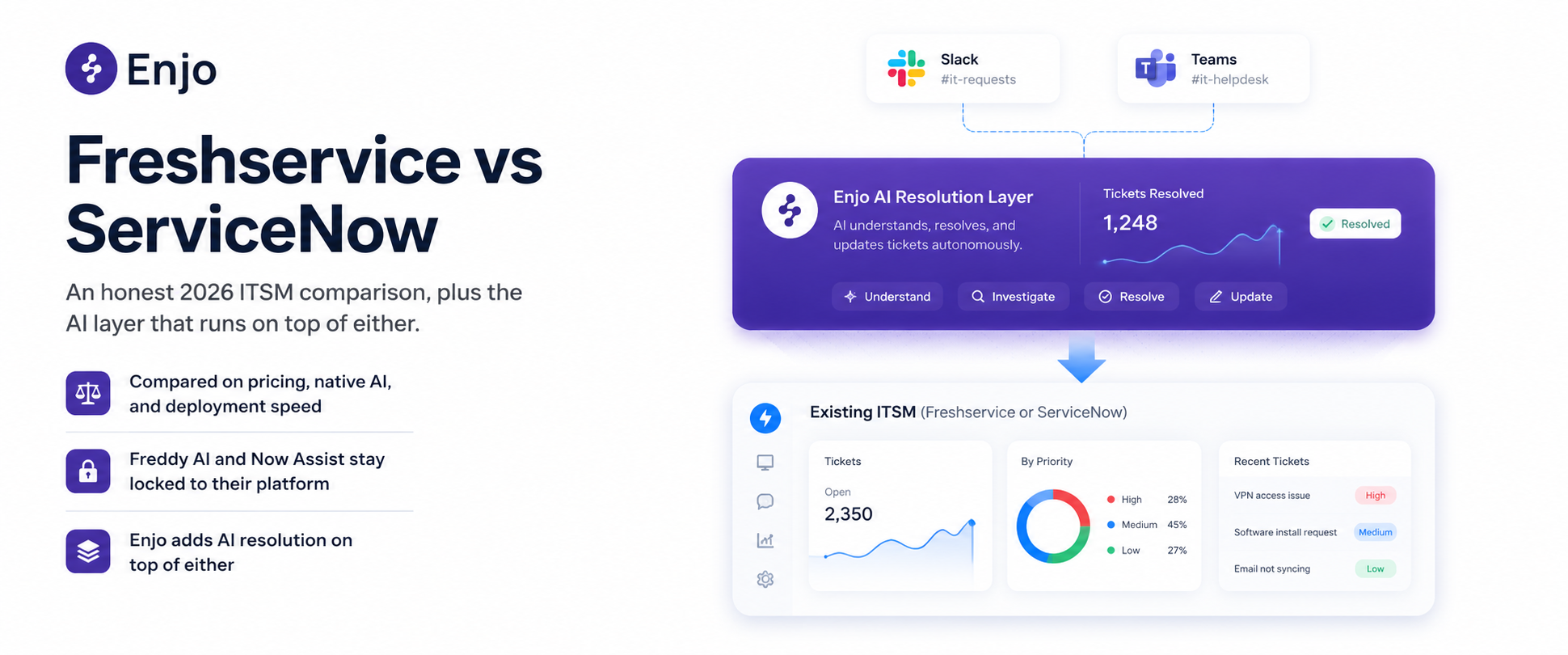
Freshservice vs ServiceNow is the decision almost every growing IT team faces once ticket volume outgrows a shared inbox. Freshservice is the cloud ITSM built for mid-market teams. ServiceNow is the enterprise platform that runs IT for much of the Fortune 500. The pitch you have heard a hundred times is to pick the one that matches your size and move on.
That framing is mostly right and completely incomplete. Most comparison pages ranking for this question are written by affiliates or migration shops, and they all tell the same tidy story. This one is written for the person who actually has to sign the contract and live with it. Freshservice vs ServiceNow compared on pricing, native AI, and deployment speed, plus the AI layer that runs on top of either platform.
If you run a mid-market IT team, want to be live in weeks, and need to know your bill before you sign, Freshservice is the easier yes. If you are a large enterprise with deep CMDB needs, custom workflow logic, and a platform team to maintain it, ServiceNow is built for exactly that, and it is very good at it. Both are real ITSM platforms with real customers, so this is a genuine choice, not a setup.
Here is the part that the size-based framing skips. The AI that handles your actual ticket load does not have to come from the platform you pick. Delivery Hero runs IT support across 95,000 employees in 70+ countries on a Jira-based stack, and after adding an AI layer on top rather than swapping platforms, the team saw 30% deflection and 80% faster response times. The helpdesk stayed where it was. The AI did the work.
If you want to see that pattern applied to your own queue, book a demo and we will walk it through with your ticket data.
Freshservice earned its reputation honestly. The interface is clean enough that a new agent picks it up in an afternoon, setup runs in weeks instead of quarters, and the pricing is right there on the website. It covers the ITIL fundamentals well: incident, problem, and change management; a service catalog; asset management; and a self-service portal. Freddy AI, the native layer, splits into Copilot for agent assist, an AI Agent for self-service deflection, and Insights for predictive reporting.
The friction shows up as you grow. Pricing is per agent, so the bill increases linearly with headcount. The ITIL disciplines a maturing team needs, problem, change, and release management, live on the Pro plan, not the entry tiers. And the piece most buyers underestimate: the full Freddy AI Agent is effectively an Enterprise-tier capability, while Freddy Copilot is a paid add-on on top of your per-agent seat. You can end up paying close to $99 an agent and still not have the autonomous AI included. Freshservice is a strong traditional service desk with AI layered on, which is a different thing from a service desk built around AI.
ServiceNow is not really a help desk. It is a workflow platform that also includes one of the best ITSM products in the market. The Now Platform spans ITSM, ITOM, ITAM, HR service delivery, security operations, and customer service management on a single data model, and its CMDB, which maps assets, services, and the dependencies between them, goes deeper than most ITSM tools attempt. For a large enterprise that needs to orchestrate work across IT, HR, facilities, and security with auditable governance, very little else competes. Now Assist adds generative AI across those workflows, and the AI runs on the same data model as the tickets, so it can see the CMDB and change schedules without a separate integration.
The cost of that power is real, and it is not only the sticker. Implementations routinely run for months and usually need specialized consultants or a dedicated platform team. The interface is dense, and admins live inside a world of tables, roles, and CMDB conventions. Pricing is quote-only and per named user, so you cannot size the deal without a sales cycle, and Now Assist typically rides on a Now Platform license uplift. Teams shopping for a ServiceNow alternative almost always cite the same two reasons: time-to-value and the total bill.
The sticker is the floor, not the total. Freddy AI Copilot is roughly $29 per agent per month on top; asset units come in packs of 500, and heavy automation can push you into orchestration overages. There is no permanent free plan, only a 14-day trial.
ServiceNow does not publish pricing at all. Deals are quoted per named user, and independent trackers tend to land north of $100 per user per month before add-ons, though ServiceNow has no public price page to confirm against. Between implementation services, platform licensing, and Now Assist uplift, the real number is a negotiation, not a line item.
The honest read on cost: Freshservice is cheaper and far more predictable at the sizes most mid-market teams care about, and ServiceNow buys you depth that a large enterprise can genuinely justify. Neither number tells you what your AI will cost, which is the next thing worth thinking about.
Notice what both native AI stories have in common. Freddy AI Agent sits at the top of the Freshservice ladder. Now Assist sits behind a ServiceNow license uplift. Each one reads only its own platform's knowledge base and acts only on its own platform's objects. So when you choose between Freshservice and ServiceNow, you are quietly choosing your AI vendor too, and locking both decisions together for years.
That bundle is the trap. The knowledge your AI needs to answer well rarely resides in a single system. It is scattered across Confluence, SharePoint, Google Drive, Notion, and across years of past tickets in multiple tools. The actions your AI needs to actually resolve a request, unlock an Okta account, provision access, open a Jira ticket, usually reach outside the ITSM entirely. A platform-bound AI can only see and touch its own yard. The same reasoning applies whether you land on Freshservice or ServiceNow's native AI Agents.
The fix is to stop treating the AI service desk as a feature of the ITSM and start treating it as its own layer. Pick the platform based on its merits. Run the AI on top of whichever one you land on.
Enjo is an AI service automation platform that resolves IT requests end-to-end in Slack and Teams, then escalates to a human with full context only when genuinely needed. It is helpdesk-agnostic by design, so it layers on top of Freshservice, ServiceNow, Jira, Zendesk, or Salesforce instead of replacing them.
The L1 queue, password resets, software access, and VPN issues are the most repetitive and most expensive slice of IT support, and it is the slice Enjo's AI Agent closes on its own. AI Actions execute real operations in Okta, Jira, ServiceNow, and custom APIs, so the agent does things rather than only answering questions. AI Flows orchestrate multi-step work with explicit fallbacks when the agent is not confident. Agent Assist embeds directly inside the ServiceNow case view (and Freshservice, Jira, Zendesk, and Salesforce) with summaries, reply drafts, and grounded knowledge on every escalated ticket. One Knowledge layer indexes all of those sources, so what the AI says matches what agents see, with no drift.
The controls are the part a CISO cares about: Guardrails, a full audit log, RBAC, SOC 2 Type II, ISO 27001, GDPR, and 100+ languages, backed by six years of 99.9% uptime across 600+ enterprise deployments. On G2, Enjo holds a 4.8/5 rating across a small set of early reviews. Speed is the part an IT lead cares about: Amber Group, a $3B crypto finance company, went from proof of concept to production in five weeks, and Aurora reached 63% autonomous resolution for frontline IT requests. If you already live in the IT service desk, this runs where your employees already are, often through Slack ticketing they never have to leave.
Pricing is usage-based per AI Reply, not per seat. The free tier includes 200 replies per month, unlimited human agent seats, and no credit card required. Paid plans start at $95 a month for 1,000 replies, with additional replies at $0.05 each. Every tier includes unlimited seats.
Where Enjo is not the answer: if you are a very large organization committed to the Now Platform roadmap and want the AI Control Tower as your single governance surface, ServiceNow's native AI (or Moveworks, which is now part of ServiceNow) is the more natural fit. Enjo is the layered play, not a Now Platform-native build.
Freshservice wins when you want modern ITSM without the enterprise overhead: fast to deploy, easy to run, priced where you can see it, ideal for teams up to a few thousand people. ServiceNow wins when you need real depth, CMDB, cross-department orchestration, heavy customization, and you have the budget and the platform team to run it. Note that ServiceNow now owns Moveworks, which is worth factoring in if your AI shortlist leans that direction.
Enjo wins when you want autonomous resolution in Slack and Teams without betting your AI investment on whichever helpdesk you happen to run this year. Pick the ITSM. Keep the AI portable.
The Freshservice vs ServiceNow decision comes down to shape. Mid-market teams that want speed and predictable cost should look hard at Freshservice. Large enterprises that need depth and can staff it should look hard at ServiceNow. Both are defensible picks, and either one can be your system of record for years.
Just do not let that choice quietly pick your AI too. If you want autonomous resolution running in Slack and Teams on top of whichever platform you land on, book a demo and bring your ticket data. We will show you exactly where the AI pays off.


