Transform complex support workflows

How to Use Slack for Customer Support (2026 Setup Guide)
If your customers already work in Slack, and many of them would rather ask you a question in a shared channel than file yet another email ticket. That's why using Slack for customer service has quietly become one of the most effective ways to deliver fast, personal, and accountable support at scale.
But running Slack customer service well isn't as simple as opening a #support channel. To turn Slack into a real support platform, you need the right channel structure, a way to capture and route tickets, integrations with your helpdesk and knowledge base, and an AI layer that can deflect repetitive questions without slowing your agents down.
Set up Slack for customer service: channel structure, Slack Connect, ticket routing into Jira or Zendesk, and AI answers that resolve requests in Slack.
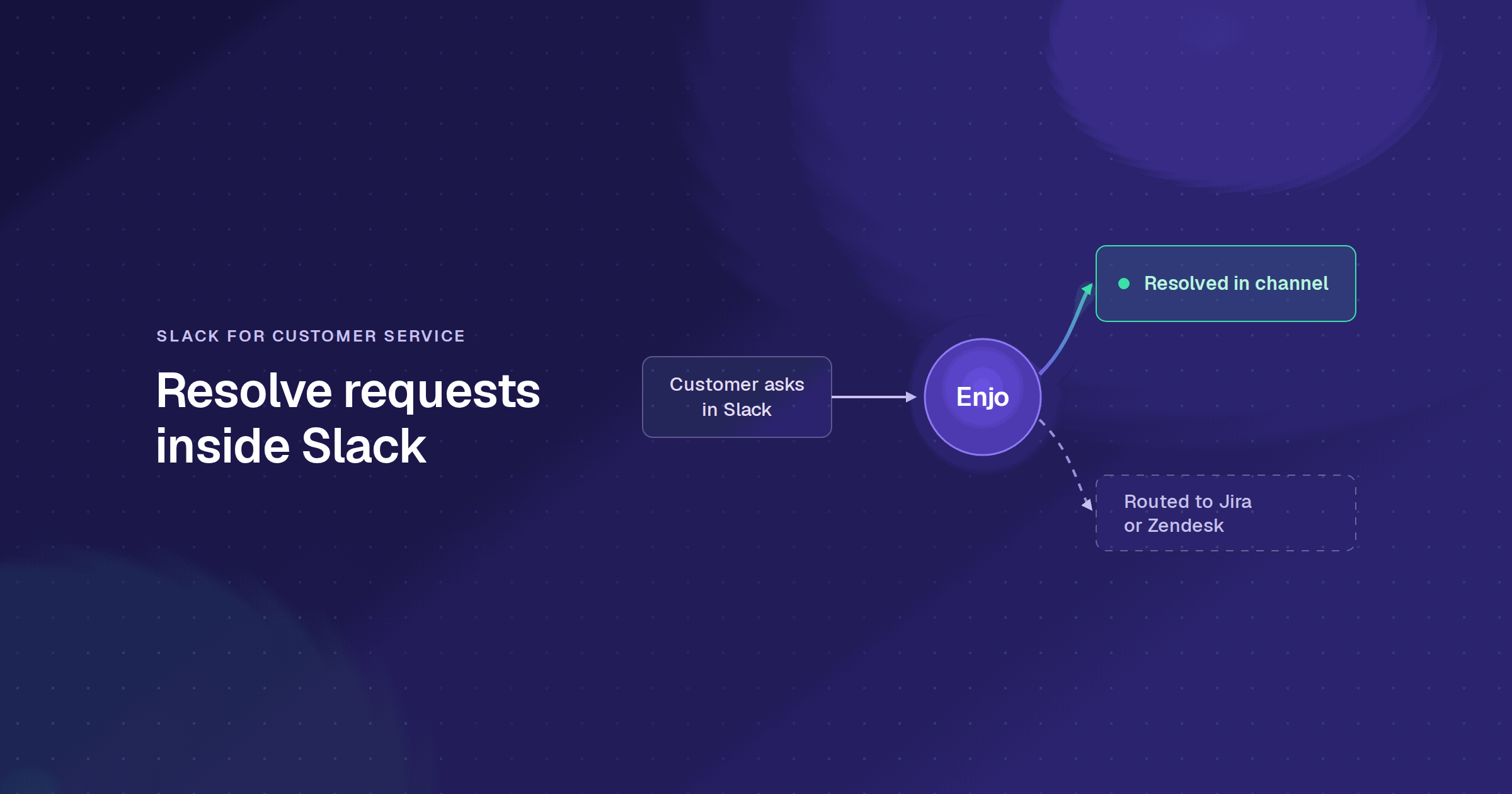
In practice, Slack customer support runs in one of a few places: a Slack Connect channel shared with each customer account, one community workspace where customers help each other, or an internal channel where employees raise requests. Your team answers in the thread, pulls in an engineer or account manager when a question needs one, and a helpdesk records what happened, so nothing depends on someone scrolling back.
Customers are ready for faster, conversational help. In Salesforce's State of the AI Connected Customer survey of more than 16,000 consumers and business buyers, nearly half of business buyers (46%) said they would work with an AI agent if it meant faster service. That makes Slack a natural place to put an AI agent in front of your team: Enjo answers in the thread from your knowledge and hands anything it can't resolve to a person with the full conversation.
Why support teams use Slack for customer service
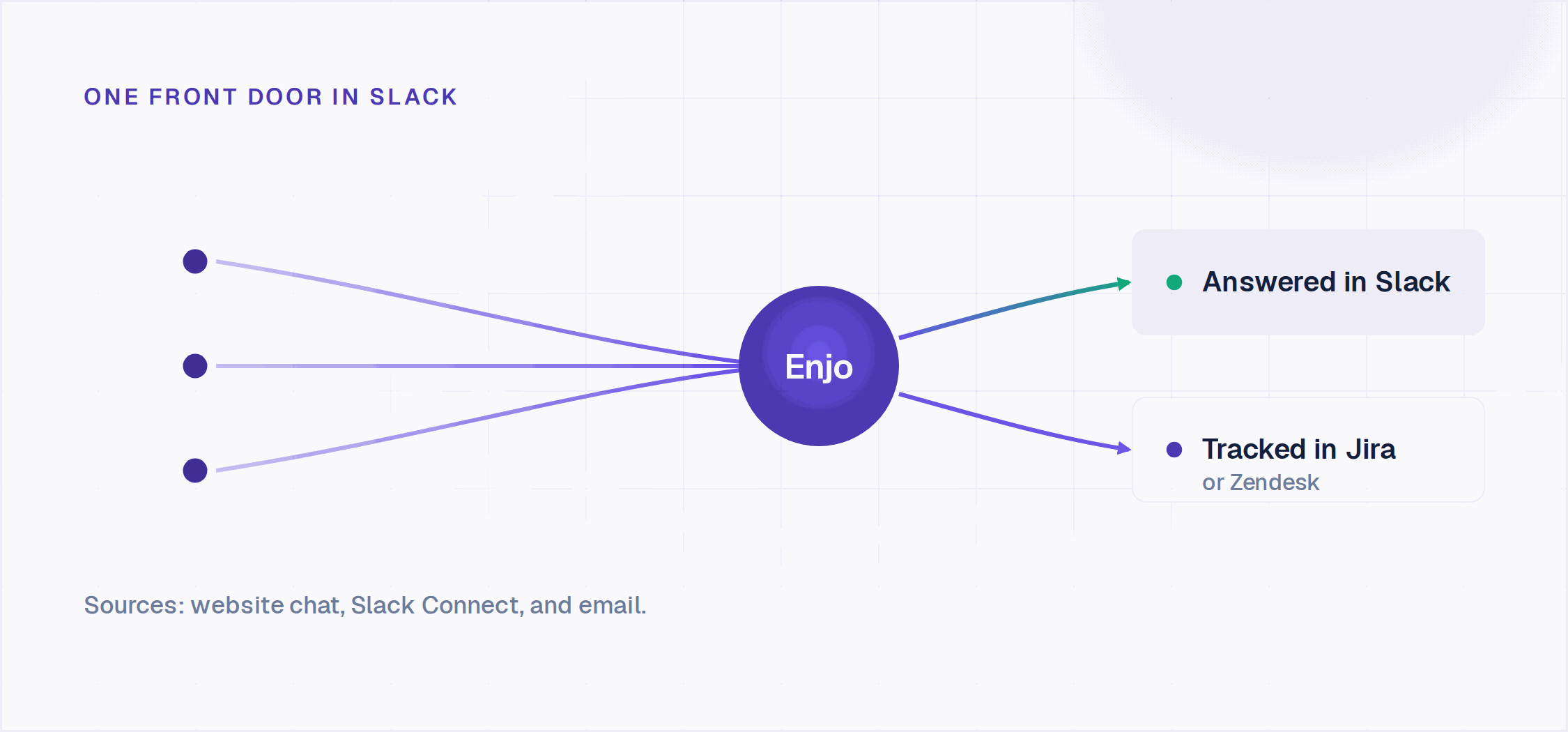
The main reason is speed. A question in a shared channel reaches the people who can answer it directly, and the customer reads the reply where they asked, without logging into a portal or waiting on an email chain.
- Your experts are already there. Engineers, product managers and account managers can join a thread without learning a helpdesk. Salesforce's own support team calls this case swarming: by pulling the right people into Slack conversations, it cut its case backlog by 64% and improved its case close rate by 29%, according to Salesforce.
- Customers see progress. Updates, files and decisions sit in one channel history instead of scattered emails. Fastly, quoted on Slack's customer service page: "We hear back from our customers that we're like an extension of their team, and part of that feeling definitely comes from the fact that we use Slack."
- The numbers move. Slack reports 36% faster support case resolution and a 12% increase in customer satisfaction at Intuit (2020 figures).
Where Slack falls short as a support tool on its own
Slack is built for conversation, not case management. Teams that run support in channels alone hit the same limits:
- No request record. A message has no status, priority, owner or due date, so "who is on this?" gets answered by scrolling.
- No response timers. Slack has no built-in SLA clock for customer requests, so a quiet thread can sit unanswered over a weekend and nobody is alerted.
- No support reporting. You can't see volume by customer, topic or agent, or show an account its response times at renewal.
- Answers stay in threads. The same question gets answered by hand in ten channels, and the best answers never reach your knowledge base.
- Plan limits on both sides. Every organization in a Slack Connect channel needs a paid Slack plan, so some customers can't join without a trial or an upgrade (step 2 below has the details).
The fix isn't to leave Slack. Keep the conversation in the channel and connect what records it: a helpdesk for tracking and SLAs, and an AI agent for the repeat questions. That pattern is called conversational ticketing: the request is raised, answered and tracked in the conversation itself.
Choose your Slack customer support model
Decide where customers will ask before you build anything. Most teams run one or two of these.
1. A shared channel per customer account
Create one Slack Connect channel for each account, such as #support-acme, and invite the customer's team. Everyone on both sides sees every open issue, and an engineer or account manager can join the thread when a question needs them. Because each channel needs an owner, teams usually keep this model for their larger accounts.
2. One shared channel for many customers
A single channel where customers ask and your team answers. It's cheaper to run and doubles as an announcements channel, but customers can see each other's questions, so keep account details out of it.
3. A community workspace
A separate Slack workspace that customers join to ask questions, share tips and give feedback on new releases. Customers often answer each other, and your team picks up what's left. It suits products with many smaller customers.
4. An internal requests channel
Employees raise IT or HR requests in a channel such as #it-help. The setup below applies unchanged; the requester is an employee instead of a customer. Our guide to creating Jira requests in Slack covers the six ways employees raise them.
5. A private triage channel for your team
Whichever model customers see, give your team one private channel where new requests from every source land: Slack Connect channels, website chat and email. Agents pick up work there, discuss it out of the customer's view, and reply in the original thread. If you still need a chat widget feeding the same queue, our ranking of the best live chat software compares free plans and the real cost at 5 and 15 agents.

How to set up Slack for customer support in 7 steps
Step 1. Name your channels so anyone can find them
Pick one naming pattern and keep it, for example #support-acme for each account and #support-triage for your team. A shared prefix groups customer channels together in the sidebar and in search, so a new agent knows where to look on day one. Put the account owner, plan and support hours in each channel's description.
Step 2. Invite customers with Slack Connect
Create the channel, then invite the customer from Slack by email or with an invitation link. They accept from their own Slack, and depending on settings the invitation may go to an admin for review first. A Slack Connect channel can hold up to 250 organizations, and only the organization that owns it can invite or remove organizations and manage posting permissions (Slack's Slack Connect guide).
Check plans before you promise a channel. To work together in Slack Connect channels, each organization must be on a paid Slack plan. A customer on Slack's free plan can accept a 90-day trial of Slack Pro with no credit card, if its workspace hasn't had one before; if the trial ends without an upgrade, its Slack Connect channels disconnect. If your company is on Enterprise Grid, free-plan teams can join the channels you invite them to without upgrading (Slack). Slack Connect direct messages work on any plan.
If a customer can't join through Slack Connect, invite their people into your own workspace as guests instead. Guests need a paid plan on your side: single-channel guests are free (up to five for every paid active member) and see one channel, while multi-channel guests are billed like regular members (Slack help).
Step 3. Give every channel an owner and a response target
Name an owner for each customer channel and a backup for their days off. Set a first-response target per support tier, for example one business hour for your largest accounts, and publish your support hours in the channel so customers know when to expect a reply.
Step 4. Turn messages into tracked requests
Decide what makes a message a request, and record it in your helpdesk so it gets a status, priority, owner and SLA timer. Teams trigger this with an emoji reaction, a message shortcut or a short form, or automatically for every new message in the channel. With Enjo on Jira, a configured emoji or the message shortcut creates the request, the whole Slack thread is copied into it as comments, and a message nobody answers within a set window becomes a request on its own.

Step 5. Connect your knowledge so repeat questions get answered
Most support channels see the same questions every week: how to set up single sign-on, where to find an invoice, whether a feature exists. Connect the places those answers already live, such as Confluence, SharePoint, Google Drive, Notion, Guru, past tickets or your website, so an AI agent can answer in the thread and cite its source. The answers customers mark as unhelpful show you which articles to fix next. If useful answers only exist in old threads, our guide to using Slack as a knowledge base shows how to capture them.

Step 6. Agree how escalation works
Write down who gets pulled in for what: billing questions to finance, bugs to the on-call engineer, renewals to the account manager. Discuss the case in your triage channel or a private thread, not in front of the customer, and reply in the customer's thread once you have an answer. Whoever picks it up should receive the full conversation, the account context and a suggested next step, not a one-line ticket.
Step 7. Measure what customers feel
Track four numbers per channel and per account: first response time, time to resolution, satisfaction after each resolved request, and the share of requests answered without a person. Review them with the team every week and post them where the team works; here's how to configure and share SLA reports in Slack on a schedule.
Slack features worth using for customer support
Before adding apps, use what Slack already includes:
- Threads. One question, one thread. Ask customers to start a new message for each new issue, so replies, files and status stay together and each thread maps to one tracked request.
- Workflow Builder. A paid feature on Slack Pro, Business+ and Enterprise: no-code workflows with conditional logic (up to 15 conditions), connectors for Salesforce and 70+ other apps, and a Generate AI response step that answers from Slack knowledge sources (Slack). A short intake form in each customer channel collects the product area and urgency up front. In Slack Connect channels, an admin first has to allow external people to use your workflows (Slack help).
- Canvases. Keep a canvas in each customer channel with the account's setup, contacts, open issues and escalation path, and co-edit it with your account team (Slack canvas).
- Huddles. When a thread goes in circles, start an audio or video huddle with screen sharing in the channel, and let AI in Slack take the notes (Slack huddles).
These features make the conversation better. They don't give you request tracking, SLA timers or automatic answers to repeat questions, which is where a helpdesk and an AI agent come in.
How Enjo resolves customer requests in Slack
Enjo is an AI Support Agent that works in Slack channels, direct messages and Slack Connect shared channels, and connects to the helpdesk you already run, with routes for Jira, Zendesk, Salesforce and ServiceNow. Here's what changes in a support channel.
1. Answers in the thread, with the source
Enjo replies to new questions in the thread, and every answer is grounded in your knowledge, with citations to the pages it used. Guardrails control what it can say, and the audit trail records every answer, so you can see why it said what it said.

2. Escalation with the whole conversation
When Enjo can't resolve a request, or the requester asks for a person, it creates the request in your helpdesk, and the agent who picks it up receives the full conversation, the account context and suggested next steps. On Jira, every thread reply becomes a Jira comment and every Jira comment or status change posts back into the Slack thread, so the requester never has to ask for an update. Your team can also create and update requests with emoji they choose.
The same Slack-to-Jira capture runs in internal IT support today: BookMyShow captures 100% of its requests through Slack automation with zero manual ticket creation, and Delivery Hero, with an agent on each of 30+ Jira service desks, reports 80% faster response for both answering and ticket creation.

3. Status without a portal
Paste a Jira issue key into the channel and Enjo posts a live request card that stays in sync with Jira, so the requester and your team see the same status, priority and assignee.

4. A rating when the request is resolved
When the request is resolved in Jira, Enjo asks the requester for a five-point rating in the same thread and writes the score back to Jira, including Jira Service Management's own satisfaction reporting.

5. A room for the hard cases
For an incident or a tricky bug, Enjo can open a dedicated Slack channel for the Jira issue, invite the assignee, reporter and watchers, keep it in sync with Jira, and archive it when the issue is resolved.
Best practices for Slack customer support
1. Pin a "how to get help here" message
Post and pin a first message in every customer channel so both sides work the same way. Slack's own template for shared channels is a good base; adapted for support, it reads:
- Post each new question as a new message, and keep replies in its thread.
- We reply within [X] hours on weekdays, [support hours and time zone]. @mention us if it's urgent.
- :eyes: on your message means we've seen it and are working on it. :white_check_mark: means it's been addressed.
- Include the product area, what you expected and what happened, and a screenshot if you have one.
2. Keep internal discussion out of the customer channel
Everyone in a Slack Connect channel sees every message, including messages from bots and apps. Talk through diagnosis and blame-free post-mortems in your triage channel, then post the answer in the customer's thread.
3. Lock down shared channels
Only the organization that owns a Slack Connect channel can invite or remove organizations and manage who can post. Review each channel's members when a customer contact leaves, and keep passwords and card numbers out of chat. With Enjo, Guardrails and data masking also apply to what flows from Slack into Jira.
4. Review settings and integrations every quarter
Slack and the tools connected to it change often, and a setup that worked six months ago can quietly slow your team down. Once a quarter, check that every customer channel still has an owner, that notifications reach the right people, and that your helpdesk and knowledge base integrations are still syncing. Remove integrations nobody uses, since each one adds noise to the channel.
5. Keep your helpdesk as the record
Jira Service Management, for example, gives every Slack request a structured record: priority, request type, reporter, assignee, created date and time to resolve. Support teams can route requests to the right team by type, filter by status, watch each person's workload, and collect customer ratings, while the conversation itself stays in Slack.
Extended Reading: How to Train AI Support Agents: Best Practices for Knowledgebase, Data & Integrations
Conclusion
Slack works for customer support when the conversation stays in the channel and everything else is connected behind it: an owner and a response target for every channel, a helpdesk that records each request, and an AI agent for the questions your team answers every week. Enjo answers in the thread, escalates to Jira, Zendesk, Salesforce or ServiceNow with the full conversation, and, on Jira, keeps the requester updated in the same Slack thread. Book a demo to see it on your own channels and helpdesk.

Frequently Asked Questions
Can I use Slack for customer support?
You can use Slack for customer support, most often through Slack Connect shared channels with customers or an internal support channel for employees. On its own, Slack handles the conversation but doesn't track status, priority, ownership or SLAs, so teams pair it with a tool that turns messages into tracked requests. Enjo answers in the thread and escalates to your team, or into a Jira work item, with the full conversation attached. Jira Service Management and Zendesk can also capture Slack messages as tickets. Our guide to the Slack ticketing system compares nine of these tools on setup and cost.
How do you set up Slack for customer support?
Set up Slack for customer support in seven steps: name channels consistently, invite customers through Slack Connect, give every channel an owner and a response target, turn messages into tracked requests in your helpdesk (Jira, Zendesk, Salesforce or ServiceNow), connect your knowledge so repeat questions are answered in the thread, agree on escalation paths, and track first response time, resolution time and satisfaction. An AI agent like Enjo handles the answering and escalation steps inside Slack.
What is Slack Connect, and do customers need a paid Slack plan?
Slack Connect lets you share a channel or a direct message with people outside your organization, such as customers, partners or vendors. For shared channels, each organization must be on a paid Slack plan. Customers on Slack's free plan can accept a 90-day trial of Slack Pro if their workspace hasn't had one before (the channels disconnect if the trial ends without an upgrade), and companies on Enterprise Grid can invite free-plan teams into their channels without an upgrade. Slack Connect direct messages work on any plan.
Is Slack better than Zendesk or email for customer support?
For customer support, Slack is faster and more collaborative than email and more conversational than Zendesk, but it isn't a one-for-one replacement. Many teams use Slack as the front door for customer conversations and connect it to Zendesk, Jira or Salesforce in the background, so every Slack thread is still tracked as a formal request. That setup gives customers the speed they want and gives your support team the analytics, audit trail and SLA reporting they need.
Can Slack act as a CRM?
Partly. Slack CRM, built on Salesforce and included in Slack's Business+ plan at no extra cost, lets teams create contacts, track leads and deals, and log activity by asking Slackbot. Slack describes it as lightweight customer management. Teams that run a full Salesforce CRM can bring its data into Slack, where records are searchable and can be updated from the conversation.
How much does Slack cost for a support team?
On Slack's pricing page (checked 30 October 2026), Slack Pro is $8.75 per user per month billed monthly or $7.25 billed annually, and Business+ is $18 per user per month billed monthly or $15 billed annually, in US dollars. Shared channels with customers need a paid plan on both sides, so check your customers' plans too.
What is the difference between Slack and Jira?
Slack is where teams talk, and Jira is where work gets tracked. In support, a request often starts as a Slack message and becomes a Jira work item when it needs engineering or follow-up. Connecting the two means a request raised in Slack becomes a Jira work item without anyone copying it across.
How do I contact Slack's own customer support?
This guide is about running your support in Slack. For help with Slack itself, use Slack's Contact Us page: sign in so Slack can match your workspace, then ask its AI agent or pick a topic and contact the support team.