Transform complex support workflows
7 Ways Employees Can Create Jira Tickets From Slack
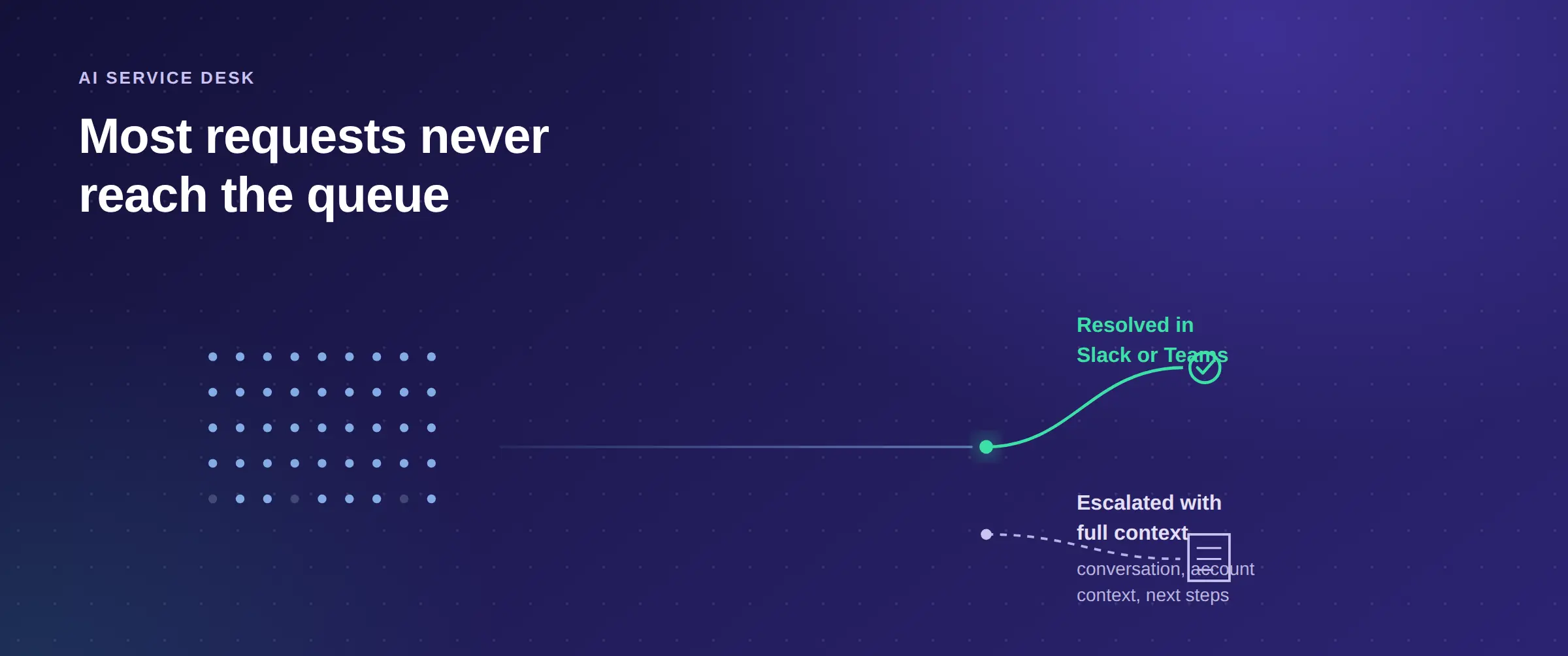
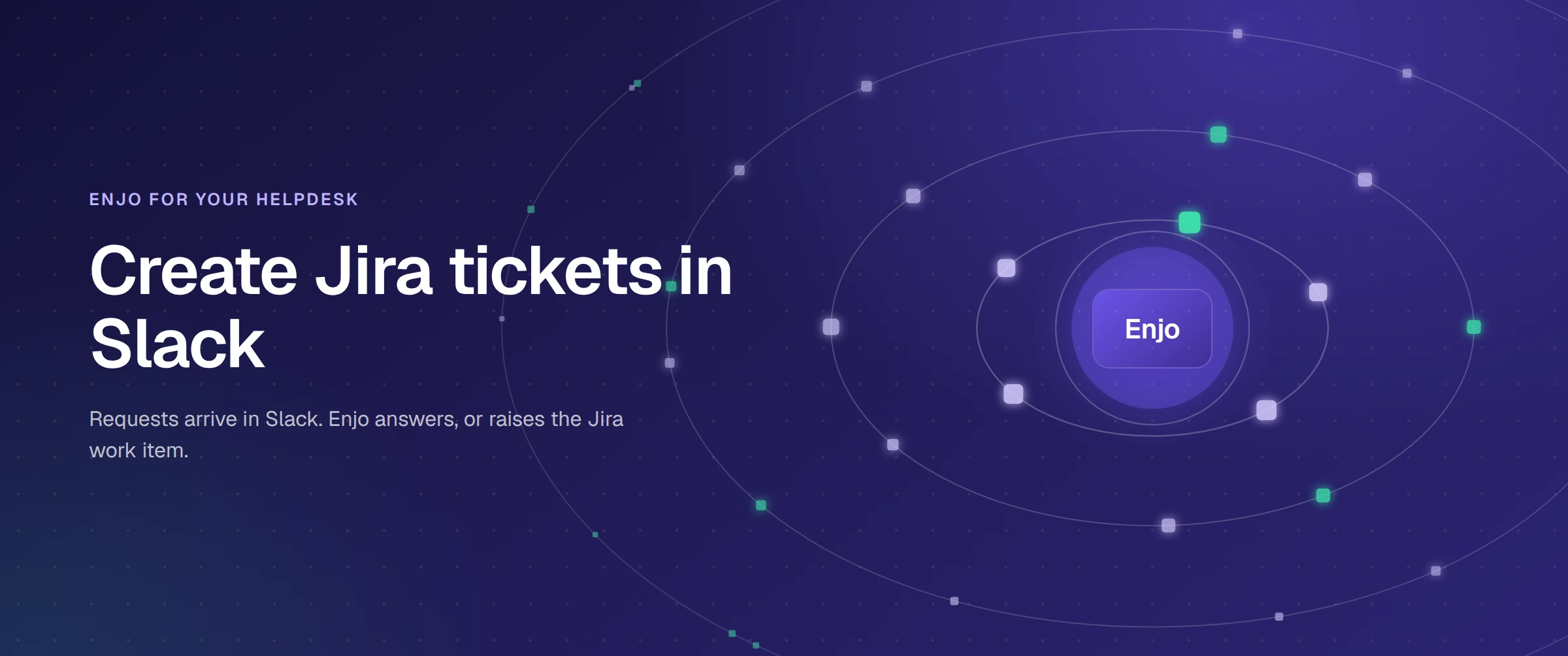
Employees can create Jira tickets from Slack without leaving the conversation they are in. With Enjo for your helpdesk connected to Jira Service Management, a request raised in Slack becomes a Jira work item, with the summary and description filled from the Slack message and the thread kept in sync afterwards. This is conversational ticketing on the Jira stack.
Below are the seven ways employees raise Jira requests through Enjo in Slack, with exact steps for each method, plus what Atlassian's own Slack apps do. Jira stays your system of record throughout: every work item lands in the Jira projects and request types your team already works.
Challenges with Jira Service Management
Jira Service Management is where many IT and HR teams run their service desk, with request types, queues, SLAs and approvals set up the way the team works. The friction sits on the requester side. An employee outside IT has to leave the conversation they are in, find the portal, pick the right request type and fill in a form they rarely see.
The result is often a request filed with missing details or under the wrong request type, which slows the help desk team down before any work starts.
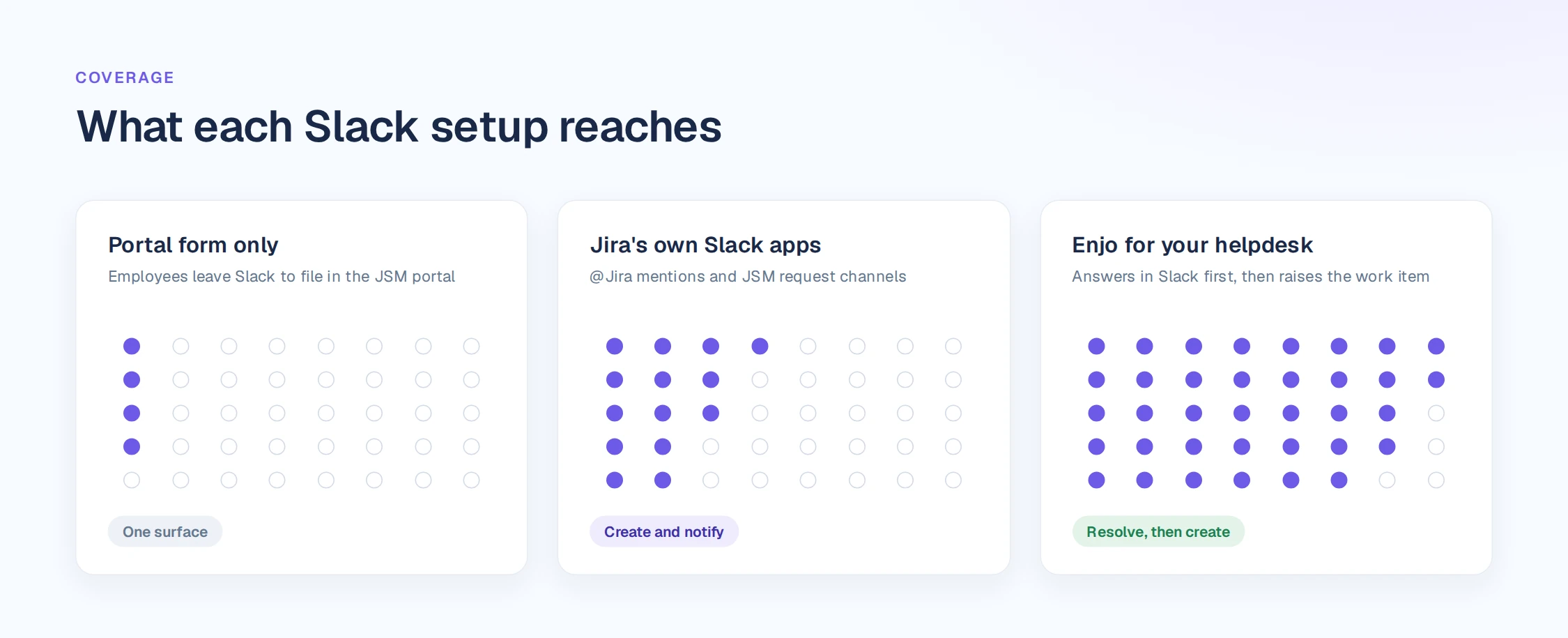
So employees skip the portal and DM a support agent in Slack instead. That moves the work to the agent, who now tracks requests across DMs and channels and copies each one into Jira by hand.
Requesters then lose track of status. Updates live in Jira, and the only way to get one is to ask an agent to check and reply in Slack.
Read in detail about AI Support Agents
Satisfaction drops on both sides: employees wait on updates, and the help desk team spends its day copying messages between Slack and Jira. The gap is between where requests start, in Slack, and where the service desk works them, in Jira.
Integrating Jira and Slack
When requests already start as Slack messages, Slack is the natural front door for a Jira Service Management desk. Enjo for your helpdesk is a Jira Slack integration built for the service desk: requesters stay in Slack, Jira stays the system of record, and every request that needs your team lands as a Jira work item in the queues your agents already work, which turns Slack into a Slack ticketing system with no new portal. Learn more about Enjo for Jira.
Atlassian's own Slack apps create Jira work items too. On June 24, 2026, Atlassian added @Jira to the Jira Cloud for Slack app: mention @Jira in a channel and Jira reads the thread to fill in the space, work item type and fields, for Jira Cloud customers with Rovo enabled (Atlassian's announcement). In Jira Service Management request channels, reacting to a message with the ticket emoji starts a new request from that message (Atlassian's guide to creating work items in Slack). Enjo for your helpdesk works alongside Jira as the system of record and adds the service desk layer around creation: Enjo answers from your knowledge in Slack first, and a request it cannot resolve becomes a Jira work item with the Slack thread, the requester and any attachments already on it.
Seven ways to create Jira tickets from Slack with Enjo
Three of the seven are actions an employee takes on a message or in the message field. The other four start in a conversation with Enjo, which answers first and raises the work item when a person is needed. All seven end in the same place: a Jira work item in the right project and request type.
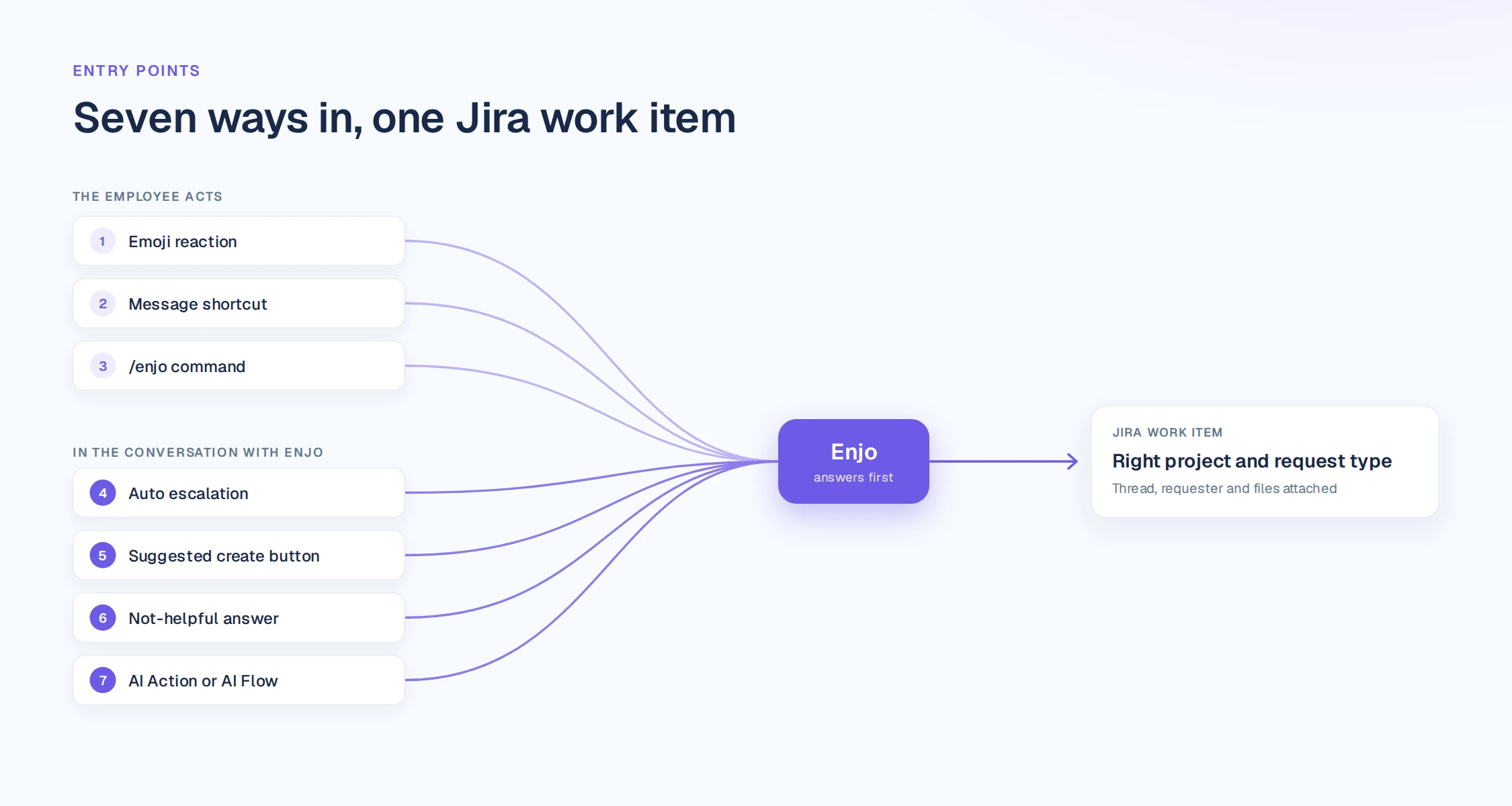
1. React to a message with an emoji
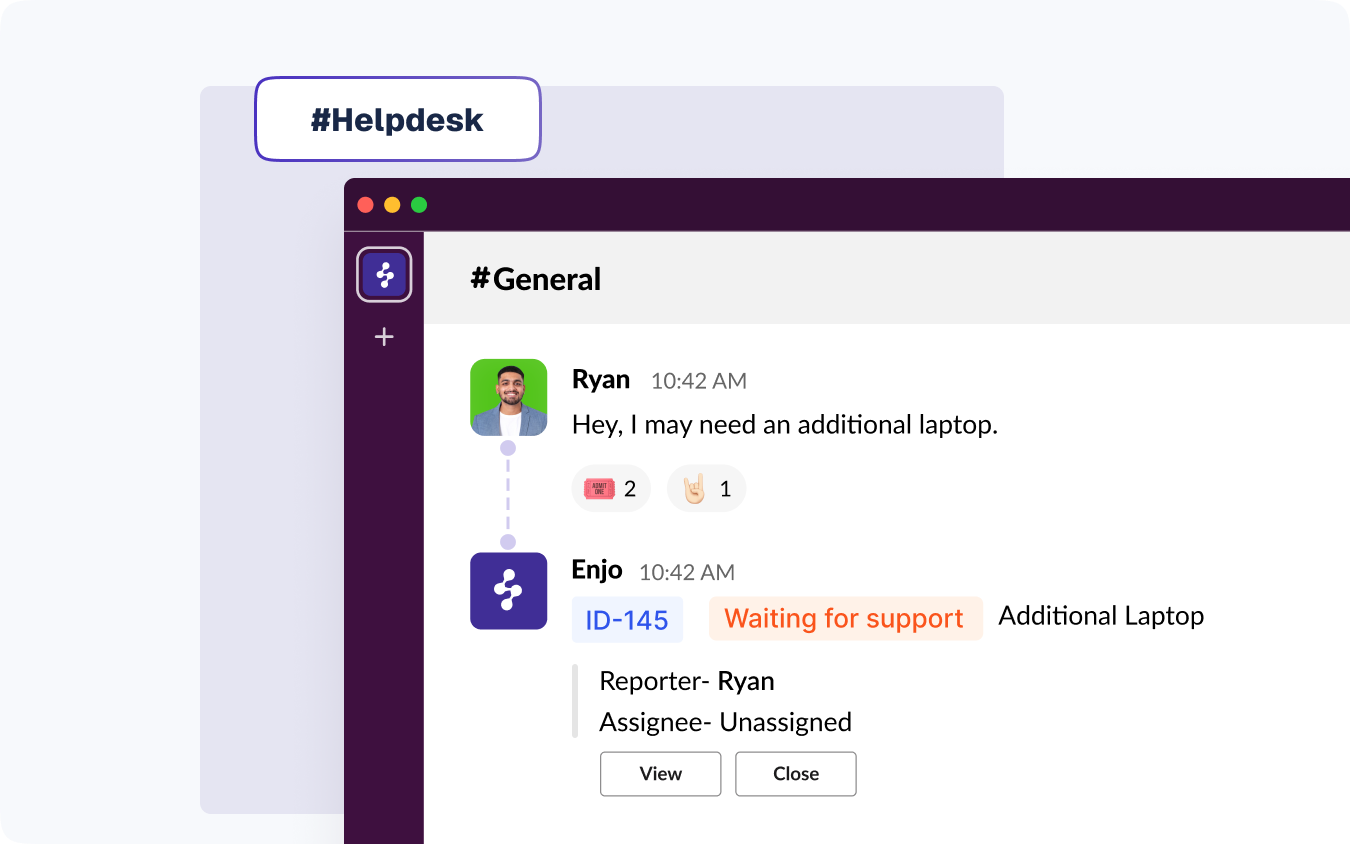
Enjo's emoji actions turn a reaction into a Jira request or work item. An admin picks the emoji (the ticket emoji, for example), the Jira project and request type, and where it works: the whole workspace, one person, or a single AI agent's channels.
Step 1: Hover over the Slack message, click the emoji button and select the emoji your admin configured.
Step 2: Enjo creates the Jira work item with the summary and description filled from the message, then posts a confirmation in the thread with the work item details.
Your admin decides when the create form appears: never, so Enjo files it silently; only when a required field is missing; or always. Different emojis can create different request types, so one reaction can raise an access request and another a bug report. Setup is in Enjo's emoji actions guide.
2. Use the message shortcut
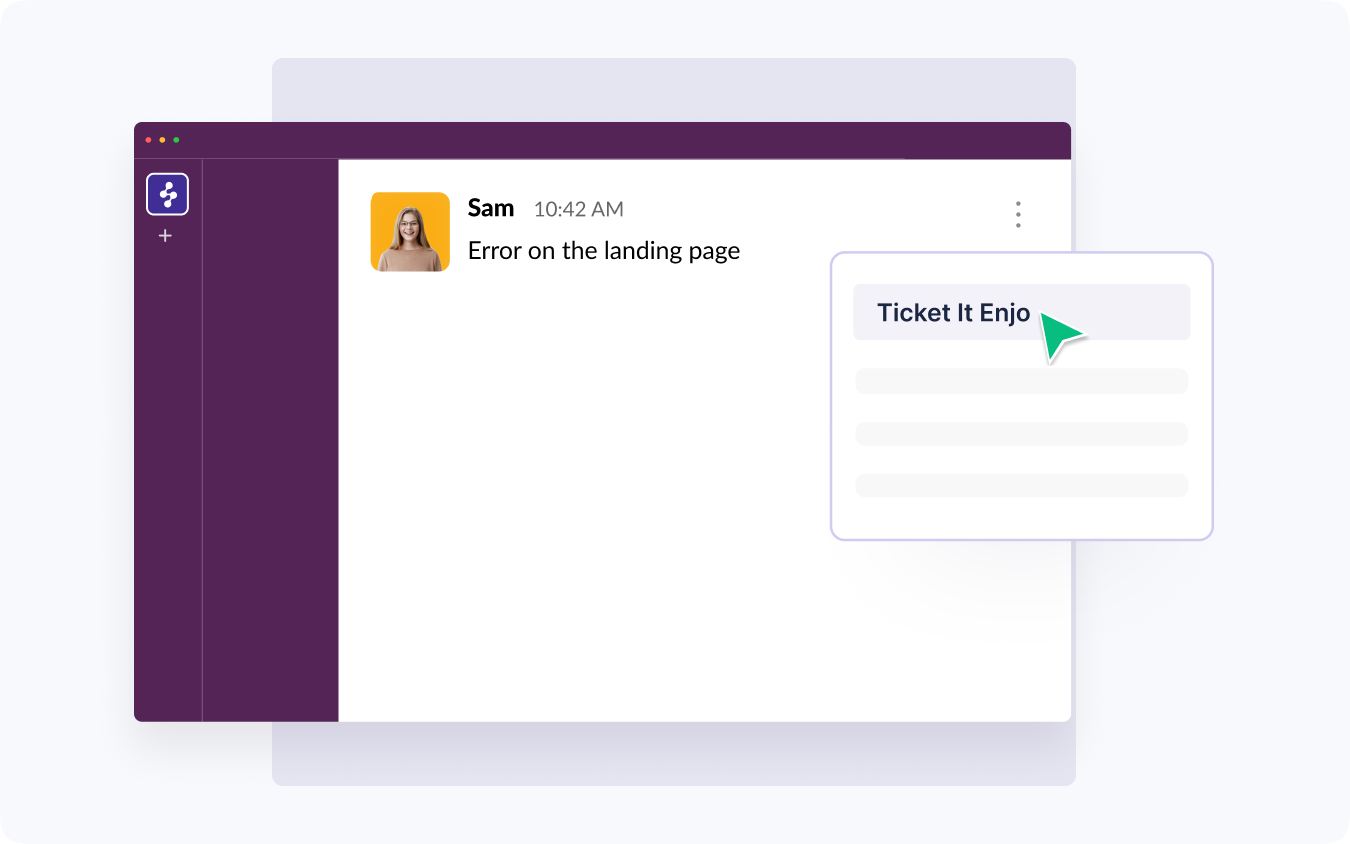
Enjo adds a shortcut to every Slack message that opens the full Jira create form, prefilled from that message.
Step 1: Hover over the message, click the three dots for more actions, and choose Enjo's create ticket shortcut from the message actions menu.
Step 2: Check the prefilled summary and description, complete any other fields your request type needs, and submit.
The form shows the fields your Jira request type uses, including dropdowns, user pickers, cascading selects and Assets objects, with field descriptions as help text and any fields your admin hides kept out of the way.
3. Type an /enjo command
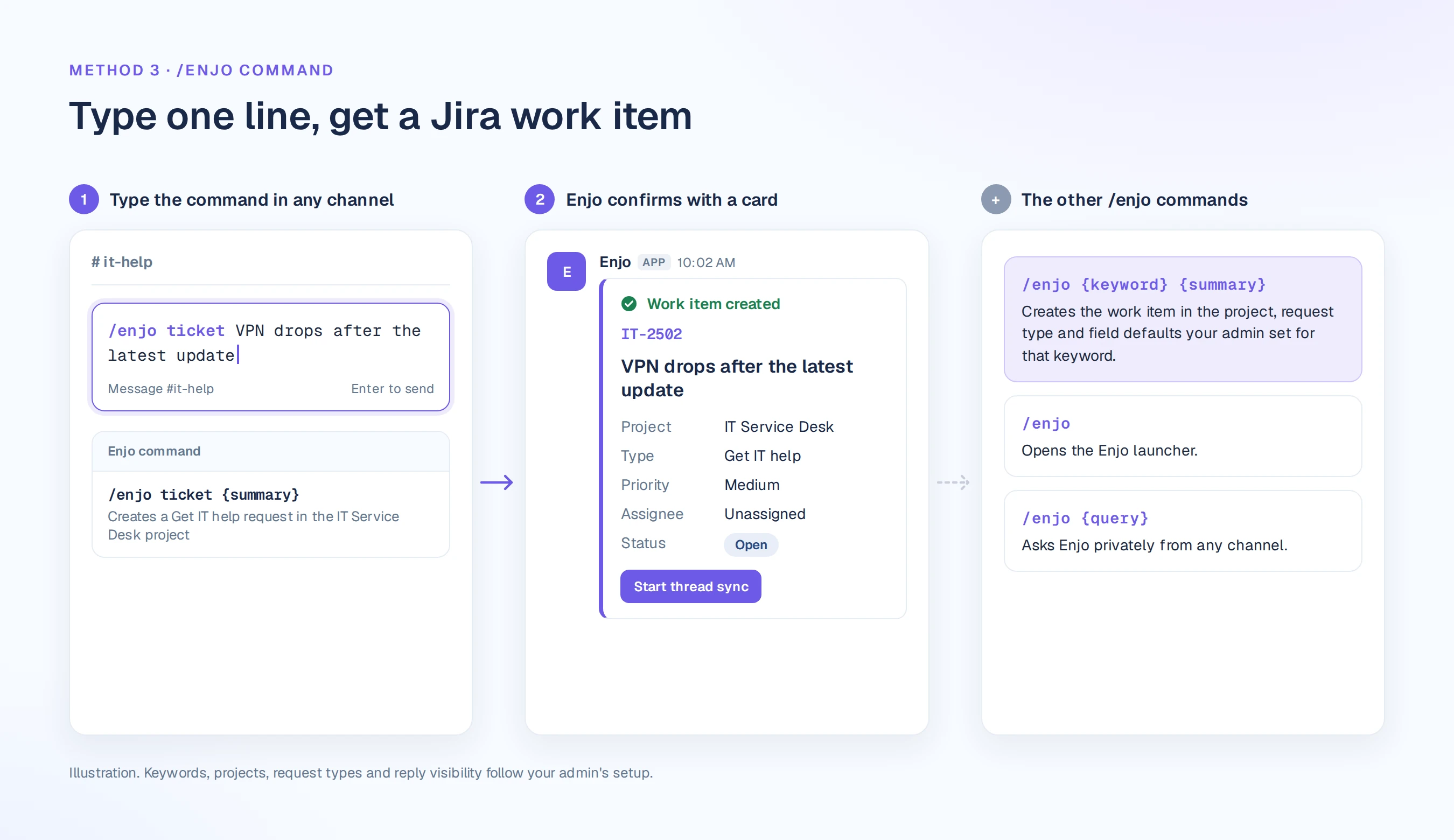
Enjo's slash commands work from the message field in any channel where Enjo is installed.
Step 1: Type /enjo {keyword} {summary}, for example /enjo ticket VPN drops after the latest update. Your admin sets up each keyword with a preset Jira project, request type and field defaults.
Step 2: Enjo creates the work item and replies with a confirmation card showing its key, project, type, priority, assignee and status, either in the channel or privately to you, as your admin chose.
Typing /enjo on its own opens the Enjo launcher, and /enjo {query} lets you ask Enjo privately from any channel. Setup is in Enjo's commands guide.
4. Let Enjo create it automatically
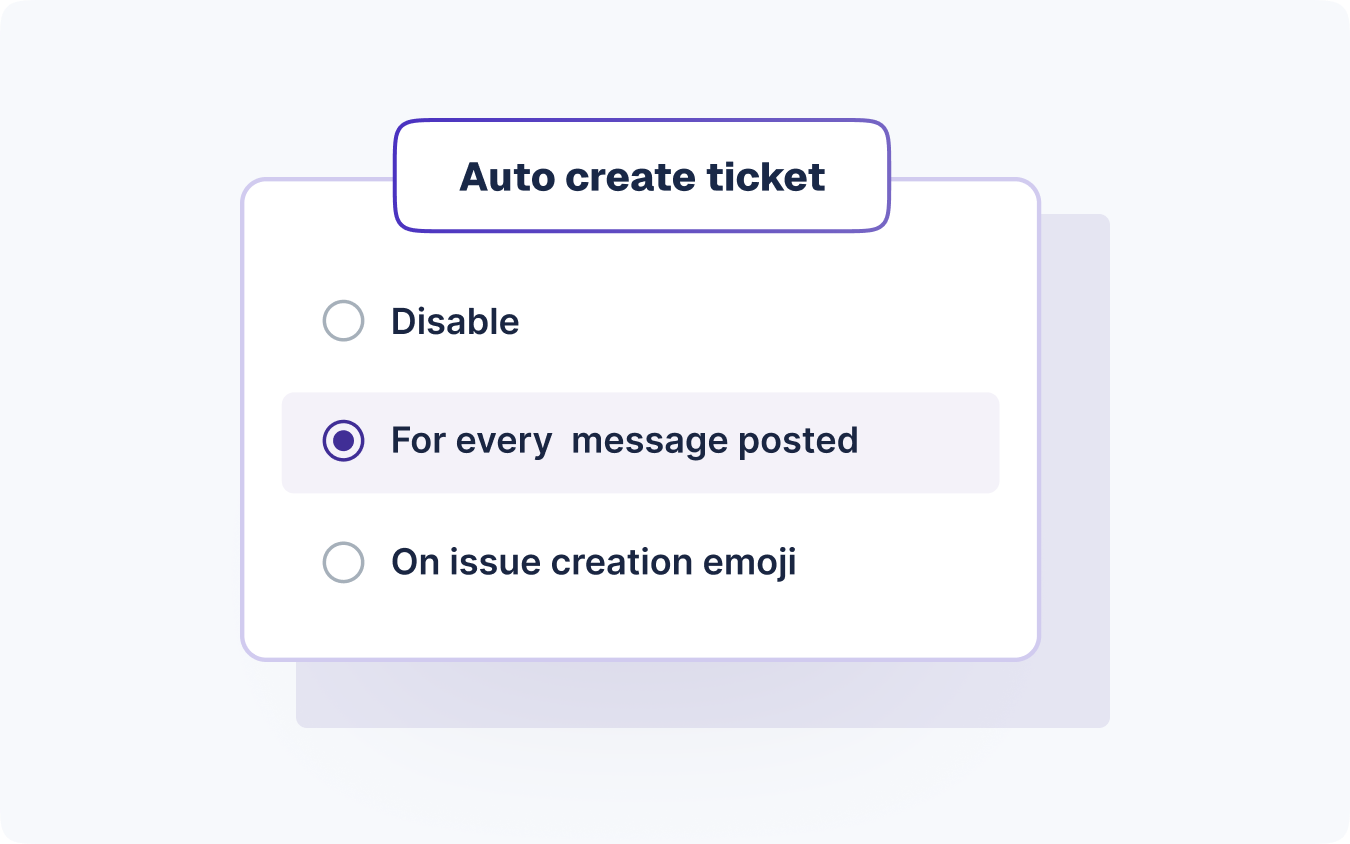
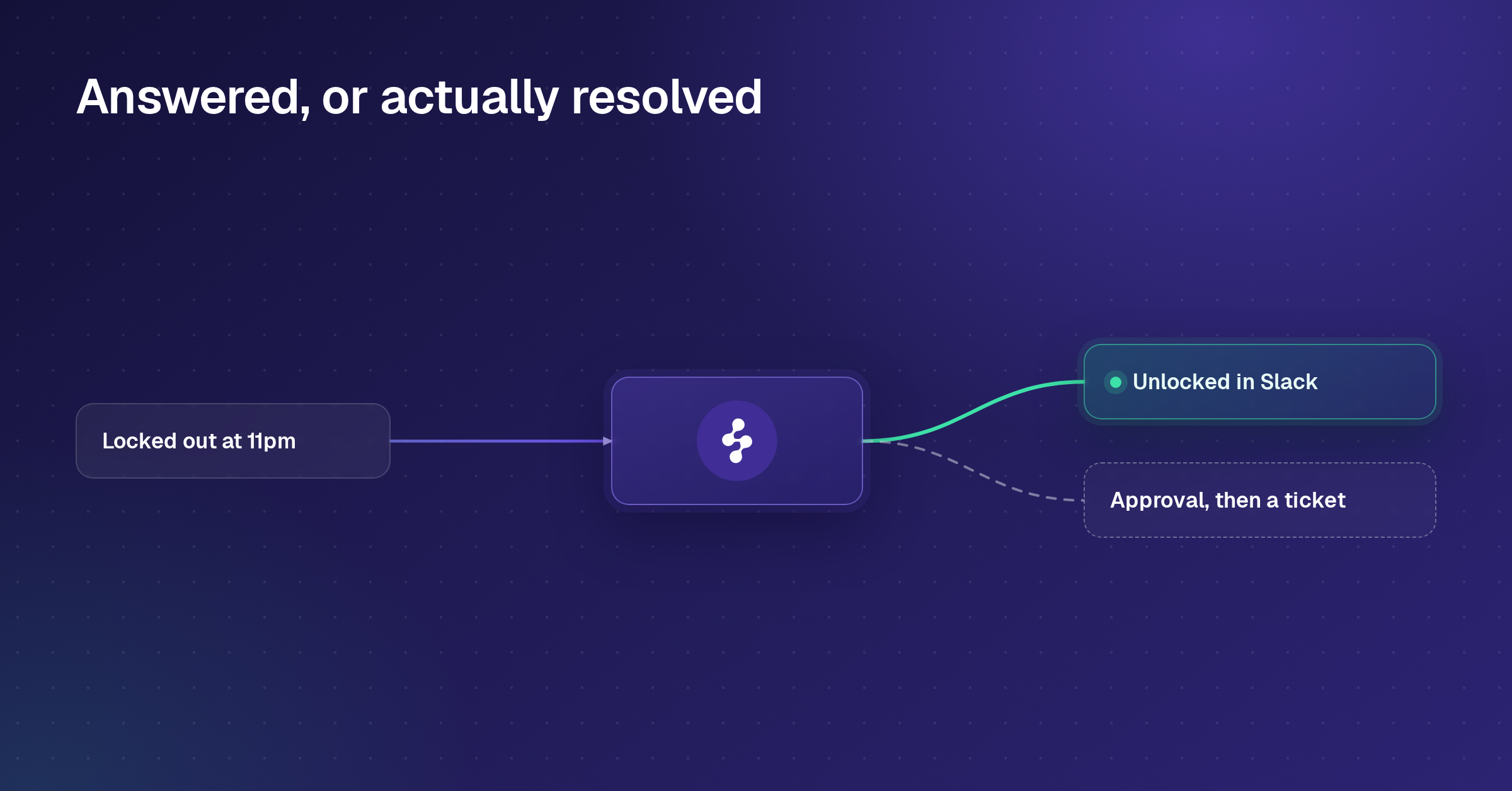
In a support channel or a DM with Enjo, the employee just describes the problem. Enjo answers from the knowledge sources you connect and within the Guardrails you set, and every AI decision is recorded in the audit log. When an escalation trigger fires, Enjo creates the Jira work item automatically.
Your admin chooses the triggers: the requester asks for a person, Enjo finds no answer in your knowledge, the request matches a Jira request type, it matches a topic or message pattern you define, or always escalate, which turns every message posted in the channel into a work item.
Enjo classifies each request against your request types and their sample requests, so the work item lands in the right Jira Service Management queue without the employee picking a form.
During the off-hours you define, Enjo creates the work item automatically for each request posted in the channel and sends your off-hours message, so the request is in the Jira queue before your team is back.
5. Click a suggested create button
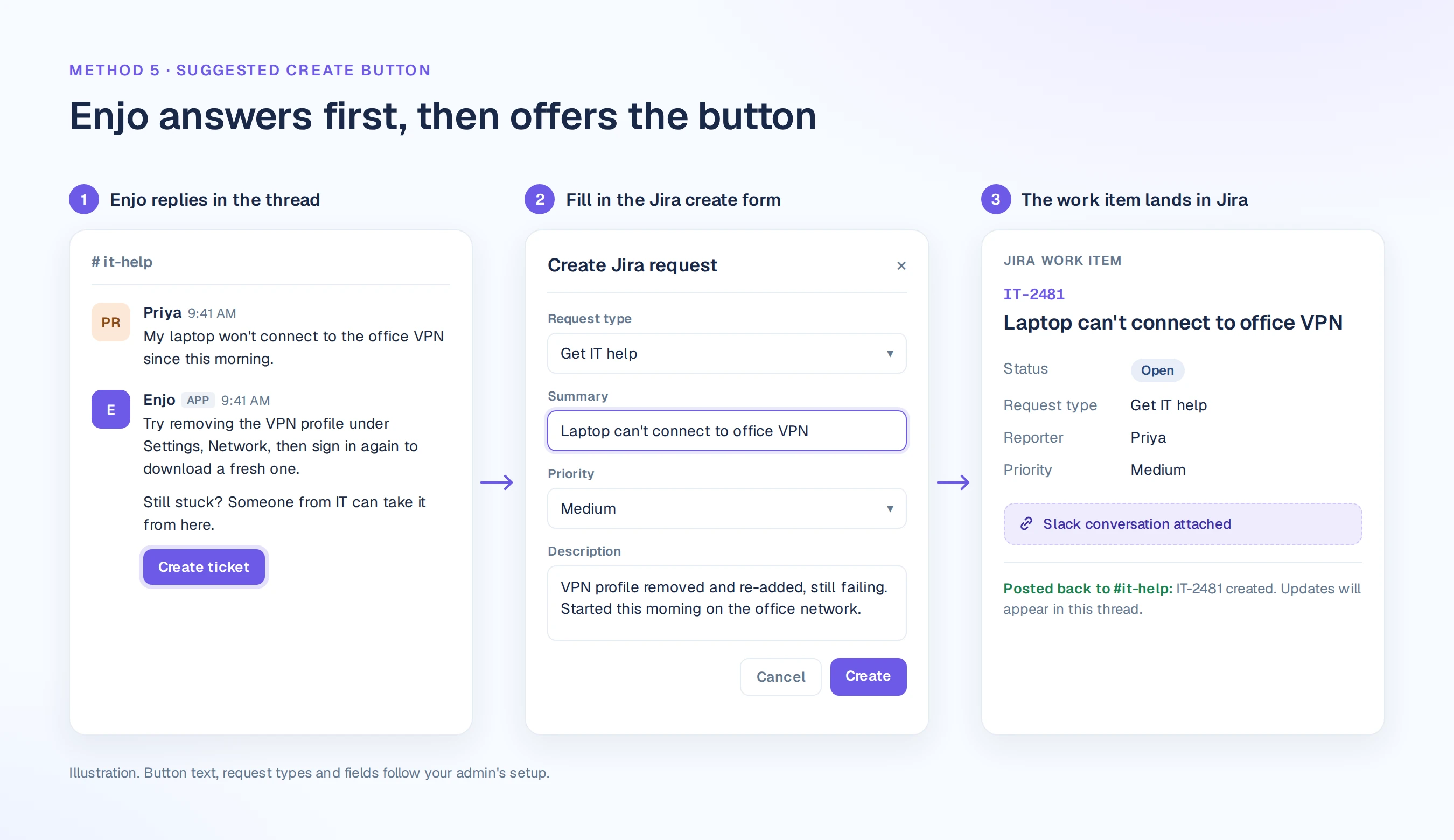
If you would rather the employee decides, set escalation to show a button instead of filing silently. When an escalation trigger fires, Enjo posts a create ticket button in the thread, with the message text and button label your admin wrote.
Step 1: Read Enjo's reply in the thread. If you still need a person, click the button.
Step 2: The Jira create form opens. Fill in the fields your request type needs and submit, and Enjo raises the Jira work item with the conversation on it.
6. Mark an answer not helpful
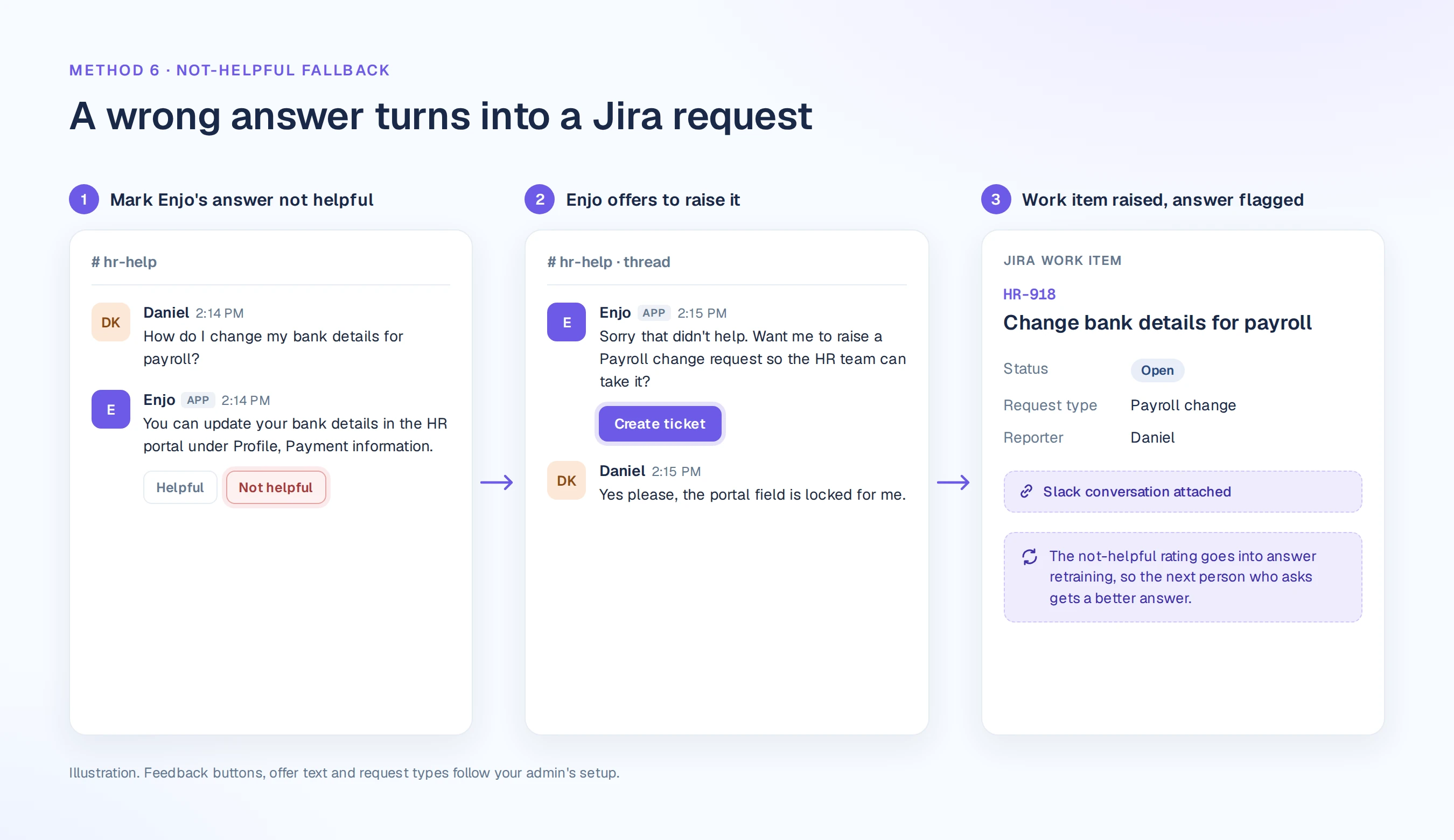
When answer feedback is switched on, employees can mark an Enjo answer not helpful, and Enjo offers to create a Jira work item right there. Your admin can name the matching request type in the offer message. The same feedback feeds Enjo's answer retraining, so the gap gets fixed for the next person who asks.
7. Let an AI Action or AI Flow raise it
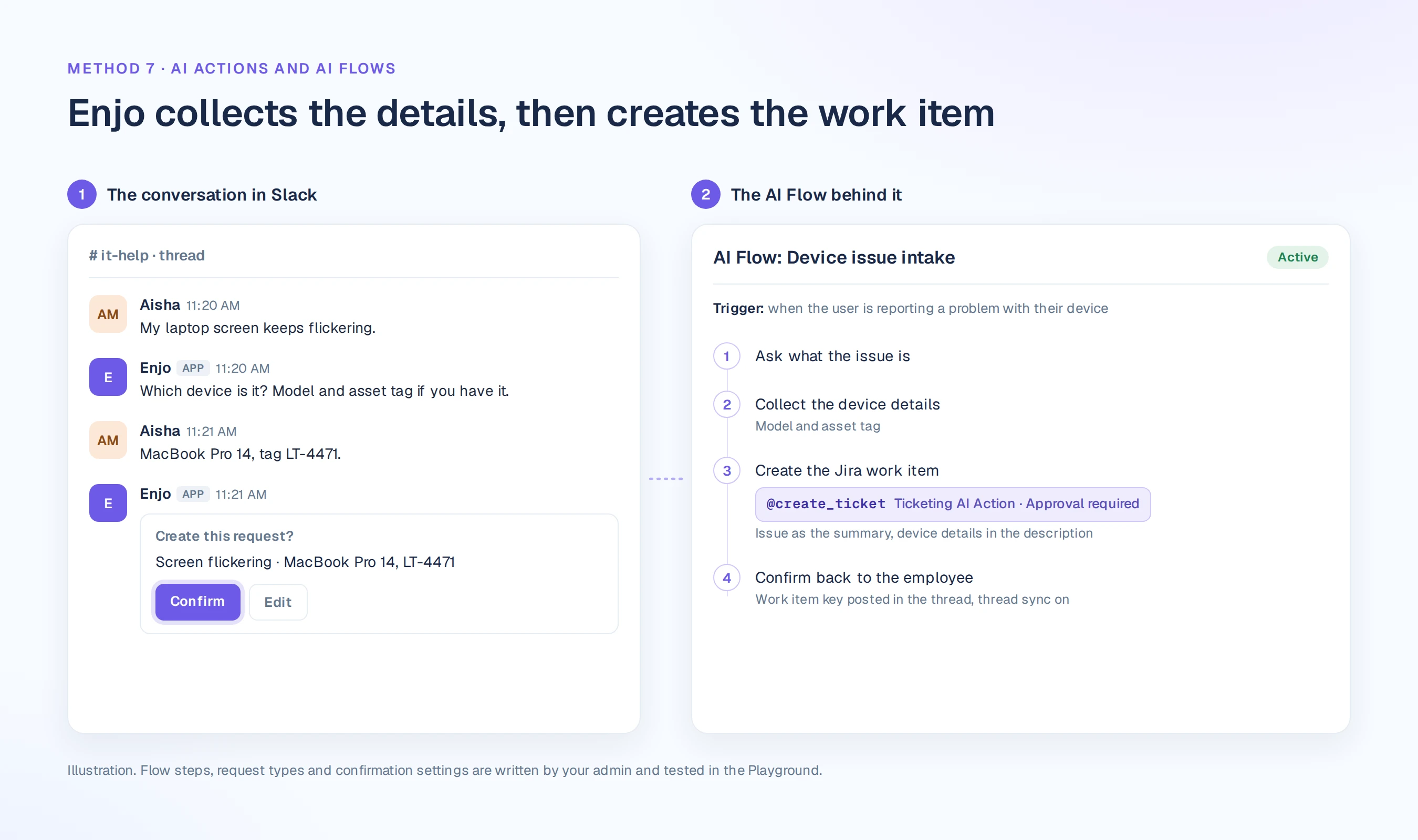
Enjo's Ticketing AI Action lets the agent open the Jira work item as a step in the conversation, in the request type you choose, with the fields you mark as required. Set it to ask the requester to confirm before it creates the work item, or to create it straight away, and switch on thread sync so the conversation keeps flowing to Jira.
AI Flows chain those steps. A device-issue flow asks what is wrong and collects the device details, then calls the create ticket action with the issue as the summary and the device details in the description, and confirms back to the employee. You write the steps in plain language and test them in the Playground before switching the flow on. Setup is in Enjo's AI Flows guide.
Requesters without a Jira account
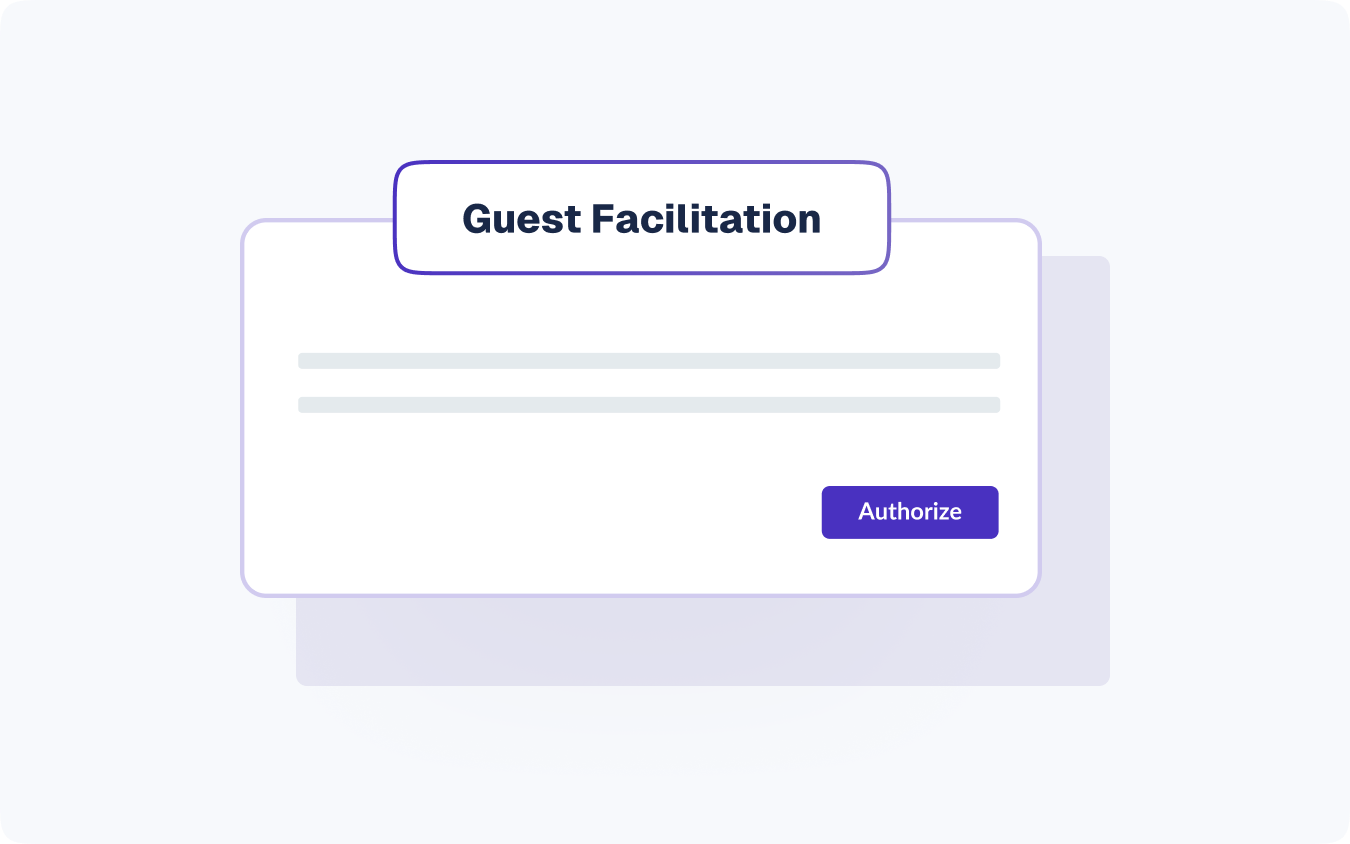
Enjo's Guest Facilitation lets employees with no Jira account, or one that is not mapped yet, create and comment on Jira requests from Slack. An admin authorizes a service account as the facilitator, and requests and comments from these users post through it, with the real person named in the content.
Verified users always act through their own Jira account and their own permissions, so Jira permissions are never widened. Admins can also allow or block specific users and choose which AI agents accept guest requests.
Step 1: In the Enjo web app, open the AI agent's ticketing settings, then Request Handling Behaviour (the path is in the Guest Facilitation guide).
Step 2: Under Guest Facilitation, click Authorize and choose the service account that will act as the facilitator.
Get more done in Slack
Creating the Jira work item is the first step. Enjo for your helpdesk also keeps the requester and the agent working the same request from Slack after it exists:
Notifications
Enjo sends personal notifications as a Slack DM for the Jira work items a person reported, is assigned, watches or participates in, filtered by event (created, updated, comment added, comment updated) and by specific fields, and a mention always gets through. Admins set the workspace default and each person can override it.
Ticket progress tracking
Requesters stop chasing status because the status comes to them. Status transitions, assignment changes and new comments on the Jira work item post into the Slack thread where the request started, filtered by the sync setting your admin picks, and Enjo can add an emoji marker to the original Slack message when the work item is created, assigned or done, or when nobody has replied inside the configured window.
Two-way thread sync
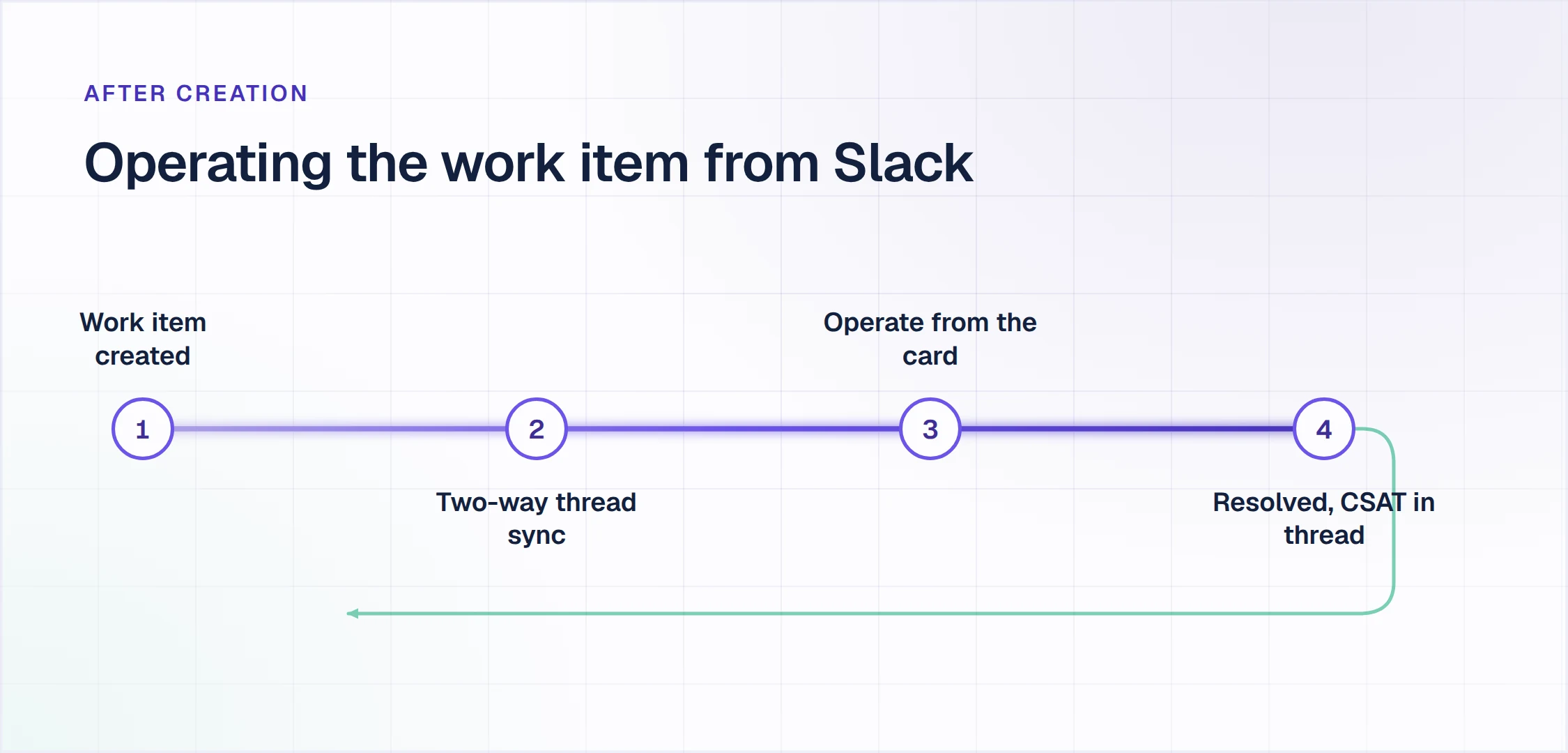
Enjo's two-way thread sync keeps the Slack thread and the Jira work item in step. Thread replies become Jira comments, Slack edits and deletions carry across, and files dropped in the thread become Jira attachments; in the other direction, Jira comments, status transitions and field edits post back into the thread. Agents work the request from Slack or from Jira Service Management, including the choice of a public or internal comment on JSM.
File attachments
Files on the Slack message upload to the Jira work item when it is created, and on Jira Service Management they land as request attachments the requester can see. After that, a file dropped in the synced thread becomes a Jira attachment, and so does a file posted in any channel with the work item key in the message.
See how Enjo works in Slack
CSAT
When the request is resolved in Jira, Enjo posts a 1 to 5 rating into the Slack thread for the requester, with an optional comment. The rating is written back to the Jira work item, and on Jira Service Management it lands in Jira's own satisfaction reporting.
Getting Started with Enjo
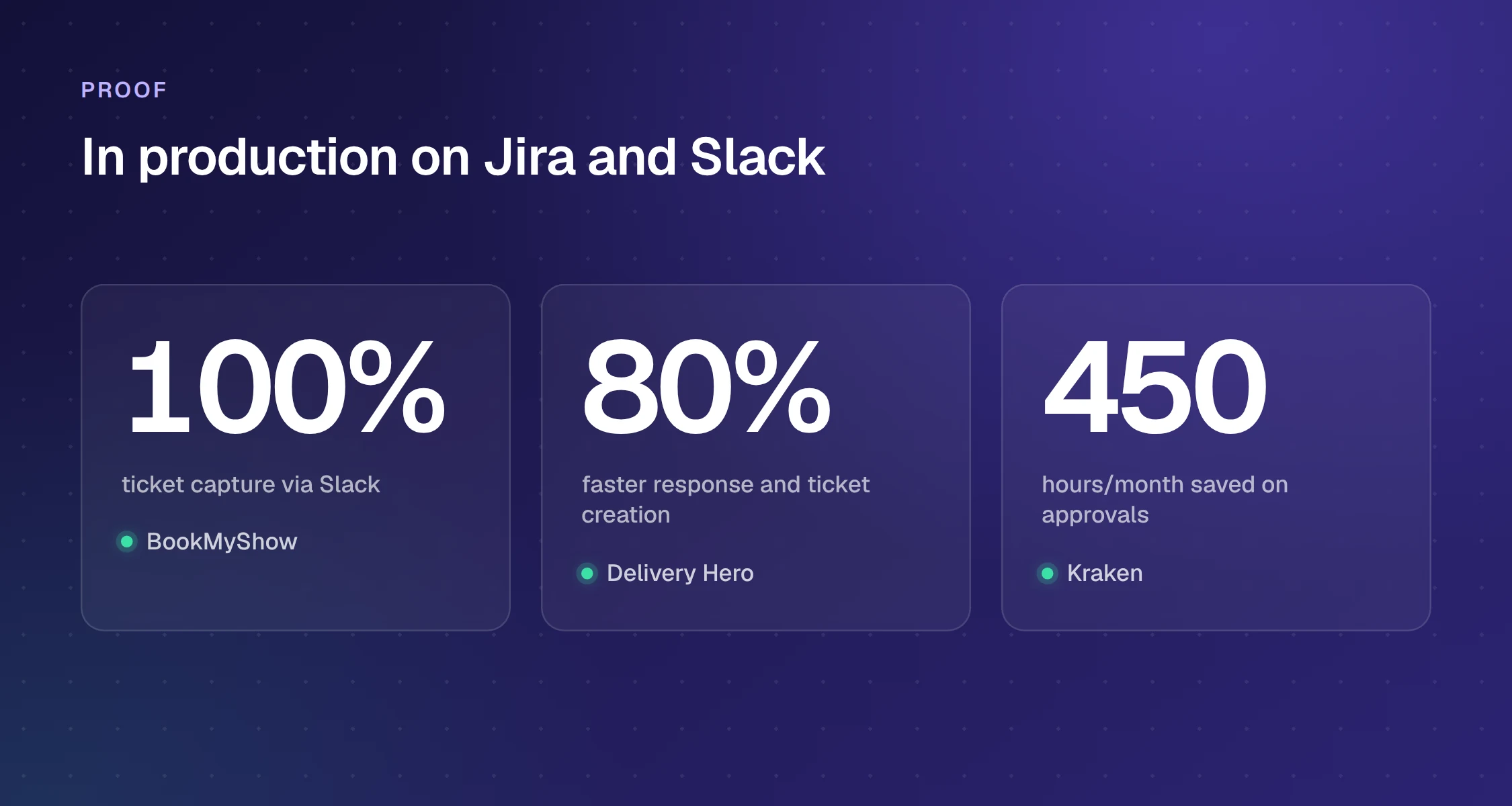
Delivery Hero runs Enjo across more than 30 Jira service desks, with 95,000+ people in Slack, and saw 80% faster response for both answering and ticket creation. BookMyShow reached 100% ticket capture through Slack automation, with zero manual ticket creation. Book a demo to see Enjo for your helpdesk raise Jira work items from your own Slack channels, with Jira staying your system of record.
FAQs
Can I create Jira tickets directly from Slack?
Yes. Atlassian's Jira Cloud for Slack app creates a work item when you mention @Jira, for Jira Cloud customers with Rovo enabled, and Jira Service Management request channels start a request from the ticket emoji. Enjo for your helpdesk adds the seven ways above, from emoji reactions and message shortcuts to automatic creation when Enjo cannot resolve the request, on Jira Cloud, Data Center and Server.
Do users need a Jira account to create tickets?
Enjo's Guest Facilitation lets people without a mapped Jira account raise and comment on Jira requests from Slack, using a service account as the facilitator. Comments a guest posts on a thread are added under the facilitator's account on that person's behalf. Which account a person needs depends on the account types Jira Service Management supports.
How do I link a Slack message to an existing ticket?
Paste the Jira work item key or URL into the Slack thread. Enjo shows a live preview of the work item and, when your admin has turned on auto start thread sync, links the thread so later replies post to that work item as comments. You can also react with an emoji your admin has set up to link to or update an existing work item, or drop a file in a message that includes the work item key to attach the file to it.