
Agentforce Pricing Guide 2026
Service Cloud, Data Cloud, Flex Credits, and implementation costs in one place. Estimate your total Agentforce investment before you buy.
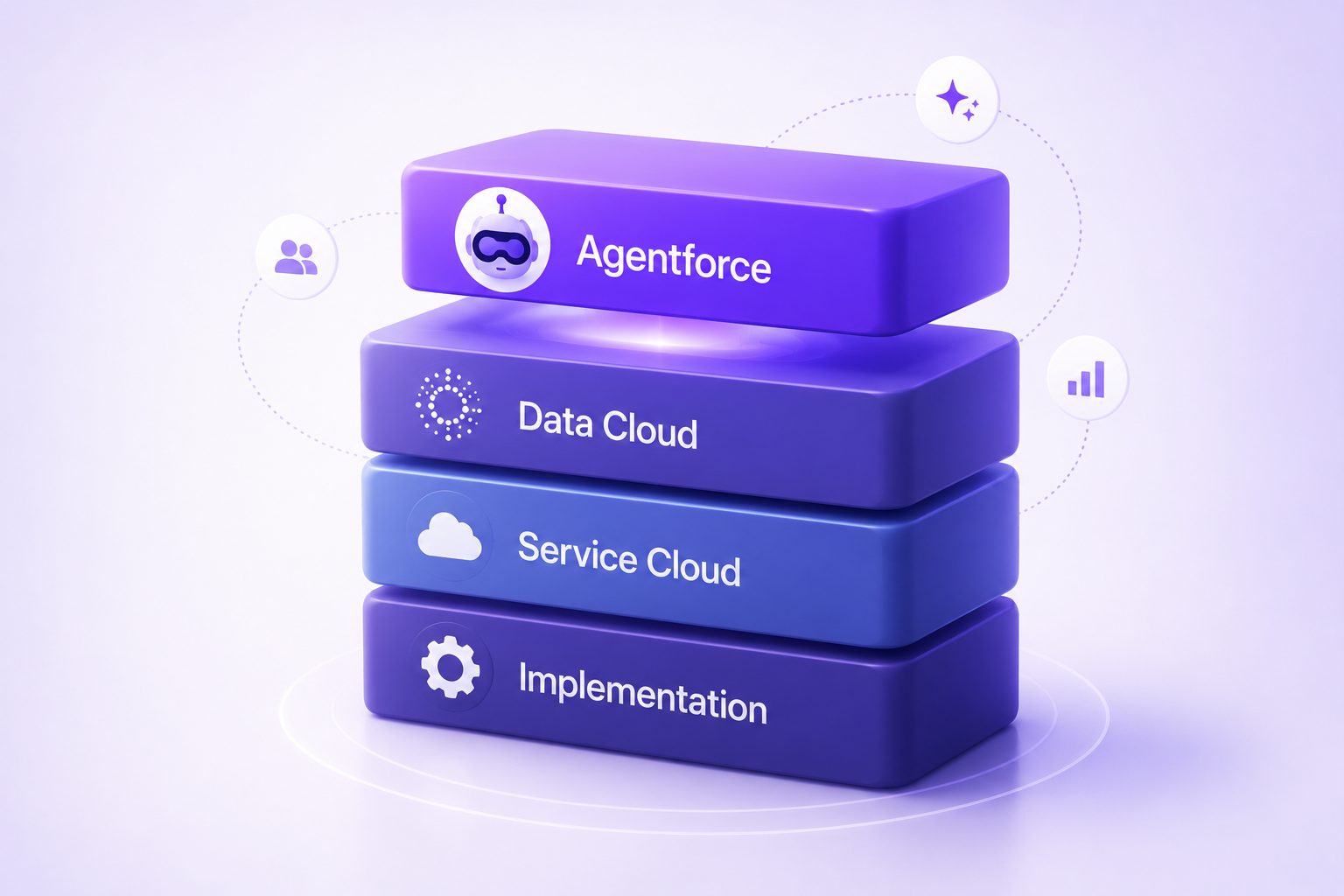







Six published tiers. Prices shown are for the Agentforce add-on. Additional platform costs apply.

Foundations
Included with Enterprise Edition. 200K Flex Credits (~10,000 actions).
Flex Credits
The most common model. Each action (a record lookup, a reasoning step, an API call) costs one credit. A typical service conversation uses 5-15 actions ($0.50-$1.50 per conversation)
Conversations
Flat rate per customer conversation. Available for customer-facing deployments only, and must be pre-purchased. Cannot run alongside Flex Credits in the same org.
Add-Ons
Unlimited AI usage per seat. $125 for Service, Sales, and Field. $150 for industry verticals.
Agentforce Editions
Flat per-seat fee with no usage cap.Data 360 and 2.5M credits per org per year included. Public Sector: $650/user/mo.
User License
Covers employee access only. Flex Credits must be purchased separately to enable any AI actions. Limited CRM access.
Source: salesforce.com/agentforce/pricing/, verified May 2026.
All three layers combined.Modeled at list prices, 3 cases/agent/day, 5 actions/case, 20 working days/month. Your actual costs will vary.
Enjo adds AI resolution to your existing Service Cloud. No Data Cloud. No edition upgrade. Live in days, not months.
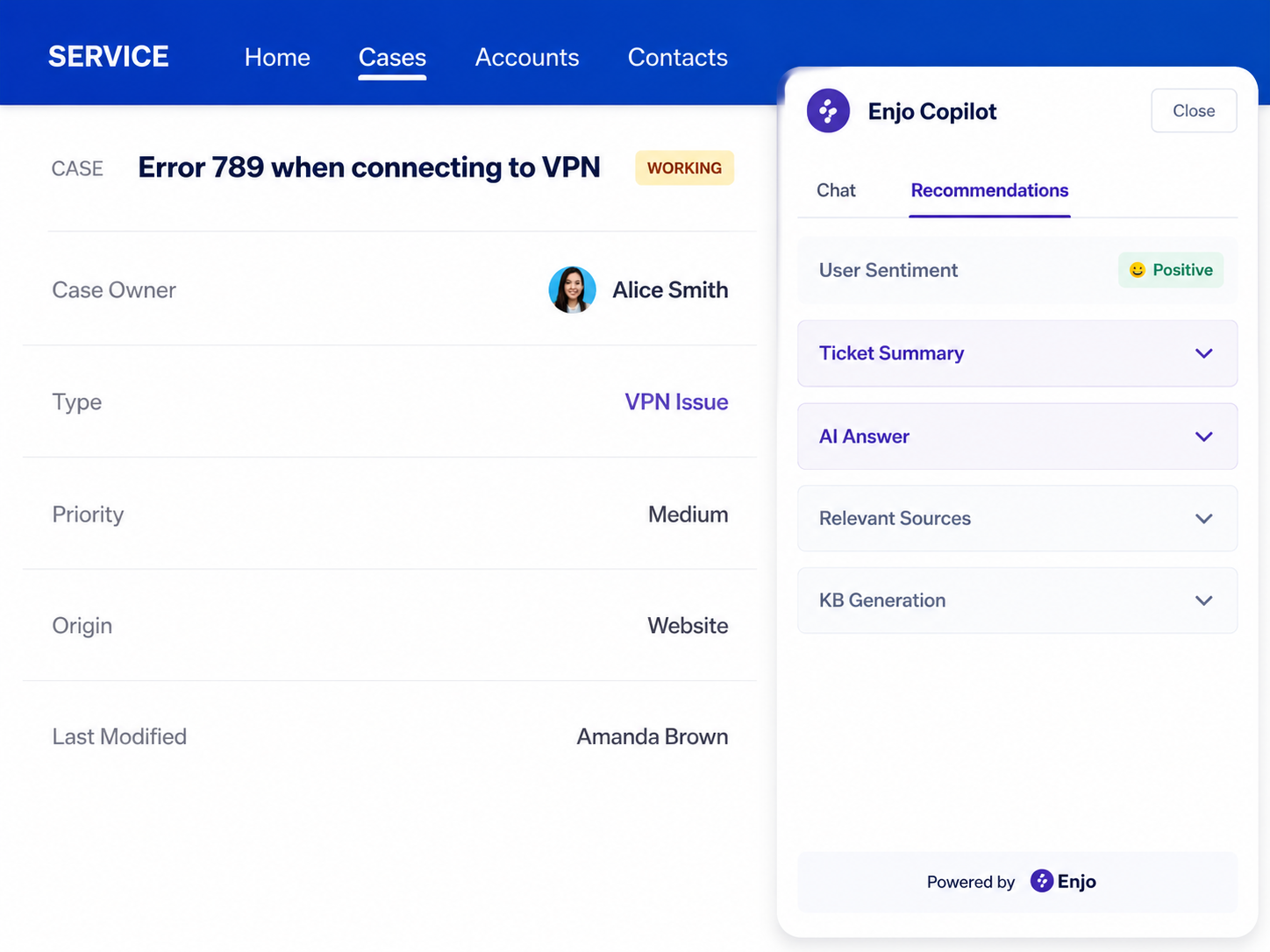
Enjo runs on your existing Service Cloud license. No Data Cloud. No edition upgrade
Pricing
Six pricing models. Flex Credits, Conversations, add-ons, editions.
Time to Production
3 to 6 months for full deployment (per SI partners)
Data Foundations
Data 360 (formerly Data Cloud) required for most capabilities
Knowledge Sources
Salesforce Knowledge native. Confluence, SharePoint, others via Data 360.
Across Helpdesk
Salesforce-native. External systems require custom integration.
Enjo helps support teams automate resolutions, assist agents, and unify knowledge across Salesforce and external systems without requiring Data Cloud, edition upgrades, or multi-month implementations.
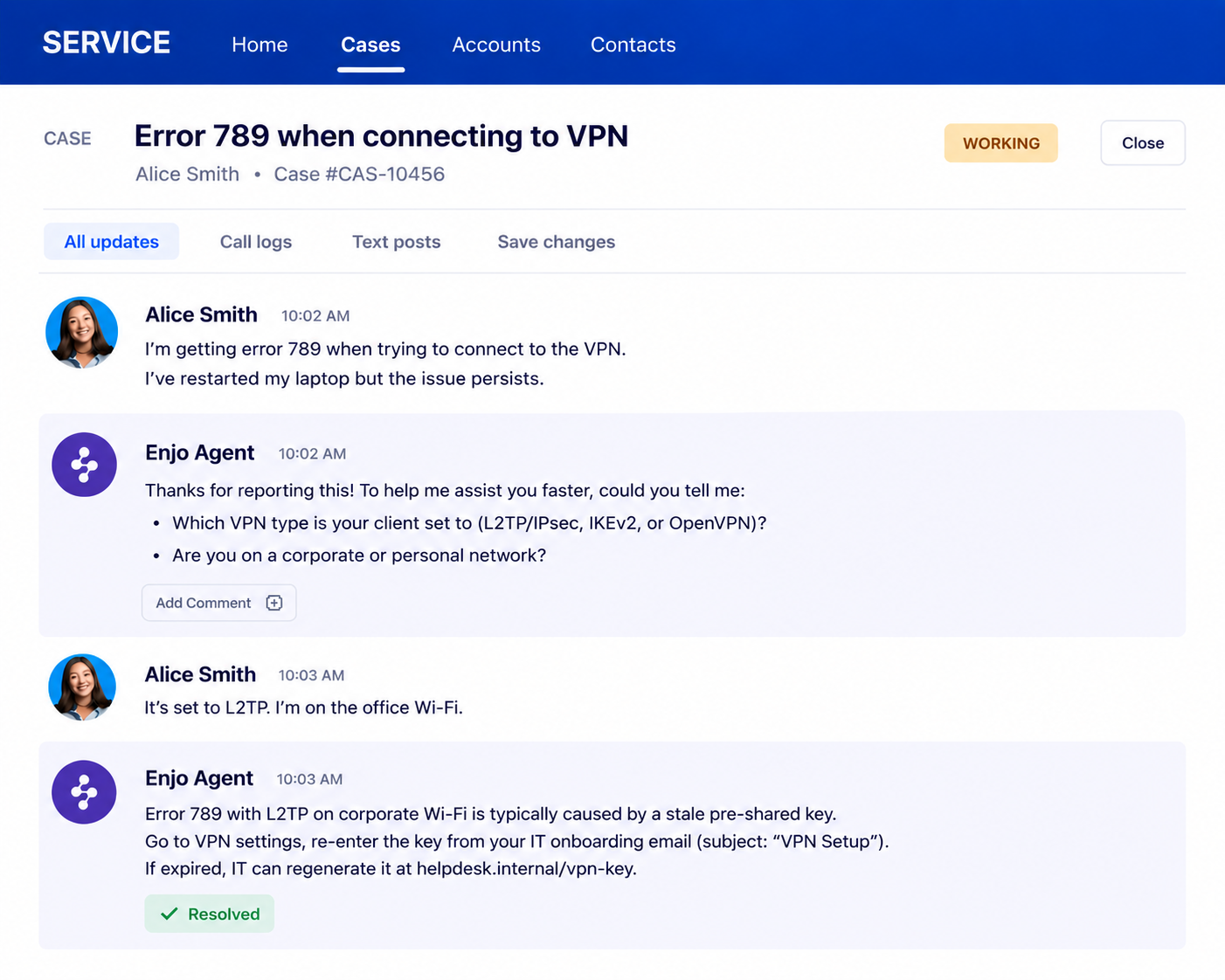
When a case is created, Enjo understands the request, asks follow-up questions when needed, and resolves issues directly using your knowledge and systems. Support teams stay focused on complex cases while routine requests are handled automatically.
Enjo Agent Assist surfaces the right knowledge, drafts responses, and provides contextual recommendations directly in the case view, helping agents resolve issues faster and more consistently.
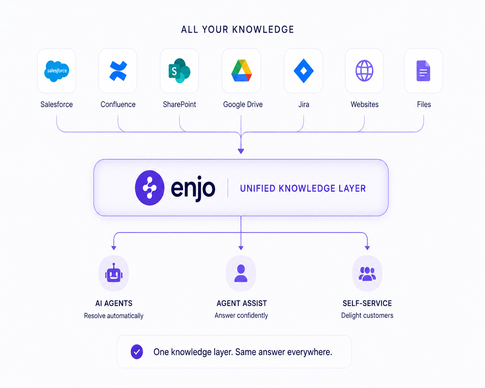
One layer powers AI Agents, Agent Assist, and self-service. What the AI says is what agents see is what customers find. No drift.
Unlimited seats on every plan. AI at a flat $0.05 per interaction. Most teams are live in days, with no migration.


requests handled by AI
Live in a single day. 2M+ documents unified into one knowledge source, cutting information retrieval time by over 80%.

autonomous resolution
45% faster resolution and a 60% satisfaction improvement, with Enjo handling frontline requests at a 2,500-person company.

saved every month
If you have further questions, simply request a demo from our team, and we'll respond promptly.
No. Enjo indexes knowledge directly from sources like Salesforce Knowledge, past Cases, Confluence, SharePoint, Drive, and Notion. No data lake required.
Agentforce is a strong native product. Enjo is complementary in most cases. We focus on three things: going live in days, one price per AI Reply, and grounding on knowledge outside Salesforce like Confluence and SharePoint. Many customers run both for different use cases. See our comparison section above for the full side-by-side.
Yes. Enjo integrates with Salesforce as an official partner. Teams can use Enjo for customer support workflows and Agentforce for other departments like sales or field service. The platforms are complementary, not mutually exclusive.
No. Enjo extends Service Cloud. Your Salesforce investment, workflows, and agent experience stay. Enjo adds AI on top
When all your knowledge and actions live inside Salesforce, you already have Data Cloud and higher Service Cloud editions, or you need AI across sales, service, field service, and commerce on one consumption model. Agentforce has the deepest native binding to the Service Cloud data model and the broadest cross-department coverage.


